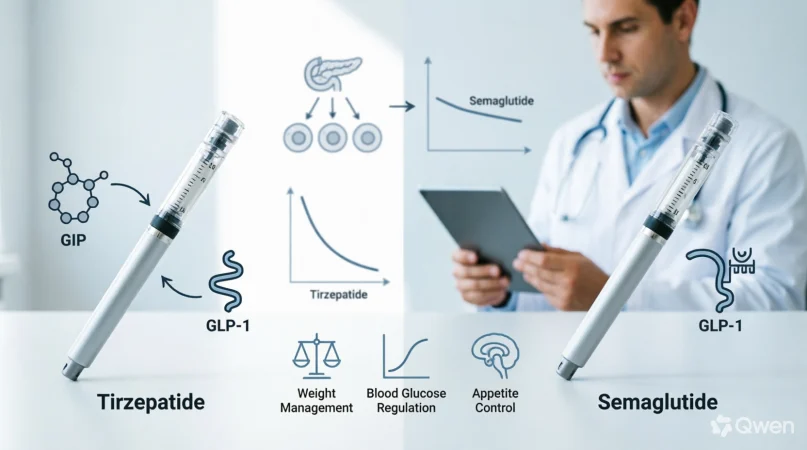
Tirzepatide and semaglutide are prescription medicines that act on hormones involved in blood sugar regulation and appetite, but they work differently. Tirzepatide targets both GIP and GLP 1 receptors, while semaglutide targets GLP 1 receptors. Which option is more appropriate depends on the condition being treated, medical history, other medicines, and individual treatment goals.
Wondering whether tirzepatide or semaglutide is the better option? Although both medicines can help with blood sugar control and weight management in appropriate patients, they work through different hormonal pathways and have different approved uses, dosing considerations, and potential side effects.
This guide compares their key differences in simple terms, using reliable medical information to help readers understand the options and have a more informed discussion with a qualified healthcare professional.
Tirzepatide vs Semaglutide: What’s the Difference?
The question of tirzepatide or semaglutide is not simply about which medication produces the largest number on a scale. Both are powerful incretin based medicines, but they are not identical drugs.
Tirzepatide is a dual GIP and GLP 1 receptor agonist. It activates receptors for glucose dependent insulinotropic polypeptide and glucagon like peptide 1.
Semaglutide is a GLP 1 receptor agonist. It primarily works through the GLP 1 pathway.
That pharmacological distinction matters because the medications have different clinical profiles, approved uses, dosing schedules, and evidence bases.
The comparison also becomes complicated because the generic drug name does not always tell you which brand or formulation is being discussed. Tirzepatide is marketed in products such as Zepbound for obesity and obstructive sleep apnea, while semaglutide is marketed in products such as Wegovy for obesity and cardiovascular risk reduction in certain adults. Their approved indications can change as regulators review new evidence.
| Feature | Tirzepatide | Semaglutide |
| Drug class | GIP and GLP 1 receptor agonist | GLP 1 receptor agonist |
| Main hormone pathways | GIP and GLP 1 | GLP 1 |
| Common obesity product | Zepbound | Wegovy |
| Typical obesity administration | Once weekly injection | Once weekly injection |
| Weight loss evidence | Very substantial | Very substantial |
| Direct comparison | Greater average weight reduction in SURMOUNT 5 | Lower average weight reduction than tirzepatide in SURMOUNT 5 |
| Common adverse effects | Gastrointestinal effects are common | Gastrointestinal effects are common |
| Prescription status | Prescription medicine | Prescription medicine |
The evidence does not mean tirzepatide is automatically appropriate for every patient.
Semaglutide remains an effective treatment with important approved indications.
The appropriate medicine depends on medical history, treatment goals, tolerability, contraindications, and the indication being treated.
Is Tirzepatide vs Semaglutide a Medical, Pharmacological, or Usage Issue?
Unlike a spelling comparison, this is a clinical comparison.
Tirzepatide and semaglutide are separate active ingredients with overlapping but different mechanisms and indications.
They should not be treated as interchangeable simply because both are often described online as weight loss injections or GLP 1 medicines.
Are Tirzepatide and Semaglutide Interchangeable?
No.
They belong to related therapeutic categories, but they are different medicines.
Tirzepatide activates both GIP and GLP 1 receptors.
Semaglutide activates the GLP 1 receptor.
That distinction can affect treatment decisions.
Patients should also avoid assuming that a dose of one medicine can be converted directly into an equivalent dose of the other. Doses are specific to each medication and formulation.
Formal Versus Casual Usage
In casual conversation, people may call both drugs “GLP 1s.”
That description is understandable but incomplete.
Tirzepatide is technically a dual GIP and GLP 1 receptor agonist.
Semaglutide is a GLP 1 receptor agonist.
In professional or educational writing, that distinction should be preserved.
Academic and Clinical Usage
Clinical research generally compares specific doses, populations, endpoints, and treatment durations.
Therefore, saying that one medicine is “better” without specifying the outcome can be misleading.
A medicine can produce greater average weight loss while another has an indication or clinical feature that matters more for a particular patient.
Tirzepatide: How It Works and Where It Fits
Tirzepatide acts on two incretin pathways.
GIP and GLP 1 are hormones involved in metabolic regulation. Their effects include influencing insulin secretion, appetite, gastrointestinal activity, and glucose regulation.
The combination of these pathways helps explain why tirzepatide has produced substantial weight reduction in clinical trials.
The FDA prescribing information for Zepbound identifies tirzepatide as a GIP and GLP 1 receptor agonist. For adults with obesity, or adults with higher weight plus at least one weight related condition, Zepbound is indicated with reduced calorie intake and increased physical activity for long term weight reduction and maintenance. The current label also includes an indication for moderate to severe obstructive sleep apnea in adults with obesity.
Workplace Example
Consider an employee whose obesity affects mobility and daily functioning.
A clinician might evaluate whether an evidence based weight management medicine is appropriate alongside nutrition, physical activity, and other interventions.
The decision would not be based solely on the person’s desire to lose weight.
A clinician would also consider medical history, current medicines, contraindications, treatment goals, and likely tolerability.
Academic Example
A research paper might describe tirzepatide as a dual incretin receptor agonist rather than simply calling it a GLP 1 drug.
That distinction provides more accurate pharmacological information.
Technology Example
Electronic health records and clinical decision support systems can distinguish between the active ingredient, brand name, dosage, indication, and formulation.
That distinction matters because similar looking medication names can lead to serious documentation errors.
Usage Recap
Tirzepatide is a dual GIP and GLP 1 receptor agonist.
It has demonstrated substantial weight reduction in clinical trials.
Its use should be based on an appropriate medical indication rather than internet comparisons alone.
Semaglutide: How It Works and Where It Fits
Semaglutide is a GLP 1 receptor agonist.
GLP 1 signaling affects glucose regulation, appetite, gastric emptying, and other physiological processes.
Different semaglutide products have different approved indications and formulations, so it is important to identify the specific product being discussed.
The FDA labeling for Wegovy includes long term weight reduction and maintenance in eligible adults and adolescents with higher weight, as well as cardiovascular risk reduction in certain adults with established cardiovascular disease and higher weight or higher weight. The current labeling also includes additional indications, so treatment decisions should be based on the current prescribing information for the specific product.
Workplace Example
A patient with higher weight and established cardiovascular disease may have treatment goals that extend beyond weight reduction.
In such a situation, the clinical question is not simply:
Which drug causes more weight loss?
The clinician may also consider whether a medication has an approved indication that matches the patient’s broader cardiovascular risk profile.
Academic Example
A scientific discussion of semaglutide should distinguish between its mechanism, formulation, dosage, patient population, and clinical endpoint.
This prevents researchers and readers from treating every semaglutide study as though it evaluated exactly the same product.
Technology Example
A medication database may store semaglutide under multiple formulations and products.
That is why electronic prescribing systems need accurate drug selection rather than relying on a broad search for “GLP 1.”
Usage Recap
Semaglutide is a GLP 1 receptor agonist.
It has substantial evidence for weight reduction and other clinically important outcomes.
Its benefits and indications depend on the specific formulation and patient population.
When You Should NOT Choose Tirzepatide or Semaglutide Based on a Simple Comparison
A direct comparison can be useful, but several common assumptions should be avoided.
1. Do Not Choose Only by Average Weight Loss
A clinical trial result represents an average across a particular study population.
It does not guarantee that an individual patient will achieve the same result.
2. Do Not Compare Doses Directly
A milligram dose of tirzepatide is not equivalent to the same number of milligrams of semaglutide.
These are different active ingredients.
3. Do Not Assume the Same Indications
Different products have different approved uses.
The relevant question is whether the specific medicine and formulation are appropriate for the condition being treated.
4. Do Not Ignore Tolerability
Both medicines commonly cause gastrointestinal adverse effects.
Nausea, vomiting, diarrhea, constipation, and abdominal discomfort can occur.
5. Do Not Switch Without Medical Guidance
Changing prescription medicines requires consideration of timing, dose escalation, other medications, medical history, and treatment response.
6. Do Not Combine Them on Your Own
The FDA labeling for Zepbound says coadministration with other tirzepatide containing products or a GLP 1 receptor agonist is not recommended. Wegovy labeling likewise states that concomitant use with other semaglutide containing products or another GLP 1 receptor agonist is not recommended.
7. Do Not Ignore Contraindications
Both current product labels contain important warnings and contraindications.
For example, both Zepbound and Wegovy carry boxed warnings concerning thyroid C cell tumors based on findings in rodents and are contraindicated in people with a personal or family history of medullary thyroid carcinoma or MEN 2.
8. Do Not Treat Online Advice as a Prescription
A comparison article can explain evidence.
It cannot determine which medicine is appropriate for a particular patient.
Common Mistakes and Decision Rules
| Correct statement | Incorrect statement | Explanation |
| Tirzepatide activates GIP and GLP 1 receptors. | Tirzepatide is only a GLP 1 drug. | Tirzepatide has dual GIP and GLP 1 activity. |
| Semaglutide is a GLP 1 receptor agonist. | Semaglutide activates GIP and GLP 1 equally. | Semaglutide is primarily a GLP 1 receptor agonist. |
| Tirzepatide and semaglutide are different medicines. | Tirzepatide and semaglutide are the same drug. | They contain different active ingredients. |
| Clinical trial results depend on the study population. | Everyone will lose the same amount of weight. | Individual responses vary. |
| Doses should not be directly equated. | 10 mg of one is equivalent to 10 mg of the other. | The medicines have different dose ranges and pharmacology. |
| Product indications should be checked individually. | Every semaglutide product has exactly the same use. | Formulations and approved indications can differ. |
Decision Rule Box
- If the goal is choosing between these medicines, start with the clinical indication rather than the weight loss percentage.
- If weight reduction is the goal, compare evidence from relevant trials.
- If cardiovascular disease, diabetes, sleep apnea, or another condition is involved, consider the indication and patient specific factors.
- If switching or combining medicines is being considered, involve the prescribing clinician.
Tirzepatide and Semaglutide in Modern Technology and AI Tools
Modern healthcare technology makes medication comparisons easier, but it also creates opportunities for misunderstanding.
AI systems can summarize clinical studies, compare mechanisms, and explain drug terminology. However, they can also produce oversimplified statements when a prompt does not identify the specific product, indication, or patient population.
For example, asking:
Which is better, tirzepatide or semaglutide?
does not specify the outcome.
A more clinically meaningful question might be:
How did tirzepatide compare with semaglutide for weight reduction in adults with higher weight without type 2 diabetes in a head to head trial?
That wording defines the population and outcome.
The 2025 SURMOUNT 5 trial provides an important example. In adults with higher weight without type 2 diabetes, maximum tolerated tirzepatide produced a greater average weight reduction than maximum tolerated semaglutide over 72 weeks.
AI tools should therefore be treated as information aids rather than substitutes for clinical judgment.
What Does the Evidence Say About Weight Loss?
The strongest recent evidence comes from a direct head to head comparison.
In SURMOUNT 5, 751 adults with higher weight but without type 2 diabetes were randomly assigned to maximum tolerated tirzepatide or semaglutide. At week 72, the least squares mean weight change was approximately 20.2 percent with tirzepatide compared with 13.7 percent with semaglutide. Waist circumference decreased by approximately 18.4 centimeters with tirzepatide compared with 13.0 centimeters with semaglutide.
Those results are important because many older comparisons relied on separate trials.
A direct trial provides a more informative comparison, although it still applies to the population and treatment conditions studied.
Earlier evidence also demonstrated substantial weight reduction with tirzepatide. In a major obesity trial, average weight reduction at 72 weeks reached approximately 20.9 percent with the 15 mg dose, compared with 3.1 percent with placebo.
Semaglutide also has strong evidence.
The important point is not that one medication works while the other does not.
Both can produce clinically meaningful weight reduction.
The newer head to head evidence indicates that tirzepatide produced greater average weight reduction than semaglutide in the specific population studied.
Safety and Side Effects
Both medications can cause gastrointestinal adverse effects.
Common problems include nausea, vomiting, diarrhea, constipation, abdominal discomfort, and related digestive symptoms.
In SURMOUNT 5, gastrointestinal adverse events were the most common adverse events in both treatment groups and were generally mild to moderate, particularly during dose escalation.
The FDA labels also contain important warnings.
Zepbound’s prescribing information lists severe gastrointestinal adverse reactions, acute kidney injury associated with volume depletion, gallbladder related issues, and other warnings.
Wegovy’s prescribing information includes warnings concerning pancreatitis, gallbladder disease, acute kidney injury associated with volume depletion, severe gastrointestinal adverse reactions, and other risks.
Both products have a contraindication involving a personal or family history of medullary thyroid carcinoma or MEN 2.
These risks are one reason the question of which medication is better cannot be answered responsibly using weight loss alone.
Tirzepatide or Semaglutide for Type 2 Diabetes
The comparison becomes more complicated when type 2 diabetes is the primary concern.
Tirzepatide has demonstrated substantial effects on both glycemic control and body weight in people with type 2 diabetes. In a direct trial comparing tirzepatide with semaglutide, tirzepatide produced greater average weight reductions across the studied doses.
However, the specific product being considered matters.
Semaglutide products have different approved indications and formulations.
Therefore, a patient with type 2 diabetes should not simply choose whichever drug appears to produce greater weight loss in an higher weight trial.
The appropriate decision may depend on glucose control, other medical conditions, existing therapies, tolerability, contraindications, insurance coverage, availability, and the exact regulatory indication.
Two Evidence Based Case Studies
Case Study 1: Obesity Without Type 2 Diabetes
SURMOUNT 5 directly compared tirzepatide and semaglutide in adults with obesity without type 2 diabetes.
The trial included 751 participants and followed them for 72 weeks.
Average weight reduction was 20.2 percent with tirzepatide and 13.7 percent with semaglutide.
The difference was statistically significant.
Waist circumference also decreased more with tirzepatide, with an average reduction of 18.4 centimeters compared with 13.0 centimeters for semaglutide.
Practical result: In this particular population and study design, tirzepatide produced greater average weight and waist circumference reductions.
That does not establish that every individual will respond better to tirzepatide.
Case Study 2: Obesity With Prediabetes
Long term evidence provides another useful perspective.
In a three year analysis of people with obesity and prediabetes, tirzepatide produced mean weight reductions ranging from 12.3 percent to 19.7 percent at 176 weeks, depending on dose, compared with 1.3 percent with placebo.
The study also found a markedly lower incidence of type 2 diabetes during the treatment period in the tirzepatide groups compared with placebo.
Practical result: The findings support sustained metabolic benefits from long term tirzepatide treatment in the studied population, although they do not directly compare tirzepatide with semaglutide.
Error Prevention Checklist
Always consider
- The exact medical indication.
- The specific brand and formulation.
- The patient’s medical history.
- Current medications.
- Contraindications.
- Expected benefits.
- Potential adverse effects.
- Dose escalation and tolerability.
- Long term treatment goals.
- The quality of the evidence being compared.
Never assume
- That the two medicines have identical mechanisms.
- That their doses are interchangeable.
- That one clinical trial applies to every patient.
- That more weight loss automatically means a better overall treatment.
- That every product containing the same active ingredient has identical indications.
- That a social media recommendation is equivalent to medical advice.
- That these medicines should be combined without medical supervision.
Related Medical Comparisons You Should Understand
Readers researching these medications often encounter several related comparisons.
- Tirzepatide vs semaglutide for weight loss
- Tirzepatide vs semaglutide for type 2 diabetes
- Zepbound vs Wegovy
- Mounjaro vs Ozempic
- GLP 1 vs GIP
- Semaglutide vs liraglutide
- Weight loss medicines vs lifestyle intervention
- Obesity treatment vs diabetes treatment
- Medication based weight management vs bariatric surgery
- Brand name vs active ingredient
The most important lesson is that these comparisons should be framed around a specific clinical outcome.
FAQs:
Is tirzepatide or semaglutide better for weight loss?
In the 2025 SURMOUNT 5 head to head trial involving adults with obesity without type 2 diabetes, tirzepatide produced greater average weight loss than semaglutide at 72 weeks. That result does not mean tirzepatide is automatically better for every individual.
Is tirzepatide or semaglutide better for diabetes?
Both medicines can be effective in diabetes management, but the answer depends on the specific product, indication, treatment goals, existing medications, and patient characteristics. A direct trial in type 2 diabetes found greater weight reduction with tirzepatide than semaglutide at the studied doses.
What is the difference between tirzepatide and semaglutide?
Tirzepatide activates both GIP and GLP 1 receptors, while semaglutide primarily activates the GLP 1 receptor. They are separate active ingredients with overlapping but different clinical profiles.
Does tirzepatide cause more weight loss than semaglutide?
In SURMOUNT 5, tirzepatide produced a greater average reduction in body weight than semaglutide after 72 weeks. The study reported 20.2 percent versus 13.7 percent average weight reduction, respectively.
Can you take tirzepatide and semaglutide together?
They should not be combined on your own. Current FDA labeling for Zepbound and Wegovy does not recommend combining these medicines with other products containing the same active ingredient or with another GLP 1 receptor agonist.
Is tirzepatide a GLP 1 drug?
Tirzepatide is a GIP and GLP 1 receptor agonist. Calling it simply a GLP 1 drug is a common shorthand, but it does not fully describe its mechanism.
Is semaglutide a GLP 1 drug?
Yes. Semaglutide is a GLP 1 receptor agonist. Products containing semaglutide have different formulations and approved uses, so the specific product should be identified when discussing treatment.
Which has fewer side effects, tirzepatide or semaglutide?
Both can cause gastrointestinal adverse effects, and individual tolerability varies. A direct comparison reported gastrointestinal adverse events as the most common adverse events in both treatment groups.
How quickly does tirzepatide or semaglutide work?
Both medicines are generally started at lower doses and increased gradually according to their prescribing information. The pace of response varies by person, dose, treatment duration, and clinical indication.
Should I choose tirzepatide or semaglutide for weight loss?
The decision should be individualized with a qualified healthcare professional. Factors include the indication, medical history, other medicines, contraindications, expected benefits, tolerability, cost and access, and the evidence relevant to the patient’s treatment goal.
Conclusion
The question of tirzepatide or semaglutide cannot be reduced to a simple winner and loser comparison.
Both medicines can produce substantial weight loss, but they work through different mechanisms. Tirzepatide activates GIP and GLP 1 receptors, while semaglutide primarily activates the GLP 1 receptor.
Current head to head evidence provides an important distinction. In adults with obesity without type 2 diabetes, SURMOUNT 5 found greater average weight reduction with tirzepatide than semaglutide after 72 weeks.
However, treatment decisions involve much more than average weight loss. The specific indication, formulation, medical history, contraindications, adverse effects, treatment goals, and long term plan all matter.
The safest decision rule is straightforward: compare these medicines according to the clinical outcome that matters to the patient, not simply according to which one appears more powerful online.