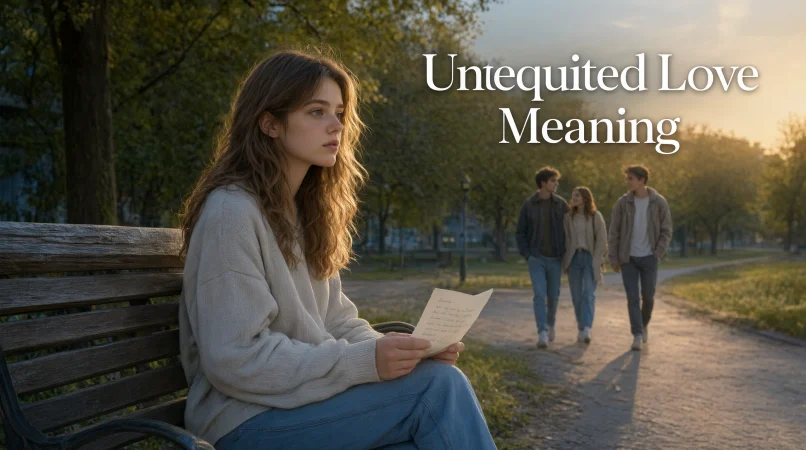
Unrequited love means having romantic feelings for someone who does not feel the same way or cannot return your affection. It happens when one person loves, admires, or desires a romantic relationship with another person, but those feelings remain one-sided.
Unrequited love can involve a crush, a close friend, or someone who is emotionally unavailable. It may bring sadness, longing, and disappointment, but understanding these feelings can help a person accept the situation and move forward.
Have you ever loved someone deeply without knowing whether they felt the same way? You may think about them often, hope for their attention, or imagine a relationship that never develops. This experience is commonly known as unrequited love.
It describes a one-sided romantic attachment in which one person has feelings that the other person does not return. Although it can happen at any age, the experience may feel especially difficult when affection, hope, and emotional expectations are not mutual.
Understanding the unrequited love meaning can help you recognize the difference between mutual affection and one-sided romantic feelings. It can also explain why someone may struggle to let go, continue hoping for a relationship, or feel emotionally hurt when the other person does not respond in the same way.
This guide explores the meaning, signs, examples, emotional effects, and common types of unrequited love, along with practical ways to cope with it while protecting your self-respect and emotional well-being.
Table of Contents
- What Does Unrequited Love Mean?
- How Unrequited Love Develops
- Common Signs of One-Sided Love
- Different Types of Unrequited Love
- Why Do People Experience It?
- The Emotional Impact of Loving Someone Who Does Not Love You Back
- Unrequited Love vs. Requited Love vs. Unavailable Love
- How to Cope With Unreturned Feelings
- When Is It Time to Move On?
- Frequently Asked Questions
- Final Thoughts
What Does Unrequited Love Mean?
Unrequited love refers to romantic affection that one person feels but does not receive in return. The person may feel emotionally connected, attracted, or deeply committed to someone who does not share those feelings. Sometimes the other person knows about the affection but cannot return it. In other situations, they may not even realize how strongly someone cares about them.
The word unrequited means not returned or reciprocated. It comes from the idea of something being given without receiving the same thing in response. When used in romantic situations, it describes an imbalance between two people’s feelings.
For example, imagine someone who has been friends with a classmate for years. They gradually develop romantic feelings and begin hoping the friendship will turn into a relationship. However, the classmate sees them only as a friend and has no romantic interest.
That is a common example of one-sided affection.
It does not necessarily mean that the person receiving the attention is cruel, insensitive, or deliberately hurtful. People cannot always control whom they develop romantic feelings for, and they cannot be expected to return affection simply because someone cares deeply about them.
The important distinction is that genuine feelings do not automatically create mutual romantic interest.
How Unrequited Love Develops
These feelings do not always appear suddenly. They can grow through ordinary interactions, shared experiences, and emotional closeness.
A person might initially feel attracted to someone’s personality, appearance, humor, or kindness. Over time, small moments begin to carry greater emotional meaning. A friendly conversation may feel special, a simple message may create excitement, and a casual compliment may encourage hopes of a deeper connection.
Several experiences can contribute to this process.
Friendship That Becomes Romantic
One person may develop romantic feelings after spending considerable time with a friend. They already share trust, memories, and personal conversations, so imagining a relationship can feel natural.
The difficulty begins when the other person values the friendship but does not want anything romantic. Both people may care about each other, but they understand the connection differently.
Attraction From a Distance
Sometimes affection develops without a close personal relationship. Someone may admire a colleague, classmate, public figure, or person they regularly see but rarely speak to.
In these situations, the admirer may know relatively little about the other person’s private life. Their feelings can grow around an idealized image rather than a fully understood person.
Emotional Connection Without Romantic Interest
Two people can share meaningful conversations and support each other without experiencing romantic attraction equally.
One person may interpret emotional closeness as a sign of potential romance. The other may simply enjoy the friendship. This difference in expectations can become painful when neither person understands what the relationship means to the other.
Common Signs of One-Sided Love
Recognizing the signs can help someone understand their emotional situation instead of constantly searching for hidden meanings in another person’s behavior.
Not every sign applies to every situation, but several patterns may suggest that romantic interest is not mutual.
You Initiate Most of the Contact
You usually send the first message, start conversations, suggest meeting up, or make an effort to stay connected. The other person may respond politely, but they rarely take the initiative.
This pattern does not prove that someone has no interest, since people communicate differently. However, consistently unequal effort can indicate that both people have different expectations.
You Think About Them More Than They Think About You
Their messages, reactions, and small gestures occupy much of your attention. You may spend time wondering what they meant by a particular sentence or whether they noticed something you did.
Meanwhile, the other person may not give the relationship the same level of emotional attention.
You Interpret Small Gestures as Romantic Signals
A smile, compliment, friendly message, or casual invitation can feel unusually meaningful when you already have strong feelings.
You may begin treating ordinary kindness as evidence that the person secretly likes you. The problem is that friendly behavior does not always indicate romantic attraction.
They Avoid Romantic Conversations
When you mention relationships or express interest in becoming closer, the other person may change the subject, give unclear responses, or explain that they see you as a friend.
Their words and behavior deserve attention. It can be painful, but repeatedly searching for a different interpretation may make acceptance harder.
You Keep Hoping They Will Change Their Mind
You may believe that more time, attention, patience, or emotional support will eventually make them develop romantic feelings.
Hope is understandable, especially when you care deeply. However, a relationship cannot be built through one person’s effort alone.
Different Types of Unrequited Love
One-sided romantic feelings can develop in different circumstances. Understanding the situation can help explain why the experience feels the way it does.
| Type | What It Means | Example |
| Secret admiration | Romantic feelings remain unspoken | Someone quietly loves a classmate without telling them |
| Friendship-based affection | One friend wants romance while the other prefers friendship | A person develops feelings for their closest friend |
| Distant attraction | Feelings develop without a close personal connection | Someone admires a person they rarely interact with |
| Rejected affection | One person expresses interest, but the other declines | Someone asks for a relationship and receives a clear no |
| Emotionally unavailable attachment | A person develops feelings for someone who cannot offer a relationship | Falling for someone already committed to another person |
These categories can overlap. For instance, a person may secretly admire a friend for years before eventually expressing their feelings and facing rejection.
The circumstances differ, but the central issue remains the same: the two people do not share equal romantic interest.
Why Do People Experience It?
There is no single reason someone develops feelings that another person cannot return. Attraction is personal, and emotional connections do not always develop at the same pace.
However, several psychological and social factors can help explain why this happens.
Emotional Compatibility Is Not Always Mutual
Two people may have similar interests, values, humor, or life goals without feeling romantic attraction toward each other.
Someone might appear to be an ideal partner from one person’s perspective, but that does not mean the other person experiences the same connection.
Compatibility involves more than having things in common. It also requires mutual interest and willingness to build a relationship.
Idealization Can Strengthen Attraction
Idealization happens when someone focuses heavily on another person’s positive qualities while overlooking their limitations.
For example, a person who admires someone from a distance may imagine that they would make a perfect partner. Since they have limited real-life experience with that individual, their expectations may come from assumptions rather than direct knowledge.
The imagined relationship can become more emotionally appealing than the actual connection.
Emotional Needs Can Influence Attachment
People sometimes become strongly attached to someone who makes them feel noticed, appreciated, or understood.
If someone has been lonely or has struggled with emotional connection, attention from a particular person may feel especially meaningful. They might begin associating that individual with comfort, confidence, or happiness.
This does not mean their feelings are false. It means personal emotional needs can influence how strongly they experience attraction.
Timing Can Be Different
One person may be ready for a relationship while the other is focused on education, work, family responsibilities, or personal goals.
Sometimes the other person simply does not feel attracted. In other cases, they may not want a relationship at that stage of life.
Timing can explain some situations, but it should not become a reason to wait indefinitely for someone who has clearly declined romantic interest.
The Emotional Impact of Loving Someone Who Does Not Love You Back
Unreturned affection can affect a person’s emotions, confidence, and everyday routine. The experience may be particularly difficult when the feelings have lasted for months or years.
Sadness and Disappointment
When someone hopes for a relationship, the realization that it will not happen can create genuine sadness. They may grieve not only the person but also the future they imagined together.
A planned relationship, shared experiences, and romantic possibilities can feel difficult to let go of, even when they never became reality.
Repeated Thoughts and Emotional Uncertainty
Some people repeatedly revisit conversations, messages, and memories. They may wonder whether they misunderstood a situation or whether they could have acted differently.
This pattern can make it difficult to focus on other parts of life. It may also keep hope alive long after the other person has communicated their feelings.
Lower Self-Confidence
Rejection can sometimes make people question their appearance, personality, or worth.
They may think they were not attractive, interesting, or successful enough to be loved by that particular person. However, romantic attraction is not a reliable measurement of someone’s value.
One person’s lack of romantic interest does not mean that nobody else could appreciate or love them.
Difficulty Building New Connections
When someone remains emotionally focused on one person, they may become less open to meeting others.
They might compare every new connection with the person they cannot have or feel that nobody else could create the same emotional excitement.
This can delay emotional recovery, especially when the person continues to expect the original situation to change.
Unrequited Love vs. Requited Love vs. Unavailable Love
These terms are related, but they describe different romantic situations. Understanding the distinctions can prevent confusion.
| Term | Meaning | Main Difference |
| Unrequited love | One person has romantic feelings that are not returned | Affection is one-sided |
| Requited love | Two people share romantic feelings | Affection is mutual |
| Unavailable love | Someone cannot or does not offer a relationship | A relationship is not realistically accessible |
| Unconditional love | Affection is given without making it dependent on certain conditions | Love is not based on receiving something in return |
| Unreciprocated affection | Care or affection is not returned equally | It can involve romantic or non-romantic feelings |
Unrequited Love and Requited Love
The main difference is mutual interest.
In requited love, both people experience romantic affection and are willing to develop a relationship. They may have different personalities or express their feelings differently, but their romantic interest is shared.
In the one-sided experience, only one person wants a romantic relationship. The other may appreciate their company without wanting the same commitment.
Unrequited Love and Unavailable Love
Unavailable love describes a situation in which a person cannot participate in the relationship someone wants. They may already have a partner, live in a different place, or be unwilling to enter a relationship.
These situations can overlap with one-sided affection, but they are not identical. Someone can have mutual feelings with a person who is unavailable, while another person may experience attraction that is never returned at all.
How to Cope With Unreturned Feelings
Accepting that someone does not share your romantic interest can take time. There is no universal schedule for emotional recovery, and trying to force yourself to stop caring immediately may create additional frustration.
Still, a few practical steps can make the process healthier.
Accept Their Feelings Without Arguing Against Them
If someone has clearly said they do not want a romantic relationship, respect their answer.
It may be tempting to search for hidden meanings or believe they will eventually change their mind. However, accepting what they have communicated is usually healthier than trying to convince them.
Their decision does not invalidate your feelings. It simply means the relationship you want is not mutual.
Give Yourself Some Emotional Distance
You do not have to remain constantly available to someone whose presence makes it difficult to recover.
Consider reducing unnecessary messaging, checking their social media, or arranging situations where you repeatedly seek their attention. A little distance can give your thoughts room to settle.
This does not require hostility or dramatic arguments. Sometimes a quieter boundary is enough.
Stop Treating Every Interaction as a Sign
A friendly conversation does not necessarily mean romantic interest. Neither does a like on social media, a quick reply, or an occasional compliment.
Try to judge the situation through consistent behavior and direct communication rather than individual moments. This can prevent ordinary interactions from creating unrealistic expectations.
Reconnect With Your Own Interests
Spend time on activities that give your life structure and enjoyment outside the relationship you hoped to have.
You might return to exercise, focus on education, spend time with friends, learn a skill, or work toward a personal goal. These activities do not erase romantic feelings, but they can help prevent those feelings from becoming the center of your daily life.
Talk to Someone You Trust
Keeping difficult emotions entirely private can make them feel heavier.
A trusted friend or family member may offer a different perspective and remind you that your life includes more than one romantic possibility. If sadness, anxiety, or obsessive thoughts begin interfering with everyday functioning, speaking with a qualified mental health professional can also help.
Avoid Blaming Yourself or the Other Person
It is natural to feel disappointed, but rejection does not automatically mean that someone behaved badly.
The person who does not return your feelings has the right to make that decision. You also have the right to feel sad and take time to recover.
Healthy acceptance allows both people to move forward without pressure, guilt, or resentment.
When Is It Time to Move On?
Moving on does not mean that your feelings were meaningless. It means recognizing when continuing to wait is preventing you from living fully.
Some situations make this decision clearer than others.
- The person has directly said they are not romantically interested.
- They have started or continued a relationship with someone else.
- You are consistently making efforts without receiving similar interest.
- Your emotional well-being depends heavily on their messages or attention.
- You keep postponing your own plans while waiting for a possible relationship.
- The situation creates more anxiety and sadness than genuine happiness.
Moving on can involve accepting that you may never receive the explanation or outcome you hoped for. It may also mean changing the nature of a friendship or stepping away from regular contact.
There is no need to turn the experience into a personal failure. Sometimes two people simply want different things.
The goal is not to forget someone overnight. It is to stop making your happiness depend on a relationship that the other person does not want.
FAQs
Is unrequited love the same as a crush?
No. A crush involves attraction, while unrequited love often involves deeper feelings that are not returned.
Can unrequited love turn into a relationship?
Yes, feelings can change, but a relationship is never guaranteed.
Is unrequited love always painful?
No. However, rejection or unmet expectations can make it emotionally painful.
Can you remain friends with someone you love?
Yes, if both people respect boundaries and friendship does not cause emotional distress.
How long does it take to get over unrequited love?
There is no fixed timeline; recovery depends on emotional attachment, contact, and personal support.
Does unrequited love mean someone is emotionally dependent?
No. However, constantly seeking validation or neglecting personal needs may indicate unhealthy attachment.
Final Thoughts
Unrequited love is a deeply personal experience, but it does not have to define someone’s future relationships or self-worth. Caring about another person is meaningful, even when they cannot return those feelings. What matters is recognizing the difference between genuine affection and waiting for something that may never happen. A healthy relationship needs mutual interest, respect, and effort from both people.