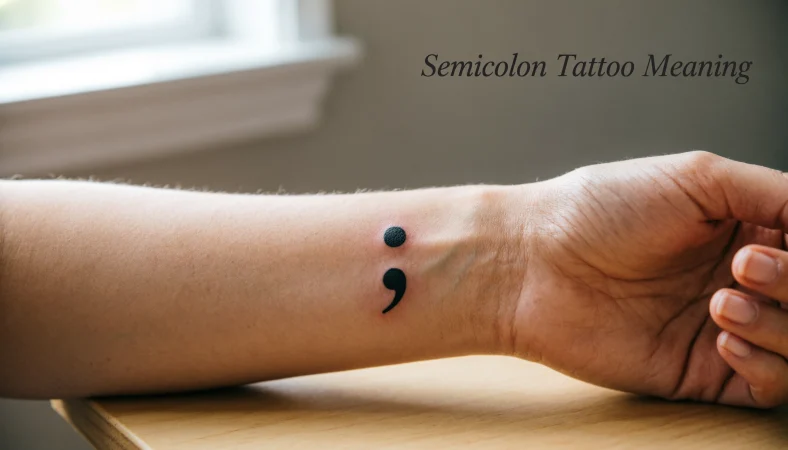
A semicolon tattoo symbolizes hope, resilience, and the decision to continue living through difficult times. Its meaning comes from punctuation: a semicolon joins two closely related thoughts when a writer could have ended the sentence. In mental health awareness, it has become a symbol of survival, recovery, and the belief that a person’s story is not over.
Table of Contents
- What a Semicolon Tattoo Represents
- The Story Behind the Symbol
- Mental Health Awareness and Personal Survival
- Different Semicolon Tattoo Designs
- Placement and Personal Expression
- Semicolon Tattoos Compared With Other Symbols
- Common Misunderstandings
- Frequently Asked Questions
What a Semicolon Tattoo Represents
A semicolon is a punctuation mark that connects two closely related independent clauses. Instead of ending the sentence with a period, a writer uses a semicolon to show that the thought continues.
That simple grammatical function gives the symbol its emotional significance. A period marks an ending, while a semicolon suggests that the sentence carries on. For people who connect with the tattoo’s modern meaning, that idea can represent choosing to continue a personal story during a difficult period.
The symbol is especially associated with mental health awareness, depression, anxiety, self harm recovery, and suicide prevention. People may choose it to recognize their own experiences, remember someone they have lost, or show support for others who face emotional struggles.
However, the tattoo does not mean exactly the same thing to everyone. Some people connect with its punctuation meaning, while others see it as a reminder of a specific challenge or a loved one.
The Symbol’s Main Interpretations
| Interpretation | What it can represent |
| Hope | Belief that difficult circumstances can change |
| Survival | Continuing after a painful or dangerous period |
| Mental health awareness | Recognition of emotional struggles and recovery |
| Personal resilience | Strength developed through challenging experiences |
| Remembrance | Honoring someone who struggled or died |
| Solidarity | Supporting people who experience mental health challenges |
| A new chapter | Continuing life without pretending the past never happened |
These interpretations overlap, but they are not identical. Someone might wear the symbol to celebrate personal recovery, while another person may choose it in memory of a friend or family member.
The most meaningful explanation is the one the wearer gives it.
The Story Behind the Semicolon Symbol
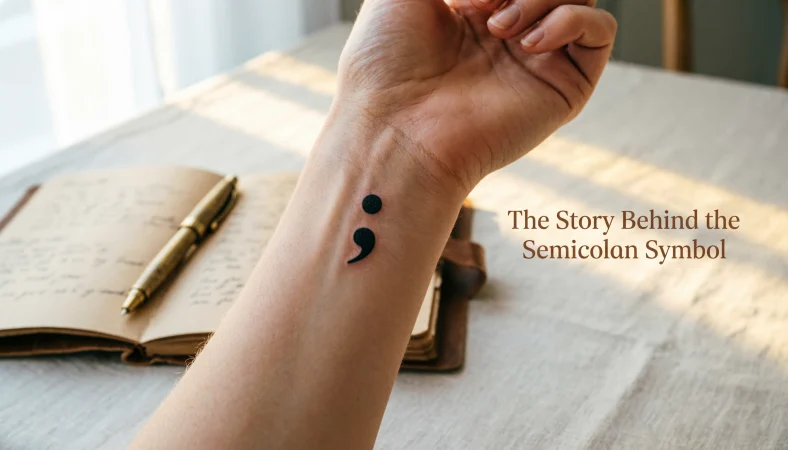
The modern association between the semicolon and mental health awareness grew through Project Semicolon, a movement founded by Amy Bleuel in 2013. Bleuel created the project in connection with her experiences of loss and emotional hardship, seeking to encourage people struggling with mental health challenges.
The movement used the punctuation mark as a metaphor for continuing a story. Its message encouraged people to recognize that a difficult chapter does not have to define the entire course of their lives.
The symbol became widely recognizable through tattoos and social media. People shared photographs of semicolon tattoos, often alongside personal accounts of depression, trauma, self harm recovery, and survival. For some, the small mark offered a way to express something deeply personal without explaining every detail.
Project Semicolon helped establish the symbol’s modern cultural association, but it did not invent the punctuation mark itself. The semicolon had served its grammatical purpose for centuries before becoming connected with mental health advocacy.
That distinction matters. The tattoo’s contemporary meaning comes from how people adopted and shared it, rather than from an inherent emotional meaning within punctuation.
Why Punctuation Became a Symbol of Hope
A semicolon creates a pause without ending the sentence. That difference makes it a natural metaphor for someone who wants to acknowledge hardship while continuing forward.
The symbol also works visually. It is small, recognizable, and easy to adapt to different tattoo styles. A simple semicolon can carry personal significance without requiring a large design or a detailed explanation.
For many wearers, the mark serves as a quiet reminder rather than a public announcement. Others use it to start conversations about mental health, encourage people to seek support, or challenge the idea that emotional struggles should remain hidden.
Mental Health Awareness and Personal Survival
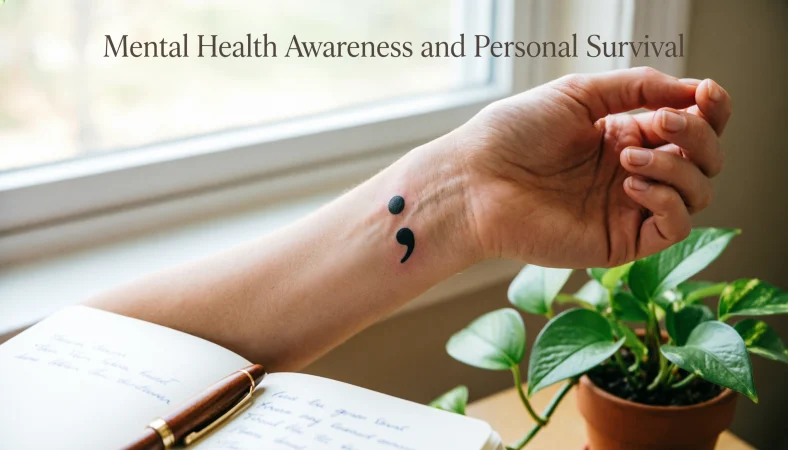
For many people, the strongest association is with surviving a period when continuing felt difficult. The tattoo may remind the wearer of progress made through depression, anxiety, trauma, grief, or another personal challenge.
It can also recognize that recovery is rarely a straight line. Someone may feel better for a time and then experience another difficult period. The semicolon can serve as a reminder that a setback does not erase earlier progress.
A Personal Reminder, Not a Diagnosis
A tattoo cannot reveal someone’s medical history. Two people with nearly identical designs may have very different reasons for choosing them.
One person may connect the mark with a past mental health crisis. Another may have lost a loved one to suicide. Someone else may simply support mental health awareness and want to encourage more open conversations.
It is important not to assume that everyone with this tattoo has experienced suicidal thoughts or self harm. Asking someone to explain the symbol can be intrusive, particularly if the question pressures them to share painful details.
If a person chooses to talk about their experience, listening without judgment is often more helpful than trying to interpret their tattoo for them.
Remembering Someone Who Died
Some people get a semicolon tattoo in memory of someone who died by suicide or struggled with mental health challenges. In this context, the mark can represent love, grief, remembrance, or a commitment to supporting others.
A memorial design might include a person’s initials, a meaningful date, or a small heart. These additions can make the tattoo specific to a relationship rather than relying entirely on the symbol’s public meaning.
Grief is personal, and memorial tattoos can hold different emotions at once. A person may feel sadness about the loss while also finding comfort in carrying a reminder of someone they loved.
Encouraging Conversations About Mental Health
The symbol can also function as a conversation starter. Someone may notice the tattoo and ask what it means, creating an opportunity to discuss mental health in a respectful way.
That does not mean every wearer wants to talk about personal experiences. A tattoo can express solidarity without inviting questions, and the wearer should decide how much they wish to share.
The broader value of the symbol lies in its ability to make a difficult subject more visible while leaving room for individual choice.
Different Semicolon Tattoo Designs and Their Meanings
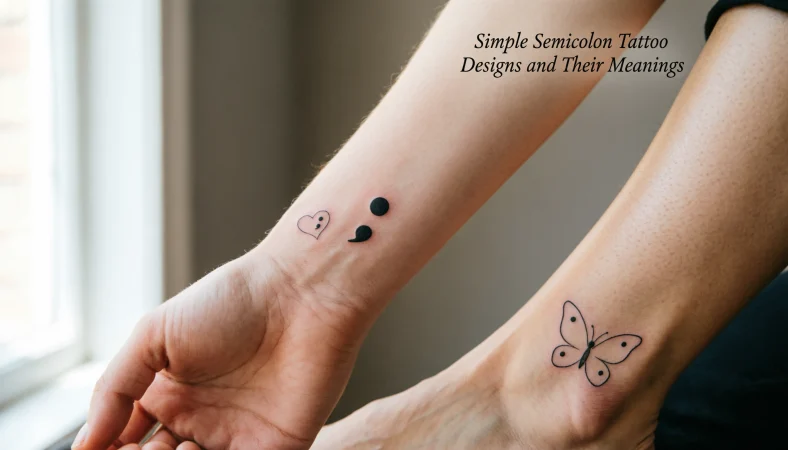
The basic punctuation mark is enough for many people. Others combine it with images that express their own experiences, beliefs, or memories.
Simple Semicolon
A small, plain semicolon focuses attention on the original metaphor. It can represent hope, continuation, or a private commitment to keep moving forward.
Semicolon With a Butterfly
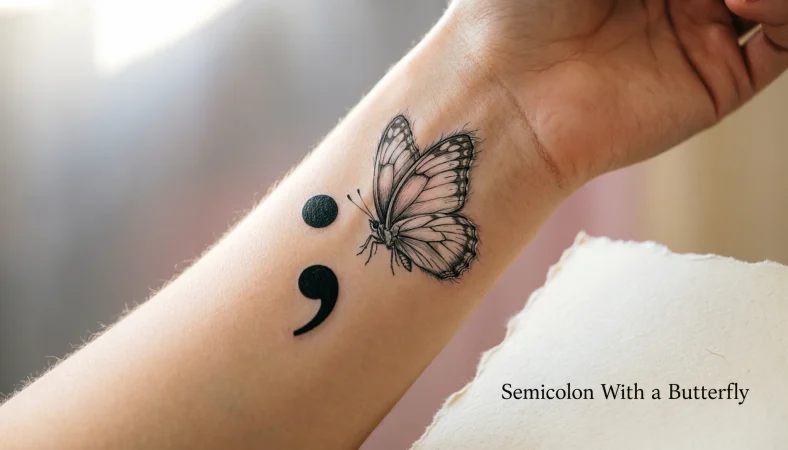
A butterfly is often associated with transformation and change. Combined with the punctuation mark, it can suggest personal growth after a difficult period.
Semicolon With a Heart
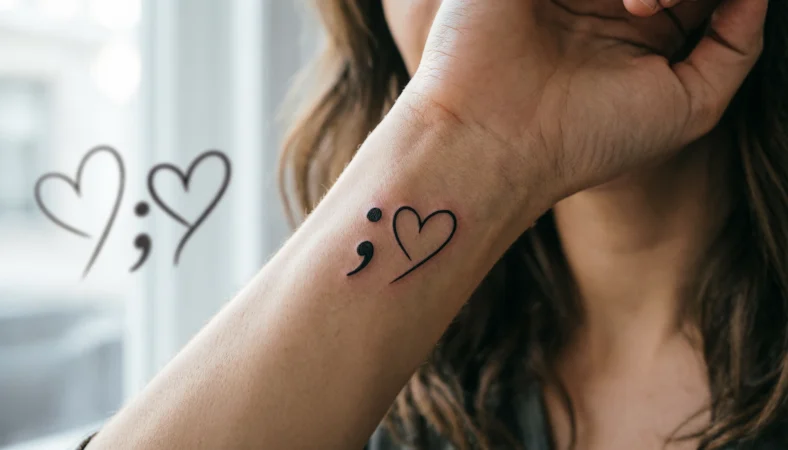
The heart can add themes of compassion, love, and self acceptance. This design may honor a personal journey or someone who provided emotional support.
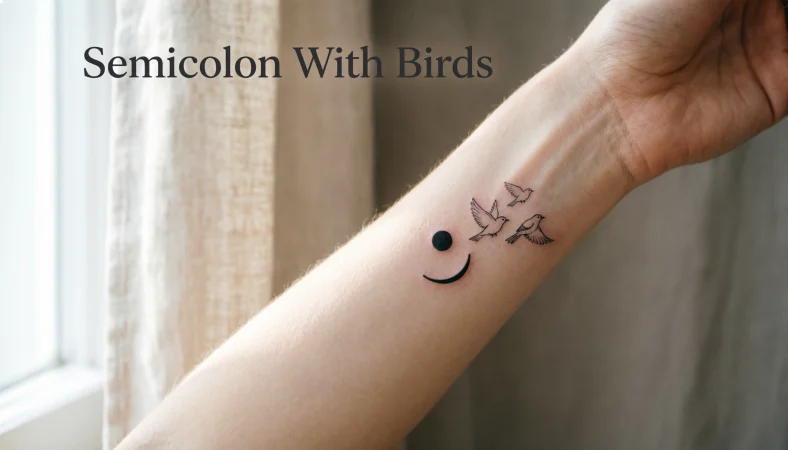
Semicolon With Birds
Birds can suggest freedom, movement, or the desire to move beyond a painful chapter. The exact meaning depends on the wearer’s own associations.
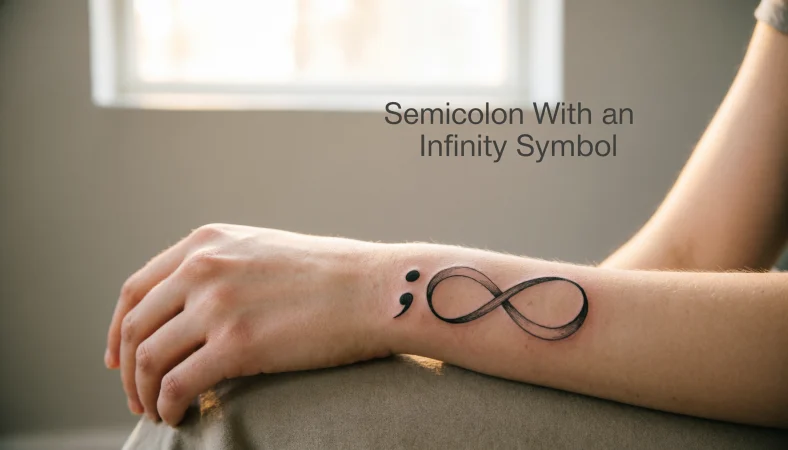
Semicolon With an Infinity Symbol
The infinity symbol can represent continuity or an ongoing journey. Together, the two marks may express the idea that healing and personal growth can continue over time.
Does Color Change the Meaning?
Black ink is common for semicolon tattoos because it keeps the punctuation clear and simple. Some people choose colored ink to make the design more personal or connect it with another image.
Purple, blue, green, or other colors may have personal associations, but there is no universal color code that determines what a semicolon tattoo means. If a particular color has significance to the wearer, that meaning comes from their own experience or chosen symbolism.
Where People Place a Semicolon Tattoo
Placement can affect how visible the tattoo is and how comfortably it fits into daily life. It does not establish the tattoo’s meaning, although some wearers select a location because it feels personally significant.
| Placement | Why someone might choose it | Practical consideration |
| Inner wrist | Easy to see as a personal reminder | Often visible in everyday settings |
| Forearm | Offers room for a small design or added artwork | Usually easy to display or cover |
| Behind the ear | Allows a discreet, compact tattoo | Limited space for additional detail |
| Ankle | Provides a small, subtle placement | Visibility changes with footwear |
| Shoulder | Offers space for a larger design | Usually easy to cover with clothing |
| Finger | Keeps the symbol small and visible | Tattoos in this area can fade or blur more quickly |
Some people prefer a visible placement because the tattoo reminds them of their journey throughout the day. Others choose a discreet location because they want the meaning to remain private.
Before deciding, consider how the design may age, whether the placement suits your work or lifestyle, and the aftercare it will require. A qualified tattoo artist can explain how skin movement and repeated friction may affect the final result.
Semicolon Tattoos Compared With Other Symbols
Semicolon tattoos share themes with other designs, but their origins and common associations differ.
| Symbol | Common association | Main distinction |
| Semicolon | Continuing a story, mental health awareness, and survival | Draws meaning from punctuation and the modern advocacy movement |
| Butterfly | Change, transformation, and growth | Emphasizes transformation more than the idea of a sentence continuing |
| Phoenix | Rebirth after destruction or hardship | Uses a mythological creature to represent renewal |
| Infinity symbol | Continuity, lasting connection, or permanence | Focuses on something without an apparent end |
| Heart | Love, care, and emotional connection | Often represents relationships or compassion |
| Awareness ribbon | Support for a particular cause | Its meaning depends on the cause and ribbon color |
A semicolon may be combined with any of these symbols, allowing someone to express more than one idea in a single design.
For example, a semicolon with a butterfly might represent both continuation and transformation. A semicolon with a heart might connect survival with love or support from another person.
These interpretations are possibilities, not rules. The wearer may have a specific reason that differs from the meanings commonly associated with the artwork.
Common Misunderstandings About the Symbol
Because the semicolon has become recognizable through mental health awareness, people sometimes assume it carries the same message in every situation. That assumption can lead to misunderstandings.
It does not automatically indicate a mental health condition. A person may choose the symbol because they support the cause, remember someone, or like its message of continuation.
It is not proof of a suicide attempt. Although the symbol is associated with suicide prevention, you cannot determine someone’s history from a tattoo.
It does not promise that recovery will be easy. For some wearers, it represents hope during a difficult journey, not a claim that every problem has been resolved.
It is not limited to one gender or age group. People with different backgrounds may connect with the same message for different reasons.
It does not have to be visible to matter. A small tattoo in a private location can carry as much personal significance as a larger design that invites public attention.
Respecting these differences helps preserve the symbol’s meaning without turning it into a label for the person wearing it.
FAQs
Is a semicolon tattoo connected to Project Semicolon?
Yes. Project Semicolon, founded by Amy Bleuel in 2013, helped popularize the semicolon as a symbol associated with mental health awareness, suicide prevention, and the continuation of a personal story.
Can someone get a semicolon tattoo for a friend?
Yes. Some people choose it to honor a friend or family member who struggled with mental health challenges or died by suicide. Others use it to recognize someone who supported them during a difficult time.
Does a semicolon tattoo have a religious meaning?
The semicolon tattoo is widely associated with mental health awareness, while any spiritual meaning reflects the wearer’s personal beliefs rather than a universal religious interpretation.
Is a semicolon tattoo appropriate as a memorial?
A semicolon tattoo can honor a loved one, with initials, dates, or personal details making the memorial more meaningful.
Should I ask someone what their semicolon tattoo means?
You can ask politely if the situation feels appropriate, but avoid assuming the person has experienced a particular hardship. They may prefer not to discuss it, and they do not owe anyone an explanation.
Can a semicolon tattoo represent a fresh start?
Yes. Some people interpret it as a reminder that a difficult chapter does not have to be the final one. For them, the mark represents the possibility of change and the decision to keep writing their story.
Conclusion
A semicolon tattoo can carry a deeply personal message about continuing through hardship, remembering someone, or supporting mental health awareness. Its power comes from a simple punctuation mark that leaves room for a story to continue. If you choose one, let its meaning reflect your own experience rather than a label that other people place on you.