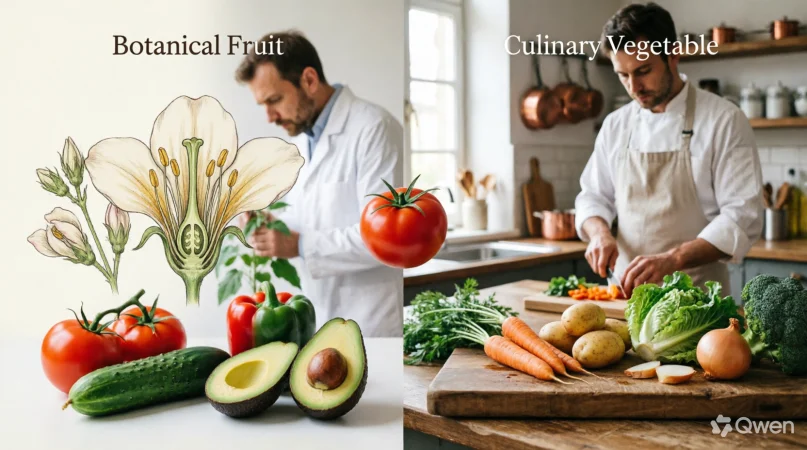
The difference between a fruit or vegetable depends on whether you use a botanical or culinary definition. Botanically, a fruit develops from a flower’s ovary and usually contains seeds, while a vegetable is a culinary term for edible plant parts such as roots, stems, leaves, and some immature fruits. This explains why tomatoes and cucumbers can be fruits botanically but vegetables in cooking.
The question fruit or vegetable seems simple until botanical science and everyday cooking use different definitions. In a kitchen, people usually classify foods by flavor, texture, and how they are prepared. Botanists classify plant structures according to how they develop.
That difference creates some surprisingly common disagreements. Tomatoes, peppers, eggplants, cucumbers, pumpkins, and avocados are commonly treated as vegetables in recipes, yet they are botanically fruits. Meanwhile, carrots, potatoes, onions, and lettuce are vegetables in both everyday and botanical discussions.
Understanding the distinction makes it easier to classify foods accurately without assuming that one definition automatically makes the other wrong.
Fruit vs Vegetable: What’s the Difference?
The most important distinction is that fruit has a specific botanical meaning, while vegetable is primarily a culinary and everyday category.
A botanical fruit develops from the ovary of a flowering plant after fertilization. Its role is connected to the plant’s reproductive process and seed development.
A vegetable, in culinary language, refers broadly to an edible plant part that people commonly prepare and eat as part of a savory meal. This can include roots, stems, leaves, bulbs, flowers, and sometimes botanical fruits.
| Feature | Fruit | Vegetable |
| Botanical category | Yes | No single equivalent botanical category |
| Common culinary role | Often sweet or tart | Often savory |
| Typical plant origin | Develops from a flower ovary | Can come from roots, stems, leaves, bulbs, flowers, or other parts |
| Seeds | Often present | Usually not relevant to classification |
| Examples | Apple, peach, tomato, cucumber | Carrot, potato, lettuce, onion |
| Scientific classification | Based on plant development | Usually based on culinary use |
| Common use | Desserts, snacks, drinks, salads | Soups, sides, salads, stews |
This distinction becomes especially useful when discussing foods that occupy both categories.
A tomato is a good example.
Botanically, it is a fruit because it develops from the ovary of a flower and contains seeds.
Culinarily, it is commonly treated as a vegetable because people often use it in salads, sauces, sandwiches, soups, and savory dishes.
So the two classifications can coexist.
Quick Recap
Fruit is a botanical classification.
Vegetable is primarily a culinary classification.
Some foods can be fruits botanically and vegetables in everyday cooking.
The classification depends on the context in which the word is being used.
Is Fruit vs Vegetable a Grammar, Vocabulary, or Usage Issue?
The distinction between fruit and vegetable is primarily a vocabulary and classification issue, not a grammar issue.
Grammar determines how words function within sentences. Classification determines what category something belongs to.
For example:
A tomato is a fruit.
This is grammatically straightforward.
The interesting question is whether fruit is being used in a botanical sense or whether vegetable is being used in a culinary sense.
Are Fruit and Vegetable Interchangeable?
No.
Although some foods can reasonably be described using both terms in different contexts, the words themselves aren’t interchangeable.
You cannot normally call a carrot a fruit.
You also would not normally call an apple a vegetable.
However, certain foods sit at the boundary between scientific classification and culinary convention.
Tomatoes are the classic example.
Formal and Informal Usage
In scientific or botanical writing, fruit should be used according to its botanical definition.
In ordinary conversation, vegetable usually refers to edible plant foods commonly served in savory meals.
A cookbook might describe tomatoes as vegetables because the culinary category is what matters.
A botany textbook would classify tomatoes as fruits because their structure and development determine the classification.
Academic and Casual Usage
Academic writing should make the intended classification clear.
For example:
The tomato is botanically a fruit but is commonly treated as a vegetable in culinary contexts.
This sentence avoids confusion because it recognizes both systems.
Casual conversation usually doesn’t require that level of precision.
If someone asks whether tomatoes belong in a vegetable salad, answering simply “yes” may be perfectly reasonable in a culinary context.
What Is a Fruit?
A fruit is, in botanical terms, a mature structure that develops from the ovary of a flowering plant.
Its biological role is closely connected with reproduction.
After a flower is pollinated and fertilization occurs, the ovary can develop into a fruit. The developing structure may protect seeds and help with their eventual dispersal.
This definition includes many foods that people don’t normally think of as fruits.
Tomatoes, peppers, eggplants, cucumbers, pumpkins, and avocados all fit the botanical definition.
Workplace Example
Consider a food company developing product descriptions.
A scientific nutrition or agriculture team might write:
The tomato is botanically classified as a fruit.
A culinary marketing team might describe the same tomato as:
A versatile vegetable for salads and sauces.
Neither statement necessarily contradicts the other because each uses a different classification system.
Academic Example
In a biology course, a student might write:
The strawberry develops from a flower but has a complex botanical structure that differs from a typical simple fruit.
The important point is that botanical classification depends on plant structure and development rather than sweetness.
Technology Example
Food databases and agricultural software can use botanical classifications to organize plant information.
A database designed for cooking, however, might categorize tomatoes, peppers, and cucumbers under vegetables because users generally search for them as savory ingredients.
Usage Recap
Use fruit when discussing botanical classification or foods that develop from a flower’s ovary. In everyday cooking, some botanical fruits may still be grouped with vegetables.
What Is a Vegetable?
Unlike fruit, vegetable does not represent one specific botanical structure.
The term is primarily culinary.
People use vegetable to describe edible parts of plants that commonly form part of savory meals.
That can include roots, stems, leaves, flowers, bulbs, and tubers.
Carrots are roots.
Potatoes are tubers.
Lettuce consists primarily of leaves.
Celery is commonly eaten for its stalk.
Onions are bulbs.
Broccoli is an immature flowering structure.
These foods come from very different parts of plants, yet culinary language groups them together as vegetables.
Workplace Example
A restaurant menu might classify carrots, onions, broccoli, and potatoes as vegetables.
This classification is useful for customers because it reflects how the ingredients are prepared and served.
Academic Example
A biology teacher may avoid treating vegetable as a strict botanical category because the term doesn’t identify one particular plant structure.
Instead, the teacher may explain exactly which part of the plant people consume.
Technology Example
A grocery shopping application might place carrots, spinach, broccoli, and onions in a vegetable category even though these foods represent several different botanical structures.
The category is designed for practical shopping rather than botanical precision.
Usage Recap
Use vegetable primarily when discussing food in a culinary or everyday context. Remember that vegetables can come from many different parts of a plant.
Why Are Tomatoes Fruits but Vegetables in Cooking?
Tomatoes cause more confusion than almost any other food in this discussion.
Botanically, a tomato is a fruit.
It develops from the ovary of a flower and contains seeds.
Culinarily, however, tomatoes are commonly treated as vegetables.
People use them in pasta sauces, sandwiches, soups, salads, pizzas, and savory dishes. Their flavor profile and culinary role make the vegetable label feel natural in everyday language.
This demonstrates an important principle.
Botanical classification and culinary classification answer different questions.
Botany asks:
What part of the plant is this, and how did it develop?
Cooking asks:
How is this food normally prepared and eaten?
Once you understand that distinction, the tomato debate becomes much easier to explain.
When You Should NOT Use Fruit or Vegetable
There are several situations where careless classification can cause confusion.
1. Don’t Assume Sweetness Determines Fruit
A food doesn’t become a fruit simply because it tastes sweet.
Botanical classification depends on plant structure and development.
2. Don’t Assume Savory Flavor Means Vegetable
A savory food can still be botanically a fruit.
Tomatoes and peppers demonstrate this clearly.
3. Don’t Treat Vegetable as a Botanical Structure
Vegetable is primarily a culinary category rather than one specific part of a flowering plant.
4. Don’t Call Every Seed Containing Food a Fruit Without Context
Seeds alone don’t provide the complete classification rule.
The developmental origin of the structure matters.
5. Don’t Assume Culinary Classification Is Scientifically Wrong
Calling tomatoes vegetables in a recipe isn’t a botanical statement.
It reflects ordinary culinary usage.
6. Don’t Assume Botanical Classification Is the Only Useful Classification
A chef doesn’t need to organize a menu according to plant anatomy.
Culinary categories exist for practical reasons.
7. Don’t Confuse Roots With Fruits
Carrots and radishes are edible roots, not botanical fruits.
8. Don’t Treat the Two Categories as Perfect Opposites
Fruit and vegetable do not form a simple scientific pair in which every edible plant part must fit neatly into one of two botanical boxes.
Common Mistakes and Decision Rules
| Correct sentence | Incorrect sentence | Explanation |
| A tomato is botanically a fruit. | A tomato is botanically a vegetable. | Tomatoes develop from the ovary of a flower. |
| A carrot is a vegetable. | A carrot is a fruit. | A carrot is an edible root. |
| Cucumbers are botanically fruits. | Cucumbers are botanically roots. | Cucumbers develop from flowers and contain seeds. |
| Potatoes are vegetables in culinary usage. | Potatoes are fruits. | Potatoes are underground tubers. |
| Peppers are botanically fruits. | Peppers are botanically vegetables. | Peppers develop from flower ovaries. |
| Lettuce is a vegetable. | Lettuce is a fruit. | Lettuce is primarily an edible leaf. |
Decision Rule Box
- If you’re discussing plant anatomy and development, use the botanical definition of fruit.
- If you’re discussing cooking, recipes, menus, or grocery shopping, vegetable usually refers to the culinary category.
- If a food seems to fit both descriptions, check whether you’re using a botanical or culinary definition.
Fruit and Vegetable in Modern Technology and AI Tools
Modern technology has made food classification more complicated and more useful.
Grocery applications, recipe platforms, nutritional databases, agricultural software, and AI systems all organize food information according to different goals.
A recipe application might group tomatoes with vegetables because users typically expect to find them alongside lettuce, onions, and peppers.
A botanical database would classify tomatoes as fruits.
An AI system answering a question needs to understand which definition the user expects.
For example, the question:
Is a tomato a fruit or vegetable?
requires more than a one word answer.
The strongest response explains both classifications.
This is also important for search optimization. People often search for direct answers, but high quality content should resolve the underlying confusion rather than simply repeat the familiar “tomatoes are fruits” statement.
The Etymology of Fruit and Vegetable
The word fruit comes through Old French from Latin roots associated with enjoyment, produce, and what is produced or enjoyed from something.
Over time, English developed a botanical sense of fruit referring to the reproductive structure of flowering plants.
The word vegetable has a different history.
It ultimately relates to Latin roots associated with growing and flourishing. English later used vegetable to describe plant matter and eventually developed the familiar culinary meaning associated with edible plants.
The two words therefore developed through different linguistic paths.
Their modern overlap exists partly because everyday food classification doesn’t follow botanical taxonomy.
Language adapts to practical human needs.
That is why a cook can naturally call a tomato a vegetable while a botanist accurately calls it a fruit.
An Expert View of Fruit and Vegetable
“Fruit is fundamentally a botanical classification, while vegetable is primarily a culinary category. Confusion arises when people expect everyday food terminology to follow scientific plant taxonomy exactly.”
This distinction provides the most reliable way to resolve arguments about foods that appear to belong to both categories.
The issue isn’t that one side understands the food and the other doesn’t.
They’re often answering different questions.
Two Practical Case Studies
Case Study 1: The Tomato
Imagine a school science lesson asking students to identify the botanical fruit in a selection of tomatoes, carrots, lettuce, and potatoes.
The tomato belongs in the fruit category because it develops from the flower’s ovary.
Now imagine a cooking class using the same ingredients.
The instructor may group tomatoes with the vegetables because they’re being prepared in a savory recipe.
The ingredients haven’t changed.
Only the classification system has changed.
Case Study 2: The Cucumber
Cucumber creates the same kind of confusion.
Botanically, it is a fruit.
In the kitchen, it is commonly treated as a vegetable.
A salad recipe might list cucumber alongside lettuce and onions.
A botany lesson would discuss its development from a flowering plant.
This makes cucumber a useful example because it demonstrates that the tomato isn’t an isolated exception.
Error Prevention Checklist
Always use Fruit when
- You’re discussing botanical classification.
- The structure develops from the ovary of a flower.
- You’re explaining plant reproduction.
- You’re writing a biology or botany lesson.
- You’re discussing botanical anatomy.
Use Vegetable when
- You’re discussing cooking.
- You’re describing a savory ingredient.
- You’re organizing a grocery list.
- You’re writing a recipe.
- You’re discussing common food categories.
Never assume
- Sweet foods are automatically fruits.
- Savory foods are automatically vegetables.
- Vegetable is a single botanical structure.
- Culinary classification must match botanical classification.
- A food cannot have both a botanical and culinary description.
Related Grammar and Vocabulary Confusions You Should Master
The fruit and vegetable debate connects with several other classification questions.
- Berry or fruit
- Nut or seed
- Legume or vegetable
- Grain or seed
- Herb or spice
- Root or tuber
- Bean or vegetable
- Mushroom or vegetable
- Fruit or berry
- Botanical fruit or culinary vegetable
Learning these distinctions can make food terminology much easier to understand.
It also demonstrates why everyday vocabulary and scientific vocabulary sometimes organize the same objects differently.
FAQs:
Is a tomato a fruit or vegetable?
A tomato is botanically a fruit because it develops from the ovary of a flower and contains seeds. In cooking, however, tomatoes are commonly treated as vegetables because they are usually used in savory dishes.
Is a cucumber a fruit or vegetable?
A cucumber is botanically a fruit because it develops from a flower and contains seeds. Culinary traditions commonly treat cucumber as a vegetable.
Is an avocado a fruit or vegetable?
An avocado is botanically a fruit. It develops from a flower and contains a large seed. In everyday cooking, it is often used in savory dishes.
Is a pepper a fruit or vegetable?
A pepper is botanically a fruit because it develops from a flower’s ovary. It is commonly treated as a vegetable in culinary contexts.
Is a potato a fruit or vegetable?
A potato is generally classified as a vegetable in culinary usage. Botanically, it is a tuber, which is a modified underground stem rather than a fruit.
Is a carrot a fruit or vegetable?
A carrot is a vegetable in everyday usage and is botanically an edible root. It does not develop from the ovary of a flower.
Why is a tomato called a fruit?
A tomato is called a fruit because of its botanical development. It forms from the ovary of a flower and contains seeds, which places it within the botanical definition of fruit.
Why are tomatoes called vegetables?
Tomatoes are commonly called vegetables because people use them as savory ingredients in cooking. Culinary classification focuses on how foods are prepared and eaten rather than their botanical structure.
What is the difference between fruit and vegetable?
Fruit is a botanical category based on how a plant structure develops, while vegetable is primarily a culinary category covering many edible plant parts, including roots, leaves, stems, bulbs, and some botanical fruits.
Are fruits and vegetables the same thing?
No. They are different categories, but the categories can overlap in everyday language. Some foods, such as tomatoes, are fruits botanically while being treated as vegetables in cooking.
Conclusion:
The question of fruit or vegetable becomes much easier once you understand that botanical science and everyday cooking use different classification systems.
A fruit develops from the ovary of a flowering plant and is connected to seed production. A vegetable is primarily a culinary term for edible plant parts that people commonly prepare and eat.
That is why tomatoes, cucumbers, peppers, pumpkins, and avocados can be botanical fruits while still appearing in recipes under vegetable categories.
Carrots, potatoes, onions, and lettuce represent different plant parts and are commonly treated as vegetables.
The most important rule is simple: use botanical classification when discussing plant structure and culinary classification when discussing food preparation. Neither system makes the other wrong. They simply describe plants from different perspectives.