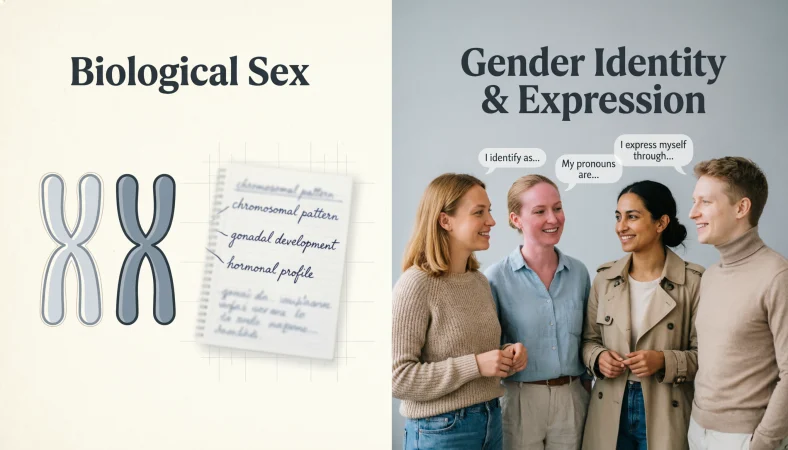
The terms male and female generally describe biological sex, while man and woman usually describe people or gender identity. The choice between them depends on context. Male and female are commonly used in medical, biological, scientific, and demographic settings, whereas man and woman are often more natural when referring to people in everyday language.
The question of male or female can seem straightforward, but the terminology becomes more complicated when biological sex, gender identity, anatomy, and social context are discussed together. Male is an adjective or noun referring primarily to biological sex characteristics, while female is the corresponding term for the female sex. Confusing these terms with gender categories can create inaccurate or insensitive wording, especially in medical, academic, workplace, and official contexts.
This distinction matters because English gives speakers several ways to describe sex and gender, and those terms aren’t always interchangeable. A sentence that is appropriate for a biological study may sound unnatural in casual conversation. Likewise, a form asking about sex may use different terminology from one asking about gender.
Understanding the difference helps you choose language that is accurate, clear, respectful, and appropriate for the situation.
Male or Female: What’s the Difference?
Male and female are corresponding terms used primarily to describe sex. They can function as adjectives and nouns, although their noun use when referring to people can sound more clinical or formal in ordinary conversation.
In biological terms, sex relates to physical and reproductive characteristics. These can include reproductive anatomy, chromosomes, hormones, and other biological traits. In humans, classifications are commonly described as male or female, although biological sex characteristics can also vary among individuals.
The words man and woman, by contrast, are generally nouns referring to adult people. They are commonly used in everyday speech and can relate to both social identity and gender.
| Term | Typical grammatical role | Primary meaning | Common contexts | Example |
| Male | Adjective or noun | Relating to the male sex | Biology, medicine, statistics | The study included male participants. |
| Female | Adjective or noun | Relating to the female sex | Biology, medicine, statistics | The study included female participants. |
| Man | Noun | An adult human male or a person identifying as a man | Everyday speech, social contexts | The man spoke with the researcher. |
| Woman | Noun | An adult human female or a person identifying as a woman | Everyday speech, social contexts | The woman spoke with the researcher. |
| Boy | Noun | A male child | Everyday and educational contexts | The boy joined the class. |
| Girl | Noun | A female child | Everyday and educational contexts | The girl joined the class. |
The simplest distinction is useful:
Male and female primarily describe sex.
Man and woman generally refer to adult people.
Boy and girl generally refer to children.
Context determines which term sounds most natural and communicates the intended meaning most accurately.
Is Male or Female a Grammar, Vocabulary, or Usage Issue?
The difference is mainly a vocabulary and usage issue, rather than a difficult grammar rule.
Both male and female are grammatically valid English words. The challenge is knowing when each one is appropriate and understanding what information the word communicates.
For example, consider these two sentences:
The patient is female.
The woman is waiting outside.
Both can be grammatically correct, but they serve different purposes. The first sentence emphasizes a sex classification. The second identifies an adult person.
Are male and female interchangeable?
Not always.
They are opposites when discussing biological sex, but they aren’t interchangeable with every word referring to people.
For example:
The researchers compared male and female participants.
This is natural in a scientific context.
However:
The male went to the store.
Although grammatically possible, this can sound unusually clinical when referring to an ordinary person. In everyday English, man would usually be more natural.
The same applies to female.
The female patient reported abdominal pain.
This is perfectly normal in a medical context.
The female bought some groceries.
This sounds unnecessarily clinical in ordinary conversation. The woman bought some groceries is generally more natural.
Formal versus informal usage
Male and female are especially common in formal contexts. Medical records, scientific research, demographic reports, surveys, and biological discussions often require precise terminology.
Everyday conversation usually favors words such as man, woman, boy, and girl when the speaker is referring to people.
Academic versus casual usage
Academic writing frequently uses male and female because researchers may be discussing populations, biological characteristics, experimental groups, or statistical differences.
For example:
The researchers examined differences between male and female participants.
In casual conversation, someone might instead say:
The study included both men and women.
Neither construction is automatically better. The best choice depends on what the speaker is actually describing.
How to Use Male Correctly
Male refers to the male sex. As an adjective, it commonly appears before a noun.
Examples include:
- male patient
- male athlete
- male participant
- male animal
- male reproductive system
- male hormone patterns
The adjective form is especially common in professional and scientific writing.
Workplace example
A workplace report might say:
The survey included 600 male and female employees.
This wording is appropriate when the report is presenting demographic information.
In ordinary conversation, however, you might say:
The meeting included several men and women from different departments.
The second version sounds more conversational because it refers directly to people.
Academic example
A biology paper might state:
The researchers observed different reproductive patterns among male and female specimens.
Here, male is appropriate because the discussion concerns biological characteristics.
Technology example
Technology and artificial intelligence systems can also encounter the distinction. A database might contain a field labeled sex with categories such as male and female. However, a system designed to record gender identity may use different categories.
This distinction matters when designing forms, databases, surveys, and software because the label should accurately describe the information being collected.
Usage recap
Use male when you need to describe the male sex, particularly in scientific, medical, statistical, or biological contexts. When simply referring to an adult person in everyday language, man is often more natural.
How to Use Female Correctly
Female refers to the female sex. Like male, it can function as an adjective or noun.
Common adjective phrases include:
- female patient
- female athlete
- female participant
- female animal
- female reproductive system
- female population
The adjective form is widely accepted in medical, biological, academic, and demographic writing.
Workplace example
A human resources report might say:
Female employees represented 48 percent of the surveyed workforce.
This is concise and appropriate for statistical reporting.
In everyday conversation, someone might instead say:
Women represented 48 percent of the surveyed workforce.
Both can communicate similar information, but the second uses a people focused noun rather than a sex classification.
Academic example
A scientific study could state:
Female participants reported a higher average response rate.
The word female works naturally because the researchers are categorizing participants according to sex.
Technology example
A health application might collect information related to biological sex because certain medical calculations can depend on biological characteristics. A different application might ask about gender identity for social or demographic purposes.
The wording should therefore reflect the purpose of the field. A poorly labeled field can create confusion for users and produce misleading data.
Usage recap
Use female when describing the female sex, especially in scientific, medical, demographic, and statistical contexts. When referring to adult people in everyday language, woman is often more natural.
When You Should NOT Use Male or Female
Knowing when not to use a term is just as important as knowing when to use it.
1. Do not automatically use male or female when referring to an adult person
Instead of:
The female entered the office.
Everyday English would normally prefer:
The woman entered the office.
The original sentence isn’t necessarily grammatically wrong, but it can sound detached or clinical.
2. Do not use male or female when you actually mean gender identity
Sex and gender can overlap in ordinary discussion, but they aren’t identical concepts. If the subject of a survey is gender identity, use terminology appropriate to that question rather than assuming that a biological sex label answers it.
3. Do not use man or woman when discussing animal biology
In zoology, male and female are normally more appropriate.
For example:
The researchers observed male and female lions.
Using man and woman for animals would be incorrect.
4. Do not confuse biological terminology with social terminology
A scientific study may be discussing sex characteristics, while a sociological study may be examining gender. Using the wrong terminology can change the meaning of the research.
5. Do not use female as a replacement for woman in every sentence
Female is grammatically valid, but context matters. In ordinary conversation, woman often sounds more natural when referring to an adult person.
6. Do not assume every form asking for male or female is asking about the same thing
A medical form, government document, research questionnaire, and social profile can have different purposes. Always consider what information the form is actually requesting.
7. Do not treat the terms as complete descriptions of every person’s biological characteristics
Human biology is more complex than two simple labels in some medical and developmental contexts. Certain individuals have sex characteristics that don’t fit neatly into typical male or female classifications.
8. Do not ignore the audience
A medical professional may need precise biological terminology. A casual conversation may call for ordinary people focused language. Good writing matches the vocabulary to the situation.
Common Mistakes and Decision Rules
| Correct sentence | Incorrect or less suitable sentence | Explanation |
| The study included male and female participants. | The study included men and women specimens. | Scientific classification favors male and female. |
| The woman spoke to the doctor. | The female spoke to the doctor. | Woman is usually more natural in ordinary conversation. |
| The researchers studied male and female mice. | The researchers studied men and women mice. | Male and female are appropriate for animals. |
| The report compares men and women. | The report compares male and female people. | Men and women can be more natural when referring directly to adult people. |
| The patient is a female. | The patient is a woman. | Both may be meaningful, but the appropriate choice depends on whether sex or personhood is being emphasized. |
| The form asks about biological sex. | The form asks about gender when it actually records sex. | Sex and gender are not always the same category. |
Decision Rule Box
- If you are describing biological sex, male or female may be appropriate.
- If you are referring naturally to adult people, man or woman is often preferable.
- If you are discussing gender identity, use terminology that accurately reflects gender rather than assuming sex and gender are identical.
Male or Female in Modern Technology and AI Tools
Digital systems increasingly need to distinguish between different kinds of personal information.
A database might record biological sex for medical research. Another system might record gender identity for demographic analysis. A third system might not need either category at all.
This distinction is particularly important in artificial intelligence, healthcare software, online forms, customer databases, and statistical systems.
Imagine a health application asking users to select male or female when the application actually needs information about gender identity. The problem isn’t simply wording. The system could collect the wrong data.
Likewise, a medical research database should not casually replace a scientifically relevant sex variable with a gender variable if the study is investigating biological characteristics.
Good technology design begins with a simple question: What information does this field actually need?
The label should match the data being collected.
The History and Meaning of Male and Female
The words male and female have long histories in English.
Male entered English through French and ultimately traces back to Latin masculus, meaning male or masculine.
Female developed through Middle English and was influenced by the relationship between words for women and men. Its history is more complicated than simply being the opposite of male, and its spelling was influenced by the form of male.
Over time, both terms became established as standard vocabulary for describing biological sex.
Their meanings have remained relatively stable, although their preferred usage has changed depending on context. Modern English distinguishes among biological, medical, demographic, social, and identity related uses more carefully than many older texts did.
An expert style perspective
A useful principle for precise writing is:
Choose the word that identifies the characteristic you are actually describing.
That principle prevents many unnecessary disagreements. Instead of asking whether one word is universally correct, ask whether the word accurately matches the subject and context.
Two Practical Case Studies
Case Study 1: Scientific research
Imagine a research team studying reproductive biology in a population of animals.
The researchers need to classify specimens according to biological sex. In this situation, male and female are the appropriate terms because the study concerns biological characteristics.
Writing:
The study examined male and female specimens.
is clear and scientifically conventional.
Writing:
The study examined men and women specimens.
would be inappropriate because men and women refer to adult humans.
The important result is not merely grammatical correctness. Correct terminology allows readers to understand the research population immediately.
Case Study 2: Workplace reporting
Consider a company preparing a demographic report.
If the organization is reporting biological sex, a table may use:
| Category | Percentage |
| Male | 49 percent |
| Female | 51 percent |
If the organization is reporting gender identity, however, the categories and terminology may need to be designed differently.
The concrete lesson is that the label must match the variable. A report becomes more accurate when the terminology reflects what the organization actually measured.
Error Prevention Checklist
Always use male when
- You are describing the male sex.
- You are discussing biological characteristics.
- You are describing male animals.
- You are writing about reproductive biology.
- A medical or scientific context specifically requires the term.
- You are describing a demographic category based on sex.
Always use female when
- You are describing the female sex.
- You are discussing biological characteristics.
- You are describing female animals.
- You are writing about reproductive biology.
- A medical or scientific context specifically requires the term.
- You are describing a demographic category based on sex.
Be careful with male or female when
- You are referring casually to an adult person.
- You are discussing gender identity rather than biological sex.
- The context is social rather than biological.
- The terminology could sound unnecessarily clinical.
- A form does not clearly explain what information it is collecting.
- The distinction between sex and gender affects the meaning of the discussion.
Related Grammar Confusions You Should Master
Understanding male and female becomes easier when you also understand related vocabulary distinctions.
1. Man or male
Man normally refers to an adult human person, while male primarily describes biological sex.
2. Woman or female
Woman is generally an adult person term, while female is commonly used as a biological or descriptive classification.
3. Boy or male
Boy refers to a male child, while male can describe sex at any age and across many contexts.
4. Girl or female
Girl refers to a female child, while female is a broader sex related term.
5. Sex or gender
These terms are related but aren’t automatically synonymous. Sex generally concerns biological characteristics, while gender can concern identity, roles, and social categories.
6. Masculine or male
Masculine is usually an adjective describing qualities, characteristics, style, or grammatical categories. Male primarily concerns sex.
7. Feminine or female
Feminine can describe qualities, presentation, language, or grammatical categories. Female primarily concerns sex.
8. Men or males
Men refers to adult human people. Males can refer to people or animals and is often more clinical or scientific.
9. Women or females
Women refers to adult human people. Females can refer to people or animals and is frequently used in biological or statistical contexts.
10. Biological sex or gender identity
These describe different kinds of information and should not be treated as automatic substitutes.
FAQs:
What is the difference between male and female?
Male and female are corresponding terms primarily used to describe biological sex. Male refers to the male sex, while female refers to the female sex. In everyday English, man and woman are often more natural when referring directly to adult people.
Is male or female more appropriate for people?
It depends on context. Male and female are appropriate in medical, biological, scientific, and demographic contexts. In ordinary conversation, man and woman are often more natural when referring to adult people.
Is female the same as woman?
Not exactly. Female primarily describes biological sex, while woman generally refers to an adult person and can also describe gender identity. The words can overlap in many contexts, but they are not identical in meaning.
Is male the same as man?
Not exactly. Male primarily describes biological sex, while man is generally a noun referring to an adult human person. In scientific contexts, male is often the more precise choice.
Should I say male or man?
Use male when describing sex or biological characteristics. Use man when naturally referring to an adult human person in ordinary language. The surrounding sentence and purpose should determine the choice.
Should I say female or woman?
Use female when discussing biological sex, medical characteristics, scientific research, or demographic categories based on sex. Use woman when referring naturally to an adult person.
Are male and female adjectives or nouns?
Both words can function as adjectives and nouns. Their adjective use is especially common in phrases such as male patient and female athlete. Their noun use is also established, although it can sound more clinical when referring to people.
Can male and female describe animals?
Yes. Male and female are standard terms for describing the sex of animals. For example, a biologist might discuss male and female birds, mammals, insects, or fish.
Are male and female the same as masculine and feminine?
No. Male and female primarily concern biological sex. Masculine and feminine can describe qualities, characteristics, social presentation, or grammatical categories. They are related concepts but should not automatically be substituted for one another.
Conclusion:
The distinction between male or female is ultimately about precision and context. Male and female are established terms for describing biological sex, making them especially useful in medicine, biology, science, statistics, and demographic reporting. Man and woman are usually more natural when referring directly to adult people in everyday communication.
The most reliable approach is to identify what your sentence is actually describing. If the subject is biological sex, male or female may be the right terminology. Also If you’re talking about an adult person, man or woman may communicate the idea more naturally. If the subject is gender identity, use language that accurately describes gender rather than automatically treating it as the same thing as sex.
Good writing isn’t simply about choosing a word that is technically possible. It’s about choosing the word that communicates the intended meaning clearly and appropriately.
Author Bio: Written by a professional linguist and SEO content strategist specializing in English usage, vocabulary distinctions, grammar clarification, and people first educational content.











1 thought on “Male or Female: Understanding Sex, Gender, And The Right Terminology For 2026”