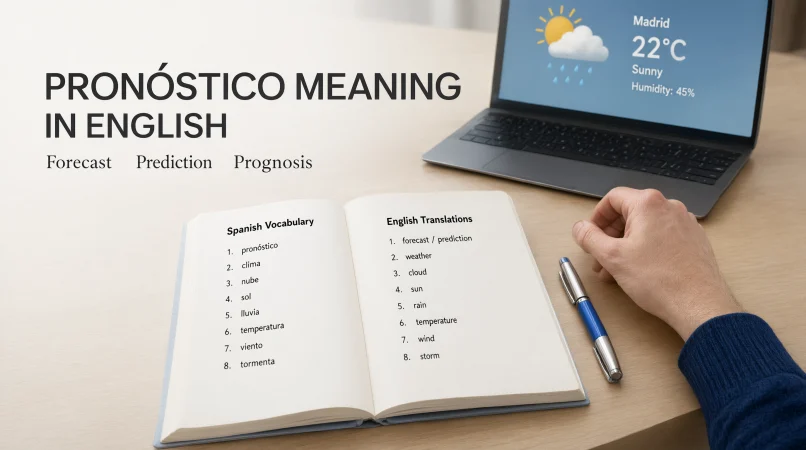
Pronóstico is a Spanish word that translates to “forecast” or “prognosis” in English, depending on the context. It commonly refers to a prediction about future events, especially the weather, but it can also describe an expected medical outcome or the likely development of a situation.
For example, pronóstico del tiempo means “weather forecast,” while pronóstico médico means “medical prognosis.” The correct English translation depends on what is being predicted.
Have you come across the Spanish word pronóstico and wondered what it means in English? This word appears in everyday Spanish conversations, news reports, weather updates, and medical discussions.
Although “forecast” is one of its most common translations, its meaning can change with the situation. Understanding the context is essential because a weather forecast, a medical prognosis, and a prediction about future events do not describe exactly the same thing.
In this guide, you will learn the meaning of pronóstico in English, explore its common translations, and see how Spanish speakers use it in different situations. With clear definitions and practical examples, you will understand when to translate pronóstico as “forecast,” “prognosis,” or “prediction.”
You will also learn common phrases containing the word, helping you recognize its meaning more confidently when reading Spanish texts or communicating with Spanish speakers.
Table of Contents
- What Does Pronóstico Mean in English?
- How Pronóstico Is Used in Different Contexts
- Pronóstico in Weather Forecasts
- Pronóstico in Medicine and Health
- Pronóstico in Sports, Business, and Everyday Predictions
- Pronóstico vs. Predicción vs. Previsión
- Pronunciation and Grammar
- Common Spanish Phrases With Pronóstico
- Frequently Asked Questions
What Does Pronóstico Mean in English?
Pronóstico is a Spanish noun that refers to an estimate or statement about what is likely to happen in the future. English has several words for this idea, and the best choice depends on the situation.
The three most common translations are:
- Forecast: A prediction about a future event, especially the weather or economic conditions.
- Prediction: A general statement about what someone expects to happen.
- Prognosis: An assessment of the likely course or outcome of a medical condition.
For example, a weather presenter might give a pronóstico for tomorrow, while a doctor might discuss a patient’s pronóstico after reviewing a diagnosis. Both refer to an expected future outcome, but the English translations differ because the situations are different.
Simple Examples
| Spanish phrase | English translation |
| Pronóstico del tiempo | Weather forecast |
| Pronóstico médico | Medical prognosis |
| Pronóstico reservado | Guarded prognosis |
| Pronóstico deportivo | Sports prediction or forecast |
| Pronóstico económico | Economic forecast |
| Pronóstico de ventas | Sales forecast |
| Pronóstico de lluvia | Rain forecast |
| Pronóstico favorable | Favorable prognosis or outlook |
| Pronóstico desfavorable | Unfavorable prognosis or outlook |
| Hacer un pronóstico | To make a forecast or prediction |
These examples show why a single English equivalent cannot cover every use. In ordinary conversation, “forecast” is often the most natural choice when discussing weather, while “prognosis” is especially common in medical contexts.
How Pronóstico Is Used in Different Contexts
The meaning becomes easier to understand when you look at the subject of the sentence. Spanish speakers use this word for more than weather reports.
Weather and Climate
In weather reporting, pronóstico usually means “forecast.” It describes the expected conditions for a particular place and period, such as tomorrow’s temperature, the chance of rain, or an approaching storm.
For example:
– El pronóstico del tiempo anuncia lluvia.
The weather forecast predicts rain.
– ¿Cuál es el pronóstico para mañana?
What is the forecast for tomorrow?
– El pronóstico indica temperaturas altas.
The forecast indicates high temperatures.
In these sentences, “prognosis” would sound unnatural in English. Weather is the subject, so “forecast” is the appropriate translation.
Medical and Health Contexts
In medicine, the word refers to the likely course of a disease or a patient’s expected recovery. The English equivalent is usually “prognosis.”
A doctor may consider the diagnosis, the severity of the condition, the patient’s overall health, and the response to treatment when assessing a prognosis. It describes what may happen, not a guarantee of what will happen.
Examples include:
– El pronóstico del paciente es favorable.
The patient’s prognosis is favorable.
– El médico explicó el pronóstico.
The doctor explained the prognosis.
– El pronóstico es reservado.
The prognosis is guarded.
A guarded prognosis means that the likely outcome remains uncertain or raises concern. It does not automatically mean that recovery is impossible.
Business and Economics
Businesses use forecasts to estimate future sales, customer demand, costs, and financial performance. In these situations, pronóstico often translates as “forecast.”
For example:
– El pronóstico de ventas es positivo.
The sales forecast is positive.
– La empresa revisó su pronóstico económico.
The company revised its economic forecast.
– El pronóstico de demanda cambió.
The demand forecast changed.
A business forecast can help managers plan budgets, manage inventory, or prepare for changes in demand. Like a weather forecast, it relies on available information and remains subject to uncertainty.
Sports and Competition
In sports, pronóstico can refer to a prediction about the result of a match, tournament, or competition. Depending on the sentence, English speakers may use “prediction,” “forecast,” or “projected result.”
Examples:
– Mi pronóstico es que ganará el equipo local.
My prediction is that the home team will win.
– El pronóstico del partido es incierto.
The match outcome is uncertain.
– Los expertos hicieron sus pronósticos para el torneo.
The experts made their predictions for the tournament.
Sports predictions often reflect statistics, recent performance, injuries, and expert opinion. They are estimates, not confirmed results.
Everyday Predictions
The word can also appear in conversations about personal plans or future events, although other Spanish words may sound more natural in some informal situations.
For example:
– Mi pronóstico es que llegaremos tarde.
My prediction is that we will arrive late.
– El pronóstico para el proyecto es positivo.
The outlook for the project is positive.
– No puedo dar un pronóstico exacto.
I cannot give an exact prediction.
In English, “outlook” may be a smoother choice when discussing a broad situation, especially when the sentence concerns general prospects rather than a formal forecast.
Pronóstico in Weather Forecasts
Weather is one of the most familiar settings for this word. Spanish-language weather services commonly use pronóstico del tiempo or pronóstico meteorológico to describe expected weather conditions.
The forecast may include temperature, cloud cover, wind, rainfall, and severe-weather risks. The period matters, too: a forecast for the next few hours may differ from one covering the next seven days.
Common Weather Vocabulary
| Spanish expression | English meaning |
| Pronóstico del tiempo | Weather forecast |
| Pronóstico de lluvia | Rain forecast |
| Probabilidad de lluvia | Chance of rain |
| Temperatura máxima | High temperature |
| Temperatura mínima | Low temperature |
| Cielo despejado | Clear skies |
| Parcialmente nublado | Partly cloudy |
| Tormenta eléctrica | Thunderstorm |
| Alerta meteorológica | Weather alert |
| Condiciones climáticas | Weather conditions or climatic conditions |
Consider the sentence El pronóstico anuncia lluvias durante la tarde. It means “The forecast predicts rain during the afternoon.”
Notice that a forecast does not promise that rain will occur. It communicates the expected conditions based on available meteorological information.
This distinction is useful when reading weather apps, news reports, or travel advisories in Spanish. Understanding the surrounding vocabulary helps you interpret the forecast rather than simply recognize the word itself.
Pronóstico in Medicine and Health
The medical use deserves special attention because “prognosis” is a more specialized English word than “forecast.”
A diagnosis identifies or describes a medical condition. A prognosis concerns its expected course and possible outcome. The two terms are related, but they answer different questions.
For example, a diagnosis might identify pneumonia. A prognosis would address the expected recovery, possible complications, and how the patient may respond to treatment.
Common Medical Expressions
| Spanish phrase | English meaning |
| Pronóstico médico | Medical prognosis |
| Buen pronóstico | Good prognosis |
| Pronóstico favorable | Favorable prognosis |
| Pronóstico reservado | Guarded prognosis |
| Pronóstico desfavorable | Unfavorable prognosis |
| Pronóstico de recuperación | Recovery prognosis |
| Evolución del paciente | Patient’s progress or course |
| Diagnóstico médico | Medical diagnosis |
The phrase buen pronóstico usually indicates that the expected outcome is positive. It does not guarantee complete recovery, since individual results depend on many factors.
Similarly, pronóstico desfavorable suggests concern about the likely outcome, but it does not describe every detail of what will happen. A medical professional interprets the term in light of the particular condition and patient.
If you encounter this word in a medical report, read it alongside the rest of the document. One term alone cannot explain the severity of a condition or determine an individual’s future health.
Pronóstico vs. Predicción vs. Previsión
Spanish has several words connected with future expectations. They overlap, but their usage is not always identical.
| Spanish word | Common English translation | Typical use |
| Pronóstico | Forecast; prognosis; prediction | Weather, medicine, economics, sports |
| Predicción | Prediction | A general statement about a future event |
| Previsión | Forecast; anticipation; provision | Planning ahead, anticipating needs, economic expectations |
| Estimación | Estimate | An approximate amount, value, or calculation |
| Expectativa | Expectation | A belief or hope about what may happen |
What Is the Difference Between Pronóstico and Predicción?
Predicción is a broad term for saying what may happen in the future. It can refer to anything from a sports result to a personal guess.
Pronóstico often suggests an assessment based on available information, observations, or professional judgment. It is common in weather reports, medicine, and technical settings.
For example, una predicción sobre el ganador means “a prediction about the winner.” Meanwhile, el pronóstico meteorológico means “the weather forecast.”
The distinction is not absolute. In some situations, both words can be used, and the more natural choice depends on the sentence and regional usage.
What Is the Difference Between Pronóstico and Previsión?
Previsión often emphasizes anticipation or preparation. It may refer to planning for a possible future event, while pronóstico more directly describes an expected outcome.
For example, previsión de gastos can mean “budgeting for expenses” or “forecasting expenses,” depending on context. Pronóstico económico is more directly translated as “economic forecast.”
These differences are useful, but they should not be treated as rigid rules. Spanish vocabulary varies across countries, professions, and individual speakers.
Pronunciation and Grammar
The word is written pronóstico, with an accent mark over the first o in the final syllable sequence nós. A simple pronunciation guide for English speakers is proh-NOS-tee-koh, with the strongest emphasis on NOS.
In Spanish, the accent mark signals where the stress falls. Without it, the word would not follow the same written stress pattern.
Is Pronóstico Masculine or Feminine?
Pronóstico is a masculine noun. It usually appears with masculine articles and adjectives.
Examples:
- El pronóstico means “the forecast” or “the prognosis.”
- Un pronóstico favorable means “a favorable forecast” or “a favorable prognosis.”
- El pronóstico es bueno means “The forecast is good” or “The prognosis is good.”
The plural form is pronósticos. For example, los pronósticos del tiempo means “the weather forecasts.”
Related Word Forms
The related Spanish verb pronosticar means “to forecast” or “to predict.” It is useful when describing the action rather than the prediction itself.
- Pronosticar lluvia means “to forecast rain.”
- Los expertos pronostican crecimiento. means “Experts forecast growth.”
- Es difícil pronosticar el resultado. means “It is difficult to predict the outcome.”
Learning the noun and verb together makes it easier to understand Spanish sentences in news reports, professional writing, and everyday speech.
Common Spanish Phrases With Pronóstico
These phrases are useful when reading Spanish articles or speaking about future events.
| Spanish phrase | Natural English translation |
| Según el pronóstico | According to the forecast |
| El pronóstico indica | The forecast indicates |
| Cambiar el pronóstico | To change or revise the forecast |
| Dar un pronóstico | To give a forecast or prognosis |
| Pronóstico a corto plazo | Short-term forecast |
| Pronóstico a largo plazo | Long-term forecast |
| Pronóstico del resultado | Prediction of the outcome |
| Mejorar el pronóstico | To improve the prognosis or outlook |
| Empeorar el pronóstico | To worsen the prognosis or outlook |
| Pronóstico incierto | Uncertain forecast or prognosis |
For example, Según el pronóstico, mañana hará frío means “According to the forecast, it will be cold tomorrow.”
In a medical setting, el tratamiento puede mejorar el pronóstico means “the treatment may improve the prognosis.” The translation changes because the subject changes, even though the Spanish noun stays the same.
FAQs
Does pronóstico always mean forecast?
No. It often means “forecast,” especially when discussing weather or economics, but it can mean “prognosis” in medicine or “prediction” in sports and other situations.
What does pronóstico reservado mean in English?
It usually means “guarded prognosis.” In a medical context, this indicates uncertainty or concern about the likely outcome. The phrase alone does not provide a complete assessment of the patient’s condition.
What is the plural of pronóstico?
The plural is pronósticos. For example, los pronósticos meteorológicos means “the weather forecasts.”
What is the verb form of pronóstico?
The related verb is pronosticar, meaning “to forecast” or “to predict.” For example, Los expertos pronostican lluvia means “Experts forecast rain.”
Is pronóstico the same as diagnóstico?
No. Diagnóstico means “diagnosis,” which identifies a condition or problem. Pronóstico refers to the expected course or outcome of that condition, or to a forecast in another context.
Final Thoughts
The Spanish word pronóstico describes an expectation about what may happen, but its best English translation depends on the subject. Use “forecast” for weather and many economic situations, “prognosis” for medical outcomes, and “prediction” for broader expectations. Learning the phrases around the word is the easiest way to understand its meaning accurately.