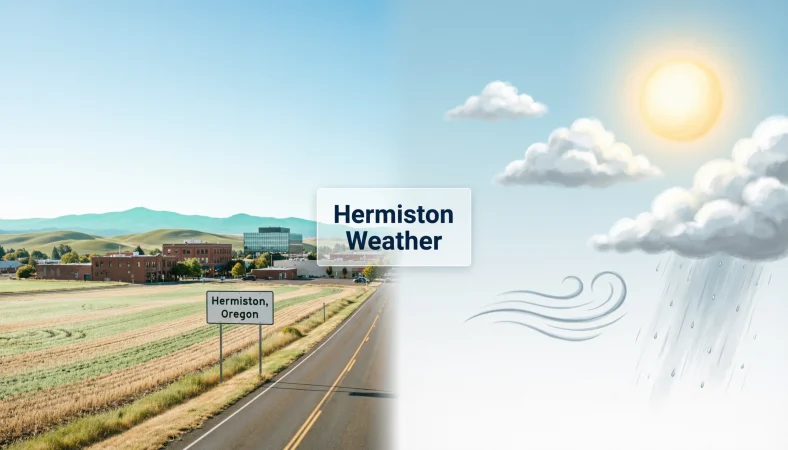
Hermiston and weather are different words, but if you are searching for “Hermiston or weather,” you may be looking for the weather in Hermiston, Oregon. Hermiston is a city in northeastern Oregon, while weather refers to atmospheric conditions such as temperature, rain, wind, and sunshine.
If your goal is to check the local forecast, search for Hermiston weather to find current conditions and upcoming forecasts for the area.
Are you searching for Hermiston or weather and trying to find accurate information about local conditions in Hermiston, Oregon? Knowing the weather can help you plan outdoor activities, travel, work, and everyday errands. From sunny afternoons to rainy or windy conditions, checking a local forecast gives you a clearer idea of what to expect before heading outside.
In this guide, you will learn how to find Hermiston weather information, understand important forecast details, and identify the conditions that may affect your daily plans. By focusing on local temperature, precipitation, wind speed, and upcoming weather changes, you can use reliable forecast information to make better decisions about travel and outdoor activities.
Hermiston vs Weather: What’s the Difference?
Hermiston and weather are not competing spellings or interchangeable words. They serve completely different purposes in English. Hermiston is a proper noun used as a place name, while weather is a common noun describing atmospheric conditions.
The phrase “Hermiston or weather” is unusual as a standalone expression because or normally connects alternatives. A person searching for this phrase may actually want information about Hermiston weather, a local forecast, or the meaning of the two words.
What Does Hermiston Mean?
Hermiston is a proper noun and the name of a city in Umatilla County, Oregon, in the United States. The city lies in northeastern Oregon and is known for its agricultural activity, regional services, and warm summer conditions.
When people search for Hermiston online, they may be looking for local businesses, directions, community information, events, or weather conditions.
Examples:
- Hermiston is a city in Oregon.
- My family plans to visit Hermiston next month.
- The Hermiston forecast calls for changing temperatures.
- We checked road conditions before driving to Hermiston.
In each example, Hermiston identifies a place. It begins with a capital letter because it is a proper noun.
What Does Weather Mean?
Weather is a common noun that describes the condition of the atmosphere at a particular place and time. It includes temperature, precipitation, wind speed, humidity, cloud cover, and other atmospheric conditions.
Examples:
- The weather is sunny today.
- We checked the weather before leaving home.
- Cold weather can affect outdoor activities.
- The weather forecast predicts rain this afternoon.
Weather can change over minutes, hours, or days. It differs from climate, which describes longer term patterns and averages in atmospheric conditions.
Hermiston vs Weather Comparison Table
| Feature | Hermiston | Weather |
| Word type | Proper noun | Common noun |
| Meaning | A city in Oregon | Atmospheric conditions |
| Capitalization | Usually capitalized | Usually lowercase |
| Main purpose | Identifies a place | Describes environmental conditions |
| Example | Hermiston is in Oregon. | The weather is windy. |
| Search intent | Location, services, travel, local information | Forecasts, temperature, rain, wind |
| Relationship | Provides the location for a forecast | Describes conditions at a location |
Quick recap: Hermiston is a place name, while weather describes atmospheric conditions.
The words are not alternatives and should not be used interchangeably.
When combined as “Hermiston weather,” they identify the atmospheric conditions in or around Hermiston, Oregon.
That combined phrase is more natural and useful when searching for a local forecast.
Is Hermiston vs Weather a Grammar, Vocabulary, or Usage Issue?
The distinction between Hermiston and weather is mainly a vocabulary and search intent issue, rather than a spelling dispute. Both words are valid, but they mean different things and perform different grammatical roles.
Are Hermiston and Weather Interchangeable?
No. Hermiston identifies a location, while weather describes atmospheric conditions.
Consider these sentences:
- Correct: Hermiston has warm summers.
- Correct: The weather in Hermiston can change.
- Incorrect: The weather visited Oregon last year.
The third example incorrectly uses weather as though it were a place. If the intended meaning is a city visit, the sentence should use a location name.
Similarly, saying “I checked Hermiston” may be unclear without context. A reader might wonder whether you checked information about the city, a business, or a forecast for the area.
A clearer sentence would be:
I checked the weather in Hermiston before traveling.
Formal vs Informal Usage
Both words work in formal and informal English.
In a formal report, you might write:
The weather conditions in Hermiston may affect outdoor work schedules.
In casual conversation, you might say:
What’s the weather like in Hermiston today?
The difference is not formality. It is the role each word plays in the sentence.
Academic vs Casual Usage
Academic writing may use Hermiston in geography, economics, environmental studies, or regional research. The word weather may appear in meteorology, climate research, agriculture, and environmental science.
For example:
Researchers examined weather patterns affecting agricultural production near Hermiston.
In casual writing, someone might simply ask:
Is it going to rain in Hermiston tomorrow?
Both examples use the terms appropriately. The surrounding sentence determines the precise meaning.
Understanding the Search Phrase
If you entered “hermiston or weather” into a search engine, you may have intended one of several queries:
- Hermiston weather today
- Hermiston Oregon weather forecast
- Current temperature in Hermiston
- Hermiston weather tomorrow
- Hermiston seven day forecast
These queries are more specific because they identify both the location and the information being requested.
How to Use Hermiston Correctly
Use Hermiston when referring to the city, its residents, its businesses, its local institutions, or events associated with the area.
Workplace Example
A business owner might write:
Our company provides delivery services throughout Hermiston and nearby communities.
Here, Hermiston identifies the service area.
A manager could also say:
Please review the Hermiston office schedule before arranging the visit.
The city name helps identify which office or regional operation the sentence concerns.
Academic Example
A geography student might write:
Hermiston is located in northeastern Oregon and serves as a regional center for surrounding communities.
In an agricultural study, the student might discuss crop production, irrigation, regional development, or local environmental conditions.
The name remains capitalized because it identifies a specific place.
Technology Example
A mapping application may use Hermiston as a destination for navigation. A weather application may ask the user to select Hermiston, Oregon, before displaying local forecast information.
For example:
Set Hermiston as your location to view the local forecast.
This sentence uses the city name as a geographic reference.
Additional Examples
- We booked a hotel in Hermiston.
- The conference will take place in Hermiston.
- Hermiston businesses serve customers across the region.
- The driver checked directions to Hermiston.
- Our weather station records temperatures near Hermiston.
Usage recap: Capitalize Hermiston when referring to the city. Use the name when identifying a place, destination, community, or local service area.
How to Use Weather Correctly
Use weather when discussing atmospheric conditions. The word can describe current conditions, expected changes, or the effects of temperature, wind, rain, and other environmental factors.
Workplace Example
A construction supervisor might say:
We will review the weather forecast before scheduling the outdoor work.
Weather matters because rain, strong winds, extreme temperatures, or poor visibility can affect worker safety and project schedules.
A delivery company may also monitor weather conditions to anticipate road delays.
Academic Example
A science student might write:
Weather conditions influence soil moisture, plant growth, and agricultural activity.
The sentence uses weather to describe atmospheric factors that may affect the environment.
Weather and climate are related, but they are not identical. Weather describes conditions over shorter periods, while climate concerns long term patterns.
Technology Example
Weather applications use observations and forecasting models to estimate conditions such as temperature, precipitation, and wind speed.
For example:
The weather application displays hourly temperatures and the chance of rain.
A user searching for Hermiston weather is typically looking for this kind of information for a particular location.
Additional Examples
- The weather is cloudy this morning.
- Severe weather may delay travel.
- Hot weather can increase water demand.
- The forecast predicts a chance of rain.
- Windy weather may affect outdoor events.
Usage recap: Use weather to describe atmospheric conditions. When you need a local forecast, pair the word with a location, such as “weather in Hermiston.”
When You Should NOT Use Hermiston or Weather
The two words have distinct meanings. These eight scenarios can help you avoid common mistakes.
When You Mean Atmospheric Conditions, Not a Place
Incorrect: The weather is a city in Oregon.
Correct: Hermiston is a city in Oregon.
Use the place name when identifying a city.
When You Mean a Place, Not Atmospheric Conditions
Incorrect: We drove to weather yesterday.
Correct: We drove to Hermiston yesterday.
Use Hermiston when referring to the destination.
When You Need a Local Forecast
Less clear: What is the weather?
Clearer: What is the weather in Hermiston, Oregon?
The first question is grammatically correct but does not identify a location. The second provides the geographic context needed for a local forecast.
When You Are Discussing Climate
Do not automatically use weather when you mean long term environmental patterns.
Less precise: Hermiston’s weather has remained the same for decades.
Clearer: Hermiston’s climate patterns have changed over the decades.
The best choice depends on whether you are discussing short term conditions or longer term patterns.
When You Are Writing a Proper Place Name
Incorrect: We visited hermiston in Oregon.
Correct: We visited Hermiston in Oregon.
Capitalize the name because it identifies a specific city.
When You Mean a Forecast, Not Current Conditions
A current observation and a forecast are different kinds of information.
For example, “The weather is 70 degrees” is less precise than “The temperature is 70 degrees.” Weather refers to the broader atmospheric situation, while temperature is one measurable component.
If you want to know what conditions are expected later, ask for a forecast.
When You Are Comparing Two Cities
Do not use weather as though it were the name of a second destination.
Unclear: Is Hermiston or weather better for a weekend trip?
Clearer: Is Hermiston or another nearby city better for a weekend trip?
If you intend to compare forecasts, you could ask:
How does the weather in Hermiston compare with the weather in Pendleton?
When You Are Entering a Search Query
Avoid combining unrelated terms without specifying the intended information.
Less specific: Hermiston or weather
More specific: Hermiston weather forecast today
A focused query is more likely to return results that match your needs.
Common Mistakes and Decision Rules
The most frequent mistakes involve confusing the place name with the conditions being described, or entering an incomplete search phrase.
| Correct sentence | Incorrect sentence | Explanation |
| The weather in Hermiston is sunny. | The Hermiston is sunny weather. | The sentence needs a clear grammatical relationship between the city and the conditions. |
| We visited Hermiston last summer. | We visited weather last summer. | Hermiston identifies the destination. |
| Check the weather before driving. | Check the Hermiston before driving. | Weather is the relevant noun when discussing atmospheric conditions. |
| What is the weather in Hermiston today? | What is Hermiston today weather? | The correct phrasing connects the weather to the location naturally. |
| Hermiston is a city in Oregon. | Weather is a city in Oregon. | Weather does not identify the city. |
| The forecast predicts rain in Hermiston. | The forecast predicts Hermiston in rain. | The corrected sentence clearly identifies the expected conditions and location. |
The Simple Decision Rule
- If you mean a city or destination, use Hermiston.
- If you mean temperature, rain, wind, or atmospheric conditions, use weather.
- If you want a local forecast, combine them: Hermiston weather.
This rule also applies to searches for other locations. Replace Hermiston with the relevant city name, then add weather, forecast, temperature, or another specific condition.
Hermiston and Weather in Modern Technology and AI Tools
Search engines, navigation platforms, digital assistants, and weather applications can interpret location based queries. A search for “Hermiston weather” clearly connects a place with the information requested.
An AI assistant may understand a less precise phrase such as “weather in Hermiston,” but specific wording usually makes the desired result easier to identify.
For example, compare these searches:
- Hermiston weather today
- Hermiston hourly forecast
- Hermiston temperature tomorrow
- Hermiston wind speed
- Hermiston chance of rain
Each query expresses a different need. Someone planning a drive may care about rain and visibility, while a gardener may want temperatures and precipitation.
Weather forecasts are estimates based on observations and forecasting models. Current conditions and predicted conditions may differ, so users should check the forecast’s date, time, and location.
AI tools can explain weather terms and summarize forecast information when reliable data is available. However, they should not be treated as a substitute for a current forecast when decisions depend on changing conditions.
The Etymology of Hermiston and Weather
The word weather has roots in Old English and related Germanic forms. Historically, it referred to atmospheric conditions and has retained that central meaning in modern English. Today, it appears in expressions such as weather forecast, weather report, severe weather, and weather conditions.
Hermiston, by contrast, is a proper place name. It follows the conventions used for geographic names, so it begins with a capital letter. Its meaning in ordinary writing depends on its role as the name of the Oregon city rather than as a general vocabulary term.
The two words therefore have different linguistic histories and functions. One identifies a particular location, while the other describes environmental conditions.
Understanding this distinction helps writers construct clear sentences and helps searchers form more precise queries.
An Expert Perspective on Local Weather Searches
A useful editorial principle is:
A clear search query connects the place you care about with the specific information you need.
For example, “Hermiston weather” identifies a location and a topic. Adding “today,” “hourly,” or “tomorrow” narrows the query further.
The same approach works for many local information searches. A person looking for a restaurant, a road closure, or a public service can combine the place name with the relevant topic.
The goal is not to make a query longer without purpose. It is to remove ambiguity so the result better matches the user’s intention.
Case Study One: Planning an Outdoor Event in Hermiston
Consider an illustrative scenario in which an event organizer is planning an outdoor gathering in Hermiston.
The organizer initially searches for “Hermiston or weather.” The wording does not clearly express the intended question, so the results may include general information about the city alongside weather related pages.
The organizer refines the query to “Hermiston weather forecast for Saturday.” This makes the location, subject, and relevant time period explicit.
The organizer then checks the forecast for possible rain, wind, and temperature changes before deciding whether to prepare an indoor alternative.
Result: The revised query communicates the intended need more clearly and supports more relevant planning. It does not guarantee a particular forecast, since conditions can change.
The lesson is to specify both the location and the time when searching for weather information.
Case Study Two: Improving a Local Information Article
Imagine an editor preparing a website article for readers interested in Hermiston.
The original draft uses phrases such as “Hermiston weather” and “weather in Hermiston” without explaining whether the article covers current conditions, seasonal patterns, or forecasts.
The editor reorganizes the content into clear sections about the location, the meaning of weather, and the type of forecast information readers should look for.
The editor also replaces vague wording with precise phrases such as “current weather in Hermiston” and “Hermiston hourly forecast” where appropriate.
Result: Readers can identify the purpose of each section more easily, and the article communicates its subject more consistently. These are editorial improvements, not a guarantee of higher search rankings.
The lesson is that clear terminology helps both readers and search engines understand a page’s purpose.
Error Prevention Checklist
Use this checklist when writing about Hermiston and weather.
Always Use Hermiston When
- You mean the city in Oregon.
- You are identifying a destination, local business area, or community.
- You are discussing events or services associated with the city.
- You need to specify the location for a local forecast.
Always Use Weather When
- You mean atmospheric conditions.
- You are discussing rain, wind, temperature, humidity, or cloud cover.
- You are asking for a forecast or weather report.
- You are explaining how conditions may affect travel, agriculture, or outdoor activities.
Check Before Publishing
- Is Hermiston capitalized as a proper noun?
- Does the sentence distinguish the city from the conditions?
- Have you specified a location when asking for a local forecast?
- Have you distinguished weather from climate where necessary?
- Does the search phrase clearly state the information you need?
Related Grammar and Search Confusions You Should Master
Understanding the distinction between a place and a weather term can help you write more precise queries and sentences. These related topics are also useful:
- Weather or whether: Atmospheric conditions versus a word introducing alternatives or uncertainty.
- Climate or weather: Long term patterns versus short term atmospheric conditions.
- There or their: A location or existence versus possession.
- Its or it’s: Possession versus a contraction.
- Affect or effect: Influence as a verb versus a result as a noun in common uses.
- City or state: A municipality versus a larger administrative region.
- Forecast or climate: Predicted future conditions versus long term patterns.
- Temperature or weather: One atmospheric measurement versus the broader set of conditions.
- Rain or precipitation: A specific form of water falling from the atmosphere versus a broader category.
- Local weather or regional climate: Conditions in a particular area versus patterns over a longer period.
These distinctions improve both general writing and the accuracy of informational search queries.
FAQs
What does Hermiston or weather mean?
The phrase is ambiguous and is not a standard expression. It likely refers to a search for the weather in Hermiston, Oregon. A clearer query is “Hermiston weather” or “Hermiston weather forecast today.”
Is Hermiston a city or a weather term?
Hermiston is the name of a city in northeastern Oregon. It is a proper noun, not a weather term. The word weather refers to atmospheric conditions such as temperature, rain, and wind.
How do I search for Hermiston weather today?
Enter “Hermiston weather today” into a search engine or weather application. For more specific information, search for the hourly forecast, current temperature, wind speed, or chance of rain.
What is the difference between Hermiston and weather?
Hermiston identifies a place, while weather describes atmospheric conditions. The phrase “weather in Hermiston” combines both terms to identify the location where the conditions are being reported.
Should I write Hermiston weather or weather Hermiston?
“Hermiston weather” and “weather in Hermiston” are both clear and natural. “Weather Hermiston” may appear in search queries, but it is less natural as a complete phrase in ordinary prose.
Is weather the same as climate in Hermiston?
No. Weather describes conditions over a short period, such as today’s temperature or tomorrow’s rain. Climate describes longer term patterns and averages. Both terms can be used when discussing the environment around Hermiston.
Why should I include Oregon when searching for Hermiston weather?
Adding Oregon can help distinguish the city from other places or similarly named locations. It makes the search more specific, especially when using a general search engine rather than a weather application with a selected location.
Can AI tools provide the weather in Hermiston?
AI tools can explain forecasts or summarize weather data when they have access to reliable current information. Because weather changes frequently, verify time sensitive details with a current forecast before making important plans.
What is the best search phrase for a Hermiston forecast?
The best phrase depends on what you need. Try “Hermiston weather today” for current conditions, “Hermiston hourly forecast” for changes throughout the day, or “Hermiston weather tomorrow” for a future forecast.
Conclusion:
Hermiston and weather serve different purposes in English. Hermiston is the name of a city in Oregon, while weather describes atmospheric conditions such as temperature, wind, rain, and cloud cover.
If you want information about local conditions, the clearest wording is Hermiston weather or weather in Hermiston, Oregon. Adding a time period or specific condition can make the search even more useful.
The simple rule is to use Hermiston for the place and weather for the atmospheric conditions. Combining the two produces a clear, practical local weather query.