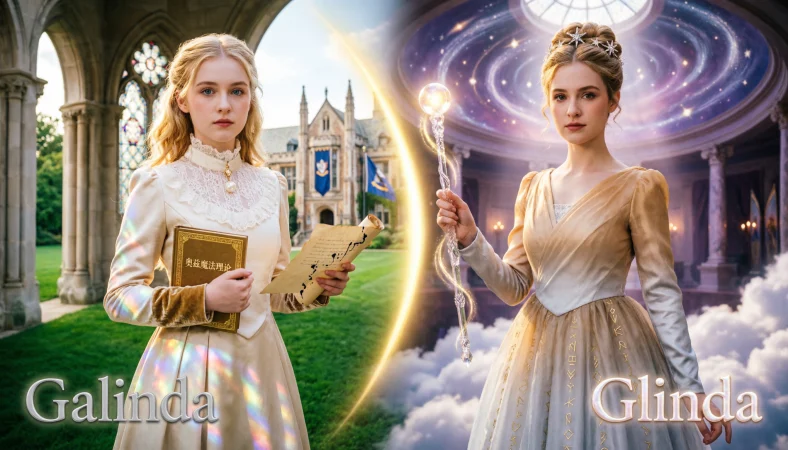
Glinda is the correct name for the character commonly known as the Good Witch in The Wizard of Oz and Wicked. Galinda is also correct in the context of Wicked, where Galinda Upland is her original name before she adopts the name “Glinda.” So, Glinda is the familiar character name, while Galinda specifically refers to her earlier name in Wicked.
Have you ever wondered whether the character’s name is Galinda or Glinda? The confusion is understandable because both names are associated with the same character in Wicked, but they aren’t used in exactly the same context.
Galinda is her original name in the story, while Glinda becomes the name by which she is widely known. This guide explains the difference, character history, spelling, and usage clearly so you can use each name correctly.
Galinda or Glinda: What’s the Difference?
The difference between Galinda and Glinda comes from the character’s development in Wicked. Galinda is the name used when the character first appears at Shiz University. Later, she changes her name to Glinda, presenting the shorter form as part of her emerging public identity.
This distinction can cause confusion because modern discussions of Wicked frequently use “Glinda” when referring to the character as a whole. Promotional material, film discussions, merchandise, fan communities, and casual conversation often favor Glinda, while earlier scenes and discussions of her original identity may use Galinda.
The two forms therefore refer to the same fictional character, but they carry different contextual meanings.
| Name | Type | Meaning in Wicked | When it is used |
| Galinda | Proper noun | The character’s original name | Mainly during the earlier part of her story |
| Glinda | Proper noun | The shorter name she adopts | Mainly after her name change |
| Galinda Upland | Full proper name | The character’s original full name | Formal character identification |
| Glinda the Good | Title and name | Her public identity as a celebrated figure | Later in the story |
The easiest way to understand the distinction is to think of Galinda as the original form and Glinda as the later form.
The character does not become a completely different person when the name changes.
Instead, the change contributes to the story’s exploration of identity, popularity, image, and personal growth.
This is why both names can appear in discussions about the same character without being contradictory.
Who is Galinda?
Galinda Upland is one of the central characters in Gregory Maguire’s novel Wicked and in the stage musical and screen adaptations based on it. She is initially portrayed as a socially confident, fashionable, ambitious young woman studying at Shiz University.
Her personality creates an interesting contrast with Elphaba. Galinda is highly concerned with popularity and social acceptance, while Elphaba is often treated as an outsider because of her appearance, personality, and beliefs.
Galinda’s original name establishes her identity at the beginning of the story. As events develop, she begins using the shorter form Glinda.
Who is Glinda?
Glinda is the later form of Galinda’s name and eventually becomes the name most audiences recognize.
The name is especially familiar because of the character’s connection with the title “Glinda the Good.” Her public identity becomes increasingly important as the story progresses.
Glinda is therefore not a separate character from Galinda. The name represents a later stage in the same character’s journey.
Why does Galinda become Glinda?
The name change is partly presented as a personal choice and partly as a playful character moment. In Wicked, the transition from Galinda to Glinda becomes part of her evolving identity.
The change also fits the character’s fascination with social image. Names can influence how people perceive a person, and Galinda understands the importance of presentation.
That makes the name change more meaningful than a simple spelling correction.
Is Galinda or Glinda a Spelling, Name, or Usage Issue?
This question is primarily about name usage and character continuity, rather than ordinary English spelling.
If you are discussing the character at the beginning of her story, Galinda is appropriate. If you are discussing her later identity, Glinda is appropriate. If you are talking about the character generally, Glinda is usually the name most modern audiences expect.
Unlike a typical spelling pair such as “color” and “colour,” these names do not represent two competing standard spellings of the same English word.
They represent two forms used by the same fictional character.
Are Galinda and Glinda interchangeable?
They can be interchangeable when you are referring generally to the character, but they are not completely interchangeable when discussing specific points in the story.
For example:
“Galinda arrives at Shiz University.”
This emphasizes her earlier identity.
“Glinda becomes a powerful public figure.”
This emphasizes her later identity.
You could call the character Glinda throughout a general discussion, and readers would understand whom you mean. However, using Galinda when discussing the later name can remove an important piece of context.
Is Galinda the correct name?
Yes. Galinda is a correct name for the character and is particularly appropriate when referring to her original identity in Wicked.
Is Glinda the correct name?
Yes. Glinda is also correct. It is the shortened form that becomes associated with her later public identity.
The important point is that neither form should automatically be treated as a misspelling of the other.
The Story Behind the Name Change
One reason people search for this distinction is that the name change happens within the story itself.
At Shiz University, Galinda is already confident about the image she wants to project. She enjoys attention, values popularity, and has a strong awareness of social expectations. Her relationship with Elphaba gradually complicates that worldview.
The transition to Glinda becomes one small part of a much larger transformation.
Names often carry social meaning in literature. Authors can use a character’s name to establish identity, status, personality, or change. In this case, the transition from Galinda to Glinda fits naturally into a story that repeatedly asks whether people are defined by their public image or by their private choices.
The shorter name also sounds more polished and memorable. That quality becomes particularly useful as the character develops a public reputation.
How Galinda Is Used in Wicked
The original form Galinda is particularly useful when discussing the character’s early experiences.
Workplace style example
Imagine a theatre company preparing a character profile:
“Galinda begins the production as a socially ambitious student at Shiz University.”
This wording identifies the character according to her early role.
Academic example
A literature student might write:
“Galinda’s early concern with social status contrasts with Elphaba’s rejection of conventional popularity.”
Here, the original name helps distinguish the character’s early personality from her later public identity.
Technology example
Suppose someone creates a database containing information about Wicked characters. The entry might identify the character as:
“Galinda Upland, later known as Glinda.”
That format is especially useful because it preserves both forms while making their relationship clear.
Usage recap
Use Galinda when emphasizing the character’s original identity or early story.
Use Glinda when emphasizing her later identity or public reputation.
Use both when explaining the complete character arc.
How Glinda Is Used in Wicked
Glinda is the form that most people recognize today. It is closely connected with the character’s public persona and her eventual association with goodness, popularity, and magical prestige.
Workplace style example
A theatre review might say:
“Glinda provides a striking contrast to Elphaba throughout the production.”
This is natural because the character is being discussed in general rather than at one specific point in the story.
Academic example
A literary analysis might state:
“Glinda’s changing relationship with popularity reveals how public identity can differ from private character.”
This focuses on the later identity while examining the broader themes of the story.
Technology example
A search query such as “Glinda character explained” will generally refer to the same character audiences encounter under the name Galinda earlier in the narrative.
Usage recap
Glinda is the most recognizable modern form.
It works well when discussing the character generally.
It is especially appropriate when discussing her later public identity.
When You Should NOT Use Galinda or Glinda
Knowing when not to use each form prevents unnecessary confusion.
1. Do not treat them as two different characters
Galinda and Glinda refer to the same character. They are not two separate women in the story.
2. Do not automatically call Galinda a misspelling
Galinda is an intentional character name. It is not simply an incorrect version of Glinda.
3. Do not assume Glinda is the original name
Within Wicked, Galinda comes first. Glinda develops later.
4. Do not use the two forms randomly in a detailed character analysis
If you are discussing a specific stage of the story, consistent naming makes your writing clearer.
5. Do not confuse the name with a completely separate character
Someone unfamiliar with Wicked may assume the two names refer to different people. Explain the transition if your audience may not know the story.
6. Do not describe the name change as merely a spelling mistake
The change has a narrative and character related purpose.
7. Do not assume every adaptation presents the details identically
The novel, stage musical, and screen adaptations have differences in characterization, presentation, and emphasis. Context matters.
Common Mistakes and Decision Rules
| Correct sentence | Incorrect sentence | Explanation |
| Galinda is her original name in Wicked. | Galinda is a misspelling of Glinda. | Galinda is an intentional character name. |
| Glinda is the name she later adopts. | Glinda and Galinda are different characters. | Both names belong to the same character. |
| Galinda and Elphaba meet at Shiz University. | Glinda and Elphaba meet under two separate character identities. | The name change does not create a new person. |
| Glinda is the name most audiences recognize. | Galinda should never be used. | Galinda remains useful when discussing her original identity. |
| Galinda becomes Glinda. | Galinda is replaced by another character named Glinda. | The story follows one character through the name change. |
Decision Rule: If you are emphasizing her original identity or earlier story, use Galinda. If you are emphasizing her later identity or public persona, use Glinda. If you are discussing the character broadly, Glinda is usually the clearest choice.
Galinda or Glinda in Modern Technology and AI Tools
Modern search engines, writing assistants, databases, and AI systems can create additional confusion because they often simplify character names.
When someone enters a query about Glinda, an AI system may discuss events involving Galinda without explaining the name change. That happens because modern systems generally connect both names to the same fictional character.
For writers, this creates an important lesson: context matters.
A search optimized article should naturally mention both forms rather than repeatedly treating them as competing spellings. Someone searching “Galinda or Glinda” usually wants clarification about the relationship between the two names, not a dictionary definition of either one.
AI generated summaries can also flatten character development. A strong explanation should preserve the chronology:
First, the character is Galinda.
Later, she becomes associated with the name Glinda.
Eventually, Glinda becomes the identity most audiences recognize.
That sequence provides a much clearer answer than simply saying both names are correct.
Why the Name Matters to the Character
The name change works particularly well because identity is one of the major themes surrounding Glinda.
At first, Galinda is strongly invested in appearances. She knows how she wants others to see her, and she understands the social value of popularity.
As the story develops, her relationship with Elphaba challenges some of those assumptions.
The name change therefore sits alongside larger questions about who a person really is.
Is identity determined by popularity?
Can someone who cares deeply about public approval still make courageous choices?
Can a public reputation accurately represent a person’s private character?
These questions give the name more significance than it might initially appear to have.
Etymology and Naming Context
The two forms are not best understood through ordinary English etymology because they function primarily as character names within the fictional world of Wicked.
Galinda is associated with the character’s original name, while Glinda becomes the shorter form she adopts.
The most useful linguistic distinction is therefore not “correct spelling versus incorrect spelling.” It is original name versus later name.
This distinction is important because names do not always behave like ordinary vocabulary. A person can change a name, shorten a name, adopt a nickname, or develop a public identity without creating a new person.
The same principle applies to fictional characters.
An expert style observation
“The difference between Galinda and Glinda is meaningful because the name change accompanies a change in how the character presents herself and how others perceive her.”
That makes the distinction particularly useful in literary analysis, character studies, theatre discussions, and general explanations of Wicked.
Two Character Based Case Studies
Case Study 1: The early Shiz University character
When discussing Galinda during the early university portion of the story, the original name provides useful context.
A sentence such as “Galinda struggles with her relationship with Elphaba” immediately places the discussion within the earlier part of the character arc.
The result is greater chronological clarity. Readers can understand that the writer is focusing on the character before her later public identity fully develops.
Case Study 2: The later public identity
When discussing Glinda as the celebrated figure audiences recognize, the shorter name is more appropriate.
A sentence such as “Glinda becomes associated with a powerful public image” clearly signals that the discussion concerns the later stage of her development.
The result is a cleaner distinction between the private student introduced earlier and the public figure who emerges later.
These examples show why choosing between Galinda and Glinda can improve precision even though both names identify the same fictional character.
Error Prevention Checklist
Always use Galinda when
- You are discussing her original name.
- You are focusing on her early identity.
- You are analyzing her early relationship with Elphaba.
- You want to explain the beginning of her character arc.
- You are introducing the name change to readers.
Always use Glinda when
- You are discussing her later identity.
- You are referring to her public persona.
- You are discussing Glinda the Good.
- You are talking about the character generally for a modern audience.
- You are discussing her later role in the story.
Never assume
- Galinda is a spelling mistake.
- Glinda and Galinda are separate characters.
- The name change is meaningless.
- Every discussion must use only one form.
- Readers automatically know why the two names differ.
Why People Search for Galinda or Glinda
The query is especially common because Wicked exists across several forms of media, including literature, theatre, and film.
Different audiences encounter the character at different points and may therefore encounter different versions of her name.
Someone watching a film might primarily remember Glinda. Someone reading about the character’s early story might encounter Galinda. A fan discussing the musical may use both.
Search behavior also encourages people to compare names that look almost identical. When two forms appear in different sources, readers naturally wonder whether one source contains an error.
In this case, the apparent inconsistency has an explanation within the story.
Related Character Name Confusions You Should Know
If you enjoy researching Wicked and related literature, several other distinctions can also cause confusion.
- Elphaba and the Wicked Witch of the West
- Galinda and Glinda
- The Wizard and the Wizard of Oz
- Nessarose and the Wicked Witch of the East
- Boq and the Tin Man
- Fiyero and the Scarecrow
- Shiz University and the wider world of Oz
- Gregory Maguire’s Wicked and the stage musical
- The stage version and screen adaptation
- Glinda the Good and her earlier identity as Galinda
Understanding these distinctions helps readers separate character names, titles, adaptations, and narrative identities.
FAQs
Is Galinda the same person as Glinda?
Yes. Galinda and Glinda refer to the same fictional character in Wicked. Galinda is her original name, while Glinda becomes the name she uses later.
Why does Galinda change her name to Glinda?
The name change is part of the character’s development and public identity. The shorter name also contributes to her increasingly polished and recognizable persona.
Is Galinda spelled correctly?
Yes. Galinda is a valid and intentional character name in Wicked. It should not automatically be treated as a spelling mistake.
Is Glinda the correct name?
Yes. Glinda is the later form of the character’s name and the version most audiences recognize.
Why is she called Galinda at first?
Galinda is the character’s original name at the beginning of her story. She later adopts the shorter form Glinda.
Are Galinda and Glinda two different characters?
No. They are two names used by the same character. The difference reflects a change in identity and presentation rather than a change of person.
Should I use Galinda or Glinda when writing about Wicked?
It depends on context. Use Galinda when discussing her original identity or earlier story. Use Glinda when discussing her later identity or the character generally.
Is Galinda the original name?
Yes. Galinda is the original form of the character’s name before she becomes known as Glinda.
Why do people call her Glinda instead of Galinda?
Glinda becomes her later and more recognizable public identity. It is also the name associated with her title and reputation as Glinda the Good.
Does the name change have a deeper meaning?
Yes. The change can be viewed as part of the story’s broader exploration of identity, popularity, appearance, reputation, and personal growth.
Conclusion:
Galinda or Glinda is not a simple case of correct spelling versus incorrect spelling. Both names refer to the same character in Wicked. Galinda is her original name, while Glinda becomes the name associated with her later identity and public reputation. For general discussion, Glinda is usually the most recognizable choice, but Galinda remains important when discussing the character’s earlier identity and development.
The key is context. If you are describing the beginning of her story, Galinda gives readers useful chronological information. If you are discussing her later public identity, Glinda is more appropriate. Understanding that distinction makes character discussions more accurate and prevents the common mistake of treating the two names as separate people.