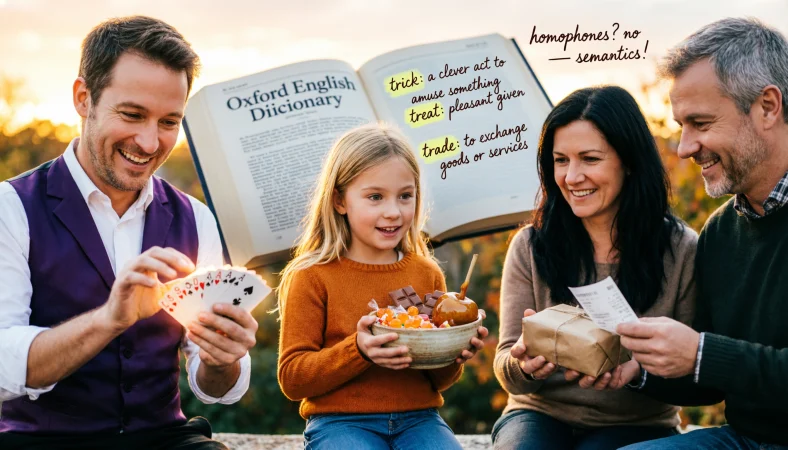
Trick or trade is usually a mistaken version of the common phrase “trick or treat,” which is associated with Halloween. “Trick or treat” means children ask for candy while playfully suggesting they may perform a trick if they do not receive a treat. “Trade” has a different meaning, so it generally should not replace “treat” in the standard expression.
Have you heard someone say “trick or trade” and wondered whether it’s actually correct? The confusion usually comes from mishearing or intentionally changing the familiar Halloween phrase “trick or treat.” Although “trade” is a real English word, it does not have the same meaning in this expression. This guide explains the difference between “trick or trade” and “trick or treat,” including their meanings, correct usage, common mistakes, and the context behind the traditional phrase.
Trick or Treat vs Trick or Trade: What’s the Difference?
The clearest way to understand the issue is to compare the meanings of the individual words.
Trick is a noun when it refers to a deceptive maneuver, prank, clever device, or unexpected action. It can also be a verb meaning to deceive or fool someone.
Treat is a noun when it means something enjoyable, desirable, or given as a reward. As a verb, “treat” can mean to behave toward someone in a particular way, provide medical care, or provide something enjoyable.
Trade is a noun referring to the buying and selling of goods or services, an exchange, or a particular occupation. As a verb, it means to exchange, buy, sell, or engage in commercial activity.
| Expression | Word type | Basic meaning | Typical context | Standard expression? |
| Trick | Noun or verb | A prank, deception, maneuver, or act of fooling | Games, jokes, deception, performance | Yes |
| Treat | Noun or verb | Something enjoyable or an act of providing something enjoyable | Food, rewards, behavior, healthcare | Yes |
| Trade | Noun or verb | Exchange, commerce, occupation, or commercial activity | Business, markets, occupations | Yes |
| Trick or treat | Fixed expression | A traditional Halloween request for treats | Halloween | Yes |
| Trick or trade | Noun combination | Usually a playful variation or mistaken form | Advertising, jokes, wordplay | Not the standard Halloween phrase |
Mini recap
“Trick or treat” is the established Halloween expression.
“Trade” has a completely different meaning from “treat.”
“Trick or trade” can be intentional wordplay, but it is not the conventional phrase.
If you’re talking about Halloween, “trick or treat” is normally the correct choice.
Is Trick or Trade a Grammar, Vocabulary, or Usage Issue?
This is mainly a vocabulary and usage issue, rather than a basic grammar problem.
There is nothing grammatically impossible about placing the words “trick” and “trade” together. English allows speakers to create new combinations constantly.
For example, a business could invent a slogan containing “trick or trade.” A magician could use it as a joke about exchanging secrets. A writer could deliberately replace “treat” with “trade” to create a commercial pun.
The problem arises when someone intends to use the traditional Halloween phrase but writes “trick or trade.”
In that situation, the issue is not that “trade” is an ungrammatical word. The issue is that it does not communicate the established meaning.
Are trick and trade interchangeable?
No.
“Trick” describes an act, maneuver, deception, prank, or clever technique.
“Trade” concerns exchange, commerce, or an occupation.
For example:
“She played a clever trick.”
“She works in the building trade.”
Replacing “trick” with “trade” would alter the sentence substantially.
Likewise, replacing “treat” with “trade” changes the meaning of “trick or treat.”
Formal versus informal usage
“Trick or treat” is informal and culturally familiar, but it is still a standard expression.
“Trick or trade” is not normally used as a formal equivalent.
If a writer deliberately uses “trick or trade” as a pun, the surrounding context should make the joke obvious.
Academic versus casual usage
Academic writing should generally use “trick or treat” when discussing the Halloween tradition.
If a researcher is studying advertising language, wordplay, or language variation, “trick or trade” could be discussed as an intentional expression.
The key is to distinguish between describing a standard phrase and analyzing a creative variation.
How to Use Trick Correctly
The word trick has a surprisingly broad range of meanings.
As a noun, it can describe deception:
“He played a trick on his brother.”
It can describe a clever technique:
“The magician performed an impressive trick.”
It can describe a practical method:
“She knows a useful trick for remembering names.”
As a verb, “trick” means to deceive:
“He tricked me into believing the story.”
Workplace example
A manager might say:
“There is a simple trick for organizing these files.”
Here, “trick” means a useful technique, not deception.
Another workplace sentence might be:
“The employee tried to trick the system.”
Here, the meaning is deception.
Academic example
A psychology paper might discuss how people can be tricked by misleading information.
A mathematics teacher might explain a “trick” for solving a difficult problem more efficiently.
In both cases, context determines whether “trick” means deception or technique.
Technology example
A technology writer might say:
“Here is a useful trick for improving your phone’s battery life.”
The word refers to a practical tip.
A cybersecurity article might discuss techniques designed to trick users into revealing information. In that context, the meaning is deceptive.
Usage recap
Use “trick” for a prank, deception, clever maneuver, or useful technique.
The word can be positive, negative, playful, or neutral depending on context.
It is not synonymous with “trade.”
How to Use Treat Correctly
The word treat is equally flexible.
As a noun, a treat is something enjoyable or desirable.
For example:
“Chocolate is a special treat.”
As a verb, “treat” can mean to behave toward someone in a certain way:
“She treated everyone kindly.”
It can also refer to medical care:
“The doctor treated the patient for an infection.”
It can describe paying for something:
“I’ll treat you to dinner.”
Workplace example
A manager might say:
“We’ll treat this request as a priority.”
Here, “treat” means to handle or regard something in a particular way.
Academic example
A research paper might state:
“The study treats these variables separately.”
Here, “treats” means handles or considers.
Technology example
A software developer might write:
“The application treats missing values as zero.”
This means the software handles or interprets missing values in a particular manner.
Usage recap
“Treat” can refer to something enjoyable, a method of handling something, behavior toward another person, or medical care.
In “trick or treat,” however, it specifically refers to a desirable reward, traditionally candy or another small gift.
Why Trick or Treat Is the Correct Halloween Expression
The phrase “trick or treat” has become deeply associated with Halloween in North American English.
The basic idea is simple.
A child approaches a home while wearing a costume and says “trick or treat.” The implied choice is between receiving a treat and facing a harmless trick or prank.
The expression became widely established in the United States and Canada during the twentieth century, although its precise historical development has connections to older European customs involving seasonal celebrations, disguises, begging, and playful performances.
The important point for modern usage is that trick or treat is a fixed cultural expression.
Fixed expressions behave differently from freely assembled combinations of words.
For example, English speakers recognize:
“Break the ice.”
“Spill the beans.”
“Once in a blue moon.”
Likewise, “trick or treat” is recognized as a conventional Halloween phrase.
Changing one of its words can create a joke, but it also removes the familiar expression.
When You Should NOT Use Trick or Trade
There are several situations where “trick or trade” is likely to create confusion.
1. When you’re talking about Halloween
Use “trick or treat.”
2. When writing for children
Children generally encounter the established phrase “trick or treat,” so changing it to “trick or trade” may confuse them unless the change is intentional.
3. When writing educational material
Use the standard expression unless you’re specifically explaining the unusual variation.
4. When writing about Halloween history
Historical and cultural explanations should use the conventional phrase when referring to the tradition.
5. When writing formal content
An unexplained substitution can look like an editing error.
6. When answering a language question
If someone asks what children say on Halloween, “trick or treat” is the accurate answer.
7. When translating the phrase
Don’t automatically translate “trade” as though it were part of the established Halloween expression.
8. When correcting someone’s English
Explain the difference rather than simply calling “trick or trade” wrong. It may have been deliberate wordplay.
Common Mistakes and Decision Rules
| Correct sentence | Incorrect or confusing sentence | Explanation |
| The children shouted “trick or treat.” | The children shouted “trick or trade.” | “Trick or treat” is the established Halloween phrase. |
| She played a trick on her friend. | She played a trade on her friend. | “Trick” can mean a prank. “Trade” cannot normally be used this way. |
| They trade goods internationally. | They treat goods internationally. | “Trade” refers to commercial exchange. |
| The doctor treated the patient. | The doctor traded the patient. | “Treat” can refer to providing medical care. |
| He knows a useful trick. | He knows a useful trade. | “Trick” can mean a technique or clever method. |
| They agreed to trade books. | They agreed to treat books. | “Trade” can mean exchange. |
Decision Rule Box
- If you mean the Halloween tradition, use “trick or treat.”
- If you mean exchanging goods, money, services, or objects, use “trade.”
- If you mean a prank, deception, or clever technique, use “trick.”
- If you mean something enjoyable, rewarding, or a method of handling something, use “treat.”
This simple distinction resolves most confusion.
Trick or Trade in Modern Technology and AI Tools
Modern technology creates many opportunities for intentional wordplay.
A technology company could create a Halloween campaign called “Trick or Trade,” using “trade” because the company sells or exchanges products.
An online marketplace might use the phrase as a seasonal slogan.
An AI writing system could also generate “trick or trade” when prompted to create a Halloween themed business slogan.
That doesn’t necessarily mean the phrase is grammatically incorrect. It may mean that the writer has intentionally created a new expression.
This is an important distinction in modern language.
Language isn’t frozen. People constantly create slogans, memes, product names, jokes, headlines, and puns.
AI systems encounter this creative language and may reproduce it without understanding whether a phrase is conventional or deliberately altered.
When evaluating AI generated writing, ask a simple question:
Is the unusual wording intentional, or is it replacing a familiar expression by mistake?
That question is often more useful than asking whether a phrase has ever appeared online.
The Etymology of Trick, Treat, and Trade
The three words have different histories.
“Trick” entered English through French and ultimately has connections to words associated with deception, cleverness, and cunning.
“Treat” developed from Latin roots associated with handling or managing something and came into English through French. Its meanings expanded over time to include behavior toward someone, medical care, and something enjoyable.
“Trade” has Germanic roots and developed in English in connection with paths, business, commerce, and occupations.
Their different histories help explain why the words have distinct semantic fields even though their short forms can make them easy to confuse.
The similarity becomes especially noticeable in the expression “trick or treat,” where replacing “treat” with another short word can sound superficially plausible.
An Expert Linguistic Perspective
A useful principle for understanding “trick or trade” is:
“Context determines whether a familiar word combination carries its conventional meaning or creates a new one.”
This explains why an unusual phrase shouldn’t automatically be judged as meaningless.
If someone writes “trick or trade” in a Halloween article without explanation, it probably looks like a mistake.
If a store creates a Halloween promotion called “Trick or Trade,” the same words may function as intentional branding.
The words haven’t changed their dictionary meanings. The writer has simply placed them together for a particular rhetorical purpose.
Author expertise
Written by a language and SEO content specialist with expertise in English usage, semantic search, phrase interpretation, cultural language, search intent, and reader focused educational content.
Two Practical Case Studies
Case Study One: A Halloween classroom lesson
Imagine an elementary teacher preparing a Halloween vocabulary lesson.
The teacher accidentally writes “trick or trade” on the classroom board.
Students may reasonably assume that “trade” refers to exchanging something.
If the teacher changes the phrase to “trick or treat,” the cultural meaning becomes immediately recognizable.
The concrete result is improved comprehension because the vocabulary matches the established expression.
The lesson can then explain the difference between the three words.
“Trick” can mean a prank.
“Treat” can mean something enjoyable.
“Trade” can mean an exchange.
Case Study Two: A business Halloween campaign
Now imagine an online retailer launching a Halloween promotion called “Trick or Trade.”
The business deliberately uses “trade” because customers are exchanging or purchasing products.
In this context, the phrase isn’t necessarily an error.
Instead, it is a pun based on the familiar expression “trick or treat.”
The concrete result is a memorable marketing phrase because the audience recognizes the original expression and notices the deliberate substitution.
This demonstrates an important principle: unusual language can be effective when the audience understands that the unusual wording is intentional.
Error Prevention Checklist
Always use “trick or treat” when
- Referring to the traditional Halloween activity.
- Writing for readers who expect standard English.
- Explaining what children traditionally say at Halloween.
- Writing an educational definition of the Halloween phrase.
- Referring to the established cultural tradition.
Use “trick or trade” only when
- You intentionally want to create a pun.
- The context clearly involves exchange or commerce.
- A brand or event has deliberately chosen the phrase.
- You’re discussing the phrase itself as a language variation.
Never assume
- “Trick or trade” is the standard Halloween expression.
- “Trade” means the same thing as “treat.”
- Every unusual appearance of the phrase is a grammatical mistake.
- A phrase found online must be a standard expression.
Related Grammar Confusions You Should Master
Understanding “trick or trade” can lead to several other useful vocabulary distinctions.
- Treat vs treatment
- Trade vs exchange
- Trick vs prank
- Trick vs deceive
- Treat vs reward
- Affect vs effect
- Advice vs advise
- Practice vs practise
- Compliment vs complement
- Stationary vs stationery
These pairs and groups illustrate a broader truth about English vocabulary.
Words that look or sound similar can have completely different meanings.
The safest way to choose between them is to identify the intended meaning first.
FAQs.
What does trick or trade mean?
“Trick or trade” is not the standard Halloween expression. It can be used as an intentional pun, particularly when “trade” relates to exchanging goods or services, but most people expect “trick or treat” in a Halloween context.
Is trick or trade correct English?
The individual words are correct English, but “trick or trade” is not the conventional Halloween expression. It can be perfectly understandable when deliberately used as wordplay or branding.
Is it trick or treat or trick or trade?
The established Halloween phrase is “trick or treat.” “Trick or trade” is generally a creative variation rather than the standard expression.
Why do people say trick or treat?
“Trick or treat” developed as a traditional Halloween expression in which children request treats while invoking the possibility of a playful trick if they receive nothing.
What does trick mean in trick or treat?
In the expression, “trick” refers to the possibility of a prank or playful act. The contrast is between receiving a treat and potentially experiencing or performing a trick.
What does treat mean in trick or treat?
“Treat” refers to something desirable given to the children, traditionally candy, sweets, or another small gift.
What does trade mean in English?
“Trade” generally refers to exchanging goods, services, or other things. It can also refer to commercial activity or a particular occupation or skilled profession.
Can trick or trade be a pun?
Yes. A writer, business, teacher, or advertiser can deliberately replace “treat” with “trade” to create a joke or wordplay, especially when the subject involves commerce or exchanging items.
Is trick or trade a Halloween phrase?
Not in standard modern usage. “Trick or treat” is the established Halloween phrase. “Trick or trade” may appear as a creative variation.
Why does trick or trade sound familiar?
It sounds familiar because it closely resembles “trick or treat,” a highly recognizable expression. The shared word “trick” and the similar structure make the altered phrase easy to understand as wordplay.
Final Thoughts:
The phrase trick or trade is best understood as a nonstandard variation of the familiar expression “trick or treat.”
If you’re referring to Halloween, use “trick or treat.” That is the established expression recognized by English speakers and associated with children requesting treats while invoking a playful trick.
If you’re discussing commerce, exchange, or a business related joke, “trick or trade” can work as intentional wordplay.
The important distinction is meaning.
“Trick” can describe a prank, deception, maneuver, or clever technique.
“Treat” can describe something enjoyable or an act of handling or caring for something.
“Trade” concerns exchange, commerce, or an occupation.
Once these meanings are separated, the confusion becomes straightforward. When standard usage matters, choose the established phrase. When creative language is intentional, an unusual expression such as “trick or trade” can be effective precisely because readers recognize the familiar phrase behind it.











11 thoughts on “Trick or Trade Meaning: Correct Phrase, Usage & Common Mistakes For 2026 Guide”