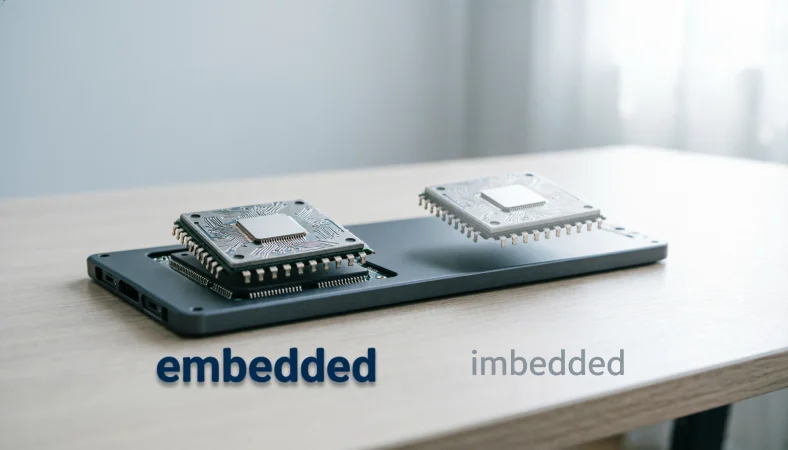
The correct spelling in modern standard English is embedded. It means placed firmly, deeply, or securely within something else, and it is the standard form used in academic, professional, technical, and everyday writing. Imbedded is a less common variant that can still be found, but embedded is generally the preferred choice.
If you’ve ever hesitated over imbedded or embedded, you’re not alone. Both spellings appear in dictionaries and published writing, which makes the choice surprisingly confusing. However, there is a clear practical answer: embedded is the overwhelmingly preferred spelling in contemporary English.
The word embedded is the past participle and adjective formed from the verb embed. It describes something placed firmly inside, within, or as an integral part of something else. Imbedded can also function as a variant spelling, but it is much less common and is usually unnecessary when you want conventional modern usage.
This distinction matters because spelling choices can affect credibility. In technical documentation, academic papers, business communication, journalism, and digital content, readers generally expect the established form embedded. Choosing the less familiar spelling may distract readers even when the meaning is technically understandable.
Embedded or Imbedded: What’s the Difference?
The two spellings have essentially the same meaning. The major difference is usage frequency and stylistic preference, not a significant difference in definition.
| Feature | Embedded | Imbedded |
| Word type | Verb form and adjective | Verb form and adjective |
| Meaning | Placed firmly or deeply within something | Placed firmly or deeply within something |
| Modern usage | Very common | Much less common |
| Technical writing | Preferred | Usually avoided |
| Academic writing | Preferred | Less common |
| Everyday English | Preferred | Uncommon |
| Recommended choice | Yes | Usually no |
A quick recap
Embedded is the standard and most widely accepted spelling.
Imbedded is a legitimate variant found in some dictionaries and publications.
The meanings are essentially identical.
For modern professional writing, embedded is normally the safest choice.
Is Embedded or Imbedded a Grammar, Vocabulary, or Usage Issue?
This is primarily a spelling and usage issue, rather than a grammatical distinction.
Neither spelling represents a different grammatical tense or a different basic concept. Both are associated with the verb embed, and both can appear as participles or adjectives.
For example:
The sensor was embedded in the device.
A writer could theoretically use:
The sensor was imbedded in the device.
The meaning remains understandable. However, the first sentence sounds much more natural to most modern readers.
Are they interchangeable?
In a strict sense, the spellings can sometimes be treated as variants. That does not mean they are equally useful in every context.
English contains many spelling variants that are technically possible but differ greatly in frequency. Embedded belongs to this category. It is the form readers are much more likely to encounter.
Formal versus informal usage
In formal writing, embedded is strongly preferable because it is the established contemporary spelling.
In casual writing, an occasional use of imbedded is unlikely to prevent understanding. Still, there is little practical reason to choose it when embedded is available.
Academic versus casual usage
Academic writing benefits from consistency and conformity with established terminology. Researchers, students, editors, and publishers will generally expect embedded.
Casual communication is more forgiving, but the same recommendation applies: use embedded unless you have a specific reason to preserve a source’s spelling.
How to Use Embedded Correctly
Embedded is the form you should normally choose in contemporary English. It can describe physical objects, ideas, systems, technologies, information, advertisements, software, and social structures.
Workplace example
The company uses an embedded feedback system to monitor customer satisfaction.
Here, embedded means that the feedback mechanism is built into the larger system.
Another example is:
The analyst found an embedded chart in the quarterly report.
The chart exists inside the report rather than functioning as a separate document.
Academic example
The researchers examined cultural assumptions embedded in the educational system.
Here, the word is not describing a physical object. Instead, it describes ideas or assumptions that are deeply incorporated into a system.
This figurative use is extremely common in academic writing.
Technology example
The manufacturer developed an embedded processor for the new device.
In technology, embedded is especially common. An embedded system or embedded component is designed to perform a specific function as part of a larger device or system.
Usage recap
Use embedded when something is physically or conceptually placed within something else. It works naturally in professional, academic, technical, and everyday contexts.
How to Use Imbedded Correctly
Imbedded has the same basic meaning as embedded, but it is much less common.
You may encounter it in older publications, certain edited works, dictionaries that record spelling variants, or writing influenced by historical usage.
For example:
The stone was imbedded in the wall.
The sentence is understandable, and the spelling has historical legitimacy. However, modern readers are far more accustomed to:
The stone was embedded in the wall.
Workplace example
Suppose you’re writing a company report:
The security controls are embedded within the company’s infrastructure.
This is preferable to:
The security controls are imbedded within the company’s infrastructure.
The second version isn’t likely to cause confusion, but the first looks more conventional.
Academic example
Gender expectations may be embedded within social institutions.
This is the form readers are most likely to expect in scholarly writing.
Technology example
The software contains an embedded authentication system.
Technical terminology strongly favors embedded.
Usage recap
Imbedded is not meaningless or automatically wrong. It is a recognized variant, but it is substantially less common. In most modern writing, choosing embedded is the better editorial decision.
When You Should NOT Use Imbedded or Embedded
There are several situations where writers misuse these words or choose the wrong form.
1. Do not use imbedded simply because it looks logical
The presence of the prefix im in other English words does not make imbedded the preferred spelling.
2. Do not treat the two spellings as different meanings
There is generally no useful semantic distinction between them.
3. Do not switch spellings within the same document
Consistency matters. If a document uses embedded, don’t alternate randomly with imbedded.
4. Do not use embedded when you mean merely nearby
Something that is adjacent to another object isn’t necessarily embedded in it.
The label is next to the screen.
This does not mean:
The label is embedded in the screen.
5. Do not use embedded when you mean attached externally
An externally attached component may be connected to something without being incorporated into it.
6. Do not assume imbedded is incorrect in every context
It is better described as a less common variant rather than simply a meaningless misspelling.
7. Do not preserve an unusual spelling in polished copy without reason
If you’re editing a website, report, article, or technical manual, the conventional form is usually the stronger choice.
Common Mistakes and Decision Rules
| Correct sentence | Incorrect or less preferred sentence | Explanation |
| The image is embedded in the article. | The image is imbedded in the article. | Embedded is the standard modern form. |
| The chip is embedded in the device. | The chip is imbedded in the device. | Embedded is strongly preferred in technical English. |
| The idea is embedded in the culture. | The idea is imbedded in the culture. | Embedded is more conventional in academic writing. |
| The video is embedded on the page. | The video is imbedded on the page. | Digital writing normally uses embedded. |
| The sensor is embedded within the machine. | The sensor is imbedded within the machine. | The first spelling is standard contemporary usage. |
Decision Rule
If you’re writing modern English, use embedded.
If you encounter imbedded in an older or specialized source, recognize it as a variant rather than assuming the writer has invented the word.
Embedded or Imbedded in Modern Technology and AI Tools
The preference for embedded becomes particularly obvious in technology.
You regularly encounter expressions such as:
- embedded system
- embedded software
- embedded device
- embedded processor
- embedded application
- embedded analytics
- embedded AI
- embedded content
- embedded model
In digital publishing, an embedded video is displayed directly within a webpage. Also In software development, embedded systems combine hardware and software to perform specialized functions. In artificial intelligence, embedded AI can refer to AI capabilities incorporated directly into devices, applications, or workflows.
For example:
The application uses embedded AI to analyze images locally.
Replacing embedded with imbedded would be understandable, but it would look unusual in contemporary technical documentation.
This is one reason spelling frequency matters. A word can be technically defensible while still being a poor stylistic choice for a particular audience.
Why Embedded Is the Better Default
Language isn’t determined only by whether a spelling can be found in a dictionary. Usage frequency, editorial conventions, professional terminology, and reader expectations also matter.
Think about the difference between a word being possible and being preferred.
Imbedded is possible.
Embedded is preferred.
That distinction is useful when writing for search engines, universities, employers, technical audiences, or professional publications.
A reader who sees embedded is unlikely to pause over the spelling. A reader who sees imbedded may wonder whether it is a typo.
Good writing reduces unnecessary friction.
Etymology of Embed
The verb embed comes from the idea of placing something firmly within another thing. Historically, the word developed through forms associated with being placed or fixed in a surrounding material.
The modern English verb can describe both literal and figurative placement.
Literal:
The jewel was embedded in the metal.
Figurative:
The tradition is embedded in the community.
Technical:
The software is embedded in the device.
This broad semantic range explains why the word is now common across science, technology, journalism, education, business, and everyday communication.
An Expert Style Explanation
“When two spellings convey the same meaning, contemporary usage and reader expectations are often the best practical guides. In modern professional English, embedded is the established choice.”
This principle is especially useful for editors. The goal isn’t merely to identify whether a form exists. The goal is to select the form that communicates naturally to the intended audience.
Two Practical Case Studies
Case Study 1: Technical documentation
Imagine a software company publishing documentation for a device.
Version A:
The application contains an imbedded authentication module.
Version B:
The application contains an embedded authentication module.
Both communicate the intended idea. Version B, however, aligns with established technical terminology and is less likely to trigger a spelling concern.
The practical result is greater consistency with the language used throughout technical documentation.
Case Study 2: Academic writing
Consider a student writing about social structures.
Version A:
Certain beliefs are imbedded within institutional practices.
Version B:
Certain beliefs are embedded within institutional practices.
Again, the meaning doesn’t substantially change. The second version fits contemporary academic conventions more comfortably.
The result is a sentence that reads naturally without drawing attention to the spelling.
Error Prevention Checklist
Always use embedded when
- You are writing a modern article.
- You are preparing academic work.
- You are writing technical documentation.
- You are describing software or hardware.
- You are discussing embedded content.
- You are writing professional business material.
- You are optimizing content for a broad modern audience.
Never use imbedded when
- You are deliberately trying to create a different meaning.
- You assume it is more formal.
- You want to make technical writing sound more sophisticated.
- You are using it simply because the spelling looks logical.
- You are alternating between the two spellings without a stylistic reason.
Related Spelling and Usage Confusions You Should Master
If you’re interested in distinctions like imbedded or embedded, several other English spelling questions are worth mastering:
- Focused or focussed
- Learned or learnt
- Canceled or cancelled
- Labeled or labelled
- Catalog or catalogue
- Toward or towards
- Among or amongst
- Theater or theatre
- Practice or practise
- Judgment or judgement
These pairs demonstrate an important principle: English often permits regional, historical, or stylistic variation. The best choice depends on standard usage, audience, and context.
FAQs
Is embedded or imbedded correct?
Embedded is the standard and strongly preferred spelling in contemporary English. Imbedded is a recognized variant, but it is considerably less common.
Is imbedded a misspelling of embedded?
Not necessarily. Imbedded has historical and dictionary recognition as a variant spelling. However, modern writers generally prefer embedded.
Why is embedded more common than imbedded?
English usage has settled strongly around embedded, especially in technical, academic, professional, and digital contexts. Frequent exposure reinforces that spelling.
Should I use embedded in academic writing?
Yes. Embedded is the safer and more conventional choice for academic writing.
Is embedded the correct spelling in American English?
Yes. Embedded is widely used in American English.
Is embedded the correct spelling in British English?
Yes. Embedded is also standard in British English, although British English has many spelling differences from American English that do not affect this particular word.
What does embedded mean?
Embedded means placed firmly or deeply within something else. It can describe a physical object, an idea, a system, information, or digital content.
What does imbedded mean?
Imbedded has essentially the same meaning as embedded. It is a less common spelling variant.
Should I change imbedded to embedded?
If you’re editing modern professional, academic, technical, or general audience content, changing imbedded to embedded is usually sensible for consistency with contemporary usage.
Is embedded a verb or an adjective?
It can be both. It is the past participle of the verb embed and can also function adjectivally.
For example:
The programmer embedded the video.
Here, embedded is part of the verb construction.
The embedded video plays automatically.
Here, embedded functions as an adjective.
Conclusion:
When choosing between imbedded or embedded, the practical answer is straightforward: use embedded in almost all modern writing. Although imbedded exists as a variant spelling and can be found in published sources, embedded is far more common and is the form expected in academic, professional, technical, and digital contexts.
The two spellings generally share the same meaning, so the issue isn’t really about grammar or a major vocabulary distinction. It is primarily about conventional spelling and usage. If your goal is clear, polished, reader friendly English, embedded is the safest choice.











6 thoughts on “Embedded Or Imbedded: Which One Is Correct? Meaning, Spelling & Examples For 2026”