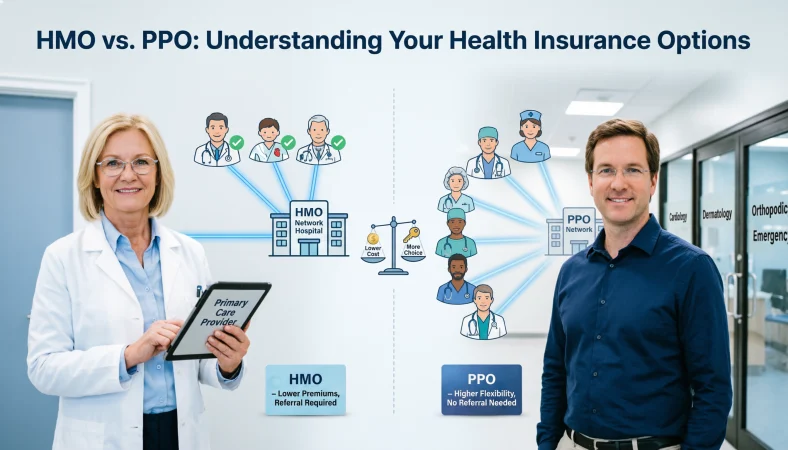
HMO and PPO are two common types of health insurance plans, but they differ mainly in provider choice, referrals, and out of pocket costs. HMO plans typically require you to use a network and may require referrals for specialists, while PPO plans generally offer more flexibility to see out of network providers without referrals but often cost more. The better option depends on your healthcare needs, budget, and preferred doctors.
Choosing between HMO or PPO can feel confusing when both plans cover many of the same basic healthcare services but work differently. Your choice can affect your monthly premium, deductible, doctor access, specialist visits, and potential out of pocket expenses.
This guide explains the key differences between HMOs and PPOs in simple terms, using standard health insurance concepts to help you compare your options and make a more informed decision based on your healthcare needs and financial priorities.
HMO or PPO: What’s the Difference?
The main difference between an HMO and a PPO is how you access healthcare and how much flexibility you have in choosing providers. Both are managed care health insurance models, but they balance cost, network restrictions, referrals, and provider choice differently.
HMO stands for Health Maintenance Organization. It generally emphasizes coordinated care through a network of participating doctors and facilities. Depending on the plan, you may choose a primary care provider who coordinates your care and provides referrals to specialists.
PPO stands for Preferred Provider Organization. It generally gives members more freedom to see healthcare providers without requiring referrals and may provide some coverage for eligible out of network care. The tradeoff is often higher premiums, deductibles, or cost sharing.
| Feature | HMO | PPO |
| Full name | Health Maintenance Organization | Preferred Provider Organization |
| Provider network | Usually more restrictive | Usually more flexible |
| Primary care provider | Often important | Usually not required |
| Specialist referral | Often required | Usually not required |
| Out of network care | Usually limited, except certain situations | Often covered at a higher cost |
| Premiums | Often lower | Often higher |
| Provider choice | More limited | Broader |
| Care coordination | Strong emphasis | More member flexibility |
| Best suited for | People comfortable with network based care | People who value provider flexibility |
Quick recap
An HMO generally prioritizes coordinated care and predictable network use.
A PPO generally prioritizes flexibility and broader provider access.
Neither plan is automatically better for everyone.
The right choice depends on your healthcare needs, budget, preferred doctors, and willingness to manage network restrictions.
Is HMO or PPO a Health Insurance, Coverage, or Cost Issue?
The comparison is primarily a health insurance plan design issue, but it affects coverage and costs directly.
HMO and PPO plans are not interchangeable. They can cover many of the same broad categories of healthcare, but the rules governing access and cost sharing can be substantially different.
For example, imagine that you regularly see a specialist. Under an HMO, you may need a referral from your primary care provider before the specialist visit is covered according to the plan’s rules. Under a PPO, you can generally make an appointment with a participating specialist without a referral.
That difference can matter considerably.
Formal versus casual usage
In formal insurance documents, HMO and PPO are defined plan structures with specific contractual rules. In everyday conversation, people often use the terms more loosely to describe plans as either restrictive or flexible.
That shortcut can be misleading.
Not every HMO has exactly the same referral requirements, and not every PPO has identical out of network benefits. The actual Summary of Benefits and Coverage, provider directory, and plan documents determine the details.
Academic and professional usage
In healthcare administration, insurance research, and academic writing, HMO and PPO describe established models of managed healthcare.
In casual conversation, someone might simply say, “The PPO is better because I can see any doctor.” That may capture the general idea of greater flexibility, but it doesn’t mean every doctor is covered at the same rate.
The important lesson is simple: the plan type tells you something important, but it does not tell you everything about a specific plan.
How an HMO Works
An HMO is designed around a defined network and coordinated healthcare.
When you enroll in an HMO, you typically select or are assigned a primary care provider. That provider can become the central point for routine care and coordination.
For example, suppose you develop persistent knee pain. You might first visit your primary care provider. If further evaluation is necessary, the provider may refer you to an orthopedic specialist within the plan’s network.
This structure can make healthcare more organized, especially for people who prefer having one provider coordinate their treatment.
Workplace example
An employer may offer an HMO with a relatively affordable employee premium. An employee who primarily receives care from nearby participating doctors may find the arrangement convenient.
The employee checks whether their primary doctor participates in the network and confirms which specialists and hospitals are included.
Academic example
A healthcare policy researcher comparing managed care models might describe an HMO as a structure that emphasizes network based care, coordinated services, and cost management.
The researcher would distinguish those characteristics from a PPO model that generally provides broader provider flexibility.
Technology example
Modern health insurance websites and mobile applications can make HMO management easier by allowing members to search provider directories, review claims, locate participating facilities, and access digital insurance cards.
However, technology doesn’t replace the need to verify network participation. Provider directories can change, so members should confirm current network status when receiving important care.
HMO usage recap
An HMO is often attractive when lower costs and coordinated care matter most.
Its network rules can be more restrictive.
Understanding referral requirements is particularly important.
Always verify the rules of the specific HMO before receiving specialist or out of network care.
How a PPO Works
A PPO generally gives members more freedom when selecting healthcare providers.
You usually don’t need to choose a primary care physician as the central coordinator of all care, and referrals to specialists are generally not required. PPOs can also provide benefits for eligible out of network services, although you will often pay more.
Consider someone who frequently travels between cities. A PPO might appeal to that person because provider flexibility can be valuable when care is needed outside their immediate area.
That doesn’t mean every provider everywhere is covered. Network status still matters.
Workplace example
An employer might offer employees a PPO with a higher monthly premium but broader provider access. An employee who already has established relationships with several specialists may prefer this arrangement.
Academic example
In an insurance economics study, a PPO could be examined as a model that gives consumers greater provider choice while using financial incentives to encourage members to use preferred providers.
Technology example
PPO members can often use insurer websites and apps to compare participating providers, check estimated costs, review claims, and locate facilities.
Technology can make a broad network easier to navigate, but members should still check whether a specific physician, facility, and service are covered.
PPO usage recap
A PPO generally offers greater provider flexibility.
Specialist referrals are usually not required.
Out of network benefits may be available, but they often cost more.
A PPO can be useful for people who value provider choice, but the additional flexibility may come with higher costs.
When You Should NOT Choose an HMO or PPO Based on the Label Alone
Choosing a plan solely because it is called an HMO or PPO can lead to expensive surprises. The label provides useful information, but the actual plan details matter more.
Here are several situations where relying only on the plan type can be misleading.
- You assume every HMO is identical
Different HMOs can have different networks, referral rules, deductibles, copayments, and covered services.
- You assume every PPO covers every doctor
A PPO may cover out of network services, but that does not mean every provider is treated as an in network provider.
- You compare only monthly premiums
A cheaper premium can be offset by higher deductibles, copayments, coinsurance, or other expenses.
- You ignore your existing doctors
If you have established relationships with particular physicians, check their network status before enrolling.
- You overlook prescription coverage
Two plans with similar provider structures can have very different prescription formularies and medication costs.
- You assume out of network means fully covered
Out of network care may have separate deductibles, higher coinsurance, or different allowed amounts.
- You ignore travel requirements
Someone who frequently travels may value broader provider access differently from someone who receives nearly all care close to home.
- You choose based on reputation rather than benefits
A plan that works well for a friend may be a poor fit for someone with different doctors, medications, healthcare needs, or financial priorities.
Common HMO and PPO Mistakes
| Correct statement | Incorrect statement | Explanation |
| I checked whether my doctor is in network. | PPO means I can use any doctor at the same cost. | PPOs can have different cost levels for preferred and nonpreferred providers. |
| I checked whether my HMO requires a referral. | Every HMO requires a referral for every specialist. | Referral requirements vary by plan. |
| I compared the deductible and premium. | The plan with the cheapest premium is always cheaper. | Total healthcare costs depend on several factors. |
| I verified hospital network status. | My doctor is in network, so every hospital must be in network. | Provider and facility networks can differ. |
| I reviewed the plan documents. | The HMO or PPO label tells me everything. | The specific plan determines actual benefits and restrictions. |
| I checked prescription coverage. | All health plans cover my medication equally. | Formularies and cost sharing can vary. |
Decision Rule Box
If your priority is coordinated care and potentially lower costs, an HMO may be worth considering.
If your priority is greater provider flexibility and access to out of network benefits, a PPO may be worth considering.
Always compare the actual plan details before enrolling.
HMO or PPO in Modern Technology and AI Tools
Health insurance is increasingly supported by digital tools that make plan comparison and healthcare navigation easier.
Members can use insurer websites and applications to search for doctors, examine claims, find participating facilities, review plan documents, and estimate certain healthcare expenses.
AI tools can also help consumers understand unfamiliar insurance terminology. For example, an AI assistant may explain the difference between a deductible, copayment, coinsurance, premium, network, and out of network benefit.
However, AI should not be treated as a replacement for official plan documents. Insurance benefits are contractual, and small differences in plan language can affect actual coverage.
A useful approach is to use technology for understanding and organizing information, then confirm important coverage questions with the insurer or official plan materials.
HMO and PPO Etymology and Origins
The terms HMO and PPO developed from the evolution of managed healthcare in the United States.
Health Maintenance Organization describes an organization structured around maintaining health and coordinating medical services. The concept became associated with organized healthcare systems that emphasized defined provider networks and coordinated care.
Preferred Provider Organization reflects the idea of a network of healthcare providers who agree to negotiated arrangements. The term “preferred” is important because members generally receive more favorable cost sharing when they use participating providers.
Both models developed as the American healthcare system sought ways to balance access, provider choice, healthcare costs, and coordinated treatment.
An expert perspective
A useful way to understand the distinction is this:
“The important question is not simply whether a plan is an HMO or PPO, but how its network, cost sharing, and access rules affect your actual healthcare choices.”
That principle prevents an overly simplistic comparison.
Two Practical Case Studies
Case Study 1: The patient with established specialists
Imagine a patient who regularly sees a cardiologist, dermatologist, and physical therapist. Before changing insurance, the patient checks each provider’s network status.
The HMO has a lower monthly premium, but two preferred specialists are outside its network. The PPO costs more each month but includes all three providers in its preferred network.
For this patient, the PPO’s additional premium could potentially be worthwhile because maintaining existing healthcare relationships is important.
The concrete result is not simply “PPO wins.” Rather, the patient’s provider relationships changed the value calculation.
Case Study 2: The employee who rarely needs specialist care
Now consider an employee who receives routine preventive care from a local primary care physician and rarely sees specialists.
The employee compares an HMO with a PPO. The HMO has a lower premium and a convenient network containing the employee’s preferred local providers.
For this person, the additional flexibility of the PPO may have little practical value.
The concrete result is that the HMO may provide a better fit because the employee does not need extensive provider flexibility.
These examples show why insurance decisions should be based on personal circumstances rather than the assumption that one plan type is universally superior.
Error Prevention Checklist
Always check these things before choosing an HMO
- Your preferred primary care provider
- Specialist referral requirements
- Hospital network participation
- Prescription coverage
- Deductible and cost sharing
- Maximum annual out of pocket responsibility
Never assume these things about an HMO
- That every specialist requires a referral
- That every nearby doctor participates
- That emergency and routine out of network care follow the same rules
- That a lower premium automatically means lower total spending
Always check these things before choosing a PPO
- Preferred provider network
- Out of network cost sharing
- Deductible
- Coinsurance
- Prescription coverage
- Maximum annual out of pocket responsibility
Never assume these things about a PPO
- That every provider is covered at the preferred rate
- That out of network care has the same cost as in network care
- That referrals are never required for any service
- That higher premiums guarantee lower total healthcare costs
Related Health Insurance Confusions You Should Master
Understanding HMO and PPO becomes easier when you also know the difference between several related insurance terms.
- Premium versus deductible
A premium is what you pay for the insurance policy, while a deductible is generally the amount you pay for covered services before the plan begins paying according to its terms.
- Copayment versus coinsurance
A copayment is usually a fixed amount for a covered service. Coinsurance is generally a percentage of the allowed cost.
- In network versus out of network
In network providers have an arrangement with the plan. Out of network providers generally do not have the same preferred arrangement.
- Deductible versus out of pocket maximum
These are different limits with different purposes. Reaching a deductible does not necessarily mean you’ve reached your annual out of pocket maximum.
- Primary care provider versus specialist
A primary care provider generally handles routine and coordinated care, while a specialist focuses on a particular medical field.
- Referral versus prior authorization
A referral involves directing a patient to another healthcare provider. Prior authorization is an insurer approval process that may apply to certain services.
- Marketplace plan versus employer plan
These describe how insurance may be obtained rather than whether the underlying plan is an HMO or PPO.
- Preventive care versus diagnostic care
Preventive services aim to detect or prevent health problems, while diagnostic services investigate symptoms or suspected conditions.
- In network versus preferred provider
These terms can have specific meanings under individual plans, so members should examine the plan’s definitions rather than relying on everyday assumptions.
FAQs
What is the main difference between an HMO and a PPO?
The main difference is provider flexibility. An HMO generally uses a defined network and coordinated care, while a PPO offers more provider choice and may cover out of network care at a higher cost.
Is an HMO cheaper than a PPO?
An HMO often has lower premiums than a comparable PPO, but this isn’t guaranteed. You should compare premiums, deductibles, copayments, coinsurance, prescription costs, and other potential expenses.
Is a PPO better than an HMO?
A PPO is not automatically better. It may be better for someone who values provider flexibility, while an HMO may be more suitable for someone who prefers coordinated care and lower premiums.
Do HMOs require referrals to see specialists?
Many HMOs require referrals for certain specialist services, but requirements vary by plan. Always check the specific plan’s rules.
Can I see an out of network doctor with a PPO?
Many PPO plans provide some coverage for eligible out of network services, but members generally pay more. The specific provider and service should be checked against the plan’s benefits.
Can I use any doctor with a PPO?
Not necessarily. A PPO usually offers broader provider choice, but using an in network or preferred provider can result in lower costs.
Which is better for families, an HMO or PPO?
It depends on the family’s doctors, healthcare needs, medications, travel patterns, and budget. A family with several specialists may value PPO flexibility, while a family comfortable with a local network may prefer an HMO.
Which is better for someone who travels frequently?
A PPO may suit frequent travelers because it often offers greater provider flexibility and out of network coverage. However, check the plan’s network and coverage rules before enrolling.
Should I choose an HMO or PPO based only on the monthly premium?
No. Monthly premium is only one part of the cost. Compare the deductible, copayments, coinsurance, provider network, prescription coverage, and maximum out of pocket responsibility.
Conclusion:
Choosing between an HMO or PPO ultimately comes down to the balance between cost, provider choice, and healthcare coordination. An HMO can be appealing when you want a structured network and potentially lower premiums. A PPO can be valuable when broader provider access and flexibility matter more.
The smartest comparison isn’t simply “HMO versus PPO.” Look at the actual doctors you use, the hospitals you prefer, your prescriptions, expected healthcare needs, travel habits, and total potential costs. Once those details are considered, the better plan is usually much easier to identify.