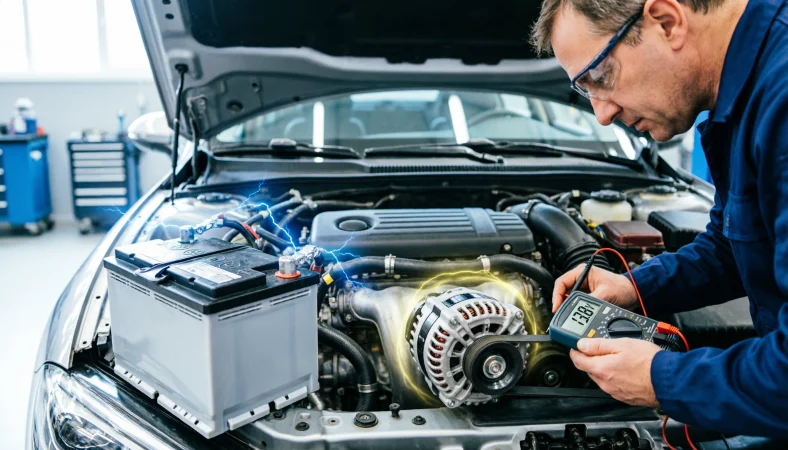
The battery stores electrical energy to start the vehicle, while the alternator generates electricity and recharges the battery while the engine runs. When a car struggles to start, develops dim lights, or shows a charging warning, understanding the difference helps identify whether the problem is a weak battery, a failing alternator, or another electrical fault.
If your vehicle suddenly refuses to start, it’s easy to blame the battery. After all, the battery is responsible for supplying the initial electrical power needed to crank the engine. But the battery isn’t the only important part of the charging system. The alternator keeps electrical systems powered after the engine starts and restores energy used during starting.
That is why knowing the difference between an alternator or battery problem matters. Replacing a battery when the alternator is failing may solve the starting problem temporarily, only for the new battery to become discharged again. Likewise, replacing an alternator when the battery is simply old can waste money.
This guide explains what each component does, how their symptoms differ, what testing can reveal, and when a charging problem requires professional attention.
Alternator or Battery: What’s the Difference?
The battery and alternator work together, but they perform different jobs. The battery is primarily an energy storage device. The alternator is an electrical generator driven by the engine.
The battery provides the strong burst of electrical energy needed by the starter motor when you turn the key or press the start button. It also supplies electricity when the engine is off and can help support the vehicle’s electrical system when demand temporarily exceeds alternator output.
The alternator takes over much of the electrical workload once the engine is running. It converts mechanical energy from the engine into electrical energy and sends that electricity through the vehicle’s charging system. At the same time, it replenishes the energy that the battery used during starting.
| Component | Main function | When it works most importantly | Common failure symptom |
| Battery | Stores electrical energy | Starting and when the engine is off | Slow or failed cranking |
| Alternator | Produces electrical energy | While the engine is running | Charging warning or electrical problems |
| Starter motor | Turns the engine during starting | When starting the engine | Clicking or no engine rotation |
| Voltage regulator | Controls charging voltage | While the engine is running | Overcharging or undercharging |
The simplest way to remember the relationship is this:
The battery stores power.
The alternator produces power.
The starter uses battery power to turn the engine.
The alternator restores the energy used by the battery.
A healthy vehicle needs all of these systems to work together.
Is Alternator or Battery a Mechanical, Electrical, or Usage Issue?
This question is primarily about automotive electrical diagnosis rather than grammar or vocabulary. The terms are not interchangeable because the two components have different functions.
A battery can be fully charged and still be defective. It may have enough voltage when sitting unused but lack the internal capacity to deliver sufficient current when the starter demands it. This is one reason a simple voltage reading doesn’t always prove that a battery is healthy.
An alternator can also produce some electricity while still failing to charge the battery properly. A weak alternator, faulty voltage regulation, damaged wiring, slipping belt, or poor electrical connection can reduce charging performance.
The distinction becomes especially important during diagnosis.
If the engine does not crank or cranks very slowly, the battery is one of the first things to investigate. If the engine starts normally but electrical problems appear while driving, the alternator and charging system deserve closer attention.
The symptoms can overlap, however. A failing alternator can eventually drain a perfectly good battery. In that situation, testing only the battery may lead to an incomplete diagnosis.
What Does the Battery Do?
The battery is essentially the vehicle’s electrical energy reservoir. In a conventional gasoline or diesel vehicle, the starter motor requires a substantial amount of electrical current to turn the engine. The battery supplies that initial burst.
It also provides electricity when the engine is switched off. For example, the battery can power interior lights, electronic systems, the alarm system, and other accessories while the vehicle is parked.
A healthy battery has enough stored energy to deliver the required starting current. Its ability to do this depends on factors such as age, temperature, state of charge, and internal condition.
Workplace Example
Imagine a delivery company preparing several vehicles for an early morning shift. One vehicle has been sitting unused for several weeks. When the driver attempts to start it, the engine turns slowly and eventually stops cranking.
A battery inspection and load test reveal that the battery cannot maintain adequate performance under starting demand. The alternator is not necessarily responsible because the problem appears before the engine has even started.
Academic Example
In an automotive technology class, a student might learn that battery voltage and battery health are not identical concepts. A battery can show a seemingly normal resting voltage while still having insufficient starting capacity.
This distinction is important because electrical diagnosis should consider both voltage and the battery’s ability to deliver current under load.
Technology Example
Modern vehicles place considerable electrical demands on their batteries. Electronic control units, security systems, sensors, communication systems, and other modules can consume small amounts of power even when the vehicle is parked.
A battery that repeatedly becomes discharged may therefore require investigation for both battery condition and unwanted electrical drain.
Battery Usage Recap
A battery primarily stores electrical energy.
It provides the initial power needed to start the engine.
It can power vehicle electronics when the engine is off.
A weak battery commonly causes slow cranking, clicking, or failure to start.
What Does the Alternator Do?
The alternator performs a different job. Once the engine is running, it generates electrical power for the vehicle and helps recharge the battery.
The alternator is driven mechanically by the engine, usually through a belt system. Inside the alternator, mechanical rotation is converted into electrical energy. The vehicle’s charging system then regulates and distributes that electrical output.
This means a vehicle can have a good battery but still develop a starting problem if the alternator fails. After the battery supplies energy to start the engine, the alternator may be unable to restore what was consumed.
A vehicle with a failing alternator may continue running for a while because the battery still contains stored energy. Eventually, however, that stored energy can become depleted.
Workplace Example
Consider a company vehicle that starts normally every morning but repeatedly develops electrical problems during long trips. The driver notices that the headlights become weaker and several warning indicators appear on the dashboard.
The pattern points toward the charging system rather than a simple starting battery problem. If alternator output is inadequate, the vehicle may eventually stop once the battery is sufficiently discharged.
Academic Example
An automotive student studying charging systems may measure voltage at the battery with the engine off and then compare it with the voltage while the engine is running.
The change in voltage can provide useful diagnostic information, although a proper diagnosis may require additional tests. A single measurement should not be treated as proof that a component has failed.
Technology Example
Modern vehicles can monitor charging voltage and electrical system performance electronically. Some models use sophisticated charging strategies that adjust alternator output according to operating conditions and electrical demand.
As a result, technicians should consider the vehicle’s specific charging architecture instead of relying exclusively on a generic rule.
Alternator Usage Recap
The alternator generates electricity while the engine runs.
It helps power the vehicle’s electrical systems.
It replenishes energy used from the battery during starting.
A failing alternator can eventually leave a healthy battery completely discharged.
When You Should NOT Assume It Is the Battery or Alternator
Not every starting or electrical problem is caused by one of these two components. Assuming the answer too quickly can lead to unnecessary replacement.
Here are several situations where another cause should be considered.
1. The Engine Does Not Crank at All
A completely silent starting attempt could involve the battery, but it could also involve the starter motor, starter relay, ignition system, wiring, or a poor electrical connection.
2. You Hear Repeated Clicking
Rapid clicking often indicates inadequate electrical power reaching the starter. A weak battery is a possibility, but loose or corroded connections can create a similar symptom.
3. The Battery Keeps Going Flat
Repeated battery discharge does not automatically mean the battery itself is defective. The alternator may not be charging correctly, or another electrical component may be drawing power while the vehicle is parked.
4. The Vehicle Starts With a Jump but Dies Later
This pattern deserves careful attention. A jump start supplies temporary electrical energy, but the vehicle still needs a functioning charging system once the engine is running.
If the alternator cannot maintain adequate electrical supply, the vehicle may eventually lose power again.
5. Electrical Accessories Behave Strangely
Flickering lights, unstable electronics, warning indicators, or unusual electrical behavior can be associated with charging problems. They may also result from wiring, grounding, battery, or control system issues.
6. The Battery Is Very Old
A battery near or beyond its expected service life may simply have reached the end of its useful capacity. Installing an alternator unnecessarily will not solve that problem.
7. The Alternator Belt Is Damaged
A charging problem can originate with the mechanical system that drives the alternator. If the belt is damaged, loose, or otherwise unable to drive the alternator properly, the alternator may not produce sufficient electrical power.
8. Connections Are Corroded
Battery terminals and electrical connections need good contact. Corrosion or looseness can create resistance that interferes with starting and charging.
Common Mistakes and Decision Rules
One of the biggest diagnostic mistakes is treating every electrical symptom as evidence of a bad battery.
| Correct statement | Incorrect assumption | Explanation |
| The battery is weak and the alternator tests normally. | The alternator must be bad because the car will not start. | A weak battery can prevent starting even when charging is normal. |
| The alternator is not charging properly. | The battery must be bad because it is discharged. | A failing alternator can discharge a healthy battery. |
| The battery terminals are corroded. | The battery must be defective. | Poor connections can interfere with current flow. |
| The starter clicks repeatedly. | The alternator caused the starting problem. | Starting symptoms often involve the battery or starting circuit. |
| The battery repeatedly loses charge overnight. | Replace the battery immediately. | The vehicle may have an electrical drain or charging issue. |
| Charging voltage is abnormal while running. | Replace the battery first. | The charging system should be investigated before replacing parts. |
Decision Rule Box
If the main problem occurs during starting, investigate the battery and starting circuit first.
If the main problem develops while the engine is running or the battery repeatedly becomes discharged, investigate the alternator and charging system as well.
This is a diagnostic starting point, not an absolute rule. Vehicle electrical systems can produce overlapping symptoms, so testing remains more reliable than guessing.
How to Test the Battery
Battery testing usually begins with a visual inspection and electrical measurements.
A technician may inspect the battery case, terminals, cables, and surrounding components. The battery’s resting voltage can provide information about its state of charge, but voltage alone does not establish whether the battery can deliver adequate starting power.
A load test or electronic battery test can provide additional information about starting performance and battery condition.
Temperature also matters. Batteries generally perform less effectively in very cold conditions, which is why a marginal battery may reveal its weakness during cold weather.
A battery that repeatedly requires charging should also be investigated for the reason behind the discharge. Simply recharging it may not address the underlying problem.
How to Test the Alternator
Alternator diagnosis generally involves checking the charging system while the engine is running.
A technician may measure voltage at the battery, observe charging behavior under different electrical loads, inspect the alternator belt, and examine wiring and connections.
Electrical load can include headlights, climate control, blower motors, heated systems, and other accessories. The purpose is to determine whether the charging system can maintain appropriate electrical performance under realistic conditions.
Modern vehicles may require more advanced diagnostic equipment because charging strategies can vary by vehicle design.
For that reason, a generic voltage number should not automatically be treated as a universal pass or fail threshold. The correct specification depends on the vehicle and charging system.
Warning Signs of a Bad Battery
Battery related symptoms often appear most clearly when starting the vehicle.
Common signs include slow engine cranking, repeated clicking during startup, difficulty starting after the vehicle has been parked, and the need for frequent jump starts.
Interior or exterior lights may also appear weaker when the engine is off.
Another important clue is age. Batteries have a finite service life, although actual longevity varies significantly according to climate, driving habits, vehicle design, maintenance, and battery quality.
A battery that has repeatedly been deeply discharged may also suffer reduced capacity.
Still, symptoms should be combined with testing. Replacing a battery solely because the vehicle failed to start can miss a charging or starting system problem.
Warning Signs of a Bad Alternator
Alternator problems often become more noticeable after the engine starts.
Possible warning signs include a battery or charging warning light, dimming or flickering lights, electrical accessories behaving inconsistently, unusual noises from the belt or alternator area, and repeated battery discharge.
In some cases, the vehicle may start normally in the morning but gradually develop electrical problems during driving.
A particularly important pattern is a battery that repeatedly becomes discharged despite being relatively new and properly maintained. This can indicate that the charging system is not restoring sufficient energy.
However, the same pattern can also result from an electrical drain or poor connection. Testing is therefore essential.
Two Diagnostic Case Studies
Case Study One: The Car That Needed a Battery
A vehicle arrives at a workshop after failing to start one morning. The starter turns the engine very slowly. The owner recently drove the car normally and reports no warning lights while driving.
Testing shows that the battery has significantly reduced starting capacity. Charging system checks indicate that the alternator is operating normally.
The appropriate repair is battery replacement rather than alternator replacement.
The practical result is that the vehicle regains reliable starting performance while the healthy charging system remains in service.
The lesson is simple: a no start condition does not automatically identify the alternator as the cause.
Case Study Two: The New Battery That Keeps Going Flat
A second vehicle receives a new battery after repeated starting problems. The vehicle starts normally after the replacement, but several days later the battery becomes discharged again.
Further investigation shows that the charging system is not maintaining adequate battery charge while the engine is running.
In this situation, the new battery did not solve the underlying problem. The battery was acting as the storage component that was repeatedly being depleted because the charging system was not restoring enough energy.
The practical result is that diagnosing the charging system prevents repeated battery replacement.
The lesson is equally important: when a replacement battery quickly becomes discharged, look beyond the battery itself.
X and Y in Modern Technology and AI Tools
Modern vehicles increasingly depend on electronic control systems, sensors, computer modules, communication networks, and sophisticated charging strategies.
This changes how electrical problems should be approached. A technician may use a diagnostic scanner alongside a multimeter, battery tester, charging system analyzer, and visual inspection.
Artificial intelligence can also assist automotive diagnostics by identifying patterns across large collections of vehicle data. For example, a diagnostic system could recognize that repeated battery discharge combined with low charging performance is more consistent with a charging system problem than ordinary battery aging.
However, AI based recommendations still depend on accurate vehicle information and reliable measurements. A computer generated suggestion should support diagnosis rather than replace physical testing.
This is particularly important because similar symptoms can originate from different components.
Technology makes diagnosis more sophisticated, but the basic relationship remains unchanged: the battery stores electrical energy, while the alternator generates electrical energy while the engine runs.
Why the Battery and Alternator Must Be Diagnosed Together
The strongest approach is not to think of the battery and alternator as isolated components.
They form part of one electrical system.
Suppose an alternator stops charging correctly. The battery initially continues supplying electrical energy. The vehicle may still start several times, creating the impression that the battery is functioning normally.
As the battery becomes progressively discharged, starting eventually becomes difficult or impossible.
The owner may then replace the battery. The vehicle starts again, but the underlying charging failure remains. The replacement battery gradually becomes discharged as well.
The opposite situation can also occur. A weak battery may cause starting problems even though the alternator is functioning properly.
This is why testing both components can be more informative than replacing whichever component seems most obvious.
Error Prevention Checklist
Always investigate the battery when
- The engine cranks slowly.
- The starter produces repeated clicking.
- The vehicle struggles after sitting.
- The battery is old or repeatedly needs charging.
- A battery test shows inadequate starting capacity.
Always investigate the alternator and charging system when
- The charging warning light appears.
- The battery repeatedly becomes discharged while driving.
- Electrical systems become weaker while the engine is running.
- Charging measurements are outside the vehicle manufacturer’s specifications.
- A relatively new battery repeatedly loses charge.
Never assume
- Never assume every no start problem is a battery failure.
- Never assume a discharged battery proves the battery itself is defective.
- Never replace an alternator without checking the charging system.
- Never ignore corroded or loose electrical connections.
- Never rely on one voltage measurement as the only diagnostic evidence.
Related Automotive Problems You Should Understand
Understanding starting and charging systems becomes much easier when you also know how related components interact.
Battery vs Starter Motor
The battery supplies electrical energy, while the starter motor converts that electrical energy into mechanical rotation to turn the engine.
Alternator vs Starter
The starter helps start the engine. The alternator produces electrical energy after the engine is running.
Battery Drain vs Dead Battery
A battery drain describes electrical consumption that reduces stored energy. A dead battery describes a battery that currently lacks enough usable energy to perform its required function.
Charging System vs Electrical System
The charging system is responsible for maintaining electrical energy during operation. The broader electrical system includes many additional components and circuits.
Voltage vs Current
Voltage describes electrical potential, while current describes the flow of electrical charge. Both matter when diagnosing vehicle electrical systems.
Battery Capacity vs Battery Voltage
Voltage and capacity describe different characteristics. A battery can show a reasonable voltage reading while still having inadequate capacity for reliable starting.
Electrical Fault vs Mechanical Fault
Some symptoms that appear electrical can originate from mechanical components such as belts, connections, or other systems that affect electrical generation.
Starting Problem vs Charging Problem
A starting problem primarily concerns getting the engine to crank and start. A charging problem concerns maintaining electrical energy after the engine is running.
FAQs.
Is the battery or alternator more likely to cause a car not to start?
The battery is a common cause of starting problems, but the alternator can also contribute indirectly by failing to recharge the battery. The starter, wiring, connections, and other components can produce similar symptoms.
How can I tell if my battery or alternator is bad?
Look at when the symptoms occur. Problems that appear mainly during starting can point toward the battery or starting circuit. Problems that develop while driving or repeatedly discharge the battery can point toward the charging system.
Can a bad alternator ruin a new battery?
Yes. If the alternator does not properly recharge the battery, a new battery can repeatedly become discharged. Continued abnormal charging conditions can also shorten battery life.
Can a bad battery damage the alternator?
A severely weak or damaged battery can place additional demands on the charging system, although battery and alternator failures have different causes. Proper diagnosis is better than assuming one component damaged the other.
Will a car run with a bad alternator?
A vehicle may continue running temporarily after an alternator failure because the battery still contains stored electrical energy. Once that energy is depleted, the vehicle may stop running or fail to restart.
Does a jump start mean the battery is bad?
Not necessarily. A jump start only shows that additional electrical energy helped the vehicle start. The underlying cause could be a weak battery, charging problem, electrical drain, poor connection, or another fault.
Can a car battery be charged if the alternator is bad?
An external battery charger can recharge a battery even when the vehicle’s alternator is not functioning correctly. However, the charging problem still needs to be repaired if the vehicle is to maintain its battery charge during normal operation.
How long does a car battery usually last?
Battery life varies with climate, vehicle design, driving habits, maintenance, and battery quality. There is no single lifespan that applies to every vehicle, so condition and test results are more useful than age alone.
What happens when an alternator stops charging?
The vehicle begins relying increasingly on stored battery energy. As that energy is consumed, electrical systems may weaken and the vehicle can eventually lose the ability to operate or restart.
Conclusion:
Understanding the difference between the alternator and battery can prevent unnecessary parts replacement and make vehicle diagnosis much clearer. The battery stores electrical energy and provides the strong burst needed for starting, while the alternator generates electrical power and replenishes the battery after the engine starts.
If the vehicle struggles to crank, begin by investigating the battery, connections, and starting circuit. If the battery repeatedly becomes discharged or electrical problems appear while driving, the alternator and broader charging system deserve attention.
The most reliable approach is testing rather than guessing. A battery test, charging system inspection, electrical connection check, and appropriate vehicle specific diagnostics can reveal the real cause.
In short, the battery supplies stored energy, the alternator produces energy while the engine runs, and both must function properly for dependable vehicle operation.