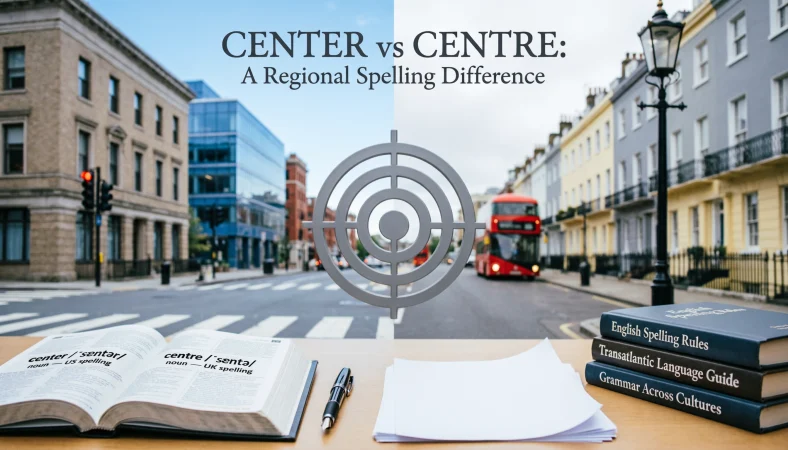
Center or centre are both correct spellings of the same English word. Center is the standard spelling in American English, while centre is preferred in British English and many other varieties influenced by British usage. The choice is mainly regional, not grammatical, so the correct form depends on your intended audience and style guide.
The question of center or centre often creates uncertainty because both forms appear in reputable dictionaries, books, websites, academic writing, and professional documents. Unlike a simple spelling mistake, this difference reflects two established standards of English.
For example, an American writer might say, “The community center is open today,” while a British writer would normally write, “The community centre is open today.” Both sentences communicate exactly the same idea.
The confusion becomes important when consistency matters. A student writing an academic paper, a company preparing international content, or an editor following a particular style guide needs to choose the appropriate spelling rather than mixing the two forms.
This article explains the difference between center and centre, when each spelling should be used, how the forms developed, and how to choose the right version confidently.
Center vs Centre: What’s the Difference?
The main difference between center and centre is geographical spelling preference. Both words function primarily as nouns and verbs, and both have the same meanings.
As a noun, the word can describe the middle point of something, a place where activities are concentrated, or an organization or facility devoted to a particular purpose.
As a verb, it means to place something at the middle or to focus something around a particular subject.
| Feature | Center | Centre |
| Part of speech | Noun and verb | Noun and verb |
| Meaning | Middle point, central place, or focus | Middle point, central place, or focus |
| Main variety | American English | British English |
| Common in | United States | United Kingdom |
| Also used in | Some international contexts | Canada, Australia, New Zealand, and other British influenced contexts |
| Pronunciation | Usually the same | Usually the same |
| Meaning difference | None | None |
The simplest rule is geographical.
Center is normally used in American English.
Centre is normally used in British English.
Neither spelling is inherently more correct than the other.
The important thing is consistency. If you begin a document using American English, continue with center. If you’re writing in British English, use centre.
A quick recap
Center is the American spelling.
Centre is the British spelling.
Both have the same meaning and pronunciation in ordinary usage.
The spelling difference does not change the grammatical function of the word.
Is Center vs Centre a Grammar, Vocabulary, or Usage Issue?
This is primarily a spelling and regional usage issue, rather than a grammar problem.
Grammar determines how a word functions within a sentence. Both center and centre can function as nouns and verbs in essentially the same grammatical patterns.
Consider these examples:
The city built a new community center.
The city built a new community centre.
The grammar is identical. Only the spelling changes.
The same applies when the word functions as a verb:
The discussion centered on education.
The discussion centred on education.
Again, the sentence structure remains the same.
The difference becomes more noticeable when a writer changes between varieties of English. American English generally uses spellings such as center, color, and organize, while British English generally uses centre, colour, and organise.
That doesn’t mean every British writer follows every traditional British spelling or every American writer follows every American spelling. English contains regional variation, and individual style guides can make specific choices.
Formal versus informal writing
Both forms are appropriate in formal writing when they match the relevant variety of English.
An American university paper can correctly use center.
A British university paper can correctly use centre.
The issue isn’t formality. It is consistency with the chosen English standard.
Academic versus casual writing
The same principle applies in academic and professional contexts.
A student in the United States would normally write:
The research center conducted a five year study.
A student in the United Kingdom would normally write:
The research centre conducted a five year study.
Neither sentence is more grammatically correct.
The best choice is the one that fits the audience, institution, publication, or style guide.
What Does Center Mean?
Center is the standard American English spelling.
As a noun, it can refer to the middle of something.
The statue stands in the center of the square.
It can also refer to a location where a particular activity or service is provided.
The children visited the science center.
The word can describe an organization or facility:
She works at a medical center.
It can also describe a position in sports, especially in American usage:
He plays center for the basketball team.
As a verb, center means to focus on or place something around a central point.
The discussion centered on climate policy.
It can also be used in a physical sense:
Center the image on the page.
The word appears extensively in American business, education, government, technology, medicine, sports, and everyday conversation.
Workplace example
Our customer service center handles inquiries from across the country.
This is the natural spelling for American English.
Academic example
The university opened a new research center for environmental studies.
Again, center fits American English.
Technology example
The company operates a data center in the region.
Technology companies frequently use this spelling when their documentation follows American English.
Usage recap
Use center when your writing follows American English.
It is appropriate in casual, professional, academic, technical, and formal contexts.
It isn’t an informal alternative to centre. Also It is the standard American spelling.
What Does Centre Mean?
Centre is the standard British English spelling.
Like center, it functions as both a noun and a verb.
As a noun, it can mean the middle of something:
The fountain is in the centre of the garden.
It can also describe a facility:
The town has a new community centre.
The same spelling appears in educational and professional contexts:
The research centre published its findings.
As a verb, centre means to focus on something or position something centrally.
The discussion centred on public health.
This form is especially common in British English and is also widely encountered in other English varieties influenced by British spelling conventions.
Workplace example
The training centre provides professional development courses.
Academic example
The university research centre focuses on renewable energy.
Technology example
The company operates a data centre in London.
Usage recap
Use centre when writing in British English.
It is fully standard in formal and academic writing.
It should not be treated as an outdated or incorrect spelling.
Center or Centre in American and British English
The regional distinction is the most useful way to understand these spellings.
American English generally uses center, while British English generally uses centre.
This difference is part of a broader pattern of spelling variation.
| American English | British English |
| center | centre |
| color | colour |
| behavior | behaviour |
| theater | theatre |
| organize | organise |
| analyze | analyse |
| traveled | travelled |
| canceled | cancelled |
There are exceptions and additional differences, so these pairs shouldn’t be treated as a complete rule for all English spelling.
One particularly interesting point is that theater and theatre can sometimes have stylistic distinctions beyond geography, especially in names of institutions or discussions of dramatic arts. That makes the broader principle more nuanced than simply changing every ending.
For center and centre, however, the regional distinction is straightforward.
When Should You Use Center?
Choose center when your content is written primarily for an American audience or follows American English conventions.
This includes situations such as American school assignments, United States government documents, American business communication, American publications, and websites whose editorial standard is American English.
For example:
The shopping center opens at nine.
The center of the circle is marked with a dot.
The company established a new training center.
The debate centered on economic policy.
All of these sentences use the standard American spelling.
If you’re writing for an international audience but your organization’s established style is American English, center can also be appropriate.
The key is to establish the spelling standard before writing and maintain it throughout the document.
When Should You Use Centre?
Choose centre when your content follows British English conventions.
This is particularly appropriate for writing intended for readers in the United Kingdom and for organizations that explicitly use British English.
For example:
The shopping centre opens at nine.
The centre of the circle is marked with a dot.
The company established a new training centre.
The debate centred on economic policy.
These sentences are standard British English.
The spelling is also common in countries and institutions where British spelling conventions have historically been influential.
When You Should NOT Mix Center and Centre
The biggest mistake isn’t necessarily choosing the supposedly wrong form. It is mixing regional spellings without a reason.
Here are several situations where you should avoid switching between the two.
1. Don’t mix them within one article
If your article uses center throughout, suddenly writing centre can make the content appear poorly edited.
2. Don’t change spelling randomly between pages
A website using American English should generally maintain that standard across its content.
3. Don’t assume one form is universally correct
British readers won’t normally consider centre strange, and American readers won’t normally consider center strange.
4. Don’t change a proper name unnecessarily
If an organization officially uses Centre in its name, preserve its official spelling.
5. Don’t choose based only on search volume
Search visibility matters, but editorial consistency and audience expectations matter more when choosing a regional spelling.
6. Don’t treat the British form as an error
Centre is not a misspelling of center.
7. Don’t treat the American form as an error
Center is not an incorrect version of centre.
8. Don’t switch varieties merely to sound more formal
Neither spelling is inherently more formal.
Common Mistakes and Decision Rules
| Correct sentence | Incorrect sentence | Explanation |
| The community center is nearby. | The community centre is nearby. | The first is appropriate for American English. |
| The community centre is nearby. | The community center is nearby. | The first is appropriate for British English. |
| The research center published its report. | The research centre published its report. | Use the first when following American English. |
| The research centre published its report. | The research center published its report. | Use the first when following British English. |
| The discussion centered on education. | The discussion centred on education. | American English generally uses the first form. |
| The discussion centred on education. | The discussion centered on education. | British English generally uses the first form. |
Decision Rule Box
- If you’re writing in American English, use center.
- If you’re writing in British English, use centre.
- If you’re writing for a specific organization, follow its established style guide.
This rule resolves most spelling questions immediately.
Center and Centre in Different Contexts
The word appears in many specialized expressions, and the same regional distinction usually continues.
Community center or community centre
Both refer to a facility serving a local community.
American:
The community center offers free classes.
British:
The community centre offers free classes.
Shopping center or shopping centre
American English generally uses shopping center.
British English generally uses shopping centre.
Research center or research centre
Academic and scientific institutions follow the regional spelling of their broader publication standard.
Medical center or medical centre
Both forms are widely used internationally.
Data center or data centre
This expression is particularly common in technology.
American technology writing normally uses data center.
British technology writing normally uses data centre.
Call center or call centre
The same pattern applies here.
American:
The call center operates twenty four hours a day.
British:
The call centre operates twenty four hours a day.
The pronunciation and meaning remain essentially unchanged.
Center or Centre in Names and Brand Identity
One important exception to general spelling rules involves proper names.
Suppose an institution is officially called European Centre for Research. You shouldn’t automatically change Centre to Center just because you’re writing in American English.
Official names have their own spelling conventions.
The same principle applies to universities, research organizations, companies, government agencies, buildings, programs, and named facilities.
For example, if an organization deliberately uses Centre in its official name, reproduce that spelling accurately.
This is a useful editorial rule:
Regional spelling can be adapted in ordinary prose, but official names should normally retain their established form.
That distinction is especially important for professional writers, editors, journalists, researchers, and SEO teams.
Center and Centre in SEO and Online Content
For SEO, the spelling choice should reflect search intent and audience rather than simply trying to rank for both forms unnaturally.
If a website targets American readers and follows American English, center should normally be the preferred spelling.
If the website targets British readers, centre will usually be the natural choice.
Search engines are capable of understanding regional spelling differences, but writers should still prioritize readability and consistency.
For example, an American audience searching for information about a shopping center would expect that spelling in the content. A British audience is more likely to expect shopping centre.
You generally don’t need to repeat both forms throughout an article simply to capture searches.
A clear explanation near the beginning can satisfy users who searched for either spelling.
For an SEO focused grammar article, however, mentioning both forms naturally is useful because the spelling difference itself is the searcher’s question.
Center and Centre in Academic Writing
Academic writers should pay particular attention to institutional conventions.
Universities often recommend a particular English variety for assignments, dissertations, theses, and publications. A student should follow the required style rather than choosing between spellings based on personal preference.
For American academic writing:
The research center collected the data.
For British academic writing:
The research centre collected the data.
Neither version is grammatically superior.
Consistency becomes especially important in long academic documents. If a paper contains dozens of occurrences, switching between center and centre can suggest that multiple editorial standards were mixed together.
The same principle applies to related spelling choices.
A document using center, color, and behavior should generally not suddenly switch to centre, colour, and behaviour without a deliberate reason.
Why Do Center and Centre Have Different Spellings?
The spelling difference developed through the history of English rather than because the words have different meanings.
English absorbed vocabulary and spelling patterns from several languages, including French and Latin. The word associated with the middle of something ultimately traces back through French and Latin forms related to the idea of a central point.
Over time, English spelling developed differently in different regions.
American English underwent a number of spelling standardization changes that favored forms such as center and theater. British English retained or developed forms such as centre and theatre.
This is why the spelling difference is best understood as a historical and regional feature of English.
It isn’t the result of one spelling becoming corrupted or another becoming more sophisticated.
An Expert Perspective on Regional Spelling
A useful editorial principle is:
“Good spelling is not only about correctness. It is also about consistency, audience, and context.”
That principle explains why center and centre can both be correct.
Professional editing isn’t simply about identifying one universal spelling and rejecting every alternative. Effective editing considers the variety of English being used, the intended audience, the publication’s standards, and the context in which a word appears.
For writers, this approach is more useful than memorizing isolated spelling rules.
Two Practical Case Studies
Case Study 1: An American education website
Imagine an education website targeting teachers and parents in the United States.
Its editorial team chooses American English as its standard. Articles use color, behavior, and center consistently.
An article about local educational facilities therefore says:
The learning center provides tutoring for students.
If the editor changed only one occurrence to learning centre, the sentence would still be understandable and technically recognizable, but the inconsistency could make the content look less polished.
The practical result is simple: selecting one English variety and applying it consistently improves editorial quality.
Case Study 2: A British technology publication
Now consider a technology publication aimed primarily at readers in the United Kingdom.
Its writers use centre, colour, and organisation according to its editorial standard.
An article about cloud infrastructure says:
The data centre supports thousands of connected devices.
Changing the spelling to data center would not alter the technical meaning, but it would introduce an American spelling into otherwise British English.
The practical result is the same: consistency matters more than treating either regional form as universally superior.
These examples demonstrate an important point. The spelling decision is usually not about right versus wrong. It is about choosing the appropriate English standard and applying it consistently.
Center or Centre in Modern Technology and AI Tools
Modern technology has made regional spelling differences especially visible.
Software interfaces, documentation, artificial intelligence systems, search engines, and digital publications often serve users from multiple English speaking regions.
An AI writing tool may generate center when responding in American English and centre when following British English conventions.
For example, a prompt asking for British English might produce:
The new research centre will open next year.
An American English version would normally use:
The new research center will open next year.
Neither output needs to be treated as an error simply because the other spelling is more familiar to the reader.
For content teams using AI, the important practice is to specify the desired English variety and then review the output for consistency.
AI can recognize regional spelling patterns, but human editorial review remains valuable when a document must follow a strict publication standard.
Error Prevention Checklist
Always use center when
- ☑ Your audience primarily uses American English.
- ☑ Your organization’s style guide requires American English.
- ☑ You’re writing American English academic or professional content.
- ☑ You’re describing ordinary American usage.
- ☑ You want consistency with other American spellings in the same document.
Always use centre when
- ☑ Your audience primarily uses British English.
- ☑ Your organization’s style guide requires British English.
- ☑ You’re writing British English academic or professional content.
- ☑ You’re describing ordinary British usage.
- ☑ The established name of an institution contains Centre.
Never mix the forms casually
- ☑ Choose your English variety before writing.
- ☑ Check the style guide when one exists.
- ☑ Preserve official names.
- ☑ Review long documents for regional spelling consistency.
Related Grammar Confusions You Should Master
Understanding regional spelling is only one part of mastering English usage. Several other commonly confused forms deserve attention.
- Color or colour
Another major American and British spelling difference. - Theater or theatre
A regional spelling difference with some additional contextual nuances. - Behavior or behaviour
Common in academic and professional writing. - Organize or organise
A frequently encountered difference between English varieties. - Analyze or analyse
Especially relevant in academic and scientific writing. - Traveling or travelling
A spelling distinction involving doubled consonants. - Canceled or cancelled
Commonly confused in American and British English. - Learned or learnt
Both can be correct, but usage varies by region and context. - Aging or ageing
Another spelling variation that often causes uncertainty. - Catalog or catalogue
A familiar regional spelling difference involving American and British English.
Learning these pairs together helps writers recognize the larger system behind regional English rather than memorizing individual words.
FAQs
Is center or centre correct?
Both spellings are correct. Center is standard in American English, while centre is standard in British English and several other varieties that use British spelling conventions.
Is center American or British?
Center is primarily the American English spelling. American publications, businesses, schools, and websites generally use this form.
Is centre British or American?
Centre is primarily the British English spelling. It is also used in several other English varieties influenced by British spelling.
Do center and centre mean the same thing?
Yes. In ordinary usage, they have the same meaning. Both can refer to the middle of something, a central location, a facility, or a point of focus.
Is centre a misspelling of center?
No. Centre is a standard spelling in British English and should not be considered a misspelling.
Is center a misspelling of centre?
No. Center is the standard American English spelling and is completely correct when American English is being used.
Should I use center or centre in academic writing?
Use the form required by your institution, publisher, or chosen English variety. American academic writing normally uses center, while British academic writing normally uses centre.
Should I use center or centre for SEO?
Choose the spelling that matches your primary audience and content standard. Don’t switch between the forms randomly. Mentioning both naturally can be useful when the article specifically explains the spelling difference.
Which spelling should international writers use?
There is no single answer for every international writer. The best choice depends on the intended audience, organization, publisher, and style guide. Consistency is more important than choosing one form as universally correct.
Why do American and British English spell center differently?
The difference developed through the historical evolution and standardization of English spelling. American English adopted or standardized several forms that differ from traditional British conventions, including center and theater.
Conclusion:
When deciding between center or centre, think about English variety rather than right versus wrong. Center is the standard American spelling, while centre is the standard British spelling. Both words have the same basic meanings, grammatical functions, and pronunciation.
The most important rule is consistency. If you’re writing for an American audience, center will usually be the natural choice. If you’re writing for a British audience, choose centre. For academic, professional, and commercial content, always consider the relevant institutional or editorial style guide.
Once you understand that the difference is regional, the choice becomes straightforward. You don’t need to memorize which spelling is supposedly correct because both are correct in the appropriate variety of English.