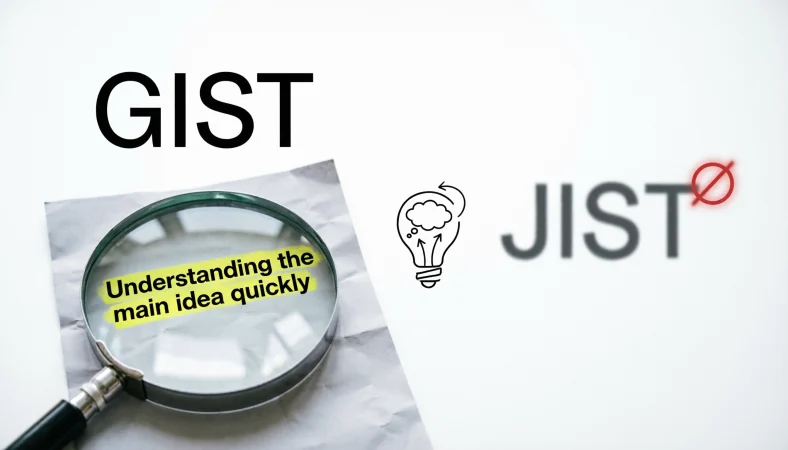
Gist is the correct standard spelling, while jist is a common misspelling. “Gist” means the main point, essential meaning, or central idea of something. For example, “I didn’t understand every detail, but I understood the gist of the conversation.” If you’re writing formally or professionally, always use gist.
Have you ever wondered whether the correct spelling is gist or jist? Because the word is often pronounced with a soft “j” sound, it’s easy to assume that “jist” is the correct spelling. However, standard English uses gist, and “jist” is generally considered a misspelling. This guide explains the meaning, pronunciation, origin, and correct usage of “gist” with clear examples so you can avoid this common spelling mistake.
Introduction: Why Gist or Jist Causes Confusion
If you have ever wondered whether to write gist or jist, you’re dealing with a spelling and vocabulary question rather than two standard English words with different meanings. The word gist refers to the central point or essential meaning of something. The spelling “jist” is not the accepted standard spelling for that meaning.
This confusion is understandable because English pronunciation doesn’t always reveal spelling. In ordinary speech, gist begins with the same sound heard at the beginning of words such as “gym,” “giant,” and “gesture.” Someone who has mainly encountered the word in conversation may reasonably guess that it begins with the letter J.
That guess, however, creates a problem in written English. Using “jist” in an essay, business email, report, application, or academic assignment can make the writer appear unfamiliar with the standard spelling.
The good news is that the distinction is simple once you know it. When you mean the central idea or main point, write gist.
The word is common in everyday English, journalism, education, business communication, literature, and technology. Understanding its meaning also makes it easier to use naturally rather than simply memorizing its spelling.
Gist vs Jist: What’s the Difference?
The most important point is that gist and “jist” are not normally two alternative spellings that you can choose according to preference. In standard modern English, gist is the correct spelling for the noun meaning the essential point or main idea.
“Jist” is generally treated as a misspelling of gist when the intended meaning is “the main point.”
Comparison of Gist and Jist
The distinction can be remembered quite easily.
Gist is the accepted spelling.
It means the central idea or essential point.
“Jist” is normally a spelling mistake when used with this meaning.
The pronunciation can make the incorrect spelling seem logical, but standard written English uses gist.
What Does Gist Mean?
Gist is a noun that refers to the main idea, central point, or essential meaning of something.
For example:
I didn’t read the entire report, but I understood the gist.
This means the speaker understood the main point of the report without necessarily knowing every detail.
Another example is:
She explained the gist of the conversation to me.
Here, gist refers to the most important information from the conversation.
The word is especially useful when someone wants to distinguish the overall meaning from minor details.
Consider this situation. A manager gives a fifteen minute explanation of a new workplace policy. Later, an employee tells a colleague:
I missed the meeting, but can you give me the gist?
The employee isn’t asking for every sentence spoken during the meeting. They want the essential information.
That is exactly where gist fits naturally.
Is Gist or Jist a Grammar, Vocabulary, or Spelling Issue?
This is primarily a spelling and vocabulary issue.
Grammar determines how words function in sentences. Vocabulary concerns the words themselves and their meanings. Spelling determines how those words are correctly represented in writing.
In this case, the important distinction is that gist is the standard English word, while “jist” is generally not an accepted alternative spelling for the same meaning.
Are Gist and Jist Interchangeable?
No.
You should not treat them as interchangeable spellings.
If you are writing:
I understand the gist of your argument.
you should not replace gist with “jist.”
The same applies in academic writing, professional communication, social media posts, articles, reports, and formal documents.
Is Gist Formal or Informal?
Gist works in both formal and informal contexts.
You can say:
I got the gist of the presentation.
That sounds natural in conversation.
You can also write:
The study provides the gist of the proposed theoretical framework.
Although that sentence is more formal, the word itself remains perfectly acceptable.
In very formal writing, alternatives such as “central argument,” “principal finding,” “essential point,” or “overall meaning” may sometimes be more precise. However, gist is not inherently informal.
Is Gist Appropriate in Academic Writing?
Yes.
For example:
Students should identify the gist of a passage before analyzing its individual arguments.
That sentence is grammatically correct and appropriate in an educational context.
However, academic writers should consider precision. If you specifically mean an author’s central argument, “central argument” may communicate more information than “gist.”
How to Use Gist Correctly
The easiest way to understand the word is to see it in different situations.
Workplace Example
Imagine an employee asks a colleague about a meeting they couldn’t attend.
Can you give me the gist of the meeting?
The colleague might answer:
The gist is that the company will change the reporting process next month.
Here, gist introduces the most important information.
Another example:
I read the proposal quickly, but I got the gist.
This means the reader understood the general idea even though they didn’t study every detail.
Academic Example
Students frequently encounter the word when reading difficult material.
After reading the chapter, explain the gist of the author’s argument.
The assignment asks students to identify the central idea rather than reproduce every supporting detail.
A teacher might also say:
Don’t worry about every unfamiliar word at first. Try to understand the gist of the passage.
This is particularly useful when teaching reading comprehension.
Technology Example
The word is also natural in discussions about software, documentation, articles, and online content.
I didn’t read the entire technical document, but I understand the gist.
Or:
The AI summarized the article and captured its gist.
The word works well because digital information is often long, while users frequently need only the central idea.
Usage Recap
Use gist when you mean the main point or essential meaning.
It can appear in casual conversation, workplace writing, academic discussion, journalism, and technology contexts.
You don’t need to avoid it simply because it sounds conversational.
Gist in Common Expressions
One reason the word is so useful is that it appears in several familiar expressions.
Get the Gist
To get the gist means to understand the basic idea.
I didn’t understand every technical term, but I got the gist.
The Gist of Something
This construction identifies the central meaning of something.
What was the gist of the email?
She explained the gist of the proposal.
Give Someone the Gist
This means to summarize the most important information.
Give me the gist before I read the full report.
These expressions are extremely common, so recognizing them helps with both reading and listening comprehension.
When You Should Not Use Gist or Jist
There are situations where gist may not be the most precise choice. There are also situations where “jist” should simply be avoided.
1. When You Mean Every Detail
Gist refers to the main idea, not complete information.
Instead of:
I need the gist of every sentence.
say:
I need a detailed explanation of every sentence.
2. When Exact Wording Matters
If you’re discussing a contract, legal document, quotation, or technical specification, the exact wording may matter more than the gist.
3. When You Need a Specific Finding
In research writing, “main finding” may be more precise than gist.
4. When You Mean a Complete Summary
A gist can be very brief. A complete summary may include major supporting points, evidence, and conclusions.
5. When Writing “Jist” as an Alternative
Don’t use “jist” as an alternative spelling for gist in standard English.
6. When You Mean a Particular Argument
If someone made several arguments, saying “the gist” might be vague. “The author’s central argument” could be more accurate.
7. When Precision Is More Important Than Brevity
Technical, scientific, and legal writing often benefits from exact terminology rather than a general reference to the main idea.
Common Mistakes: Correct and Incorrect Sentences
Decision Rule
If you mean the main point, central idea, or essential meaning, use “gist.” If you are tempted to write “jist” because of the pronunciation, remember that the standard spelling is “gist.”
This simple rule solves the spelling question in most situations.
Why Is Gist Pronounced With a J Sound?
This is one of the main reasons people spell the word incorrectly.
In English, the letter g can represent different sounds.
Compare:
give
and:
giant
In “give,” the g has a hard sound. In “giant,” it has a soft sound.
The same soft g pronunciation occurs in gist.
The beginning of gist therefore sounds similar to the beginning of words such as “giant” and “gym.”
Pronunciation alone doesn’t tell you which letter to write. English spelling contains many examples where a sound can be represented in ways that aren’t immediately obvious to learners.
This is why someone may hear “gist” and instinctively write “jist.”
Etymology of Gist
The history of gist is unusual and helps explain why the word looks different from many of its modern synonyms.
The English noun developed from an Anglo French legal expression associated with the meaning “it lies” or “it rests.” The term became connected with the essential point or substance of a legal action.
Over time, its meaning broadened. Modern English uses gist to mean the essential point, central meaning, or main substance of something.
That historical development is a useful reminder that modern word meanings don’t always remain tied to their original legal or technical contexts.
Gist and Meaning: What Is the Difference Between Gist and Summary?
These words overlap, but they aren’t identical.
A summary is a shortened account of something. It may contain several important details.
A gist is the essential point or general meaning.
For example, suppose a ten page report explains a company’s financial performance.
A summary might discuss revenue, expenses, market conditions, risks, and recommendations.
The gist might simply be:
The company performed well overall but faces financial risks next year.
The summary can be longer. The gist is usually more concentrated.
This distinction is valuable when choosing words for academic and professional writing.
Gist vs Main Idea
Gist and main idea are closely related.
In reading instruction, “main idea” often refers to the central idea communicated by a passage.
Gist can be broader and sometimes refers to a general understanding rather than a formally stated central proposition.
For example:
I got the gist of the conversation.
This doesn’t necessarily mean the conversation had one clearly stated main idea. It means the listener understood what it was generally about and what mattered most.
Gist vs Essence
Essence refers to the fundamental nature or most important quality of something.
Gist usually refers to the central point or meaning of information, communication, or an argument.
Compare:
I understand the gist of the article.
with:
Trust is the essence of their relationship.
The first sentence concerns information. The second concerns a fundamental quality.
Gist in Modern Technology and AI Tools
The word gist has become particularly useful in the age of digital information.
People regularly encounter long reports, articles, transcripts, documentation, emails, research papers, and meeting records. They often want the essential information without reading every word.
That makes expressions such as these increasingly natural:
Give me the gist of this report.
Can you explain the gist of the meeting?
What is the gist of this research paper?
AI systems are frequently used for summarization, but the distinction between gist and detailed summary remains important. A short AI generated explanation may communicate the gist while leaving out qualifications, evidence, exceptions, or technical details.
For important decisions, understanding the gist should therefore be treated as a starting point rather than a substitute for reviewing the original material.
Authority and Trust: Why Correct Spelling Matters
Spelling accuracy affects how readers perceive written communication.
A single typo doesn’t automatically indicate poor writing. Everyone makes mistakes. However, repeated use of a nonstandard spelling can reduce confidence in an article, report, application, or professional message.
Consider the difference between:
I understand the gist of the proposal.
and:
I understand the jist of the proposal.
The meaning is still understandable. Yet the first sentence follows standard spelling conventions, while the second immediately attracts attention because “jist” is not the standard form.
For professional writers, editors, teachers, students, and content creators, small spelling distinctions matter because credibility is built through many details.
An Expert Style Principle
“When pronunciation suggests one spelling but standard dictionaries establish another, follow the established written form.”
That principle applies beyond this particular word. English contains many words whose pronunciation can tempt writers toward an incorrect spelling.
Two Practical Case Studies
Case Study One: Academic Writing
Imagine a student writing an essay about a difficult research article. The student writes:
The jist of the author’s argument is that social behavior changes with technology.
The intended meaning is clear, but the spelling error weakens the sentence.
Correcting it gives:
The gist of the author’s argument is that social behavior changes with technology.
The change is small, but the result is appropriate for academic writing.
Case Study Two: Workplace Communication
Imagine an employee responding to a manager:
Thanks for the explanation. I understand the gist and will update the report accordingly.
This communicates that the employee understands the central message without claiming to have memorized every detail.
If the employee writes “jist,” the message remains understandable, but the spelling error can look careless in a professional setting.
These examples demonstrate why recognizing the standard form is useful even when the incorrect version doesn’t prevent comprehension.
Error Prevention Checklist
Always Use Gist When
- You mean the main point.
- You mean the central idea.
- You mean the essential meaning.
- You are asking for a short explanation of something.
- You are describing someone’s overall argument.
- You are referring to the substance of a conversation or document.
Never Use Jist When
- You mean the main point.
- You are writing an academic assignment.
- You are preparing a professional email.
- You are publishing an article.
- You are writing a report.
- You are creating formal documentation.
- You are trying to use the standard English noun meaning “main point.”
Related Spelling Confusions You Should Master
Learning one commonly confused word often leads to other useful spelling distinctions. Here are several worth studying:
- Definitely or definately
- Separate or seperate
- Receive or recieve
- Occasion or occassion
- Necessary or neccessary
- Embarrass or embarass
- Principal or principle
- Affect or effect
- Advice or advise
- Lose or loose
These pairs illustrate an important feature of English. Pronunciation, spelling, and meaning don’t always line up perfectly. Strong writers learn to recognize the standard written form rather than relying entirely on sound.
FAQs
Is gist or jist correct?
Gist is correct when you mean the main point, central idea, or essential meaning. “Jist” is generally a misspelling of the word.
What does gist mean?
Gist means the main point, central idea, or essential meaning of something. It can describe the important part of a conversation, article, argument, report, or explanation.
Is jist a word?
“Jist” is not the standard spelling of the English noun meaning the main point. In ordinary standard English writing, use gist.
Why do people spell gist as jist?
The confusion comes largely from pronunciation. The initial g in gist has a soft sound that resembles the sound represented by j in words such as “jungle” and “job.”
How do you use gist in a sentence?
You can say, “I didn’t read the whole report, but I understood the gist.” Here, the word means the main idea or essential meaning of the report.
What is the difference between gist and summary?
A gist is the central point or general meaning of something. A summary is a shortened account that can include several important details. A summary is often longer and more detailed than a gist.
Is gist formal or informal?
Gist can be used in both formal and informal English. It appears in everyday conversation as well as academic, professional, journalistic, and educational writing.
What does get the gist mean?
“Get the gist” means to understand the main point or general meaning of something without necessarily understanding every detail.
Can I use gist in academic writing?
Yes. Gist is grammatically correct and acceptable in academic writing. However, writers should choose more specific terms such as “central argument” or “main finding” when greater precision is needed.
How can I remember the spelling of gist?
Remember that the standard spelling is gist, even though the first sound resembles the sound of j. Connecting the word with “main idea” can help reinforce the correct spelling.
Conclusion:
When deciding between gist or jist, the answer is straightforward: use gist when you mean the main point, central idea, or essential meaning. The spelling “jist” usually results from hearing the soft g sound and writing the word the way it seems to sound.
The distinction matters because gist is standard in everyday speech, academic writing, professional communication, journalism, and technology. Once you connect the word with the idea of an essential point, the correct spelling becomes much easier to remember.
So if you’re writing about the main idea of an article, the central point of a conversation, or the essential meaning of an argument, choose gist.











17 thoughts on “Gist or Jist? Which Word Is Correct? Meaning, Spelling & Examples For 2026”