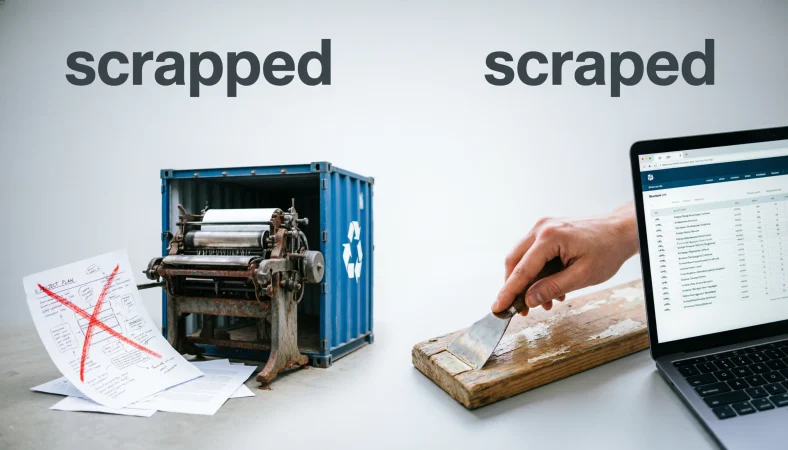
Scrapped or scraped: Both words are correct, but they have different meanings. Scraped means rubbed or dragged something against a surface, while scrapped means discarded, abandoned, or decided not to continue with something.
Choosing between scrapped or scraped can be confusing because the words look and sound similar. However, each word describes a different action. “Scraped” is the past tense of “scrape,” which means to rub, scratch, or remove something from a surface. “Scrapped” is the past tense of “scrap,” meaning to throw something away, cancel a plan, or abandon an idea.
If you are searching for scraped meaning, scrapped meaning, or scraped vs scrapped, the easiest way to remember the difference is to connect “scraped” with scratching and “scrapped” with discarding. For example, you might have scraped your knee after falling, but a company might have scrapped a project because it was too expensive. Understanding this distinction helps you choose the right spelling in everyday and professional writing.
Scraped meaning
“Scraped” means rubbed or dragged against a surface, often causing a scratch or removing material. For example, “She scraped her knee when she fell off her bike.”
Scrapped meaning
“Scrapped” means discarded, canceled, or abandoned. For example, “The company scrapped its original plan after reviewing the costs.”
Scraped
“Scraped” is the past tense and past participle of “scrape.” It describes rubbing something against a surface or removing material, such as scraping paint off a wall.
Scraped vs scrapped
“Scraped” refers to scratching or rubbing a surface, while “scrapped” means getting rid of something or abandoning a plan. You scraped the dirt off your shoes, but you scrapped an idea you no longer wanted to pursue.
Scrapped or scraped
Use “scraped” when describing a scratch or the removal of something from a surface. Use “scrapped” when something has been canceled, rejected, or thrown away.
Scrapped
“Scrapped” is the past tense and past participle of “scrap.” It means discarded or abandoned, as in “They scrapped the old design and started again.”
Meaning of scraped
The meaning of “scraped” depends on the context, but it usually describes rubbing, scratching, or removing something from a surface. For example, “He scraped the mud from his boots.”
Scraped mean
“Scraped” means rubbed, scratched, or cleared something from a surface. For example, “I scraped the remaining food from the plate before washing it.”
Scrapted
“Scrapted” is not a standard English word and is generally a spelling mistake. Depending on your intended meaning, use “scraped” for rubbing or scratching and “scrapped” for abandoning or discarding something.
Scrapped or Scraped: What’s the Difference?
The simplest distinction is based on the verbs from which these words come.
Scrapped is the past tense and past participle of scrap. As a verb, scrap means to discard something, abandon a plan, cancel an idea, or break something down for parts or recycling.
Scraped is the past tense and past participle of scrape. As a verb, scrape means to rub something against a surface, remove something by rubbing or cutting, or collect information from a source.
| Word | Base verb | Part of speech | Main meaning | Example |
| Scrapped | Scrap | Verb form | Discarded or canceled | The company scrapped the old plan. |
| Scraped | Scrape | Verb form | Rubbed, removed, or collected | She scraped the paint from the wall. |
The two words therefore describe different actions.
Scrapped often involves getting rid of something completely or abandoning it.
Scraped usually involves contact with a surface or the collection or removal of material.
In technology, scraped has another important meaning. It can describe collecting information from websites or other digital sources through automated methods.
Is Scrapped or Scraped a Grammar, Vocabulary, or Usage Issue?
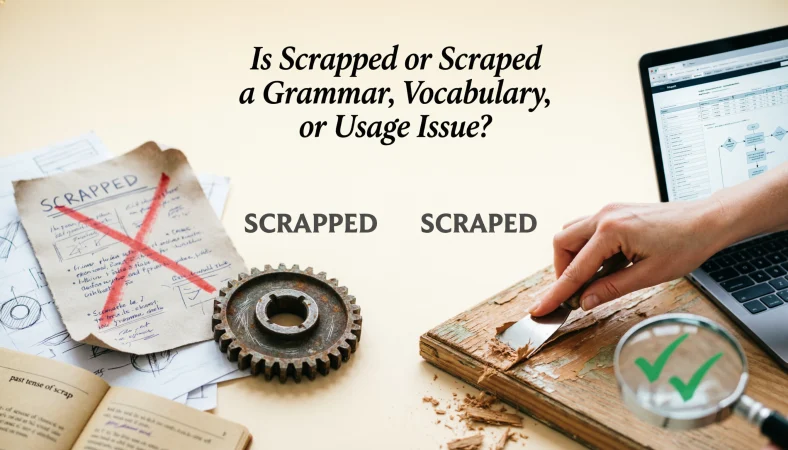
This is primarily a vocabulary and usage issue, rather than a complicated grammar rule.
Both words are grammatically correct. The problem occurs when a writer chooses the wrong word for the intended meaning.
Consider these two sentences:
The company scrapped the project.
This means the company canceled or abandoned the project.
Now compare:
The company scraped the website.
In a technology context, this generally means that the company collected information from the website through a scraping process.
The grammatical structure is similar, but the vocabulary creates a completely different meaning.
Formal and informal usage
Both scrapped and scraped appear in formal and informal English.
You can use “scrapped” in business reports, news articles, academic discussions, and everyday conversation when you mean that someone abandoned or discarded something.
You can use scraped in technical documentation, research discussions, workplace communication, and everyday descriptions of physical actions.
Academic usage
Academic writers frequently use scraped when discussing data collection.
For example:
Researchers scraped publicly available information from several websites.
They may use scrapped when describing a discontinued policy, experiment, proposal, or research plan.
The researchers scrapped the original methodology after identifying several problems.
The key is meaning, not formality.
How to Use Scrapped Correctly
Scrapped comes from the verb scrap.
The verb scrap has several closely related meanings, but they share the idea of getting rid of something, abandoning it, or treating it as no longer useful.
Scrapped meaning discarded
A person can scrap an old machine, vehicle, appliance, or piece of equipment.
The mechanic scrapped the damaged engine.
Here, people considered the engine no longer worth repairing or keeping.
The word can also describe physical objects sent for recycling or recovery of useful materials.
The factory scrapped several outdated machines.
Scrapped meaning canceled
One of the most common modern uses involves plans, projects, proposals, or ideas.
The company scrapped its expansion plans.
This means the company decided not to continue with the plans.
Another example is:
The school scrapped the proposed schedule.
People abandoned the schedule rather than physically rubbing or removing it.
Scrapped in the workplace
Imagine that a company has spent several months developing a new product. After reviewing the costs, management decides that the product is not commercially viable.
A natural sentence would be:
Management scrapped the project after reviewing the financial projections.
Using scraped here would be incorrect because the company did not rub, remove, or collect anything.
Scrapped in academic writing
Academic writing can use scrapped when researchers abandon an approach.
The research team scrapped the original hypothesis after preliminary testing produced inconsistent results.
This sentence clearly indicates that someone abandoned the original approach.
Scrapped in technology
Technology companies can also scrap software projects, features, designs, or development plans.
The development team scrapped the original interface design.
The team didn’t physically scrape the interface. It abandoned the design.
Usage recap
Use scrapped when something is:
- discarded
- canceled
- abandoned
- rejected
- removed from consideration
- broken down as unwanted material
The underlying idea is that people no longer keep or pursue something.
How to Use Scraped Correctly
Scraped comes from the verb scrape.
The word commonly describes physical contact with a surface, removal of material, or collection of information.
Scraped meaning rubbed against a surface
A person can scrape a knee, hand, arm, or another part of the body against a rough surface.
He scraped his knee on the pavement.
The skin came into contact with the pavement and suffered a minor injury.
You can also scrape an object against another object.
The car scraped the wall while turning.
Here, the side of the car rubbed against the wall.
Scraped meaning removed from a surface
The verb can also describe removing material from something.
She scraped the mud from her boots.
Someone physically removed the mud.
Another example is:
He scraped the old paint from the door.
Again, the action involves removing material from a surface.
Scraped meaning collected data
In computing and digital research, scraped has a specialized meaning.
Web scraping refers to the automated or programmatic collection of information from websites.
For example:
The program scraped product information from several pages.
This means the program collected information from those pages.
The meaning has nothing to do with canceling a project.
Scraped in the workplace
A marketing analyst might collect publicly available information from various websites.
The analyst scraped publicly available product data for comparison.
In this context, scrapped would suggest that the analyst discarded the data rather than collected it.
Scraped in academic writing
Researchers sometimes use scraping techniques to gather large datasets.
The researchers scraped publicly accessible text for their linguistic analysis.
The word describes data collection rather than cancellation.
Scraped in technology
This is one of the most important technical uses.
The application scraped prices from several online sources.
The application collected information.
The related noun scraping is common in technical discussions, while scraper can refer to software designed to collect information.
Usage recap
Use scraped when something has been:
- rubbed against a surface
- injured through contact with a rough surface
- removed from a surface
- collected from a website or digital source
The exact meaning depends on context.
When You Should NOT Use Scrapped or Scraped
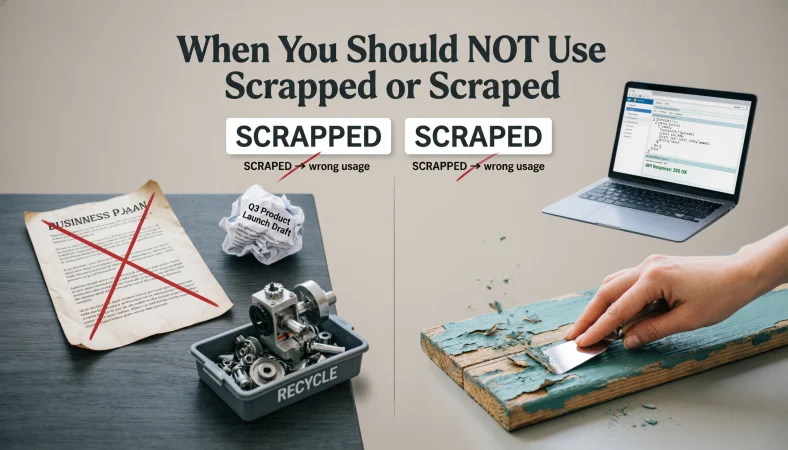
Knowing when to avoid each word can prevent subtle but important errors.
1. Do not use scrapped for physical rubbing
Incorrect:
I scrapped my knee on the sidewalk.
Correct:
I scraped my knee on the sidewalk.
The injury results from rubbing against the surface, so scraped is appropriate.
2. Do not use scraped for a canceled plan
Incorrect:
The company scraped the project.
Correct:
The company scrapped the project.
The company abandoned the project, so scrapped is the correct form.
3. Do not use scrapped when discussing data collection
Incorrect:
The program scrapped the website for information.
Correct:
The program scraped the website for information.
The program collected information, which is the technical meaning of scraped.
4. Do not use scraped when something was abandoned
Incorrect:
The committee scraped the proposal.
Correct:
The committee scrapped the proposal.
The proposal was canceled or rejected.
5. Do not confuse scraping with scraping together
There is another expression worth noticing.
They scraped together enough money.
Here, scraped together means gathered something with difficulty.
It does not mean canceled or discarded.
6. Do not assume similar spelling means similar meaning
The extra c in scraped does not make it a variation of scrapped. The words come from different verbs.
7. Do not rely only on pronunciation
In some accents, the difference can be difficult to hear in rapid speech. Writing requires you to identify the intended meaning before choosing the spelling.
8. Do not use either word without considering context
A sentence such as:
The data was scrapped.
could mean the data was discarded.
A sentence such as:
The data was scraped.
could mean the data was collected through a scraping process.
The surrounding context matters.
Common Mistakes and Decision Rules
The most reliable approach is to identify the action first.
Decision Rule
If you mean discarded, canceled, abandoned, or rejected, use scrapped.
If you mean rubbed, physically removed, or collected from a digital source, use scraped.
This rule covers most everyday cases.
Scrapped or Scraped in Modern Technology and AI Tools

Technology has made the distinction especially important because scraped has become a common technical term.
Web scraping involves collecting information from websites. Software can extract structured or unstructured information from pages and organize it for analysis.
For example:
The system scraped publicly available product descriptions.
The action is information collection.
AI systems and machine learning projects may also involve large datasets collected from online sources. In discussions about training data, researchers and engineers may use scraped to describe information gathered from websites.
By contrast, a technology company might scrap an AI feature if testing shows that it does not meet performance, safety, cost, or product requirements.
For example:
The company scrapped the experimental AI feature after internal testing.
The difference is straightforward:
Scraped data means data was collected.
“Scrapped software” means developers abandoned the software or feature.
These two expressions can appear in the same technology discussion while describing completely different actions.
The Etymology of Scrapped and Scraped
The distinction becomes easier to remember when you consider that the words come from separate verbs.
Scrap developed around the idea of a small leftover piece or discarded material. The verb eventually acquired the meaning of throwing something away, abandoning it, or dismantling it for scrap.
Scrape has a much older history connected with rubbing or scratching a surface. Its modern meanings retain that physical idea. When someone scrapes a surface, they rub against it or remove material from it.
The technical expression web scraping developed from this same general concept of extracting or removing information from a source.
So although scrap and scrape look similar, their histories reflect different concepts.
An expert style rule
“Choose the word according to the action, not according to how similar the spellings look.”
That principle works particularly well here because the two words are easy to confuse visually but have distinct meanings.
Two Practical Case Studies
Case Study 1: A canceled business project
Suppose a company plans to open a new office. After analyzing costs, leadership decides that the expansion is no longer financially practical.
The correct sentence is:
The company scrapped its plans to open a new office.
Here, scrapped communicates abandonment.
If a writer used scraped, readers could mistakenly interpret the sentence as describing a physical or technical process.
Case Study 2: Collecting online information
Now imagine that a research team creates software that gathers publicly available information from many webpages for analysis.
The correct sentence is:
The research team scraped information from hundreds of webpages.
Here, scraped describes data collection.
If the writer used scrapped, the sentence would suggest that the research team discarded the information rather than collected it.
These examples show why spelling accuracy matters. A single letter can change the action being described.
Error Prevention Checklist
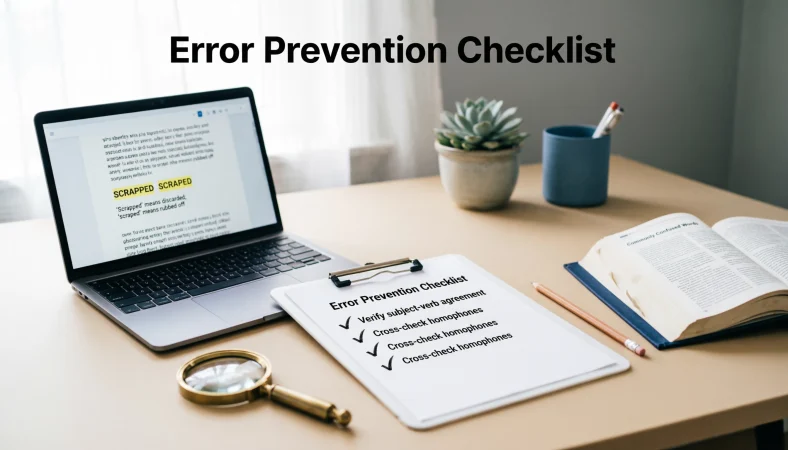
Always use scrapped when:
- ☑ Someone canceled the plan.
- ☑ Someone abandoned the project.
- ☑ Someone rejected or discarded the proposal.
- ☑ Someone sent the machine or object for disposal or recycling.
- ☑ Someone considered it no longer worth keeping.
Always use scraped when:
- ☑ Something rubbed against a surface.
- ☑ Someone injured their skin through contact with a rough surface.
- ☑ Material was removed from a surface.
- ☑ Information was collected from a website.
- ☑ A software tool gathered online information.
Never use scraped when:
The intended meaning is canceled, abandoned, or discarded.
Never use scrapped when:
The intended meaning is rubbed, physically removed, or collected as data.
Related Grammar Confusions You Should Master
English contains many pairs that look or sound similar but perform different jobs. Learning these distinctions can improve spelling accuracy and overall writing quality.
Affect or effect
Affect usually functions as a verb meaning to influence, while effect commonly functions as a noun meaning a result.
Advice or advise
Advice is a noun. Advise is a verb.
Breath or breathe
Breath is a noun referring to air taken into or expelled from the lungs. Breathe is the verb.
Lose or loose
Lose means to misplace or fail to win. Loose means not firmly attached or tight.
Practice or practise
In American English, practice serves as both noun and verb. British English generally uses practice as a noun and practise as a verb.
Passed or past
Passed is generally a verb form. Past can function as a noun, adjective, adverb, or preposition depending on context.
Stationary or stationery
Stationary means not moving. Stationery refers to writing materials.
Principal or principle
A principal can refer to a person in authority or something of primary importance. A principle is a rule, belief, or guiding idea.
Compliment or complement
A compliment expresses praise. A complement completes or enhances something.
Discreet or discrete
Discreet means careful or tactful. Discrete means separate or distinct.
FAQs
Is scrapped or scraped correct?
Both are correct words, but they have different meanings. Use scrapped for something discarded, canceled, or abandoned. Use scraped for something rubbed against a surface, removed from a surface, or collected from a digital source.
Is it scrapped the project or scraped the project?
The correct expression is scrapped the project when you mean that the project was canceled or abandoned.
The company scrapped the project.
Is it scraped my knee or scrapped my knee?
The correct expression is scraped my knee.
I scraped my knee on the pavement.
The sentence describes contact with a rough surface.
What does scraped mean in technology?
In technology, scraped commonly means information was collected from a website or another digital source. For example, a program can scrape publicly available information from webpages.
What does scrapped mean in business?
In business, scrapped commonly means a plan, project, proposal, product, or strategy was abandoned or canceled.
The company scrapped the proposal after reviewing the costs.
What is the difference between scrap and scrape?
Scrap generally means to discard, abandon, or dismantle something. Scrape generally means to rub against a surface, remove material from a surface, or collect information from a source.
Is web scraped or web scrapped?
The standard expression is web scraped or web scraping when referring to the collection of information from websites.
Can scrapped mean removed?
Yes. Scrapped can mean removed because something was discarded, canceled, or abandoned. However, if you mean physically removing material from a surface, scraped is usually the appropriate word.
Can scraped mean collected?
Yes. In technical contexts, scraped can mean collected, especially when discussing information gathered from websites.
How can I remember the difference between scrapped and scraped?
Think of scrap as getting rid of something and scrape as rubbing, removing, or collecting something. If a project disappears because someone canceled it, it was scrapped. If information comes from a website, it was scraped.
what does scraped mean
“Scraped” means that something was rubbed against a surface or removed by rubbing. It can also describe collecting information from a website using software, a process known as web scraping.
Conclusion:
The difference between scrapped or scraped becomes much easier once you focus on the action rather than the spelling.
Use scrapped when something has been discarded, canceled, abandoned, or rejected. Use scraped when something has been rubbed against a surface, physically removed, or collected from a digital source.
A canceled project was scrapped. A scraped knee was scraped. Website information can be scraped. An unwanted machine can be scrapped.
When you’re unsure, ask one simple question: Was something thrown away or abandoned, or was something rubbed, removed, or collected? That distinction will usually lead you to the correct word.











2 thoughts on “Scrapped Or Scraped: Which Word Is Correct? Meaning, Spelling & Examples For 2026”