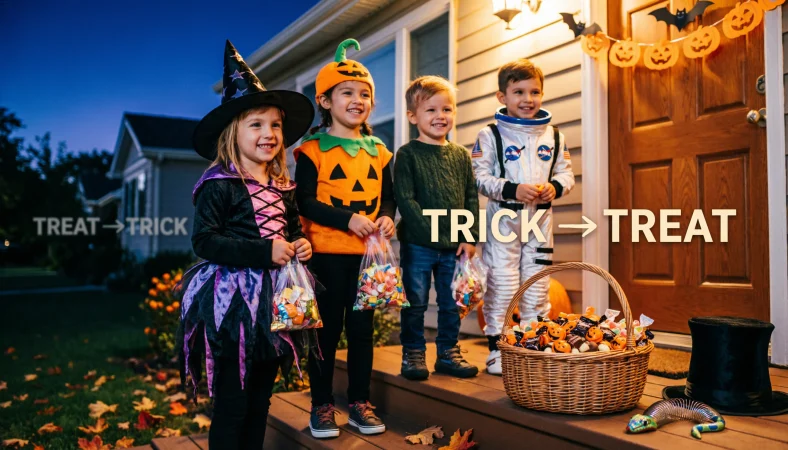
The correct and widely established Halloween expression is trick or treat, not treat or trick. It describes a Halloween custom in which children ask for candy or other treats while jokingly suggesting that a trick may follow if nothing is given. The familiar phrase has a fixed word order in standard English.
The phrase treat or trick can confuse English learners because both treat and trick are ordinary English words, and both relate naturally to Halloween. A treat is something enjoyable, especially candy given to children, while a trick is an action intended to surprise, deceive, or amuse someone.
However, switching their order changes a familiar expression into a nonstandard variation. Knowing the difference helps writers, students, parents, teachers, and anyone discussing Halloween use the conventional expression confidently.
Treat or Trick vs Trick or Treat: What’s the Difference?
The main difference is word order and established usage. Both treat and trick are valid English words, but Halloween uses them in the set expression trick or treat.
A trick is generally a noun referring to an action designed to deceive, surprise, entertain, or play a joke on someone. It can also function as a verb, as in “He tricked his friend.”
A treat is generally a noun referring to something enjoyable that is given or received as a special pleasure. During Halloween, candy is commonly described as a treat. Treat can also function as a verb meaning to behave toward someone in a particular way or to provide medical care.
| Expression | Word class | Meaning | Standard Halloween usage |
| Trick | Noun or verb | A prank, deception, surprise, or act of cleverness | Appears first in the established phrase |
| Treat | Noun or verb | Something enjoyable or something given as a pleasure | Appears second in the established phrase |
| Trick or treat | Fixed expression | A Halloween request for candy or another treat | Standard and widely recognized |
| Treat or trick | Phrase variation | Reverses the conventional order | Understandable but not the standard expression |
The important point is that trick or treat isn’t simply a random combination of two interchangeable words.
The expression has become an established part of English.
Changing the order makes the phrase sound unusual to most native speakers.
For standard writing, use trick or treat when referring to the Halloween tradition.
Is Treat or Trick a Grammar, Vocabulary, or Usage Issue?
This is primarily a usage issue, although vocabulary and grammar both play supporting roles.
There is nothing grammatically impossible about saying “treat or trick.” The words are correctly formed, and the sentence structure can technically be understood. The problem is that English has conventional expressions whose wording becomes fixed through long and repeated use.
This is similar to many other expressions in English. Speakers don’t normally rearrange the words simply because the individual meanings remain understandable.
For example, “bread and butter” has a conventional order. “Butter and bread” is grammatically possible, but it doesn’t function as the familiar expression in the same way.
The same principle applies here.
Are the two expressions interchangeable?
No. In ordinary Halloween usage, trick or treat is the conventional expression.
A speaker might deliberately say “treat or trick” as a joke, a creative variation, or a playful reversal. That doesn’t make it the standard phrase.
If you’re writing an article, school assignment, greeting, invitation, social media caption, or educational resource about Halloween, trick or treat is the safer choice.
Formal vs informal usage
The expression itself is strongly associated with informal cultural language. Children traditionally say it when visiting homes during Halloween.
That doesn’t mean the phrase is incorrect in formal writing. You can use it in a formal article when discussing Halloween customs, language, history, or popular culture.
What matters is the purpose.
A research article about Halloween traditions might explain the expression academically. A child might simply say it at someone’s front door.
Academic vs casual usage
In academic writing, you might write:
The expression “trick or treat” is associated with the Halloween custom of requesting candy from participating households.
In casual conversation, someone might simply say:
The kids are going out for trick or treat tonight.
The context changes, but the conventional wording remains the same.
Trick: Meaning and Practical Usage
The word trick has several meanings, which helps explain why it became part of the Halloween expression.
As a noun, trick can mean a prank or deceptive action.
For example:
The magician performed an impressive trick.
It can also refer to something intended to fool someone:
That question was a trick.
During Halloween, the word has a playful connection with pranks. Historically, the phrase suggests a contrast between receiving a treat and potentially facing a trick.
As a verb, trick means to deceive or fool someone.
The children tricked their father into looking in the wrong room.
The Halloween expression therefore creates a memorable contrast. A visitor asks for a treat while referring humorously to a possible trick.
Workplace example
In a workplace context, trick can describe a clever technique or method.
She showed the team a useful trick for organizing the spreadsheet.
Here, trick doesn’t involve Halloween. It means a practical technique that makes a task easier.
Academic example
A teacher might explain:
The author uses a linguistic trick to surprise the reader.
Again, the word refers to a clever technique rather than a Halloween prank.
Technology example
Technology writers frequently use trick to describe a useful shortcut.
This keyboard trick can help users navigate the application faster.
The meaning depends entirely on context.
Usage recap
Trick can describe a prank, deception, clever technique, or surprising action.
In Halloween language, it represents the playful possibility of a prank.
It comes first in the conventional expression trick or treat.
Treat: Meaning and Practical Usage
The word treat is equally versatile.
As a noun, a treat is something special or enjoyable.
For example:
Ice cream was a special treat after dinner.
During Halloween, candy is one of the most familiar examples of a treat.
As a verb, treat has several meanings. It can mean to behave toward someone in a certain way:
She treated everyone with kindness.
It can also mean to provide medical care:
The doctor treated the patient for the infection.
These meanings are completely different from the Halloween use of treat as something desirable that people receive.
Workplace example
Someone might say:
The company treated its employees to lunch.
Here, treated means that the company provided something enjoyable.
Academic example
A literary analysis might say:
The novel treats the subject of memory with unusual sensitivity.
In this context, treat means to deal with or discuss a subject in a particular way.
Technology example
A technology article could state:
The application treats each uploaded file as a separate record.
Here, treats means handles or considers.
Usage recap
Treat can be a noun or a verb.
As a noun, it can mean something enjoyable or special.
In the Halloween expression, it refers primarily to candy or another desirable gift.
Why Do People Say Trick or Treat?
The phrase is closely associated with Halloween and the custom of children visiting homes in costume to request treats.
The expression works because it creates a playful choice. The visitor asks for a treat while jokingly invoking the possibility of a trick.
The “trick” doesn’t necessarily mean that a child will actually perform a prank. In modern usage, the phrase is usually a traditional greeting rather than a serious threat.
A child standing at a door and saying “trick or treat” is participating in a cultural custom.
The householder typically responds by giving candy, chocolate, small toys, or another appropriate treat.
The phrase has become so strongly connected with Halloween that people often recognize it immediately, even when it appears without additional context.
This is one reason reversing the words can sound strange. Native speakers have heard the conventional sequence repeatedly since childhood, through conversation, television, books, advertisements, school activities, and Halloween celebrations.
When You Should NOT Use Treat or Trick
There are several situations where using the reversed expression can create unnecessary confusion.
1. When writing about the traditional Halloween custom
Use trick or treat, because that is the established expression.
2. When writing a school assignment
Teachers generally expect the conventional phrase unless the assignment specifically discusses language variation.
3. When creating educational material
Children learning English should be taught the standard expression first.
4. When writing a professional article
A conventional expression makes the content clearer and more natural.
5. When creating a Halloween invitation
Use the familiar wording so readers immediately recognize the event.
6. When explaining American Halloween traditions
The established phrase is part of the cultural vocabulary surrounding Halloween.
7. When optimizing a page for common search behavior
If your subject is the traditional Halloween greeting, the conventional wording is the natural choice.
8. When you’re unsure which version sounds native
Choose trick or treat.
The reversed form can work intentionally as wordplay, but it shouldn’t replace the standard expression in ordinary usage.
Common Mistakes and Decision Rules
| Correct sentence | Incorrect or unusual sentence | Explanation |
| The children went trick or treating. | The children went treat or tricking. | The first follows conventional Halloween usage. |
| We bought candy for trick or treaters. | We bought candy for treat or trickers. | The standard noun form is based on the established phrase. |
| The children shouted “trick or treat!” | The children shouted “treat or trick!” | The conventional word order places trick first. |
| Our neighborhood hosts a trick or treat event. | Our neighborhood hosts a treat or trick event. | The standard expression is more natural. |
| We need candy for Halloween trick or treat. | We need candy for Halloween treat or trick. | The conventional phrase is immediately recognizable. |
Decision Rule Box
If you mean the traditional Halloween request for candy, use “trick or treat.”
If you deliberately reverse the words for humor, wordplay, or a creative effect, “treat or trick” can be understood, but it isn’t the conventional expression.
This rule is more accurate for this topic than treating the two words as interchangeable choices.
Trick or Treat in Modern Technology and AI Tools
Modern technology has made Halloween vocabulary appear in many digital environments.
Search engines, social media platforms, educational applications, online dictionaries, and AI writing tools frequently process questions about Halloween expressions.
AI systems can usually identify trick or treat as the conventional phrase because the expression appears extensively in English language data.
However, AI tools can sometimes reproduce unusual variations when users specifically ask about them. That doesn’t necessarily mean the variation is standard.
This distinction matters for language learners.
A search result or AI generated sentence should be evaluated according to established usage, context, and linguistic convention. Frequency alone doesn’t always establish whether a particular expression is standard.
For example, an AI system may understand “treat or trick” perfectly well because the words are individually familiar. Yet understanding a phrase is different from identifying the most conventional form.
Human speakers use context and familiarity to make this judgment naturally.
For educational content, the safest approach is therefore to explain both forms while clearly identifying trick or treat as the standard Halloween expression.
The Etymology and History Behind Trick or Treat
The modern Halloween phrase developed from older customs involving visiting homes, requesting food, and participating in playful or sometimes mischievous activities.
Halloween itself has a long cultural history influenced by traditions from different communities and periods. The modern North American practice of children going door to door in costume developed over time rather than appearing in its present form all at once.
The exact history of the expression is more complicated than the simple definition found in a modern dictionary.
Older traditions involved activities connected with food, costumes, begging, seasonal celebrations, pranks, and community rituals. Over time, these practices became associated with Halloween in North America.
The familiar expression eventually became strongly standardized in popular culture.
That history helps explain why the words aren’t normally rearranged. Expressions can become fixed through repeated cultural use.
Expert style explanation
“When an expression becomes culturally established, its individual words may remain flexible in ordinary language while the expression itself develops a preferred form.”
That principle explains why trick or treat is natural even though “treat or trick” is grammatically understandable.
The issue isn’t that English grammar forbids the reversed order. Instead, established usage gives one order a much stronger status.
Two Practical Language Case Studies
Case Study 1: A classroom worksheet
Imagine an English teacher preparing a worksheet for young learners.
The worksheet says:
Children say “treat or trick” when they visit houses on Halloween.
The students may understand the meaning, but the worksheet teaches an unusual form of the expression.
A better educational sentence would be:
Children say “trick or treat” when they visit houses on Halloween.
The change is small, but it matters because language education should generally introduce learners to conventional expressions before teaching creative variations.
The concrete result is greater consistency between classroom language and the phrase students are likely to encounter elsewhere.
Case Study 2: A Halloween marketing campaign
Consider a business creating a Halloween campaign.
A poster says:
Treat or Trick Night
Readers will probably understand the intended meaning. However, the phrase may sound intentionally reversed or slightly unnatural because people expect “trick or treat.”
Changing it to:
Trick or Treat Night
immediately identifies the event as Halloween related.
The concrete result is clearer recognition and more natural phrasing.
A creative brand could intentionally keep “treat or trick” if the reversal is part of the campaign concept. In that case, the unusual wording becomes a stylistic choice rather than an accidental mistake.
Error Prevention Checklist
Always use trick or treat when
- ☑ Referring to the traditional Halloween custom
- ☑ Writing for English learners
- ☑ Creating school materials
- ☑ Writing a standard Halloween article
- ☑ Describing children asking for candy
- ☑ Referring to the familiar Halloween greeting
- ☑ You want the most natural conventional wording
Avoid using treat or trick when
- ☒ You simply want the standard Halloween expression
- ☒ You’re correcting a student’s ordinary usage
- ☒ You’re writing formal educational material about the tradition
- ☒ You want readers to immediately recognize the phrase
- ☒ You’re not intentionally using wordplay
The reversed form isn’t meaningless. It is simply not the normal conventional wording.
Why Word Order Matters in Fixed Expressions
English contains thousands of combinations where word order matters beyond basic grammar.
Consider expressions such as “salt and pepper,” “black and white,” “pros and cons,” and “give and take.” In many situations, reversing the elements remains grammatically possible, but the result no longer sounds like the familiar expression.
This phenomenon is especially important for language learners.
Someone can understand every individual word and still produce an expression that sounds unusual because native speakers have learned the phrase as a complete unit.
Trick or treat works in much the same way.
The phrase is not normally interpreted by calculating the meaning of each word every time someone hears it. Instead, speakers recognize the entire expression as a familiar cultural formula.
That is why memorizing common phrases as complete units can be useful when learning English.
Related Grammar and Usage Confusions You Should Master
Understanding fixed expressions can make other language questions easier to solve. These related topics are worth learning:
- Everyday vs every day: One commonly functions as an adjective, while the other refers to frequency.
- Advice vs advise: These words differ in pronunciation, word class, and meaning.
- Affect vs effect: The distinction usually involves grammatical function and meaning.
- Compliment vs complement: The words sound similar but have different meanings.
- Practice vs practise: The spelling difference depends partly on regional English conventions.
- Toward vs towards: Both forms are accepted, with usage varying by dialect and style.
- Learned vs learnt: Both can be correct, although regional preferences differ.
- Canceled vs cancelled: Different spelling conventions are used in different varieties of English.
- Favorite vs favourite: The difference reflects American and British spelling conventions.
- Trick or treat vs treat or trick: This is primarily a matter of conventional word order rather than basic grammar.
Learning these distinctions helps writers move beyond memorizing isolated corrections and understand how English actually works.
FAQs
Is “treat or trick” correct?
“Treat or trick” is understandable because both words are valid English vocabulary. However, it isn’t the conventional Halloween expression. The standard phrase is trick or treat.
Why is it called trick or treat?
The phrase refers to a playful choice between receiving a treat and facing a trick. In modern Halloween culture, it is primarily a traditional request for candy or another treat rather than a serious statement about performing a prank.
Is it trick or treat or treat or trick?
The conventional expression is trick or treat. The words normally appear in that order when referring to the Halloween tradition.
What does trick or treat mean?
“Trick or treat” is a traditional Halloween expression used by children who visit homes in costume and ask for candy or another treat. The phrase playfully suggests a choice between receiving something enjoyable and potentially experiencing a trick.
Can you say treat or trick?
You can say “treat or trick” if you’re intentionally reversing the phrase for humor, creativity, or wordplay. People will generally understand it, but it is not the standard wording for the Halloween tradition.
What is the correct spelling of trick or treat?
The standard expression is written as trick or treat. It consists of the noun “trick,” the conjunction “or,” and the noun “treat.”
What is a trick in trick or treat?
In the Halloween expression, a trick refers to a playful prank or mischievous act. In modern usage, however, the word usually functions as part of the traditional phrase rather than as a literal demand that someone perform a prank.
What is a treat in trick or treat?
A treat is something enjoyable that is given or received as a special pleasure. During Halloween, candy is the most familiar example of a treat.
Is trick or treat a phrase or an idiom?
“Trick or treat” is best described as a fixed or conventional expression associated with Halloween. It has a culturally established meaning and word order, although its meaning remains fairly transparent from the individual words.
Should I use trick or treat in formal writing?
Yes, when your subject is Halloween. The expression itself is informal in origin and everyday use, but there is nothing inappropriate about discussing it in formal writing about language, culture, education, or seasonal traditions.
Conclusion:
The main distinction between treat or trick and the conventional Halloween phrase comes down to established usage and word order. Trick can mean a prank, deception, clever technique, or surprising action, while treat can refer to something enjoyable, such as Halloween candy.
Both words are perfectly normal English vocabulary, but they aren’t normally interchangeable inside the established Halloween expression.
For standard usage, choose trick or treat.
The reversed form can still appear in jokes, advertising, creative writing, or intentional wordplay. If the goal is accuracy and natural English, however, the conventional order is the clear choice.
Understanding this distinction also teaches a broader lesson about English. Not every language question is solved by looking at whether individual words are grammatically possible. Some expressions become fixed through culture, repetition, and long established usage. Learning those conventional patterns helps writing sound more natural and makes communication clearer.
So when Halloween arrives and children appear at the door in costumes, the familiar expression remains simple: trick or treat.