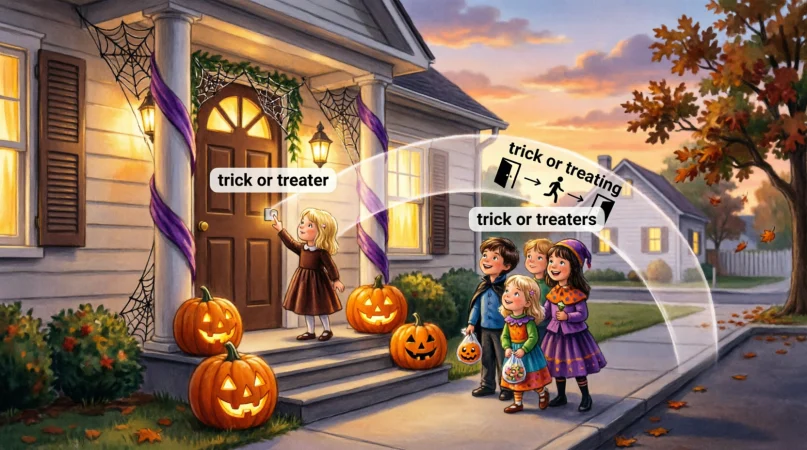
A trick or treater is a person, usually a child, who goes from home to home on Halloween asking for candy by saying “trick or treat.” The expression refers to the person participating in the tradition, while trick or treating describes the activity itself. Understanding this difference helps writers choose the correct noun or activity phrase.
Halloween brings plenty of familiar expressions, but trick or treater is one that can cause surprising confusion. Some people wonder whether it should be written as one word, two words, or with punctuation. Others confuse the person with the activity and use trick or treating when they actually mean the person knocking on a door.
The distinction becomes easier once you separate the two ideas. A trick or treater is a person. Trick or treating is an activity. The first expression functions as a noun phrase, while the second describes the act of visiting homes to request Halloween treats.
For example, “The trick or treater smiled at the homeowner” identifies a person. By contrast, “The children went trick or treating after sunset” describes what those children did.
That difference matters in everyday writing, school assignments, workplace communication, Halloween invitations, social media captions, and articles about the holiday. Using the correct expression makes the sentence clearer and prevents a common vocabulary and usage mistake.
Trick or Treater vs Trick or Treating: What’s the Difference?
The easiest way to understand trick or treater is to compare it with trick or treating. They are closely connected, but they do not have the same grammatical function.
A trick or treater is a noun phrase referring to a person who participates in the Halloween tradition. The individual typically visits homes, knocks on doors, says “trick or treat,” and receives candy or another small treat.
Trick or treating, meanwhile, refers to the activity itself. Grammatically, it uses the present participle form of the verb treat within the established expression.
| Expression | Grammatical role | Meaning | Example |
| Trick or treater | Noun phrase | A person participating in Halloween door to door visits | The trick or treater wore a vampire costume. |
| Trick or treating | Activity phrase | The act of visiting homes for Halloween treats | The children went trick or treating. |
| Trick or treat | Fixed expression | The traditional request made at a Halloween door | The children said “trick or treat.” |
The important distinction is person versus activity.
A trick or treater is someone who participates.
Trick or treating is what the participant does.
Trick or treat is the traditional phrase associated with the activity.
Once you remember this pattern, most usage questions become straightforward.
Is Trick or Treater a Grammar, Vocabulary, or Usage Issue?
The question is mainly a combination of vocabulary, grammar, spelling, and usage.
The expression trick or treater identifies a person, so it functions as a noun phrase. You can place it where a noun referring to a person would normally appear.
For example:
“The trick or treater arrived early.”
Here, the phrase is the subject of the sentence.
You can also use it as an object:
“The homeowner welcomed the trick or treater.”
The expression does not describe an action by itself. Instead, it identifies the person performing the activity.
Why the Expression Has Three Parts
The phrase is built from the familiar Halloween expression trick or treat, followed by er in the word treater.
English commonly uses er to form nouns referring to people who perform an action. Examples include:
Teacher
Runner
Writer
Singer
Treater
In trick or treater, the structure developed around the phrase trick or treat, producing a term for the person participating in the custom.
Is Trick or Treater Formal or Informal?
The expression is strongly associated with everyday Halloween language. It is natural in casual conversation, family communication, school writing, news coverage, holiday content, and general informational writing.
It can also appear in formal contexts when the subject is Halloween customs or community events.
For example:
“The community center provided refreshments for trick or treaters.”
There is nothing grammatically incorrect or inherently unsuitable about the phrase.
Academic Usage
In academic writing, the expression may appear when discussing Halloween traditions, cultural customs, childhood activities, folklore, or seasonal celebrations.
For example:
“Researchers examined how communities accommodate trick or treaters during Halloween celebrations.”
In this context, the phrase works naturally as a noun referring to participants.
How to Use Trick or Treater Correctly
The expression trick or treater refers to one person.
If you are talking about multiple people, the plural is trick or treaters.
Consider these examples:
“A trick or treater knocked on the door.”
“Another trick or treater arrived a few minutes later.”
“Several trick or treaters waited outside.”
The singular and plural forms follow normal English noun patterns.
Workplace Example
Although Halloween is usually associated with homes and neighborhoods, the expression can appear in workplace communication.
For example:
“Our office will welcome trick or treaters during the community Halloween event.”
Here, trick or treaters identifies the people expected to attend.
A workplace announcement might say:
“Employees with young children are welcome to bring trick or treaters to the afternoon celebration.”
The noun phrase identifies the participants rather than the activity.
Academic Example
A paper discussing Halloween customs might say:
“Trick or treaters traditionally visit decorated homes in residential neighborhoods.”
The phrase refers specifically to the people taking part in the tradition.
Technology Example
Digital platforms can also use the term when discussing Halloween events.
For example:
“The neighborhood app allows residents to indicate whether they are welcoming trick or treaters.”
The technology does not change the meaning of the noun phrase. The application simply provides a digital way to communicate information about a traditional activity.
Usage Recap
Use trick or treater when you mean one person.
Use trick or treaters when you mean more than one person.
If you mean the activity, use trick or treating instead.
How to Use Trick or Treating Correctly
Trick or treating refers to the Halloween activity rather than a particular person.
It normally appears after verbs such as go, enjoy, start, finish, or take part in.
Examples include:
“The children went trick or treating.”
“We started trick or treating after dinner.”
“They enjoyed trick or treating with their friends.”
The phrase can also function as a noun like other activity expressions.
Workplace Example
A community workplace announcement might state:
“Trick or treating will begin at six o’clock.”
The sentence identifies when the activity begins.
Academic Example
A cultural studies article might say:
“Trick or treating remains one of the most recognizable Halloween traditions in the United States.”
The phrase refers to the practice rather than to individual participants.
Technology Example
A weather application might display a message such as:
“Rain is expected during trick or treating tonight.”
Here, the expression identifies the activity that may be affected by weather.
Usage Recap
Use trick or treating when discussing the activity.
Use trick or treater when discussing a participant.
A simple substitution test can help:
“The child went ___.”
The natural answer is trick or treating.
“The child is a ___.”
The natural answer is trick or treater.
When You Should NOT Use Trick or Treater
Several common situations can reveal whether the expression is being used correctly.
1. Do not use trick or treater when you mean the activity
Incorrect:
“The children enjoyed trick or treater.”
Correct:
“The children enjoyed trick or treating.”
The first expression identifies a person, while the second describes the activity.
2. Do not use trick or treating when you mean one participant
Incorrect:
“The trick or treating knocked on the door.”
Correct:
“The trick or treater knocked on the door.”
A person can knock. An activity cannot.
3. Do not confuse singular and plural forms
If you mean several children, use trick or treaters.
“The trick or treaters arrived together.”
4. Do not normally combine the words into one compound spelling
Trickortreater is not the standard spelling of the noun phrase.
The conventional form is:
trick or treater
5. Do not write treater as if it means every Halloween participant by itself
The word treater has meanings outside the Halloween expression. The established holiday term is trick or treater.
6. Do not use an apostrophe for the plural
The plural is trick or treaters, not trick or treater’s.
An apostrophe indicates possession rather than ordinary plurality.
7. Do not confuse the person with the request
A child is a trick or treater.
“Trick or treat” is the phrase the child traditionally says.
8. Do not assume capitalization is required
The expression is normally written in lowercase unless it appears at the beginning of a sentence or within a title where title capitalization is appropriate.
Common Mistakes and Decision Rules
| Correct sentence | Incorrect sentence | Explanation |
| The trick or treater knocked on the door. | The trick or treating knocked on the door. | A person can knock, but an activity cannot. |
| The children went trick or treating. | The children went trick or treater. | The sentence describes an activity. |
| Several trick or treaters arrived. | Several trick or treater arrived. | The plural form requires treaters. |
| A trick or treater wore a costume. | A trick or treating wore a costume. | The sentence needs a noun referring to a person. |
| We enjoyed trick or treating. | We enjoyed trick or treater. | The activity follows the verb enjoyed. |
| The trick or treaters received candy. | The trick or treating received candy. | The sentence refers to people receiving treats. |
| The neighborhood welcomed trick or treaters. | The neighborhood welcomed trick or treating. | The people are being welcomed. |
Decision Rule Box
- If you mean the person, use trick or treater.
- If you mean multiple people, use trick or treaters.
- If you mean the activity, use trick or treating.
- If you mean the traditional request, use “trick or treat.”
This rule solves most problems immediately.
Trick or Treater in Modern Technology and AI Tools
Halloween language has entered modern digital communication without changing its basic grammar.
People now use social media posts, neighborhood applications, digital calendars, event platforms, messaging services, and community websites to organize Halloween activities. These technologies may discuss trick or treaters, but the noun still refers to people.
For example:
“Residents can mark their homes as welcoming trick or treaters.”
An AI writing tool might also generate sentences involving Halloween vocabulary. When reviewing such content, writers should identify whether the sentence refers to a person, an activity, or the traditional phrase.
Consider:
“Families are preparing for trick or treating.”
This refers to the activity.
“Families are preparing for trick or treaters.”
This means they are preparing for the arrival of participants.
Both can be grammatically correct, but their meanings differ.
That distinction is particularly useful when writing event announcements, neighborhood notices, school communications, social media posts, or seasonal marketing content.
The Etymology of Trick or Treater
The expression trick or treat developed as part of Halloween customs involving children visiting homes and requesting treats. The wording reflects the traditional playful suggestion that a treat should be provided or a trick might follow.
The noun trick or treater developed from that established phrase to identify the person taking part.
The construction is similar to many English nouns formed around activities or roles. English speakers often create person nouns using an ending such as er.
For example:
- A person who teaches is a teacher.
- A person who runs is a runner.
- A person who writes is a writer.
- A person associated with treating in the expression becomes a treater.
The complete phrase preserves the familiar wording of the Halloween request while turning it into a noun referring to the participant.
An Expert Style Explanation
A useful linguistic principle is:
“The easiest way to distinguish the expressions is to ask whether you are naming the participant, describing the activity, or quoting the traditional request.”
That approach avoids memorizing isolated examples.
- If you are naming the participant, use trick or treater.
- If you are describing the activity, use trick or treating.
- If you are referring to the traditional Halloween request itself, use trick or treat.
This distinction is based on grammatical function, not personal preference.
Two Practical Case Studies
Case Study One: A School Halloween Announcement
Imagine a school sending this announcement:
“Students may bring costumes for trick or treating after the evening program.”
The announcement describes an activity, so trick or treating is appropriate.
Now change the sentence:
“Teachers will supervise the trick or treaters during the evening program.”
The meaning changes because the sentence now identifies the participating children.
The concrete result is greater precision. One expression describes what students are doing, while the other identifies who is participating.
Case Study Two: A Neighborhood Event
Consider a neighborhood message:
“Residents should turn on their porch lights if they are welcoming trick or treaters.”
Here, the phrase refers to the children or other participants who may visit.
Now compare:
“Residents should prepare their homes before trick or treating begins.”
This sentence refers to the activity.
The two sentences can appear in the same announcement because they address different parts of the same event.
That is the key distinction: trick or treater identifies a person, while trick or treating identifies the activity.
Error Prevention Checklist
Always use trick or treater when
You mean one Halloween participant.
You are identifying a child or person visiting homes.
The phrase acts as a noun referring to a person.
Examples:
“The trick or treater smiled.”
“A trick or treater knocked.”
“The trick or treater wore a costume.”
Always use trick or treaters when
You mean multiple participants.
Examples:
“The trick or treaters arrived early.”
“We prepared candy for the trick or treaters.”
Always use trick or treating when
You mean the Halloween activity.
Examples:
“Children went trick or treating.”
“Trick or treating starts at six.”
“We enjoyed trick or treating.”
Never use trick or treater when
You are describing the activity itself.
Never use trick or treating when
You need a noun referring to a person.
Related Grammar and Usage Confusions You Should Master
Learning this expression also opens the door to several related vocabulary questions.
1. Trick or Treat or Trick or Treating
The first is the traditional request. The second describes the activity.
2. Trick or Treater or Trick or Treaters
The first is singular. The second is plural.
3. Halloween or Hallowe’en
Both forms have historical connections, although Halloween is the overwhelmingly common modern spelling.
4. Costume or Costum
Costume is the standard English spelling.
5. Candy or Candies
Candy is commonly treated as an uncountable noun in American English, while candies can refer to individual varieties or pieces.
6. Everyday or Every Day
Everyday is an adjective. Every day means each day.
7. Children or Childrens
The plural of child is children, not childrens.
8. Who or Whom
These forms differ according to grammatical function and can create confusion in formal writing.
9. Costume or Custom
A costume is clothing associated with a particular appearance or role. A custom is a traditional practice or behavior.
10. Treat or Treatment
A treat can be something enjoyable or a special item, while treatment generally refers to the process of dealing with something.
FAQs
What does trick or treater mean?
A trick or treater is a person who participates in the Halloween tradition of visiting homes, saying “trick or treat,” and receiving candy or another small treat.
Is trick or treater one word or two words?
The standard expression is written as three separate words: trick or treater. It is not normally combined into one word.
Is trick or treater hyphenated?
No. The standard expression is generally written as separate words without a hyphen.
What is the plural of trick or treater?
The plural is trick or treaters. For example, “The trick or treaters walked down the street.”
What is the difference between trick or treater and trick or treating?
A trick or treater is a person, while trick or treating is the activity. For example, “The trick or treater knocked” identifies a person, while “They went trick or treating” describes an activity.
Should trick or treater be capitalized?
Normally, no. It should be lowercase unless it begins a sentence or appears in a title where capitalization is being used for title style.
Is trick or treater singular or plural?
Trick or treater is singular. The plural form is trick or treaters.
Is trick or treat a noun?
The expression trick or treat is primarily a fixed phrase associated with the Halloween request. In some contexts, it can also be discussed as a noun phrase referring to the traditional practice or custom.
How do you use trick or treater in a sentence?
You can write, “The trick or treater knocked on the front door.” Here, the phrase functions as a noun referring to one Halloween participant.
How do you use trick or treaters in a sentence?
You can write, “The trick or treaters arrived just before sunset.” The plural phrase refers to multiple Halloween participants.
Conclusion:
The expression trick or treater is used for a person who participates in the Halloween tradition of visiting homes for treats. When you mean the activity itself, use trick or treating. When you mean multiple participants, use trick or treaters.
The easiest rule is to focus on what your sentence is describing.
- If you are naming a person, choose trick or treater.
- If you are naming several people, choose trick or treaters.
- If you are describing the activity, choose trick or treating.
- If you are referring to the traditional request spoken at the door, use trick or treat.
Once you separate the participant from the activity, the spelling and grammar become much easier to remember. The expression trick or treater is not a difficult spelling choice once you understand its grammatical role and its relationship to the familiar Halloween tradition.