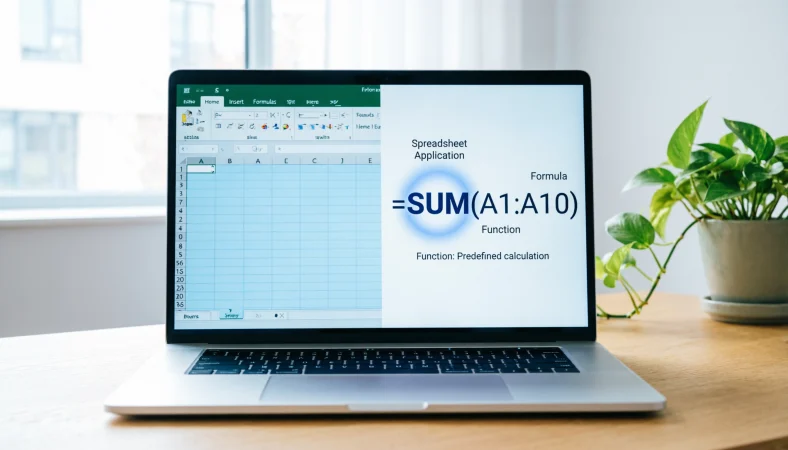
Excel and function are not interchangeable terms. Excel is a spreadsheet application used to organize, calculate, analyze, and present data, while a function is a predefined calculation that can be used inside Excel formulas. In simple terms, Excel is the tool, whereas a function is one of the tools available within that application.
When people search for excel or function, they may be trying to understand whether Excel itself is called a function, whether a function is the same thing as Excel, or how the two concepts relate. The confusion is understandable because everyday Excel work often involves functions such as SUM, AVERAGE, IF, and COUNT.
However, Excel and a function describe completely different things.
Microsoft Excel is a spreadsheet program. It provides a complete environment for entering information, creating tables, performing calculations, building charts, analyzing data, and automating repetitive tasks.
A function, by contrast, is a predefined operation that performs a particular calculation. In Excel, functions are commonly used as components of formulas. For example, =SUM(A1:A10) uses the SUM function to add the values in cells A1 through A10.
This distinction matters because calling Excel a function can create confusion when discussing spreadsheets, programming, data analysis, or workplace tasks. Knowing the difference makes technical explanations more accurate and helps users choose the right terminology when asking questions, writing instructions, or learning spreadsheet skills.
The simplest way to remember the relationship is this: Excel is the application, while a function is a predefined calculation that Excel can perform.
Excel vs Function: What’s the Difference?
The most important difference is the level at which each term operates. Excel refers to the entire spreadsheet application, while a function refers to a specific predefined operation available within a spreadsheet environment.
| Term | Part of speech | Meaning | Example |
| Excel | Proper noun | A spreadsheet application | Microsoft Excel |
| Function | Common noun | A predefined operation used to perform a calculation | SUM |
| Formula | Common noun | An expression that performs a calculation | =A1+B1 |
| Worksheet | Common noun | A spreadsheet page within a workbook | Sheet1 |
| Workbook | Common noun | An Excel file containing worksheets | Annual Report |
Excel can contain thousands of different calculations and operations. Functions are among the most important because they allow users to perform calculations without manually writing every mathematical step.
For example, suppose a worksheet contains monthly sales figures from January through December. Instead of adding each value manually, you can use the SUM function:
=SUM(B2:B13)
Here, Excel is the application in which the calculation takes place. SUM is the function performing the addition.
The distinction becomes even clearer with an example involving averages:
=AVERAGE(C2:C20)
The spreadsheet application is Excel. The calculation being requested is handled by the AVERAGE function.
The relationship between Excel and functions
Think of Excel as a workshop. A function is one of the specialized tools available in that workshop.
Excel provides the overall environment.
Functions provide predefined operations.
Formulas combine values, references, operators, and functions.
Worksheets provide the space where calculations and data are organized.
This relationship is why the terms sometimes appear together but should not be treated as synonyms.
Mini recap
Excel is software.
A function is a predefined calculation.
A formula can contain one or more functions.
Functions operate inside spreadsheet applications such as Excel.
Is Excel vs Function a Grammar, Vocabulary, or Usage Issue?
The difference between Excel and function is primarily a vocabulary and usage issue, not a grammar issue.
There is nothing grammatically incorrect about either word. The problem occurs when one term is used where the other is intended.
For example, consider this sentence:
“I used an Excel to calculate the total.”
The problem is not really grammar alone. The phrase suggests that Excel is being treated like a countable object in a way that does not fit standard usage. A clearer sentence would be:
“I used Excel to calculate the total.”
Now consider:
“I used the SUM Excel to calculate the total.”
That is also incorrect terminology. SUM is a function in Excel, not an Excel.
A better version is:
“I used the SUM function in Excel to calculate the total.”
Are Excel and functions interchangeable?
No. They are not interchangeable.
You can say:
“I created the report in Excel.”
You can also say:
“I used the SUM function in Excel.”
But you cannot normally replace Excel with function or function with Excel and preserve the same meaning.
Formal versus informal usage
In casual conversation, someone might say:
“I used Excel to add everything up.”
That is perfectly natural.
In a technical training document, a more precise statement might be:
“Use the SUM function to calculate the total of the selected range.”
The second sentence is more specific because it identifies the exact feature being used.
Academic versus casual usage
Academic or technical writing benefits from precise terminology. If you are explaining spreadsheet concepts, distinguish among Excel, formulas, functions, cell references, operators, worksheets, and workbooks.
In casual conversation, people often say things such as:
“Excel did the calculation.”
That sentence is understandable. Technically, however, the calculation was performed through a formula, function, or calculation mechanism within Excel.
How Excel Is Used
Excel is a spreadsheet application designed for working with structured information. Its capabilities extend far beyond simple arithmetic.
A user can enter customer information, track expenses, analyze sales, prepare budgets, organize research data, create schedules, produce charts, and build reporting systems.
Workplace example
Imagine an employee preparing a monthly sales report.
They might use Excel to organize customer names, sales figures, dates, product categories, and revenue totals. The workbook can contain several worksheets, each designed for a different part of the report.
The employee might then use formulas and functions to calculate totals and averages.
A natural workplace statement would be:
“I prepared the monthly sales report in Excel.”
Notice that Excel describes the application used to create the report.
Academic example
A university student conducting research might use Excel to organize survey responses.
The student could create columns for age, location, response category, and numerical scores. Functions could then calculate averages, counts, or other statistics.
A suitable sentence would be:
“The survey data were organized and analyzed in Excel.”
Again, Excel refers to the software environment.
Technology example
Excel can also work with imported datasets, tables, charts, formulas, queries, and other analytical features.
For example:
“The team imported the dataset into Excel before analyzing the results.”
The dataset is placed into the application, after which functions and formulas can be used to process the information.
Usage recap
Use Excel when you mean the spreadsheet application.
Say:
“Open Excel.”
“Create the report in Excel.”
“Import the data into Excel.”
Do not use Excel when you specifically mean a predefined calculation such as SUM or IF.
How Functions Are Used
A function is a predefined operation designed to perform a particular task. In Excel, functions are generally entered as part of formulas.
A function usually begins with its name followed by parentheses containing arguments.
For example:
=SUM(A1:A5)
Here, SUM is the function, while A1:A5 is the range supplied to it.
Workplace example
A finance employee might use:
=SUM(B2:B50)
This calculates the total of the values in the specified range.
The employee could describe the task as:
“I used the SUM function to calculate total revenue.”
That is more precise than saying:
“I used Excel to calculate revenue.”
The second statement is not wrong, but it identifies the software rather than the specific calculation method.
Academic example
A student analyzing test scores might use:
=AVERAGE(C2:C31)
The AVERAGE function calculates the arithmetic mean of the selected values.
The student could write:
“The AVERAGE function was used to calculate the mean score.”
This is particularly useful in technical explanations because the reader immediately knows what operation was performed.
Technology example
A more advanced worksheet could use functions such as IF, XLOOKUP, COUNTIF, or TEXTJOIN.
For example:
=IF(B2>=50,”Pass”,”Fail”)
Here, the IF function evaluates a condition and returns one result when the condition is true and another when it is false.
Usage recap
Use function when you mean a predefined calculation or operation.
Say:
“Use the SUM function.”
“The IF function checks the condition.”
“The XLOOKUP function retrieves the matching value.”
When You Should NOT Use Excel or Function
Several common mistakes come from using these words too broadly.
1. Do not call Excel a function
Excel is an application, not a single function.
Incorrect:
“Excel is a function used for calculations.”
Better:
“Excel is a spreadsheet application that provides functions for calculations.”
2. Do not call every formula a function
A formula does not necessarily contain a function.
For example:
=A1+B1
is a formula, but it does not use a named Excel function.
3. Do not call a function a formula in every context
Functions and formulas are related but different.
For example:
=SUM(A1:A10)
is a formula that contains the SUM function.
4. Do not use function when you mean software
Incorrect:
“Which function should I install to open the spreadsheet?”
Better:
“Which spreadsheet application should I use?”
5. Do not use Excel when you mean a specific calculation
If someone asks which operation calculates an average, saying “Excel” does not provide enough information.
Better:
“Use the AVERAGE function.”
6. Do not assume every calculation requires a function
Simple formulas can use mathematical operators directly.
For example:
=A1*B1
does not require a named function.
7. Do not confuse a function with a worksheet
A worksheet is a page within a workbook. A function is a calculation mechanism.
8. Do not confuse Excel with an Excel file
Excel is the application. An .xlsx file is a workbook file commonly opened using Excel.
Common Mistakes and Decision Rules
| Correct sentence | Incorrect sentence | Explanation |
| I opened Excel. | I opened a function. | Excel is the application. |
| I used the SUM function. | I used the SUM Excel. | SUM is a function. |
| I created a formula. | I created a function. | A formula can exist without a named function. |
| I saved the Excel workbook. | I saved the Excel function. | A workbook is a file containing worksheets. |
| I used Excel to analyze the data. | I used a function to open the data. | Excel is the application used for the broader task. |
| The IF function checks the condition. | The IF Excel checks the condition. | IF is a function. |
Decision Rule Box
- If you mean the application, use Excel.
- If you mean a predefined calculation, use function.
- If you mean a complete calculation expression, use formula.
- If you mean a page inside a workbook, use worksheet.
This four way distinction eliminates most terminology mistakes.
Excel and Functions in Modern Technology and AI Tools
Modern spreadsheet work increasingly involves automation, data analysis, artificial intelligence, and advanced formulas.
AI tools can help users generate formulas, explain functions, identify errors, organize datasets, and suggest ways to analyze information. However, the underlying terminology remains important.
If an AI assistant generates:
=SUM(B2:B20)
it has generated a formula containing the SUM function.
If the user enters that formula into a spreadsheet application, Excel provides the environment in which the calculation is evaluated.
This distinction is especially useful when communicating with AI tools. A vague request such as:
“Give me an Excel for this calculation.”
is unclear.
A more precise request is:
“Give me an Excel formula that calculates the total in column B.”
An even more specific request could be:
“Give me a formula using the SUM function that adds B2 through B20.”
Precise terminology helps both people and AI systems understand what the user actually needs.
Etymology and Meaning of the Terms
The word Excel in this context is a proper name associated with Microsoft’s spreadsheet software. The ordinary English verb excel means to perform exceptionally well or to be superior in something, but that meaning is separate from the software name.
The word function has a much broader history. It comes through French from Latin functio, connected with the idea of performing or carrying out something.
That broader meaning explains why function is used in many fields.
- In mathematics, a function describes a relationship between inputs and outputs.
- In programming, a function is a reusable block of instructions.
- In spreadsheets, a function is a predefined operation that can be used in calculations.
So while the meaning changes somewhat across disciplines, the central idea remains similar: something performs a particular operation or role.
An expert style explanation
A useful way to explain the distinction is:
“Excel names the working environment, while a function names a specific operation performed within that environment.”
This distinction is simple, but it prevents a surprising number of spreadsheet terminology errors.
Two Practical Case Studies
Case study 1: Monthly business reporting
Imagine a small business that records daily sales in an Excel worksheet.
The business owner wants to calculate monthly revenue. The spreadsheet itself does not become the calculation. Instead, the owner can use a formula containing the SUM function.
For example:
=SUM(B2:B32)
In this situation, Excel provides the environment for organizing and analyzing the sales data. The SUM function performs the addition.
If the owner later wants the average daily sale, the AVERAGE function can be used instead.
The practical lesson is that the same Excel workbook can use many different functions depending on the task.
Case study 2: Student grade analysis
Consider a teacher who stores student scores in a spreadsheet.
A formula such as:
=AVERAGE(B2:B26)
can calculate the average score.
Another formula using COUNTIF can count how many students achieved a particular result.
The teacher might say:
“I analyzed the grades in Excel using several functions.”
That sentence is precise because it identifies both the application and the specific tools used inside it.
The important point is not that Excel and functions compete with each other. They operate at different levels and work together.
Error Prevention Checklist
Always use Excel when
- You mean the spreadsheet application.
- You are talking about opening or closing the software.
- You are discussing creating a workbook.
- You are describing spreadsheet based data analysis.
- You are referring to the overall environment used for calculations.
Always use function when
- You mean a predefined operation.
- You are discussing SUM, AVERAGE, IF, COUNTIF, or another named operation.
- You are explaining how a particular calculation works.
- You are teaching spreadsheet terminology.
Never use Excel when
- You specifically mean a predefined calculation.
- You are naming a particular function.
- You are explaining the difference between formulas and functions.
Never use function when
- You mean the spreadsheet application.
- You mean an Excel workbook.
- You mean a worksheet.
- You mean a complete formula without necessarily referring to a named function.
Related Grammar and Technology Confusions You Should Master
Understanding Excel and functions becomes easier when you also distinguish related spreadsheet terms.
- Formula or function
A formula is a complete calculation, while a function is a predefined operation that can appear inside a formula. - Workbook or worksheet
A workbook is the larger Excel file, while a worksheet is an individual spreadsheet page inside it. - Cell or range
A cell is one location, while a range contains multiple selected cells. - Value or formula
A value is the data stored or displayed in a cell, while a formula calculates a result. - Column or row
Columns run vertically, while rows run horizontally. - SUM or TOTAL
SUM is a specific Excel function, while total describes the resulting amount. - Formula or equation
A formula performs a calculation, while an equation traditionally expresses equality between mathematical expressions. - Data or information
Data refers to recorded facts or values, while information generally refers to meaningful interpretation of data. - Excel or spreadsheet
Excel is a particular spreadsheet application, while spreadsheet can describe a broader category of software or a spreadsheet document. - Function or formula
These terms are related but should not be treated as synonyms.
FAQs
Is Excel a function?
No. Excel is a spreadsheet application. It contains many functions that users can employ to perform calculations and analyze data.
What is the difference between Excel and a function?
Excel is the software application, while a function is a predefined operation used within a spreadsheet. A function such as SUM can be used in Excel to perform a specific calculation.
Is SUM an Excel function or formula?
SUM is a function. When you write =SUM(A1:A10), the complete expression is a formula containing the SUM function.
Is every Excel formula a function?
No. A formula can use mathematical operators without a named function. For example, =A1+B1 is a formula that does not contain a named function.
What is an example of a function in Excel?
Common examples include SUM, AVERAGE, IF, COUNT, COUNTIF, MAX, MIN, and XLOOKUP. Each function performs a particular type of operation.
What is the difference between an Excel formula and an Excel function?
A formula is a complete calculation expression. A function is a predefined operation that can be included within a formula. A formula can contain one function, multiple functions, or no functions.
Can a function exist outside Excel?
Yes. Functions are used in many fields, including mathematics and programming. Spreadsheet functions are specifically designed for spreadsheet calculations.
Should I say Excel formula or Excel function?
Use Excel formula when you mean the entire calculation expression. Use Excel function when you mean a named predefined operation such as SUM or IF.
Why is it important to distinguish Excel from a function?
The distinction makes technical communication more precise. Saying Excel identifies the software, while saying function identifies a specific calculation operation. This helps readers understand exactly what tool or concept is being discussed.
Conclusion: Excel or Function
The difference between excel or function is straightforward once you understand the levels involved. Excel is the spreadsheet application, while a function is a predefined operation that can be used inside a formula. Excel provides the environment, formulas express calculations, and functions perform specific predefined operations.
When discussing spreadsheet work, use Excel when referring to the software. Use function when referring to operations such as SUM, AVERAGE, or IF. If you are talking about the entire calculation, use formula instead.
The easiest rule to remember is this: Excel is the application, a function is a predefined calculation, and a formula is the complete calculation expression.
That distinction is useful for beginners, students, professionals, technical writers, and anyone who wants to communicate accurately about spreadsheet software.