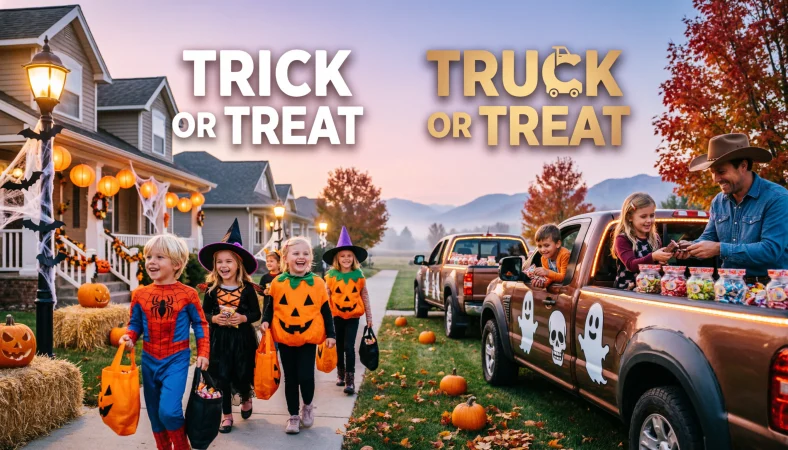
Trick or treat is the correct and traditional Halloween expression, while truck or treat is generally a playful variation or a mistaken version of the phrase. “Trick or treat” refers to the custom of children asking for candy while offering the playful choice of a trick or a treat. “Truck or treat” may also appear in events such as vehicle based Halloween celebrations, but it isn’t the standard phrase.
Have you ever wondered whether people should say “truck or treat” or “trick or treat”? The two phrases sound similar, but they have different meanings and uses. Trick or treat is the familiar Halloween expression, while truck or treat is usually used as a creative name for Halloween events involving trucks or vehicles. This guide explains the difference, correct usage, meaning, and context so you can understand which phrase fits your situation.
Truck or Treat vs Trick or Treat: What’s the Difference?
The confusion between truck or treat and trick or treat usually comes from a simple spelling or hearing mistake. The words sound different, but in fast speech, especially when children say the phrase quickly, the first word can sometimes be misheard.
Trick or treat is the established Halloween expression. Children traditionally say it when visiting homes on Halloween and asking for candy. The phrase refers to a playful choice between receiving a treat and facing a harmless trick.
Truck or treat, by contrast, is not the standard Halloween expression. In most ordinary writing, if you want to describe the traditional Halloween activity, trick or treat is the correct form.
| Expression | Part of speech | Standard meaning | Typical use |
| Trick | Noun | A prank, joke, or playful deception | Halloween tradition |
| Treat | Noun | Something enjoyable, especially candy | Halloween tradition |
| Truck | Noun | A large road vehicle | Vehicles and transportation |
| Trick or treat | Fixed expression | A Halloween request for candy | Standard Halloween usage |
| Truck or treat | Phrase | Usually a playful variation or mistaken form | Themed events or informal usage |
The key distinction is simple.
Trick or treat is the conventional Halloween phrase.
Truck or treat is normally a mistaken spelling when someone means the Halloween expression.
However, truck or treat can be deliberately used as a creative name for a Halloween event involving trucks.
That difference between standard usage and creative wordplay is important.
What Does Truck or Treat Mean?
The meaning depends heavily on context.
If someone writes, “The children went truck or treat last night,” they probably mean trick or treat. In that sentence, “truck” is almost certainly an error.
If a community organization announces a “Truck or Treat” event, however, the phrase may be intentional. Such events can involve decorated trucks, parking lots, community gatherings, or children visiting vehicles to collect candy. The expression works as a pun based on the familiar phrase.
This is similar to the way businesses and community groups create playful Halloween names. A traditional expression is modified to fit a particular theme.
For example:
“Bring the kids to our Truck or Treat event for candy, costumes, and decorated vehicles.”
Here, Truck or Treat has a deliberate meaning. The presence of trucks explains why the organizer chose the unusual wording.
By contrast:
“The children went truck or treat from house to house.”
In ordinary English, this would normally be corrected to:
“The children went trick or treat from house to house.”
Context therefore determines whether the unusual expression is an error or intentional wordplay.
Is Truck or Treat a Grammar, Vocabulary, or Usage Issue?
This is primarily a vocabulary and usage issue, rather than a complicated grammar problem.
The standard expression is a fixed phrase. Fixed expressions are combinations of words that have an established meaning in a language. Changing one word can alter the expression or make it sound incorrect.
The word trick has a relevant Halloween meaning. It can refer to a prank or playful act. The word treat refers to something enjoyable, particularly candy in the context of Halloween.
The word truck, however, has an entirely different meaning. It normally refers to a large motor vehicle used for transporting goods or people.
That is why the traditional phrase is not interchangeable.
Is trick interchangeable with truck?
No. In the conventional Halloween expression, trick is the established word.
Is truck or treat always wrong?
No. It can be intentional wordplay, particularly as the name of an event involving trucks.
Is trick or treat formal or informal?
It is an informal, familiar expression associated with Halloween.
Can truck or treat be used academically?
Only when discussing the phrase itself, a specific event, or a creative variation. It should not normally be substituted for trick or treat in formal writing about Halloween.
Why Do People Confuse Truck and Trick?
Several factors can contribute to this confusion.
First, trick and truck both begin with the consonant sound represented by “tr.” Their vowels differ, but rapid speech can make the distinction less noticeable to inexperienced listeners.
Second, children often learn the phrase by hearing it before they see it written. A child who has never encountered the phrase in writing may reproduce what they think they heard.
Third, autocorrect and typing errors can create unexpected substitutions.
Fourth, people may encounter Truck or Treat as an event title and reasonably assume that it is another accepted version of the Halloween phrase.
The last point is especially important. A phrase can be intentionally altered for branding without becoming the standard form of the original expression.
When Should You Use Trick or Treat?
Use trick or treat when you are referring to the traditional Halloween activity.
The expression is commonly associated with children wearing costumes, visiting homes, knocking on doors, and receiving candy or other treats.
Workplace example
A workplace announcement might say:
“Employees are welcome to bring their children to the office for a trick or treat celebration.”
This is appropriate because the event follows the traditional Halloween custom.
Academic example
A research paper discussing Halloween traditions might state:
“Trick or treat became an important part of Halloween celebrations in North America.”
Here, the standard expression is appropriate even though the surrounding language is formal.
Technology example
A calendar application might contain an event titled:
“Halloween trick or treat schedule.”
Likewise, a parenting website might publish an article called:
“How to keep children safe while going trick or treat.”
In each example, trick or treat refers to the established Halloween activity.
Usage recap: Use trick or treat when you mean children visiting homes or participating in the traditional Halloween custom.
When Should You Use Truck or Treat?
Use truck or treat only when the word truck is intentional.
The expression can work as a creative variation when trucks or other vehicles are central to the activity.
Workplace example
A company with a fleet of decorated vehicles might advertise:
“Join us for our annual Truck or Treat event.”
Here, the unusual phrase is intentional because trucks are part of the event.
Academic example
A researcher studying modern Halloween celebrations could write:
“Some communities have developed Truck or Treat events as alternatives to traditional door to door trick or treat activities.”
In this context, capitalization may be appropriate if Truck or Treat is the official name of an event.
Technology example
A local event listing might say:
“Our mobile app now includes nearby Truck or Treat activities.”
Again, the phrase makes sense if the events involve vehicles.
Usage recap: Use truck or treat when you specifically mean a truck themed Halloween activity or an intentionally creative event name.
When You Should NOT Use Truck or Treat
There are several situations where truck or treat should normally be avoided.
- When describing the traditional Halloween custom
Write trick or treat, not truck or treat.
- When writing a school announcement about ordinary Halloween activities
A standard announcement should use the established expression.
- When explaining the meaning of the Halloween phrase
The conventional expression is trick or treat.
- When writing a formal article about Halloween traditions
Unless you are discussing the unusual phrase itself, replacing “trick” with “truck” creates an unnecessary error.
- When proofreading a child’s Halloween sentence
If the child wrote “truck or treat” but clearly means the traditional activity, correct it to trick or treat.
- When writing an educational resource for English learners
Teach the established expression rather than presenting the playful variation as an equivalent.
- When creating search optimized content about the traditional Halloween phrase
Use trick or treat for accuracy and clarity. Mention truck or treat only when explaining the common confusion or discussing truck themed events.
Common Mistakes: Truck or Treat and Trick or Treat
| Correct sentence | Incorrect sentence | Explanation |
| The children went trick or treat. | The children went truck or treat. | The traditional Halloween expression uses “trick.” |
| We bought candy for trick or treaters. | We bought candy for truck or treaters. | “Trick or treater” is the established noun. |
| The school is hosting a trick or treat night. | The school is hosting a truck or treat night. | Use “truck” only if the event actually involves trucks. |
| Our neighborhood has a Truck or Treat event. | Our neighborhood has a truck or treat event. | Capitalization may indicate an official event name. |
| Children often go trick or treat on Halloween. | Children often go truck or treat on Halloween. | The conventional activity is called trick or treat. |
Decision Rule
If you mean the traditional Halloween activity, use “trick or treat.” If you mean a deliberately truck themed Halloween event, “Truck or Treat” can be appropriate.
This rule resolves most cases immediately.
The Meaning of Trick in Trick or Treat
Understanding trick helps explain why the phrase is structured the way it is.
A trick can mean a deceptive action, a prank, or a playful act designed to surprise someone. In Halloween tradition, the word refers to the possibility of a playful prank if no treat is offered.
A treat, meanwhile, is something enjoyable given or received as a pleasure. Candy is the classic Halloween treat.
The phrase therefore creates a playful contrast:
trick represents the mischievous alternative.
treat represents the desired reward.
That contrast is what gives the expression its memorable structure.
Why “Trick or Treat” Became So Familiar
The phrase became closely associated with Halloween customs in North America during the twentieth century. Halloween itself has much older roots, with traditions influenced by celebrations and customs from several historical cultures.
Over time, organized community celebrations, costumes, candy, decorations, and neighborhood visits helped establish trick or treating as one of the best known Halloween customs.
Because the phrase became so familiar, people generally recognize trick or treat immediately. This familiarity also makes small spelling variations stand out.
Someone who writes truck or treat may simply have made a spelling mistake, or they may be deliberately using a pun.
Truck or Treat in Modern Events and Community Culture
Modern communities sometimes adapt Halloween traditions to make them safer, more accessible, or more convenient.
A truck themed Halloween event can bring children together in a controlled location such as a school parking area, community center, church property, or local fairground. Decorated vehicles can provide candy while creating a festive atmosphere.
The name Truck or Treat is effective because it immediately reminds people of trick or treat while highlighting the vehicle theme.
This is an example of linguistic creativity rather than a replacement for the traditional expression.
The distinction is similar to a business creating a pun based on a familiar phrase. The new wording can be memorable without becoming the standard dictionary form.
Trick or Treat in Modern Technology and AI Tools
Digital platforms can make the confusion more visible.
Search engines, spell checkers, messaging applications, and AI writing tools may encounter both phrases. A language model or writing assistant should consider context rather than automatically declaring every occurrence of truck or treat incorrect.
For example, if a user asks:
“Is truck or treat the correct spelling for Halloween?”
The appropriate response is that trick or treat is the standard expression.
If the user asks:
“What should I call our Halloween event where children visit decorated trucks?”
Then Truck or Treat may be a suitable creative event name.
This distinction illustrates an important principle in language technology: correctness depends partly on intended meaning and context.
Etymology and Word Origins
The words themselves have long histories.
Trick entered English through Old French and ultimately traces back to Latin roots associated with deception or cunning.
Treat has a different history. It developed through Old French from Latin roots associated with handling, discussing, or dealing with something, eventually acquiring meanings connected with providing something enjoyable.
Truck also has a separate linguistic history. The modern noun referring to a large vehicle developed in English through earlier meanings associated with exchange, barter, or trade before acquiring its modern transportation sense.
These unrelated histories reinforce why truck is not simply an alternative spelling of trick.
The words look similar enough to cause occasional confusion, but they are distinct words with distinct meanings.
An Expert View of the Difference
A useful way to understand this distinction is:
“Standard expressions depend on established usage, while creative variations depend on context and intention.”
That principle applies far beyond Halloween. English contains thousands of fixed expressions that speakers occasionally modify for humor, advertising, branding, or wordplay.
The existence of a creative variation doesn’t automatically make it the standard form.
Two Practical Case Studies
Case Study One: A Child’s Halloween Writing
Imagine a student writes:
“On Halloween, we went truck or treat and got lots of candy.”
The context makes the intended meaning obvious. The child is describing the traditional activity.
A teacher or editor would normally change the phrase to:
“On Halloween, we went trick or treat and got lots of candy.”
The correction is necessary because the student is not referring to trucks. The issue is vocabulary accuracy rather than sentence structure.
Case Study Two: A Community Truck Event
Now imagine a community organization publishes:
“Join us for Truck or Treat on October 31.”
The event takes place in a parking lot filled with decorated pickup trucks. Children walk from vehicle to vehicle and collect candy.
In this situation, changing Truck or Treat to Trick or Treat could actually remove the intended wordplay. The event name deliberately emphasizes trucks.
The lesson is straightforward: context determines whether the unusual wording is an error or a purposeful variation.
Error Prevention Checklist
Always use trick or treat when
- You mean the traditional Halloween activity.
- Children are visiting homes for candy.
- You are explaining the standard Halloween phrase.
- You are writing educational material about Halloween vocabulary.
- You are proofreading a sentence that uses “truck” accidentally.
Never use truck or treat when
- You simply mean the conventional Halloween expression.
- You are writing a formal explanation of standard English usage.
- You are teaching English learners the traditional phrase.
- You are referring to ordinary door to door Halloween visits.
- There is no connection between the activity and trucks.
Related Grammar and Usage Confusions You Should Master
Learning this distinction can lead naturally to other commonly confused English expressions:
- Trick or treat vs truck or treat
- Everyday vs every day
- Advice vs advise
- Affect vs effect
- Compliment vs complement
- Principal vs principle
- Then vs than
- Your vs you’re
- Its vs it’s
- There vs their vs they’re
These pairs and groups demonstrate a broader lesson: words that sound or look similar can have completely different meanings.
FAQs
Is truck or treat the correct spelling?
No, not when you mean the traditional Halloween expression. The standard phrase is trick or treat. Truck or Treat can be correct as a deliberately created name for an event involving trucks.
Is it trick or treat or truck or treat?
The traditional Halloween phrase is trick or treat. The word “trick” refers to the playful prank or mischief associated with the custom. “Truck” refers to a vehicle and is not the standard word in the expression.
Why do people say truck or treat?
People may say or write truck or treat because they have misheard or misspelled trick or treat. In other situations, the phrase is intentionally used as a pun for Halloween events involving trucks.
What does trick or treat mean?
Trick or treat is a traditional Halloween expression associated with children visiting homes while wearing costumes and asking for candy or other treats. The phrase refers playfully to the possibility of a trick or the offering of a treat.
Is Truck or Treat a real Halloween event?
Yes, Truck or Treat can be used as the name of Halloween events involving trucks or decorated vehicles. It is generally a creative variation of the traditional phrase rather than a replacement for it.
Should Truck or Treat be capitalized?
If it is the official name of an event, Truck or Treat can be capitalized. If someone uses the phrase accidentally while meaning the ordinary Halloween activity, it should normally be corrected to trick or treat.
Is truck or treat grammatically wrong?
Not necessarily. The phrase can be grammatically understandable when used as a creative event name. The problem occurs when someone uses it as though it were the standard Halloween expression.
What is the difference between trick and truck?
A trick is a prank, deceptive action, or clever maneuver. A truck is generally a large motor vehicle. They are separate words with different meanings, even though their spellings and sounds are somewhat similar.
Can I use Truck or Treat for a Halloween party?
Yes. It can be an effective name for a party or community event centered around trucks. If trucks aren’t part of the theme, Trick or Treat is the clearer and more conventional choice.
Conclusion:
The correct choice depends on what you mean. Trick or treat is the established Halloween expression used for the traditional custom of asking for candy. Truck or Treat is usually a mistaken version when someone means that expression, but it can be a perfectly intentional pun when a Halloween event centers on trucks. In everyday Halloween writing, choose trick or treat.
Author Bio: Written by a linguistically focused SEO content specialist with expertise in English usage, commonly confused words, search intent, and people first educational content.











2 thoughts on “What Does “Truck or Treat” Mean? Correct Phrase, Origin & Trick Or Treat Explained For 2026”