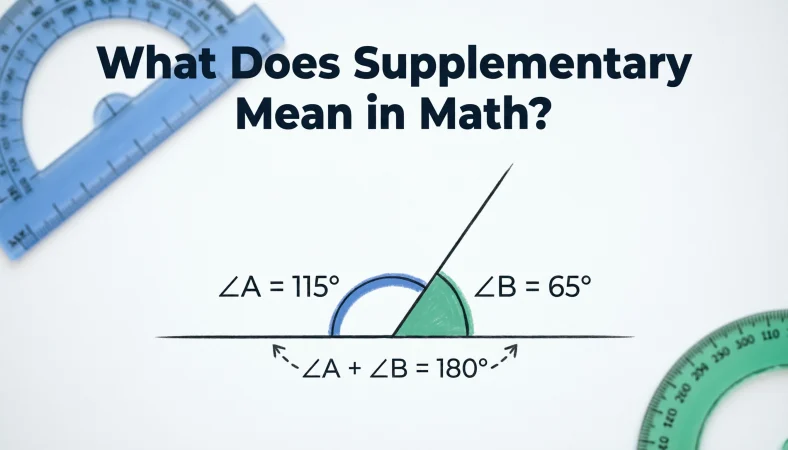
Definition: In mathematics, supplementary refers to two angles whose measures add up to exactly 180 degrees. These are called supplementary angles. The angles do not have to be next to each other, but their sum must equal 180°.
If you’re learning geometry or preparing for a math test, you’ve probably encountered the term supplementary. It often appears in lessons about angles, lines, polygons, and geometric proofs, making it one of the most important concepts in elementary and high school mathematics.
At first, the word supplementary may sound complicated, but the idea is actually simple. In math, it describes two angles whose measures add up to a specific value 180 degrees. Understanding supplementary angles will help you solve geometry problems, work with parallel lines, prove theorems, and develop stronger problem-solving skills.
In this comprehensive guide, you’ll learn what does supplementary mean in math, its definition, origin, properties, real-world applications, examples, common mistakes, comparisons with complementary angles, and practical tips for identifying supplementary angles quickly.
Think of supplementary angles as two pieces that together form a straight angle.
Mathematically:
Angle A + Angle B = 180°
Examples include:
- 90° + 90° = 180°
- 120° + 60° = 180°
- 150° + 30° = 180°
- 75° + 105° = 180°
If the total is exactly 180 degrees, the angles are supplementary.
Quick Reference Table
| Angle 1 | Angle 2 | Total | Supplementary? |
| 90° | 90° | 180° | ✅ Yes |
| 130° | 50° | 180° | ✅ Yes |
| 70° | 110° | 180° | ✅ Yes |
| 45° | 45° | 90° | ❌ No (Complementary) |
| 80° | 80° | 160° | ❌ No |
Origin
The word supplementary comes from the Latin word supplementum, meaning something added to complete or fill up.
In mathematics, this meaning fits perfectly. A supplementary angle “completes” another angle so that together they form a straight angle measuring 180 degrees.
The concept has been part of geometry for centuries, dating back to ancient mathematicians such as Euclid, whose work laid the foundation for modern geometric principles. Today, supplementary angles are taught worldwide in middle school, high school, and introductory mathematics courses.
Popularity
Supplementary angles are among the most frequently taught concepts in geometry because they appear in many mathematical topics.
You’ll encounter them in:
- Geometry classes
- Algebra with geometry applications
- Standardized tests
- Engineering
- Architecture
- Computer graphics
- Physics
- Technical drawing
Teachers emphasize supplementary angles because they help students understand relationships between intersecting lines, parallel lines, polygons, and angle theorems.
How It Is Used
Supplementary angles appear in many geometry problems.
Finding a Missing Angle
Suppose one angle measures 125°.
The supplementary angle is:
180° − 125° = 55°
Straight Lines
When a straight line is divided by another line, adjacent angles often form a supplementary pair.
Example:
- Left angle = 140°
- Right angle = 40°
Together:
140° + 40° = 180°
Parallel Lines
Supplementary relationships appear frequently when parallel lines are cut by a transversal.
Examples include:
- Same-side interior angles
- Same-side exterior angles
Polygon Problems
Students often use supplementary angles when calculating unknown interior or exterior angles in polygons.
Examples
Friendly Examples
Example 1
One angle measures 70°.
Find its supplementary angle.
Solution:
180° − 70° = 110°
Example 2
Two angles measure:
- 95°
- 85°
Their total:
95° + 85° = 180°
They are supplementary.
Example 3
One angle is 30°.
Its supplementary angle is:
180° − 30° = 150°
Professional Examples
Geometry textbook:
Two adjacent angles form a straight line. If one angle measures 118°, determine the measure of its supplementary angle.
Solution:
180° − 118° = 62°
Engineering drawing:
When two connected components create a straight line, the adjacent angles are supplementary.
Architecture:
Designers use supplementary angle relationships when planning structural layouts and geometric patterns.
Funny Examples
Teacher:
What’s the supplementary angle of 180°?
Student:
Zero degrees it used up all its friends. 😄
Math joke:
Complementary angles are best friends.
Supplementary angles are roommates they always add up to 180°. 😂
Student:
I finally understand supplementary angles.
Calculator:
I’m still doing all the work. 😅
Comparison with Similar Terms
Many students confuse supplementary angles with other angle relationships.
| Term | Sum | Example |
| Supplementary | 180° | 120° + 60° |
| Complementary | 90° | 45° + 45° |
| Vertical Angles | Equal | 75° = 75° |
| Adjacent Angles | Share a side | May or may not be supplementary |
| Straight Angle | 180° | Single straight line |
Supplementary vs. Complementary
This is the most common comparison.
| Supplementary | Complementary |
| Add to 180° | Add to 90° |
| Form a straight angle | Form a right angle |
| Common in linear pairs | Common in right triangles |
A simple memory trick:
- Complementary = Corner (90°)
- Supplementary = Straight line (180°)
Alternate Meanings
Outside mathematics, supplementary has broader meanings.
Examples include:
| Field | Meaning |
| Education | Additional learning materials |
| Law | Extra documentation |
| Medicine | Additional treatment or supplements |
| Publishing | Extra information |
| Finance | Supporting documents |
Although the general meaning is “additional” or “added,” in mathematics the term specifically refers to angles that total 180 degrees.
Professional or Polite Alternatives
In educational writing, “supplementary” is already the correct technical term.
However, when explaining the concept to beginners, you can use simpler phrases such as:
| Mathematical Term | Plain-Language Alternative |
| Supplementary angles | Angles that add to 180° |
| Supplement | Angle needed to reach 180° |
| Supplementary relationship | Straight-angle relationship |
| Supplementary pair | Pair totaling 180° |
These alternatives can make explanations easier for younger learners.
Common Mistakes
Students frequently make the following errors.
Confusing Supplementary and Complementary
Remember:
- Supplementary → 180°
- Complementary → 90°
Assuming Angles Must Be Adjacent
Supplementary angles do not have to touch.
As long as their measures total 180°, they are supplementary.
Adding Incorrectly
Always verify the total.
Example:
80° + 90° = 170°
These are not supplementary.
Forgetting the Straight Line Rule
Adjacent angles on a straight line form a linear pair, which is always supplementary.
Mixing Up Formulas
To find a supplementary angle:
180° − Given Angle
Not:
90° − Given Angle
Quick Tips
Keep these tips in mind:
- Supplementary angles always total 180°.
- Think of a straight line whenever you hear “supplementary.”
- Use the formula: 180° − known angle.
- Supplementary angles do not have to be adjacent.
- A linear pair is always supplementary.
- Don’t confuse supplementary with complementary angles.
- Draw diagrams to visualize angle relationships.
- Double-check your arithmetic before concluding that two angles are supplementary.
FAQ
1. What does supplementary mean in math?
In mathematics, supplementary describes two angles whose measures add up to exactly 180 degrees.
2. What are supplementary angles?
Supplementary angles are any two angles that sum to 180°, whether or not they are adjacent.
3. Do supplementary angles have to be next to each other?
No. They may be adjacent or separate. The only requirement is that their measures total 180°.
4. How do you find a supplementary angle?
Subtract the known angle from 180°.
Example:
180° − 65° = 115°
5. What’s the difference between supplementary and complementary angles?
Supplementary angles add to 180°, while complementary angles add to 90°.
6. Can two right angles be supplementary?
Yes. Since 90° + 90° = 180°, two right angles are supplementary.
7. Are all adjacent angles supplementary?
No. Adjacent angles are only supplementary if they add up to 180°.
8. Why are supplementary angles important?
They help solve geometry problems involving straight lines, parallel lines, polygons, proofs, engineering, architecture, and many other mathematical applications.
Conclusion
Understanding what does supplementary mean in math is essential for mastering geometry and many other mathematical concepts. In simple terms, supplementary angles are two angles whose measures add up to exactly 180 degrees. Whether the angles are adjacent or separate, the defining characteristic is their sum.
You’ll encounter supplementary angles in classroom lessons, standardized tests, engineering, architecture, technical drawing, and everyday geometric reasoning. By remembering the simple rule supplementary angles always total 180° and practicing with real examples, you’ll be able to identify and solve angle problems more quickly and accurately.
As you continue studying mathematics, recognizing supplementary relationships will make more advanced topics, such as parallel lines, transversals, polygons, and geometric proofs, much easier to understand.
Read More Articles About:
- What Does LOML Mean in Text? Meaning, Examples, Usage and When to Use It In 2026
- What Does Neat Mean in a Drink? Definition, Origin, Examples and How to Order Like a Pro in 2026
- What Does Side Out Mean in Volleyball? Definition, Rules, Examples, and Why It Matters In 2026











1 thought on “Supplementary Angles Explained: Meaning, Definition, Properties & Examples In 2026”