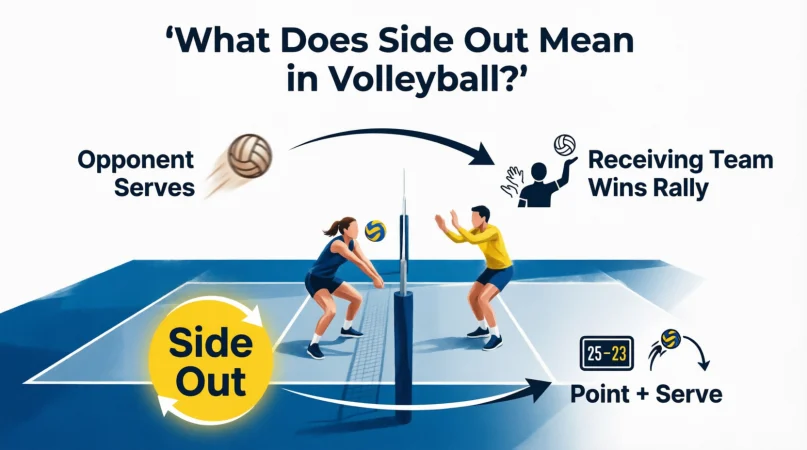
Definition: A side out in volleyball occurs when the receiving team wins the rally against the serving team, earning the right to serve next. In modern rally scoring, the receiving team also earns a point when they achieve a side out.
Ever heard a volleyball commentator shout, “Side out!”, and wondered what it actually means? You’re not alone. Whether you’re new to the game, watching professional matches, or just trying to understand volleyball scoring, knowing what does side out mean in volleyball can make every rally much easier to follow. While the term comes from the sport’s original scoring system, it’s still widely used by players, coaches, and commentators today.
In this guide, you’ll learn exactly what a side out is, why it matters, and how it affects momentum during a match. Drawing from official volleyball rules and the way the game is played at every level, this article provides a clear, accurate, and beginner-friendly explanation. By the end, you’ll understand the meaning of side out in volleyball and recognize it instantly whenever you watch or play the game.
The Origin of Side Out
Volleyball was invented in 1895 by William G. Morgan.
For most of the sport’s history, matches used side-out scoring.
Original Rules
| Situation | Result |
| Serving team wins rally | Scores point and serves again |
| Receiving team wins rally | No point; gains serve (Side Out) |
This scoring method often produced extremely long matches because only one team could earn points at a time.
Understanding Side Out in Volleyball
Imagine this situation:
- Blue Team serves.
- Red Team receives the serve.
- Red Team executes a perfect pass.
- The setter delivers the ball.
- The hitter spikes it successfully.
- Blue Team cannot return it.
Result: Side Out.
Red Team:
- Wins the rally ✅
- Scores a point ✅
- Gets the next serve ✅
That’s a textbook example of a side out.
Why Is It Called a “Side Out”?
The term dates back to volleyball’s original scoring system known as side-out scoring.
Before rally scoring existed:
- Only the serving team could score points.
- If the receiving team won a rally, they didn’t score.
- Instead, they simply gained the serve.
The ball essentially changed “sides,” leading to the phrase side out.
Although volleyball now uses rally scoring, coaches, announcers, and players still use the traditional term because it describes the receiving team successfully winning the rally.
When Did Volleyball Change to Rally Scoring?
Around 1999, international volleyball officially adopted rally scoring.
Today:
- Every rally awards a point.
- Either team can score.
- Matches are faster.
- Television broadcasts became easier to schedule.
Despite the change, “side out” remains a standard volleyball term.
What Happens During a Side Out?
Here’s the sequence:
Step 1
Team A serves.
↓
Step 2
Team B receives the serve.
↓
Step 3
Team B wins the rally.
↓
Step 4
Team B scores one point.
↓
Step 5
Team B rotates clockwise.
↓
Step 6
Team B serves next.
That’s a complete side out.
Why Is Side Out Important?
A strong side-out percentage separates average teams from championship teams.
When coaches discuss side-out efficiency, they’re measuring how often a team successfully converts serve receive into winning the rally.
Elite volleyball teams typically have very high side-out percentages because they:
- Pass accurately
- Set consistently
- Attack efficiently
- Minimize errors
Side Out Percentage Explained
One important volleyball statistic is Side-Out Percentage.
Formula
Side-Out % = Successful Side Outs ÷ Total Serve Receive Opportunities × 100
Example:
- Opponent serves 40 times.
- Your team wins 28 of those rallies.
Side-Out Percentage:
28 ÷ 40 = 70%
A 70% side-out rate is considered excellent.
Example Side-Out Statistics
| Serve Receive Opportunities | Successful Side Outs | Percentage |
| 20 | 10 | 50% |
| 30 | 18 | 60% |
| 40 | 28 | 70% |
| 50 | 40 | 80% |
Higher percentages generally indicate stronger offensive consistency.
Real Match Example
Imagine a college volleyball match.
Score:
Blue Team: 21
White Team: 20
Blue Team serves.
White Team executes:
- Perfect pass
- Quick set
- Powerful spike
Blue Team can’t dig the attack.
Result:
- White Team scores.
- White Team serves.
- White Team has achieved a side out.
Why Coaches Emphasize Side Outs
Coaches constantly practice side-out drills because every serve received is an opportunity.
Teams with excellent side-out skills:
- Stay close during difficult serving runs.
- Break opponents’ momentum.
- Regain control quickly.
- Reduce scoring streaks.
Many volleyball practices include drills that begin with serve receive specifically to improve side-out performance.
Common Side-Out Situations
A side out happens when the receiving team wins because of:
- A kill
- Opponent hitting out
- Net violation
- Service error
- Double contact
- Lift
- Attack error
- Block resulting in a point
Each of these immediately ends the rally and awards the serve to the receiving team.
Examples of Side Out in Context
Example 1 (Neutral)
“The team finally earned a side out after four consecutive opponent serves.”
Example 2 (Commentator)
“Excellent serve receive! That’s exactly how you side out against an aggressive serving team.”
Example 3 (Coach)
“We need a side out right now to stop their momentum.”
Example 4 (Player)
“Our passing improved, so our side-out percentage increased.”
Example 5 (Excited)
“Great pass! Amazing swing! SIDE OUT! 🔥🏐”
Tone and Usage
| Situation | Example |
| Friendly | “Nice side out!” 😊 |
| Coaching | “Focus on side-out efficiency.” |
| Commentary | “That was a huge side out.” |
| Competitive | “We need a side out immediately.” |
Unlike slang, “side out” is always a neutral sports term.
Side Out vs Rally Scoring
| Feature | Side-Out Scoring | Rally Scoring |
| Serving team scores | Yes | Yes |
| Receiving team scores | No | Yes |
| Receiving team gains serve | Yes | Yes |
| Used today | No | Yes |
Today’s volleyball uses rally scoring, but the phrase side out still refers to winning the rally while receiving serve.
Side Out vs Break Point
These two terms are often confused.
| Side Out | Break Point |
| Receiving team wins rally | Serving team wins rally |
| Receiving team gets serve | Serving team keeps serve |
| Ends opponent’s serving turn | Continues serving streak |
A side out stops the opponent from serving.
A break point allows the serving team to continue building momentum.
Side Out vs Ace
| Side Out | Ace |
| Receiving team wins rally | Server wins immediately |
| Changes serve | Server continues serving |
| Requires receiving success | No return by receiving team |
Common Volleyball Terms Related to Side Out
| Term | Meaning |
| Ace | A serve that scores immediately |
| Kill | Successful attack ending a rally |
| Dig | Defensive save after an attack |
| Block | Stops an opponent’s attack |
| Rotation | Players move positions after gaining serve |
| Rally | Continuous play until a point is scored |
| Serve Receive | Receiving the opponent’s serve |
Understanding these terms makes side outs much easier to follow during matches.
Strategies for Better Side Outs
Good teams improve side-out efficiency through several key skills.
Excellent Passing
Everything starts with a controlled first pass.
Smart Setting
Accurate sets create better attacking opportunities.
Aggressive Hitting
Powerful, well-placed attacks increase the chances of winning the rally.
Communication
Calling the ball prevents confusion.
Staying Calm
Teams that remain composed under pressure often side out more consistently.
Mistakes That Prevent Side Outs
Many teams lose side-out opportunities because of simple errors.
Common mistakes include:
- Poor passing
- Miscommunication
- Hitting into the net
- Serving receive errors
- Bad sets
- Attack errors
- Rotation mistakes
- Free-ball giveaways
Reducing these mistakes dramatically improves overall performance.
Does Side Out Mean Scoring a Point?
Yes but only in modern volleyball.
Old Rules
Receiving team:
✔ Gains serve
❌ No point
Modern Rules
Receiving team:
✔ Gains serve
✔ Scores one point
This difference is one reason the term sometimes confuses beginners.
Alternate Meanings of “Side Out”
Outside volleyball, “side out” has a few other meanings, though they are far less common.
| Context | Meaning |
| Beach games | Ball or possession changes sides |
| Recreational sports | Change in possession |
| Everyday language | Rarely used outside sports |
In most cases, especially online searches, side out refers to volleyball.
Professional or Beginner-Friendly Alternatives
If you’re teaching someone new to volleyball, you might explain side out using simpler language.
Instead of saying:
“We need a side out.”
You could say:
- “We need to win this rally.”
- “Let’s get the serve back.”
- “Let’s regain possession.”
- “We need to earn the next serve.”
These phrases communicate the same idea in a more beginner-friendly way.
FAQ
1. What does side out mean in volleyball?
A side out occurs when the receiving team wins the rally, earns a point under rally scoring, and gains the right to serve next.
2. Does a side out always score a point?
Yes, under modern rally scoring. Under the old side-out scoring system, it only awarded the serve.
3. Why is it called a side out?
The term comes from the original scoring system where the serve changed sides without awarding a point.
4. Is side out still an official volleyball term?
Yes. Although the scoring system changed, players, coaches, referees, and commentators still use the term regularly.
5. What is a good side-out percentage?
Competitive teams often aim for 60–70%, while elite teams may exceed 70%.
6. What is the difference between a side out and a break point?
A side out is when the receiving team wins the rally and gains the serve. A break point occurs when the serving team wins another rally and continues serving.
7. Do players rotate after a side out?
Yes. When a team gains the serve through a side out, players rotate one position clockwise before serving.
8. Why do coaches practice side-out drills?
Because strong side-out performance helps teams stop opponents’ serving runs, regain momentum, and maintain offensive consistency.
Conclusion
Understanding what side out means in volleyball is essential for anyone learning the sport. A side out occurs when the receiving team wins the rally, earns the right to serve next, and under today’s rally scoring system also scores a point. While the term originated during volleyball’s old side-out scoring era, it remains a fundamental part of the game’s language and strategy.
Whether you’re a beginner trying to follow a match, a player aiming to improve, or a coach analyzing team performance, recognizing the importance of side-out efficiency can deepen your appreciation of volleyball. Focus on strong serve receive, accurate setting, and effective attacking to increase your team’s chances of earning consistent side outs and controlling the flow of the game.











1 thought on “What Does Side Out Mean In Volleyball? Definition, Rules, Examples, and Why It Matters In 2026”