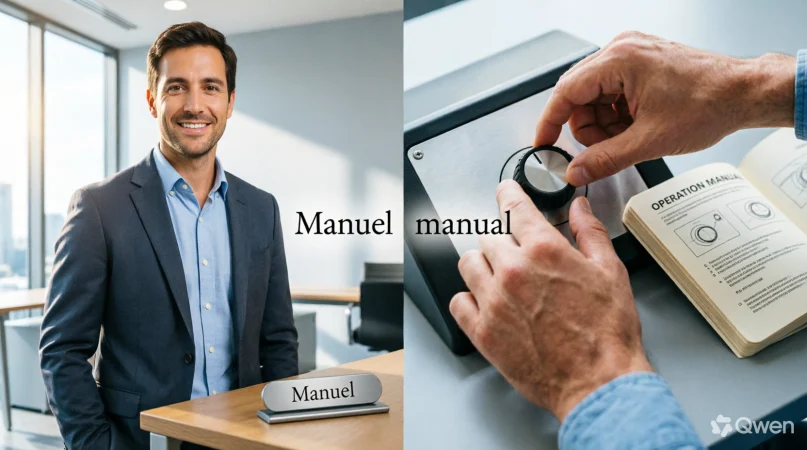
Manual is the correct standard spelling when you mean something done by hand, a handbook, or a set of instructions. Manuel is generally a proper name, not the standard spelling of “manual.” For example, “Read the user manual before operating the machine.” If you’re referring to instructions or something done by hand, use manual.
Have you ever wondered whether the correct word is manuel or manual? These words look very similar, but they have different uses and meanings. Manual is the standard English word for something done by hand or a book of instructions, while Manuel is commonly used as a personal name. This guide explains the difference, meaning, pronunciation, and correct usage with simple examples so you can avoid this common spelling confusion.
Manuel vs Manual: What’s the Difference?
The simplest way to understand manuel or manual is to recognize that these words usually belong to completely different categories.
Manual is a standard English word. It can function as an adjective or a noun. As an adjective, it describes something done with the hands or without automatic operation. As a noun, it commonly means an instruction book or guide.
Manuel, by contrast, is generally a proper noun. It is most commonly used as a male first name in Spanish, Portuguese, German, and several other languages. It can also appear as a surname in some contexts.
| Word | Part of Speech | Main Meaning | Typical Use |
| Manual | Adjective | Done by hand or operated by a person | manual work, manual transmission |
| Manual | Noun | A book or guide containing instructions | user manual, training manual |
| Manuel | Proper noun | A personal name | Manuel is coming today |
The distinction becomes much easier once you focus on capitalization and meaning.
Manual is an ordinary English vocabulary word.
Manuel is normally a person’s name.
If you are describing instructions, physical work, human operation, or a nonautomatic process, choose manual.
If you are referring to someone whose name is Manuel, use Manuel.
Is Manuel vs Manual a Grammar, Vocabulary, or Usage Issue?
The confusion between manuel and manual is primarily a spelling and vocabulary issue, although grammar can also matter depending on how the word appears in a sentence.
The two words are not interchangeable.
Manual has several established meanings in English. You might talk about manual labor, a manual process, a manual transmission, or an instruction manual. The word has been part of English vocabulary for centuries.
Manuel usually functions as a proper name. Because names are capitalized, the first letter is normally uppercase.
For example:
Manuel works at the local office.
Here, Manuel identifies a person.
Compare that with:
The employee completed the task manually.
The second sentence refers to an action performed by hand.
There is also an important pronunciation difference in many contexts. Manual is an English vocabulary word, while Manuel may be pronounced according to the language and naming tradition of the person who has that name.
Formal and Informal Usage
In formal writing, choosing the correct spelling matters because a spelling error can change the apparent meaning of a sentence.
If you write:
Please read the manuel before operating the machine.
Most readers will understand what you mean, but manuel is incorrect in this context.
The correct sentence is:
Please read the manual before operating the machine.
In casual writing, people may make this mistake because manuel and manual look and sound similar. Autocorrect can also fail to catch it because Manuel is a legitimate name.
Academic Usage
Academic writing requires greater precision. A student discussing research instructions, laboratory procedures, or a technical guide should use manual when referring to documentation.
For example:
The laboratory manual explains the required procedure.
Writing manuel in this sentence would be a spelling error.
When to Use Manual
Use manual when you are talking about something performed by hand, controlled by a person, or explained in an instruction guide.
The word has several common meanings, so understanding its grammatical role is useful.
Manual as an Adjective
As an adjective, manual describes something involving human hands or human control.
Examples include:
The factory still uses manual inspection.
The vehicle has a manual transmission.
The technician performed a manual adjustment.
Manual data entry can take considerable time.
In each example, manual describes a process that involves human action rather than complete automation.
Manual as a Noun
As a noun, manual often means an instruction book or reference guide.
Examples include:
Read the user manual before turning on the device.
The employee training manual contains the company procedures.
The technician checked the repair manual.
Here, manual does not describe an action. It refers to a document.
Workplace Example
Imagine a new employee receiving a document that explains workplace procedures.
You could write:
The manager gave Sarah the employee manual.
Using manuel would be incorrect because the sentence refers to an instruction document rather than a person named Manuel.
Academic Example
A university course might provide students with a laboratory guide.
Students should review the laboratory manual before the experiment.
Again, manual is correct because it refers to written instructions.
Technology Example
Technology provides many examples of this word.
The technician entered the settings manually.
The software manual explains how to configure the device.
The first example uses the related adverb manually, while the second uses manual as a noun.
Usage Recap
Use manual when you mean something related to human effort, hand operation, or written instructions.
If you can replace the word with hand operated, done by hand, or instruction guide, manual is probably the correct choice.
When to Use Manuel
Use Manuel when you are referring to a person whose name is Manuel.
Because it is normally a personal name, it should be capitalized.
For example:
Manuel joined the meeting at nine.
I spoke with Manuel yesterday.
Manuel submitted the report.
Have you seen Manuel?
In these sentences, the word identifies an individual. It does not describe physical work, human operation, or a book of instructions.
Workplace Example
Suppose an employee named Manuel works in an office.
Manuel will prepare the presentation.
Changing his name to manual would completely alter the sentence.
The sentence:
Manual will prepare the presentation.
would normally look like a spelling mistake unless Manual were intentionally being used as an unusual personal name.
Academic Example
A student might write about a classmate or researcher named Manuel.
Manuel presented the findings during the seminar.
The capitalization signals that the word is a proper name.
Technology Example
Technology can also contain personal names.
Manuel created the software documentation.
This sentence identifies a person named Manuel.
Compare it with:
The software manual explains the installation process.
The difference is immediately clear. Manuel is the person. Manual is the documentation.
Usage Recap
Use Manuel when you mean a person’s name.
Use manual when you mean a process, physical activity, operating method, or instruction guide.
When You Should NOT Use Manuel or Manual
Several common situations make this spelling confusion especially likely.
1. When You Mean an Instruction Book
Do not write:
Read the manuel carefully.
Write:
Read the manual carefully.
The word refers to a guide containing instructions.
2. When You Mean Work Done by Hand
Do not write:
The process requires manuel labor.
Write:
The process requires manual labor.
The adjective describes physical work performed by people.
3. When You Mean a Person Named Manuel
Do not automatically change a person’s name to manual.
For example:
Manuel called this morning.
Here, Manuel is a person’s name and must remain capitalized.
4. When Discussing a Manual Transmission
A vehicle with a driver operated gearbox has a manual transmission.
Writing manuel transmission is a spelling error.
5. When Describing Human Data Entry
Use manual data entry, not manuel data entry.
The word describes work performed by a person rather than an automated system.
6. When Referring to Software Instructions
Use software manual, user manual, or instruction manual.
The spelling manuel does not work in these expressions.
7. When Writing Someone’s Name
If a person is actually named Manuel, do not change the spelling simply because the word resembles manual.
Names should be written according to the person’s correct spelling.
8. When Editing Professional Documents
A spelling mistake involving manual can make a document appear less polished. Always check whether you are describing an object or process or referring to a person.
Common Mistakes and Decision Rules
| Correct sentence | Incorrect sentence | Explanation |
| Read the manual before use. | Read the manuel before use. | Manual means an instruction guide. |
| The machine requires manual control. | The machine requires manuel control. | Manual describes human operation. |
| Manuel called the office. | Manual called the office. | Manuel is the person’s name. |
| She prefers a manual transmission. | She prefers a manuel transmission. | Manual is the standard English spelling. |
| The technician performed manual testing. | The technician performed manuel testing. | Manual describes testing done by a person. |
| Manuel works with the engineering team. | Manual works with the engineering team. | Manuel is a personal name. |
Decision Rule
If you mean something done by hand, human controlled, or an instruction guide, use manual.
If you mean a person whose name is Manuel, use Manuel.
A quick memory trick is simple:
Manual describes or names a thing. Manuel usually names a person.
Manuel and Manual in Modern Technology and AI Tools
Modern technology makes the difference even more important because the word manual frequently appears in discussions about automation and artificial intelligence.
A task can be completed manually or automatically.
For example:
The employee manually entered the information.
This means a person performed the task.
An automated system might instead collect the information without direct human entry.
The same distinction appears in AI tools. A user might manually review AI generated text, manually upload information, or manually adjust a setting.
The word Manuel does not describe any of these processes.
For example:
The user manually reviewed the AI generated response.
Here, manually explains how the review happened.
By contrast:
Manuel reviewed the AI generated response.
Here, Manuel identifies the person who performed the review.
This distinction is useful in technical documentation, software instructions, workplace reports, and educational materials.
Where Do Manuel and Manual Come From?
The words have different histories and linguistic roles.
Manual comes from Latin roots associated with the hand. Its historical development is connected with the idea of something performed by hand. English eventually adopted the word for physical activity, human operation, and instructional books.
The connection to the hand remains visible in modern English words such as manually.
Manuel, when used as a personal name, has a different linguistic history. It is a form of a traditional given name associated with names such as Emmanuel and related forms used across several languages.
Although the two words look extremely similar, their meanings developed separately.
This is why spelling them correctly requires attention to context rather than simply relying on pronunciation.
Expert Style Explanation
“The easiest way to separate manual from Manuel is to ask whether you are describing an action or identifying a person. Meaning provides the answer before spelling does.”
This is an editorial language principle rather than a quotation from a named individual.
Two Practical Case Studies
Case Study 1: Workplace Documentation
Imagine a company preparing a new employee guide. The writer wants to tell employees where to find operating instructions.
The original sentence reads:
Please review the manuel before using the equipment.
A proofreading check identifies the problem immediately. The writer does not mean a person named Manuel. The intended meaning is an instruction document.
The corrected sentence is:
Please review the manual before using the equipment.
The correction improves spelling accuracy and eliminates ambiguity.
Case Study 2: Employee Identification
Now imagine a company report mentioning an employee named Manuel.
The original sentence reads:
Manual completed the inspection on Tuesday.
A reader could interpret manual as a spelling mistake because the context appears to require a person’s name.
The corrected sentence is:
Manuel completed the inspection on Tuesday.
The capitalized proper name makes the meaning clear.
In both cases, the solution comes from identifying the intended meaning before choosing the spelling.
Error Prevention Checklist
Always use Manual when
- You mean an instruction guide.
- You mean work performed by hand.
- You mean human controlled operation.
- You mean a manual transmission.
- You mean manual data entry.
- You mean a process that is not automated.
- You mean a physical task performed by a person.
Never use Manuel when
- You mean an instruction book.
- You mean human operated work.
- You mean a hand performed process.
- You mean manual labor.
- You mean manual testing.
- You mean manual control.
- You mean a standard English vocabulary word describing human action.
Use Manuel only when it is actually the person’s name or another proper name that specifically requires that spelling.
Related Grammar Confusions You Should Master
Understanding manuel or manual is one example of a larger group of spelling and vocabulary problems. Many confusing word pairs look or sound similar but have different meanings.
Here are several related topics worth mastering:
- Affect or effect
- Advise or advice
- Then or than
- Your or you’re
- Its or it’s
- Lose or loose
- Accept or except
- Principal or principle
- Compliment or complement
- Stationary or stationery
The most reliable strategy is to learn what each word means and how it functions in a sentence. Memorizing spelling alone is often less effective because similar looking words can have completely different grammatical roles.
FAQs
Is manual or manuel the correct spelling?
Manual is the correct spelling when you mean an instruction guide, something done by hand, or human controlled operation. Manuel is generally a personal name.
Is Manuel a word or a name?
Manuel is primarily used as a personal name. It is commonly found as a male given name in several languages and cultures.
What is the difference between Manuel and manual?
Manual is an English vocabulary word associated with hand performed work, human operation, or an instruction guide. Manuel is generally a person’s name.
Should I write user manual or user manuel?
The correct phrase is user manual. It refers to a document that explains how to use a product, device, application, or system.
Is manual work correct?
Yes. Manual work is correct when you mean work performed physically by people rather than entirely through automated systems.
Is Manuel capitalized?
Yes, when Manuel is being used as a person’s name, it should normally begin with a capital letter because it is a proper noun.
Why do people spell manual as manuel?
The mistake usually happens because the two forms look and sound similar. People may also recognize Manuel as a common name and accidentally use it when they mean the English word manual.
Is manual an adjective or noun?
Manual can be both an adjective and a noun. As an adjective, it describes something done by hand or controlled by a person. As a noun, it often means an instruction guide.
Can Manuel ever be a surname?
Yes. Manuel can occur as a surname as well as a given name. The correct spelling depends on the person’s actual name.
How can I remember manual versus Manuel?
Think about the meaning. Manual relates to hands, human operation, or instructions. Manuel usually identifies a person.
Conclusion
The choice between manuel or manual becomes simple once you identify the meaning of the word.
Use manual for an instruction guide, work performed by hand, human controlled processes, manual testing, manual data entry, or a manual transmission. Use Manuel when you are referring to a person whose name is Manuel.
The two forms look remarkably similar, but they serve different purposes in English. When in doubt, ask yourself one question: Am I describing something, or am I naming someone? If you are describing a process, task, method, or guide, choose manual. If you are naming a person, choose Manuel.