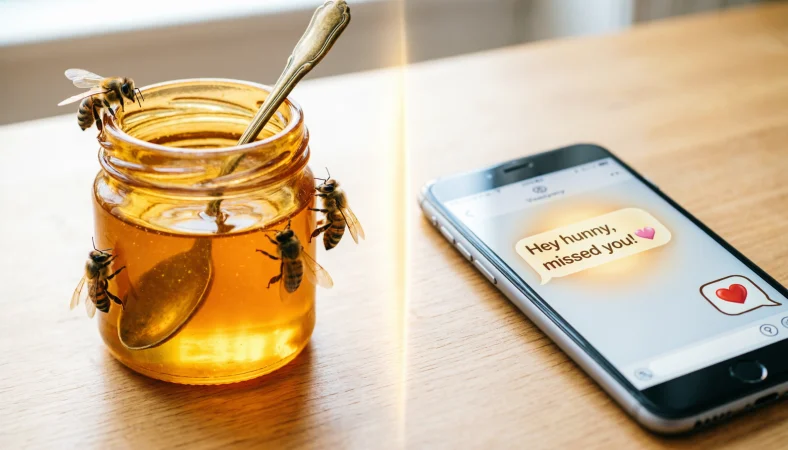
Hunny or honey depends on what you mean. Honey is the standard English spelling for the sweet substance made by bees and a common affectionate term for a person. Hunny is usually an informal, playful, or stylized spelling of honey, often used in texts, social media, usernames, and affectionate messages rather than formal writing.
If you’ve ever wondered whether you should write hunny or honey, you’re dealing with a spelling and usage distinction rather than two completely unrelated English words. The standard spelling is honey, while hunny is generally a nonstandard or deliberately playful variation.
The difference matters because these spellings communicate different things to readers. In a recipe, academic paper, workplace email, or formal article, honey is the appropriate choice. In a text message such as “Goodnight, hunny ❤️,” the alternative spelling may be intentional because it creates a cute, casual, or personalized tone.
The two forms can look almost identical, but spelling carries information about context. Choosing the wrong version can make a formal sentence look careless or make a casual message sound less natural than intended.
Understanding the distinction becomes even more useful when you encounter hunny on TikTok, Instagram, Snapchat, text messages, dating apps, or online communities. There, the unusual spelling can be part of someone’s personal style rather than a simple spelling mistake.
Hunny vs Honey: What’s the Difference?
The simplest rule is that honey is the standard English word, while hunny is generally an informal alternative spelling.
| Word | Part of speech | Standard spelling? | Common meaning | Typical context |
| honey | Noun | Yes | A sweet substance made by bees | Food, cooking, science |
| honey | Noun | Yes | A term of affection | Conversation, relationships |
| honey | Adjective | Yes | Containing or resembling honey in some contexts | Descriptive writing |
| hunny | Noun | Usually no | Playful spelling of honey | Texting, social media |
| hunny | Informal form | No | Affectionate or cute version of honey | Casual communication |
What does honey mean?
Honey has two major everyday meanings.
First, it refers to the sweet substance produced by bees:
I added honey to my tea.
Second, it can be a term of affection:
Thanks, honey.
It can be used between romantic partners, family members, friends, or sometimes even strangers, depending on tone and culture.
What does hunny mean?
Hunny usually represents a playful spelling of honey.
For example:
Good morning, hunny!
The writer probably isn’t referring to a different substance. Instead, the unusual spelling gives the message a more informal, affectionate, cute, or personal quality.
Quick Recap
Honey is the standard spelling.
Hunny is generally a playful or nonstandard spelling.
Use honey in formal and standard writing.
Use hunny mainly when deliberately adopting an informal online or conversational style.
Is Hunny vs Honey a Grammar, Vocabulary, or Usage Issue?
This is primarily a spelling and usage issue.
The word honey is a standard English vocabulary item with established meanings and uses. Hunny generally does not function as a separate standard vocabulary word with an independent meaning.
That distinction is important. When people write “hunny,” they normally aren’t introducing a new dictionary definition. They’re modifying the spelling of an existing word to produce a particular tone.
Are Hunny and Honey Interchangeable?
They can communicate the same basic affectionate meaning in casual communication, but they are not interchangeable in every context.
Consider:
Please drizzle honey over the pancakes.
Replacing it with:
Please drizzle hunny over the pancakes.
would normally look like a spelling error rather than a stylistic choice.
Now consider:
Love you, honey.
and:
Love you, hunny.
In a personal message, both can work, but the second feels more playful and deliberately informal.
Formal vs Informal Usage
Honey works in formal, neutral, academic, professional, and casual contexts when its meaning is appropriate.
Hunny belongs primarily to highly informal communication.
You wouldn’t normally write:
Dear Professor, I have attached the report, hunny.
The spelling would be inappropriate in that professional setting.
Academic vs Casual Usage
Academic writing should use honey when the substance or term of affection is relevant.
For example:
Honey contains naturally occurring sugars and other compounds.
Using hunny would make the sentence appear incorrectly spelled.
In a casual social media caption, however, hunny can be perfectly intentional:
My favorite hunny knows exactly how to make me smile.
The key is recognizing the difference between standard spelling and expressive spelling.
How to Use Honey Correctly
Honey is the default choice whenever you want standard English.
It can describe food, function as a term of affection, or appear in established compounds and expressions.
Workplace Example
Suppose a coworker is discussing a food product:
The company plans to launch a new honey based beverage.
In professional communication, standard spelling is essential.
Another example:
Please confirm whether the shipment contains organic honey.
Using hunny here would make the message appear unprofessional.
Academic Example
In a scientific or educational context:
Honey is produced by bees and is commonly used as a natural sweetener.
This is clearly the standard spelling.
Technology Example
An online recipe application might display:
Add two tablespoons of honey.
A search engine, database, or recipe platform should normally use honey because it is the recognized spelling and improves clarity.
Usage Recap
Choose honey when writing for a general audience.
It is appropriate for professional, academic, educational, commercial, and everyday writing.
It is also the correct spelling when referring to the food produced by bees.
How to Use Hunny Correctly
Hunny is most useful when you intentionally want to create a casual or playful voice.
It commonly appears in texting, social media captions, comments, memes, usernames, and affectionate conversations.
Workplace Example
In most workplace writing, avoid hunny. However, imagine coworkers who have a very informal friendship and use playful nicknames in private messages. One might write:
Thanks for helping me today, hunny!
Here, the spelling is part of the person’s established conversational style. It would still be inappropriate for formal documents.
Academic Example
Academic writing generally has little reason to use hunny unless the term itself is being studied.
For example, a linguistics paper could discuss:
The spelling “hunny” illustrates how informal digital communication can modify conventional spelling.
Here, the word is being discussed as a linguistic phenomenon.
Technology Example
Social platforms are particularly friendly to creative spellings. A user might write:
Morning, hunny ☀️
The spelling helps signal informality and affection.
Usage Recap
Use hunny when the playful spelling is intentional.
It is especially common in personal digital communication.
Don’t use it merely because you think it is the standard spelling.
When You Should NOT Use Hunny or Honey
Understanding when a word doesn’t fit can prevent embarrassing mistakes.
1. Don’t use hunny in formal documents
A business report, application, academic paper, or official letter normally requires standard spelling.
2. Don’t assume hunny is the correct spelling of the food
The sweet substance produced by bees is honey, not hunny.
3. Don’t replace honey with hunny in technical writing
Technical documents need consistency and clarity.
4. Don’t interpret every use of hunny as a spelling error
On social media, unusual spelling can be intentional.
5. Don’t use honey as an automatic term of affection
Although common, the word can sound patronizing or overly familiar depending on the relationship and situation.
6. Don’t assume hunny has one fixed emotional meaning
Its tone depends on the writer, relationship, platform, and surrounding language.
7. Don’t use hunny when writing for search optimized informational content
Standard spelling generally provides clearer communication and aligns with established vocabulary.
8. Don’t correct every informal use of hunny
If someone deliberately writes “hunny” in a text, changing it to “honey” may remove the tone they intended.
Common Mistakes and Decision Rules
| Correct sentence | Incorrect or inappropriate sentence | Explanation |
| I bought some honey. | I bought some hunny. | Honey is the standard spelling for the food. |
| Goodnight, honey. | Goodnight, honey. | Standard spelling works naturally as a term of affection. |
| Goodnight, hunny! | Goodnight, hunny! | This can be appropriate when playful spelling is intentional. |
| Honey is used in many recipes. | Hunny is used in many recipes. | Standard informational writing requires honey. |
| She called her partner honey. | She called her partner hunny. | The second may work stylistically, but it is deliberately informal. |
| The article discusses the word hunny. | The article discusses the word honey. | Both can be correct depending on which spelling is being analyzed. |
Decision Rule Box
If you mean the food or want standard English, use honey.
If you are deliberately using a cute, playful, or highly informal spelling in personal communication, hunny can work.
Hunny and Honey in Modern Technology and AI Tools
Digital communication has made alternative spellings much more visible.
Texting and social media encourage people to express personality through spelling, punctuation, capitalization, abbreviations, and emojis. A person may choose hunny because it looks softer or more playful than honey.
AI writing tools also need to distinguish between standard spelling and intentional stylistic variation. If an AI system is writing a recipe, product description, scientific article, or business email, honey should normally be selected.
If the user specifically requests a playful text message, however, hunny may better match the requested voice.
This illustrates an important principle of modern language technology: correctness depends not only on dictionary form but also on communicative purpose.
Etymology and History of Honey
The word honey has a very old history. English inherited it through Germanic language traditions, with related forms appearing across several Germanic languages.
Its long history reflects the importance of honey as a food and sweetener long before modern refined sugar became widespread.
The affectionate use of honey developed separately as an extension of the word’s positive associations. Calling someone “honey” can suggest sweetness, warmth, affection, or familiarity.
The spelling hunny is much more recent as a widespread informal variation. It fits a broader pattern in English where speakers deliberately alter conventional spelling to signal pronunciation, emotion, identity, or playfulness.
An Expert Style Perspective
A useful principle for writers is:
“Standard spelling communicates the word itself, while nonstandard spelling can communicate the speaker’s attitude toward the word.”
That is why hunny should not automatically be treated as meaningless or simply incorrect. Its value often lies in what it communicates about tone.
Two Practical Case Studies
Case Study One: A Recipe Website
Imagine a recipe website publishing:
Add one tablespoon of hunny and stir until combined.
Readers will almost certainly understand the sentence, but the spelling looks like an error.
Changing it to:
Add one tablespoon of honey and stir until combined.
immediately restores standard spelling and professional presentation.
Case Study Two: A Personal Text Message
Now imagine someone texting:
Goodnight, hunny. Sleep well ❤️
Changing the spelling to:
Goodnight, honey. Sleep well ❤️
doesn’t make the original wrong in a casual context. It simply changes the stylistic flavor.
The first version may feel more playful or personalized, while the second feels more conventional.
Error Prevention Checklist
Always use honey when
- You are writing an article.
- You are discussing the food produced by bees.
- You are preparing an academic paper.
- You are writing a business document.
- You are creating a recipe.
- You want standard English spelling.
Never use hunny when
- You need formal standard English.
- You are writing scientific or technical material.
- You are submitting an academic assignment.
- You are writing an official business document.
- You are describing the food in a professional context.
- You are unsure whether the reader will understand the intentional spelling.
Related Spelling and Usage Confusions You Should Master
Once you understand hunny or honey, several related language questions become easier to analyze.
- Honey or hun: Understanding shortened affectionate terms.
- Honey or babe: Comparing affectionate vocabulary and tone.
- Sweetie or sweety: Standard spelling versus common informal usage.
- Cutie or cutey: Why some affectionate words develop alternative spellings.
- Definitely or definately: Standard spelling versus common errors.
- Your or you’re: Possession versus contraction.
- Its or it’s: Possessive forms and contractions.
- Then or than: Time expressions versus comparisons.
- Everyday or every day: Adjective versus adverbial phrase.
- Alot or a lot: Nonstandard spelling versus established usage.
These examples demonstrate a larger principle: informal digital English often experiments with spelling, but standard written English still provides the safest foundation for formal communication.
FAQs
Is hunny a correct spelling?
Hunny is generally considered a nonstandard or playful spelling of honey. It can be intentional in informal communication, especially in texts and social media, but it is not the standard spelling.
Is hunny a word or a nickname?
Hunny can function as an informal nickname or affectionate spelling of honey. Its meaning depends heavily on context.
Is honey the correct spelling?
Yes. Honey is the standard English spelling for the sweet substance made by bees and for the common affectionate term.
What does hunny mean in texting?
In texting, hunny usually means honey and functions as an affectionate or playful form of address. The unusual spelling may make the message feel more personal or cute.
Is hunny romantic?
It can be. Someone may use hunny romantically, but the word can also appear between friends, relatives, or people using affectionate language casually. Context determines the relationship.
Why do people spell honey as hunny?
People may spell it hunny to make a message feel cute, playful, informal, affectionate, or distinctive. It can also reflect personal texting habits.
Should I use hunny in professional writing?
Generally, no. Use honey when standard English is required. Hunny is best reserved for intentionally informal contexts.
Is hunny the same as honey?
Usually, yes in meaning. The difference is primarily spelling and style. Hunny normally represents a playful or nonstandard version of honey rather than a separate standard word.
Is honey a term of endearment?
Yes. Honey is widely used as a term of affection. Depending on context, it can express romantic affection, friendliness, warmth, familiarity, or reassurance.
Which is better: hunny or honey?
For standard English, honey is the better choice. For an intentionally playful or affectionate text, hunny can be appropriate because the nonstandard spelling itself contributes to the tone.
Conclusion:
The answer to hunny or honey depends on whether you’re prioritizing standard spelling or informal expression. Honey is the correct standard form and should be used for food, academic writing, professional communication, informational content, and most general writing.
Hunny is primarily a playful variation used in texts, social media, personal messages, and other highly informal settings. It can express affection or create a cute, personalized tone, but it shouldn’t be mistaken for the standard spelling.
When in doubt, choose honey. When you’re intentionally creating an informal voice and the context supports it, hunny can be a stylistic choice rather than a simple mistake.










8 thoughts on “Hunny or Honey: Meaning, Spelling, Usage, and the Right Choice”