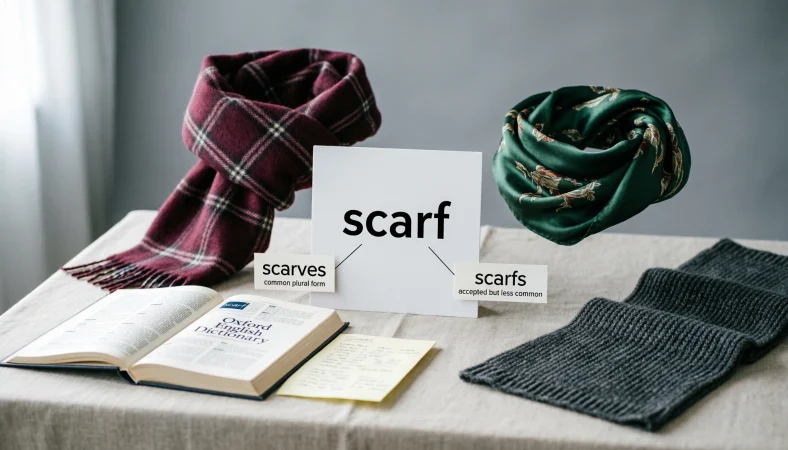
Scarves or scarfs are both accepted plural forms of the noun scarf, but scarves is the more common and widely preferred plural when referring to clothing. Scarfs is also grammatically possible, especially as a regular plural and in some specialized contexts. For most everyday writing, shopping, fashion, and general English, scarves is the safest choice.
If you’ve ever hesitated over whether to write scarves or scarfs, you’re dealing with an unusual English plural rather than two words with completely different meanings. The singular noun scarf refers to a piece of fabric worn around the neck, head, or shoulders, while both plural forms can refer to more than one. The confusion matters because choosing an uncommon form can make otherwise polished writing sound awkward, particularly in academic, professional, retail, and online content.
Scarves vs Scarfs: What’s the Difference?
The difference between scarves and scarfs is primarily a matter of plural formation and usage preference.
Scarf is a noun. In its most familiar sense, it refers to a long or rectangular piece of fabric worn for warmth, decoration, fashion, religious purposes, or protection from the elements.
The usual plural is scarves:
She bought three scarves for winter.
However, scarfs also occurs as a legitimate plural form:
The store sells colorful scarfs and hats.
Although this sentence is grammatically understandable, many readers will find scarves more natural.
English contains several nouns whose plural forms developed with competing endings. Scarf is one of them.
| Feature | Scarves | Scarfs |
| Singular form | Scarf | Scarf |
| Plural form | Scarves | Scarfs |
| Grammatical status | Correct plural | Correct plural |
| General frequency | More common | Less common |
| Everyday clothing usage | Preferred | Less usual |
| Meaning | More than one scarf | More than one scarf |
| Recommended general usage | Yes | Acceptable in appropriate contexts |
The important point is that scarfs isn’t simply a spelling mistake. It is an established plural form, although scarves is generally the more familiar choice.
Quick recap
Scarves is the most common plural of scarf.
Scarfs is also accepted as a plural form.
The two forms generally refer to more than one scarf.
For everyday clothing references, scarves is usually the better choice.
The pronunciation and basic meaning remain essentially the same.
Is Scarves vs Scarfs a Grammar, Vocabulary, or Usage Issue?
This question involves both grammar and usage, with usage preference playing an especially important role.
The singular word is scarf. When referring to multiple items, English allows both scarves and scarfs.
The unusual feature is that many English nouns ending in f or fe have historically developed plural forms ending in ves.
For example:
leaf → leaves
knife → knives
wife → wives
But English doesn’t apply this pattern consistently to every word.
For some nouns, the regular s plural is preferred:
roof → roofs
belief → beliefs
chief → chiefs
This inconsistency is one reason learners often find English plurals difficult.
Are scarves and scarfs interchangeable?
In basic meaning, yes. Both can refer to multiple scarves.
However, they aren’t equally common in every context.
If you’re writing a general article about winter clothing, scarves will usually sound more natural:
Wool scarves are popular during the colder months.
The alternative is possible:
Wool scarfs are popular during the colder months.
But many readers will instinctively expect scarves.
Formal versus informal usage
Neither form is inherently informal.
Scarves is simply the more conventional choice in much general writing.
Scarfs can appear in dictionaries, literature, specialized writing, and contexts where the writer follows a regular plural pattern.
For professional content, consistency and reader familiarity matter more than trying to make one form appear more sophisticated.
Academic versus casual usage
In academic writing, scarves is generally the more straightforward option when discussing clothing.
For example:
The researchers examined how scarves were used as markers of identity.
The plural is immediately recognizable.
In casual speech, both forms may be understood, although scarves is likely to sound more natural to many speakers.
How to Use Scarves Correctly
Scarves is the preferred plural form for most everyday uses of scarf.
Use it when referring to two or more pieces of fabric worn around the neck, head, or shoulders.
For example:
She owns several colorful scarves.
The shop sells handmade scarves.
We packed warm scarves for the trip.
The word can refer to scarves made from wool, cotton, silk, cashmere, synthetic fibers, or other materials.
It can also describe decorative and cultural garments rather than clothing worn only for warmth.
Workplace example
A clothing retailer might write:
Our new collection includes silk scarves, wool scarves, and lightweight scarves for spring.
Here, scarves is the natural plural choice because the business is describing multiple fashion products.
Academic example
A researcher studying clothing and cultural identity might write:
The photographs show women wearing scarves in different styles.
Again, scarves is clear and conventional.
Technology example
An online clothing store might display a category labeled:
Women’s Scarves
This wording is familiar to shoppers and works naturally in navigation menus, product descriptions, and search results.
Usage recap
Use scarves as your default plural when writing about clothing. It is widely recognized, natural sounding, and particularly suitable for general, professional, academic, retail, and digital writing.
How to Use Scarfs Correctly
Scarfs is also an accepted plural form of scarf.
Its existence reflects the fact that English sometimes allows competing plural forms.
For example:
The collection contains several vintage scarfs.
The sentence can be grammatically valid even though many readers would prefer scarves.
The regular s ending may seem logical because many English nouns form plurals simply by adding s. However, scarf has also developed the ves plural, which has become especially common.
Workplace example
A writer documenting historical textiles might encounter older sources that use scarfs. If the wording is being quoted or preserved as part of a historical record, retaining the original form can be appropriate.
Academic example
A linguistic discussion could deliberately use scarfs to examine competing English plural forms.
For example:
The noun scarf illustrates how English can maintain more than one plural formation.
Here, the unusual plural is actually relevant to the subject being discussed.
Technology example
A database containing user generated product descriptions might contain both scarves and scarfs. A search system should ideally understand that the forms refer to the same plural noun.
This is especially useful in search, ecommerce, and language processing because users may enter either form.
Usage recap
Scarfs is not automatically wrong. It is a legitimate plural form, but it is less common than scarves in ordinary references to clothing. When writing for a broad audience, scarves is usually the clearer choice.
When You Should NOT Use Scarves or Scarfs
Knowing both forms are possible doesn’t mean they are equally suitable in every situation.
1. Don’t call scarfs universally incorrect
Although scarves is more common, scarfs can be a valid plural.
2. Don’t assume scarves is the only possible form
English sometimes permits more than one plural form.
3. Don’t switch between forms without a reason
A single article should normally choose one form and use it consistently.
4. Don’t use scarfs simply because you think every noun takes s
English plural formation has many historical exceptions.
5. Don’t use scarves when discussing a different word
The spelling scarfs can also function as a verb in a different context, which means context matters.
6. Don’t treat plural preference as a difference in meaning
When both forms are being used as plurals of scarf, they refer to multiple scarves.
7. Don’t choose the less familiar form in customer facing content without a reason
Product pages, clothing categories, and advertisements usually benefit from the familiar scarves.
8. Don’t let automated grammar tools make the decision for you
A spelling checker may accept both forms. The more useful question is which form best suits the audience and context.
Common Mistakes and Decision Rules
Because scarves is considerably more familiar to many readers, writers sometimes assume scarfs must be an error. The opposite mistake also occurs when writers believe that every noun ending in f must form its plural with ves.
Neither assumption works reliably.
| Correct sentence | Incorrect or less suitable sentence | Explanation |
| She bought several scarves. | She bought several scarf. | A plural noun requires a plural form. |
| The store sells winter scarves. | The store sells winter scarf. | The noun must agree with the plural quantity. |
| I packed two scarves. | I packed two scarfs. | The second form can be accepted, but scarves is more conventional for general usage. |
| The designer created silk scarves. | The designer created silk scarf. | More than one item requires a plural noun. |
| These scarves are handmade. | These scarf are handmade. | A plural demonstrative requires a plural noun. |
| The museum displayed historical scarfs. | The museum displayed historical scarves. | Both plural forms can occur, so context and editorial preference matter. |
Decision Rule Box
If you mean more than one piece of clothing, use “scarves” as the default choice.
Use “scarfs” only when the context or established style supports that less common plural form.
If you are writing general content for a broad audience, “scarves” is usually the clearest option.
Why Does Scarf Have Two Plural Forms?
The answer lies partly in the history of English plural formation.
English has inherited words from several languages and has changed their grammatical patterns over time. Some nouns that ended in sounds represented by f developed plural forms involving ves, while others retained the regular s ending.
Scarf developed both forms.
This isn’t unusual in English. Language users sometimes preserve competing forms, especially when each remains understandable and established.
The important lesson is that English plurals aren’t always predictable from spelling alone.
You can’t safely assume:
Every word ending in f becomes ves.
Nor can you assume:
Every word ending in f simply adds s.
Instead, individual words have their own established plural patterns.
For scarf, both scarves and scarfs have a place in English, but frequency and context strongly favor scarves for ordinary clothing references.
Scarves or Scarfs in Modern Technology and AI Tools
Digital writing has made plural variations more visible than ever.
An ecommerce website might organize products under scarves, while a customer might search for scarfs. A well designed search system should recognize the relationship between the two forms.
AI language tools face a similar challenge.
If a user asks an AI system to write:
a product description for winter scarfs
the system should understand the intended meaning and may naturally produce winter scarves if it follows the more common form.
This doesn’t mean the original wording was necessarily grammatically invalid. It reflects a difference between grammatical acceptability and natural frequency.
Search engines, language models, spell checkers, and writing assistants increasingly handle morphological variations automatically. They recognize that singular and plural forms can differ while still representing the same underlying word.
For content creators, the practical lesson is simple: don’t obsess over the existence of scarfs when scarves is the familiar choice for your readers. Use the form that sounds natural within your publication’s overall style.
The Etymology and History of Scarf
The history of scarf is somewhat complex because the word has been connected with different historical senses and forms.
In modern English, the most familiar meaning is a strip or piece of material worn around the neck or head. Over time, scarves became associated with warmth, decoration, fashion, uniforms, cultural dress, and personal style.
The plural scarves developed alongside the regular plural scarfs, giving English speakers two accepted forms.
This is an excellent example of how language doesn’t always follow perfectly predictable rules. Historical usage, pronunciation, analogy, and frequency all influence the forms that survive.
Expert style guidance
“When two plural forms are accepted, the best choice for general writing is usually the form that readers recognize most readily and encounter most often.”
That principle explains why scarves is generally preferable even though scarfs can be grammatically valid.
The goal of good writing isn’t merely to find a form that can be defended. It is to choose language that communicates naturally and efficiently.
Two Practical Case Studies
Case Study 1: Fashion ecommerce
Imagine an online fashion retailer preparing a category page for winter accessories.
The original category title reads:
Winter Scarfs
The content editor changes it to:
Winter Scarves
The concrete result is a category label that aligns with the more familiar plural form used in ordinary clothing language.
Product descriptions can then consistently use phrases such as:
wool scarves
knitted scarves
cashmere scarves
winter scarves
The important lesson is not that scarfs is impossible. It’s that customer facing content benefits from the form most readers expect.
Case Study 2: Language education
Imagine an English teacher creating a lesson about irregular and variable plurals.
The teacher presents:
scarf → scarves
and then explains that scarfs also occurs.
The concrete result is that students learn two important facts at once. First, scarves is the usual form they are likely to encounter. Second, scarfs should not automatically be marked as a spelling mistake.
This approach prevents overcorrection and gives learners a more accurate understanding of English vocabulary.
These examples illustrate the difference between correctness and preference. A word can be grammatically possible while another form remains more natural for most situations.
Error Prevention Checklist
Always use scarves when
- ☑ Writing general content about clothing.
- ☑ Creating product categories for a broad audience.
- ☑ Writing educational material for English learners.
- ☑ Describing several pieces of neckwear.
- ☑ You want the most familiar plural form.
- ☑ Your publication already prefers scarves.
Never assume scarfs is wrong when
- ☑ You’re reading a historical or literary source.
- ☑ You’re discussing English plural variation.
- ☑ A dictionary or established style accepts the form.
- ☑ The context deliberately uses the regular plural.
- ☑ You’re analyzing language rather than writing ordinary consumer content.
Never mix the forms unnecessarily
A polished article should normally choose one plural form and maintain it throughout unless there is a specific linguistic, historical, or editorial reason to switch.
Related Grammar Confusions You Should Master
The question of scarves or scarfs connects with several other common English plural and spelling questions.
Leafs or leaves: Both forms can exist, but they have different usage patterns and meanings.
Roofs or rooves: Roofs is the standard modern plural in general English.
Chiefs or chieves: Chiefs is the standard plural.
Wifes or wives: Wives is the standard plural of wife.
Knifes or knives: Knives is the standard plural of knife.
Lifes or lives: Lives is the standard plural of life in its ordinary noun sense.
Beliefs or believes: These are not simply competing plurals because believes is a verb form.
Cloths or clothes: These forms have different meanings and should not be treated as interchangeable.
Fish or fishes: Both can be correct depending on the intended meaning and context.
Cactuses or cacti: Both forms occur, although usage varies by context and audience.
These examples demonstrate why English plural formation needs to be learned word by word rather than through one simple rule.
FAQs
Is scarves or scarfs correct?
Both scarves and scarfs can function as plural forms of scarf. However, scarves is more common and is generally the preferred form for everyday writing, especially when referring to clothing.
Is scarfs a correct plural of scarf?
Yes. Scarfs is an accepted plural form of scarf. It is less common than scarves, so many writers choose scarves when they want the most familiar and natural sounding form.
What is the plural of scarf?
The two accepted plural forms are scarves and scarfs. In ordinary modern usage, scarves is generally more common.
Why is the plural of scarf scarves?
English developed scarves as a plural form through a historical pattern in which some nouns ending in f developed a ves plural. However, English does not apply this pattern consistently to every noun.
Is scarfs grammatically wrong?
No. Scarfs can be a grammatically valid plural of scarf. It is simply less common than scarves in many modern contexts.
Which is more common, scarves or scarfs?
Scarves is generally much more common in ordinary references to clothing. It is therefore the safer choice for general writing, product descriptions, educational content, and most professional communication.
Should I write winter scarves or winter scarfs?
Winter scarves is the preferred choice for most general writing. It is more familiar to readers and is the conventional plural form used when discussing multiple winter accessories.
Can scarfs be used in formal writing?
Yes. The plural scarfs can occur in formal writing because it is an accepted form. However, scarves is generally the more natural choice when discussing clothing.
Are scarves and scarfs pronounced differently?
When they are used as plural forms of scarf, they are generally pronounced similarly. The difference is primarily in spelling and usage preference.
How do I remember whether to use scarves or scarfs?
For everyday writing, remember that scarf usually becomes scarves. If you encounter scarfs, don’t automatically assume it is an error because it can also be a valid plural. When in doubt, scarves is the safer general choice.
Conclusion:
The choice between scarves or scarfs is easier once you understand that English accepts both forms. Scarves is the more common and familiar plural of scarf, particularly when referring to clothing, fashion accessories, winter wear, and general everyday usage. Scarfs is also an accepted plural, although it appears less frequently in many modern contexts.
For most writers, the practical rule is simple: use scarves as your default. It is immediately recognizable and works naturally in academic writing, professional communication, ecommerce content, product descriptions, and casual English.
At the same time, don’t automatically label scarfs as wrong. English has retained both plural forms, and context can influence which one appears. Understanding this distinction is especially useful for editors, teachers, content creators, and English learners because it prevents unnecessary corrections.
The broader lesson is that English plural forms don’t always follow one universal rule. Some nouns take s, some take es, some change their spelling, and some retain more than one accepted plural. Scarf belongs to that last group.
So, if you’re writing about a collection of neckwear, the clearest choice is:
She owns several scarves.
That form will sound natural to the widest range of readers and is the best default for polished modern English.