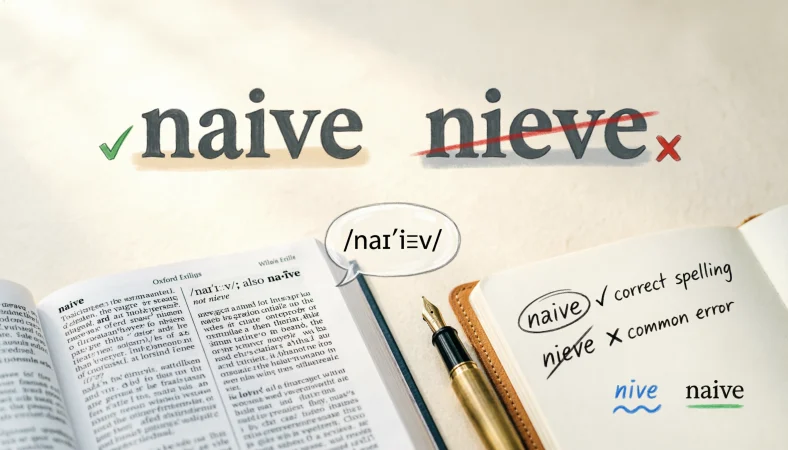
Naive is the correct standard spelling, while nieve is a common misspelling. The word “naive” describes someone who lacks experience, judgment, or knowledge and may be too trusting. For example, “It was naive to believe every promise he heard.” You may also see naïve, with the two dots over the “i,” which is an accepted spelling.
Have you ever wondered whether the correct spelling is naive or nieve? Because the word can be pronounced differently from how it looks, it is easy to mix up the letters. Naive is the standard English spelling, while “nieve” is generally incorrect. This guide explains the correct spelling, meaning, pronunciation, origin, and common usage of “naive” with simple examples to help you avoid this frequent spelling mistake.
Introduction: Naive or Nieve?
If you’ve ever wondered whether the correct spelling is naive or nieve, you’re dealing with a spelling and vocabulary question rather than a difference between two standard English words. The word you usually want is naive, which describes a person, belief, expectation, or approach that shows limited experience or a lack of sophisticated judgment.
The confusion is understandable. English spelling does not always provide a reliable guide to pronunciation, and naive is a borrowed word with a spelling that can look unusual to English speakers. The word is commonly written as naive, naïve, and occasionally naïf in related contexts.
Getting the spelling right matters in schoolwork, professional writing, applications, articles, and everyday communication. Writing “nieve” may make the intended meaning clear from context, but it is not the standard English spelling for this adjective.
Naive vs Nieve: What’s the Difference?
The central difference is straightforward: naive is the standard English spelling, while nieve is generally an incorrect spelling when the intended word is naive.
What does naive mean?
Naive is an adjective. It describes someone who lacks experience, practical knowledge, or awareness of how complicated a situation can be.
For example:
“It was naive to believe that the project would be completed in one day.”
The sentence suggests that the expectation was unrealistic because the person underestimated the situation.
Naive can also describe ideas, assumptions, expectations, or approaches:
“That is a naive assumption.”
Here, naive does not necessarily mean unintelligent. It suggests that the assumption overlooks important realities.
What does nieve mean?
In standard English, nieve is not normally the spelling you want when referring to a person who lacks experience or sophistication.
If you write:
“She is nieve about business.”
the intended meaning is probably clear, but the spelling should be:
“She is naive about business.”
| Word | Part of speech | Standard English usage | Meaning | Example |
| naive | Adjective | Correct | Lacking experience or sophisticated judgment | “His assumption was naive.” |
| nieve | Usually a misspelling in this context | Incorrect for this meaning | Intended to mean naive | “His assumption was nieve.” |
Quick recap
Naive is the standard spelling.
Nieve is usually a spelling error when you mean naive.
Naive describes limited experience or an overly simple understanding.
The word can describe people, ideas, assumptions, expectations, and approaches.
Is Naive vs Nieve a Grammar, Vocabulary, or Usage Issue?
This is primarily a spelling and vocabulary issue.
There is no meaningful grammatical contrast between naive and nieve in standard English because nieve is not normally an alternative spelling of naive. The problem occurs when someone remembers the sound of the word but reconstructs its spelling incorrectly.
Are naive and nieve interchangeable?
No.
Use naive when you mean inexperienced, unsophisticated, overly trusting, or lacking realistic judgment.
Do not substitute nieve for it in standard English writing.
Formal vs informal usage
Naive is completely acceptable in formal writing.
You can use it in:
Academic essays
Professional reports
Business writing
News articles
Research discussions
Personal correspondence
For example:
“The study challenges the naive assumption that all consumers respond identically to price changes.”
This is appropriate in an academic context.
Academic vs casual usage
Naive is also common in everyday speech:
“I was naive when I first started working.”
The word itself is not informal. What changes is the surrounding language and tone.
How to Use Naive Correctly
Naive is most useful when describing an understanding that is incomplete because of limited experience.
Workplace example
“It would be naive to assume that every customer has the same priorities.”
Here, naive means unrealistic or insufficiently informed.
Another example:
“I was naive about how long the hiring process would take.”
The speaker admits that they lacked practical knowledge.
Academic example
“The researcher rejected the naive interpretation of the results.”
Here, naive identifies an interpretation that is too simple because it fails to consider relevant complexity.
Technology example
“It is naive to assume that every software update will improve performance.”
The sentence suggests that real technology projects involve tradeoffs and unexpected effects.
Usage recap
Use naive when an idea, expectation, or person demonstrates limited experience or an overly simple understanding. The word does not automatically mean ignorant. In many contexts, it simply means inexperienced or insufficiently aware of complexity.
What Does Naive Really Mean?
The meaning of naive is broader than simply “inexperienced.”
Depending on context, it can suggest several related ideas.
Lack of experience
“She was naive about office politics.”
She had not yet learned how workplace relationships operate.
Excessive trust
“It was naive to trust the stranger immediately.”
The person trusted someone without sufficient caution.
Lack of sophistication
“His analysis was naive.”
The analysis may have ignored important factors.
Unrealistic expectations
“Thinking the negotiations would finish in an hour was naive.”
The expectation was overly optimistic or simplistic.
Innocence
In some contexts, naive can suggest innocence or a lack of exposure to unpleasant realities.
However, this meaning should be distinguished from childishness or stupidity.
When You Should NOT Use Naive or Nieve
Understanding when not to use a word is an important part of precise writing.
1. Do not write nieve when you mean naive
This is the most common problem.
Write:
“He was naive about the risks.”
Not:
“He was nieve about the risks.”
2. Do not use naive as a synonym for foolish
Someone can be intelligent and still be naive about a particular subject.
For example:
“She is highly intelligent but naive about investing.”
The sentence makes sense because intelligence and experience are different things.
3. Do not use naive simply to mean young
A young person may have extensive knowledge about a particular subject.
Age and naivety are not identical.
4. Do not use naive when you mean innocent in every context
Although naive can sometimes suggest innocence, innocent has a broader and different meaning.
5. Do not use naive when you mean inexperienced in every situation
“Inexperienced” is sometimes more neutral.
Calling someone naive can imply that their lack of experience has led to poor judgment.
6. Do not use naive as an insult automatically
The word can be critical, but its strength depends on context.
7. Do not replace precise criticism with naive
If you mean that an argument is unsupported, say “unsupported.” If you mean it ignores evidence, say “unsupported by the evidence.” Precision is often better than a broad label.
Common Mistakes and Decision Rules
| Correct sentence | Incorrect sentence | Explanation |
| “He was naive about the risks.” | “He was nieve about the risks.” | Naive is the standard spelling. |
| “That was a naive assumption.” | “That was a nieve assumption.” | Nieve is incorrect for this meaning. |
| “She was naive about business.” | “She was nieve about business.” | The adjective is spelled naive. |
| “It would be naive to expect instant results.” | “It would be nieve to expect instant results.” | Naive describes an unrealistic expectation. |
| “His view was naive.” | “His view was nieve.” | The spelling is wrong in the second sentence. |
Decision Rule Box
If you mean inexperienced, overly trusting, or insufficiently aware of complexity, use “naive.”
If you are considering writing “nieve” with this meaning, stop and use “naive” instead.
Naive or Naïve: Which Spelling Is Correct?
You may encounter both naive and naïve.
Both forms are recognized in English.
The diaeresis in naïve indicates that the two vowels are pronounced separately. In modern English, however, many writers use naive without the diacritic.
For ordinary digital writing, naive is extremely common and widely accepted.
For example:
“That was a naive assumption.”
is perfectly acceptable.
You may also see:
“That was a naïve assumption.”
The meaning is the same.
The important distinction is between naive and nieve. The latter is generally not the spelling you want.
Naive in Modern Technology and AI Tools
The word naive appears frequently in technology, programming, artificial intelligence, statistics, and computer science.
In technical writing, naive often describes an approach that is simple or unsophisticated.
For example:
“A naive implementation checks every item individually.”
Here, naive does not necessarily mean foolish. It can simply indicate a straightforward approach that may not be optimized.
This technical meaning is important because it shows how context can soften the word.
In machine learning, phrases such as Naive Bayes use the established spelling. The name refers to a statistical classification method based on a simplifying independence assumption.
AI systems also encounter the word in discussions about assumptions, reasoning, models, and algorithms. A “naive approach” may be useful as a baseline even when it is not the most sophisticated solution.
The Etymology of Naive
Naive ultimately comes from French naïf, which means natural, innocent, simple, or unsophisticated. The feminine French form is naïve.
The French word traces further back to Latin nativus, meaning natural or native.
English adopted the word and gradually developed the spelling and pronunciation used today.
This history also helps explain why the spelling can seem unusual. The word entered English from another language rather than developing entirely within English spelling patterns.
The spelling naïve preserves a visual reminder of its French origin, while naive reflects the increasingly common English practice of dropping the diacritic.
An Expert Style Perspective on Naive
A useful distinction in language is the difference between lack of knowledge and lack of intelligence.
“Naivety usually describes what someone has not yet learned, not what someone is incapable of learning.”
That distinction is valuable because calling someone naive can be unfair if the person simply has not encountered a particular situation before.
For example:
“He was naive about international trade.”
does not mean he is unintelligent. It means he lacked experience or understanding in that area.
This makes naive a more nuanced word than terms such as foolish or ignorant.
Two Practical Case Studies
Case study 1: Workplace expectations
Imagine a new employee who believes every project will be completed exactly according to the original schedule.
A manager might describe that expectation as naive because real projects often involve changing requirements, delays, reviews, and unexpected problems.
The better sentence is:
“His expectation was naive because he had limited experience with complex projects.”
The word identifies the cause of the unrealistic assumption without directly calling the employee unintelligent.
Case study 2: Technology planning
Suppose a company assumes that installing new software will immediately solve all productivity problems.
A technology consultant might describe this as a naive assumption because software alone cannot address training, workflow, organizational habits, or user adoption.
A precise explanation would be:
“The plan was based on a naive assumption that the software would solve the underlying workflow problems.”
Again, naive identifies an oversimplified belief rather than a person’s intelligence.
Error Prevention Checklist
Always use naive when
- You mean inexperienced.
- You mean overly trusting.
- You mean lacking practical knowledge.
- You mean an oversimplified assumption.
- You mean an unrealistic expectation caused by limited understanding.
- You are writing formally and need the standard adjective.
Never use nieve when
- You mean the English adjective associated with inexperience or unsophisticated judgment.
- You are writing an academic paper.
- You are preparing a professional document.
- You are editing published content.
- You want the standard English spelling.
Related Spelling and Vocabulary Confusions You Should Master
Learning naive is easier when you understand other commonly confused English forms.
Affect or effect
Affect is commonly used as a verb, while effect is commonly used as a noun.
Advice or advise
Advice is a noun, while advise is a verb.
Definitely or definately
Definitely is the standard spelling. Definately is a common misspelling.
Separate or seperate
Separate contains an “a” in the middle.
Occurred or occured
Occurred requires the doubled consonant.
Necessary or neccessary
Necessary contains one c followed by two s letters.
Privilege or priviledge
Privilege is the standard spelling.
Embarrass or embarass
Embarrass contains two r letters and two s letters.
Receive or recieve
Receive follows the familiar spelling pattern associated with “i before e” after c.
Accommodation or accomodation
Accommodation contains two c letters and two m letters.
These examples illustrate why English spelling often requires familiarity with individual word patterns rather than relying entirely on pronunciation.
FAQs
Is naive or nieve the correct spelling?
Naive is the correct standard English spelling when you mean inexperienced, overly trusting, or lacking sophisticated judgment. Nieve is generally a misspelling of naive in this context.
Is naive spelled with an accent?
Both naive and naïve are accepted forms in English. The spelling with the diaeresis preserves a feature of the French form, while naive without the mark is extremely common in modern English.
What does naive mean?
Naive means lacking experience, practical knowledge, or sophisticated judgment. It can describe a person, belief, assumption, expectation, interpretation, or approach.
Is naive a negative word?
Naive can have a negative or critical meaning, but it is not necessarily harsh. It can simply describe someone who lacks experience in a particular area. Context determines whether it sounds neutral, sympathetic, or critical.
Is naive an adjective?
Yes. Naive is an adjective. It can modify nouns such as person, assumption, belief, expectation, approach, interpretation, or idea.
What is the difference between naive and inexperienced?
Inexperienced mainly means lacking experience. Naive can suggest a lack of experience combined with overly simple assumptions, excessive trust, or unrealistic expectations. Therefore, naive can carry a stronger implication about judgment.
Is nieve a word in English?
Nieve is not normally the standard English spelling for the adjective meaning inexperienced or unsophisticated. If that is the intended meaning, use naive.
Why do people spell naive as nieve?
The error likely comes from pronunciation and unfamiliarity with the word’s spelling. English pronunciation does not always make vowel sequences easy to predict, and people sometimes write the word as it sounds to them.
How do you pronounce naive?
Naive is commonly pronounced approximately as “ny EEV” or “ny EV,” depending on accent and variety of English. The exact pronunciation can vary, but the spelling remains naive or naïve.
Can naive describe an idea?
Yes. Naive can describe an idea, assumption, theory, expectation, or approach that is overly simple or fails to account for important factors.
Conclusion:
When choosing between naive or nieve, the answer is simple: naive is the standard English spelling for the adjective meaning inexperienced, overly trusting, or lacking sophisticated judgment. You may also write naïve, particularly when retaining the traditional French inspired spelling.
The word is useful because it describes more than simple ignorance. Someone can be highly intelligent and still be naive about a subject they have never encountered. In professional and academic writing, the term can therefore provide a precise description of an oversimplified assumption or limited understanding.
Remember the spelling by connecting the word with its familiar form: naive. If you are writing “nieve” to express this meaning, change it to naive before publishing or submitting your work.











1 thought on “Naive or Nieve? Which Spelling Is Correct? Meaning, Usage & Examples For 2026”