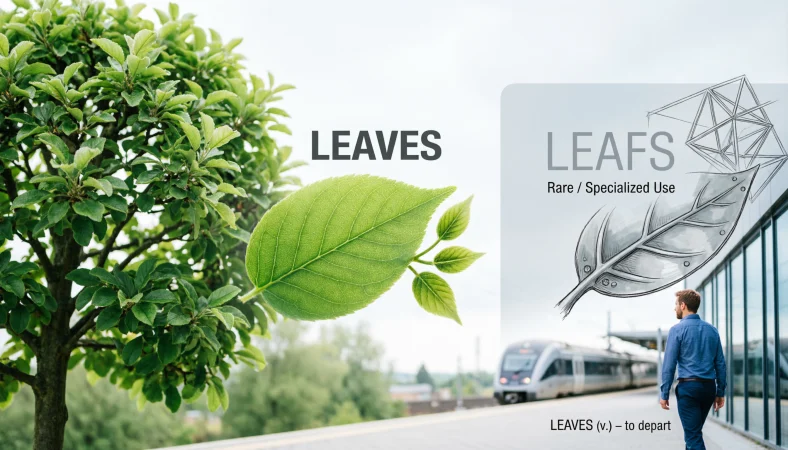
Leaves is the standard plural of leaf when referring to the parts of a plant or tree, and it is also the third person singular form of the verb leave. Leafs is uncommon as a plural noun, but it can appear in specialized contexts, especially when leaf is used as a verb meaning to make or add leaves.
If you’ve ever wondered whether to write leaves or leafs, you’re not alone. The confusion comes from the fact that leaf has an irregular plural form in ordinary English, while leafs can occasionally appear in specialized usage. Leaves normally means more than one leaf on a plant, while leafs is rarely used as a plural noun and may occur when leaf is being treated as a verb. Choosing the wrong form can make a sentence sound unnatural or incorrect, particularly in school assignments, professional writing, gardening articles, and technical descriptions.
Leaves vs Leafs: What’s the Difference?
Leaves is the standard plural noun for leaf when talking about the flat, usually green structures that grow from plants and trees.
For example:
The tree has thousands of leaves.
Leaves is also a verb. It is the third person singular present form of leave.
For example:
She leaves work at five.
Leafs is much less common. In ordinary English, it is generally not the plural of leaf when referring to plant foliage. In specialized contexts, however, leafs can appear when leaf is used as a verb, particularly in technical or mechanical language.
For most everyday writing, the rule is straightforward: when you mean more than one plant leaf, use leaves.
| Word | Part of speech | Meaning | Example |
| Leaf | Noun | One plant structure | The leaf is green. |
| Leaves | Noun | More than one plant leaf | The leaves are falling. |
| Leaves | Verb | Third person singular form of leave | He leaves at noon. |
| Leafs | Verb | Rare specialized form of leaf | The mechanism leafs outward. |
| Leafs | Noun | Rare or specialized plural usage | The term may appear in technical contexts. |
Mini recap
Leaves is the normal plural of leaf when discussing plants.
Leaves is also a verb meaning departs or goes away.
Leafs is uncommon in standard everyday English.
When you mean multiple plant leaves, leaves is almost always the correct choice.
Is Leaves vs Leafs a Grammar, Vocabulary, or Usage Issue?
The distinction is mainly a grammar and usage issue involving plural formation.
English has many regular plurals formed by adding s. For example:
book becomes books
tree becomes trees
flower becomes flowers
However, English also contains many irregular plurals that developed through the history of the language.
Leaf belongs to this group.
Its ordinary plural is:
leaf → leaves
The spelling changes from the final f sound to a v sound in the plural, followed by es.
Other familiar examples include:
knife → knives
life → lives
wife → wives
wolf → wolves
This doesn’t mean that every word ending in f behaves the same way. English has exceptions such as roof, whose common plural is roofs. That is why plural forms need to be learned individually.
Are leaves and leafs interchangeable?
No, not in ordinary writing.
If you’re talking about multiple leaves on a tree, use:
The leaves are turning yellow.
Not:
The leafs are turning yellow.
The second sentence will generally be considered incorrect in standard everyday English.
However, leafs can occur in specialized terminology when leaf is used in a technical sense or as a verb.
Formal versus informal usage
In formal writing, leaves should be used for the standard plural of leaf.
This applies to reports, essays, academic papers, professional websites, books, gardening guides, and educational materials.
There is little reason to use leafs when you simply mean several leaves.
Academic versus casual usage
Academic writing about biology, botany, ecology, agriculture, or environmental science almost always uses leaves when referring to multiple plant structures.
For example:
The leaves of the plant absorb sunlight for photosynthesis.
Casual conversation follows the same basic rule:
There are leaves all over the garden.
The difference is therefore not primarily about formality. It is about using the correct grammatical form for the intended meaning.
How to Use Leaves as a Noun
The most common use of leaves is as the plural noun of leaf.
A leaf is a plant structure that typically grows from a stem or branch and performs important functions such as photosynthesis, gas exchange, and transpiration.
When there is more than one, use leaves.
For example:
The tree has broad leaves.
The leaves are beginning to fall.
Several leaves covered the ground.
Workplace example
A landscaping company might write:
Remove dead leaves from the garden before the inspection.
The word leaves clearly refers to multiple plant structures.
Academic example
A biology textbook might state:
Plant leaves capture light energy during photosynthesis.
Here, leaves is the standard plural noun.
Technology example
A gardening application might display:
Check your plant’s leaves for signs of disease.
The application uses leaves because it is referring to multiple parts of a plant.
Usage recap
Use leaves when you mean more than one leaf.
This is the standard form in everyday, professional, academic, and scientific English.
If the sentence describes foliage on a plant or tree, leaves is almost certainly the form you need.
How to Use Leaves as a Verb
An important source of confusion is that leaves has another meaning.
As a verb, leaves is the third person singular present form of leave.
For example:
He leaves home at seven.
She leaves the office early.
The train leaves at six.
In these sentences, leaves has nothing to do with plants.
The base verb is leave:
I leave.
The third person singular form is:
He leaves.
The past tense is:
He left.
The past participle is:
He has left.
Workplace example
A manager might write:
The director leaves the office at four today.
Here, leaves means departs.
Academic example
A history text might say:
The army leaves the city before sunrise.
Again, the word is a verb rather than a plant related noun.
Technology example
A calendar application could display:
The bus leaves in ten minutes.
The meaning is departure.
Usage recap
Leaves can be either a plural noun or a verb.
Look at the surrounding words to determine the meaning.
If it refers to plant structures, it is probably a noun.
If it describes someone or something departing, it is a verb.
How to Use Leafs
Leafs is not normally the plural form you should choose for ordinary plant leaves.
If you’re writing:
The tree has green ___.
the correct answer is:
The tree has green leaves.
There are, however, specialized situations in which leafs may appear.
The word leaf can be used as a verb in technical contexts. In such usage, leafs may be formed as a third person singular verb.
For example, a technical description might use a construction involving a mechanism that leafs or moves outward in a leaf like manner.
Such specialized uses are much less common than the ordinary noun leaves.
There is also a notable proper noun usage in sports terminology. Leafs appears in the name of the Toronto Maple Leafs, a professional ice hockey team. In that context, Leafs is a proper name and should not be treated as evidence that leafs is the normal plural of the plant noun.
Workplace example
A technical document could potentially use leafs as a specialized verb if the relevant industry defines the term that way.
However, writers should verify the terminology used by their field rather than assuming that leafs is universally accepted.
Academic example
A specialized engineering or mechanical text may use unusual terminology involving components that resemble or behave like leaves.
In such cases, the field’s terminology determines whether leafs is appropriate.
Technology example
A software or engineering interface may use a specialized technical term based on leaf.
Again, the correct choice depends on the technical definition rather than ordinary botanical English.
Usage recap
Do not use leafs simply because you think it is the regular plural of leaf.
For plant foliage, use leaves.
Reserve leafs for recognized specialized uses, technical terminology, or proper names.
When You Should NOT Use Leaves or Leafs
Several common situations can help you avoid mistakes.
- Do not use leafs for ordinary plant foliage. The standard plural is leaves.
- Do not assume every noun ending in f forms its plural with s. English has several irregular patterns.
- Do not confuse leaves the noun with leaves the verb. Context determines which meaning applies.
- Do not change a proper name into a grammatical plural. A name such as the Toronto Maple Leafs follows its established official form.
- Do not use leafs in academic biology writing when you simply mean multiple leaves. Use the standard botanical plural.
- Do not assume a technical use applies to ordinary English. Specialized terminology can have rules that differ from everyday language.
- Do not use leaves when you mean departures without checking the sentence structure. In a sentence such as “She leaves at six,” the word is a verb.
- Do not choose a spelling based only on pronunciation. The pronunciation and historical spelling of irregular plurals can differ from regular patterns.
Common Mistakes and Decision Rules
| Correct sentence | Incorrect sentence | Explanation |
| The leaves are green. | The leafs are green. | Leaves is the standard plural noun. |
| Leaves cover the ground. | Leafs cover the ground. | Plant foliage takes the plural leaves. |
| She leaves at five. | She leafs at five. | Leaves is the third person singular form of leave. |
| The leaves fell from the tree. | The leafs fell from the tree. | The plural of leaf is leaves. |
| The gardener collected the leaves. | The gardener collected the leafs. | Standard English uses leaves. |
| He leaves work early. | He leafs work early. | Here leaves is a verb from leave. |
Decision Rule Box
- If you mean multiple plant structures, use “leaves.”
- If you mean someone or something departs, use “leaves.”
- If you encounter “leafs,” check whether it is a proper name or specialized technical usage.
- For ordinary English, never use “leafs” as the plural of the plant noun leaf.
Leaves and Leafs in Modern Technology and AI Tools
Modern technology creates new opportunities for words to develop specialized meanings.
Software interfaces often use terms such as leaf to describe the smallest element in a hierarchy or a terminal point in a data structure. In computing, a leaf node is an element with no child nodes.
That technical meaning is different from the botanical meaning, but it demonstrates how familiar English words can acquire specialized meanings in technology.
AI writing systems can also encounter both spellings in large collections of text. Because language models learn from varied sources, they may recognize leafs in proper names, technical writing, sports references, or unusual contexts.
A reliable language tool should therefore consider context rather than simply declaring every occurrence of leafs incorrect.
For general writing, however, the practical rule remains simple:
More than one plant leaf is leaves.
Why Does Leaf Become Leaves?
The plural leaves reflects the historical development of English.
Older forms of English included patterns in which certain nouns changed their internal vowel or consonant when forming plurals. Over time, many of these patterns disappeared, but some survived in modern English.
The change from leaf to leaves is related to historical sound changes that affected certain words ending in f.
Modern learners don’t need to memorize the entire history of English to use the word correctly. Still, understanding that irregular plurals often have historical origins can make them easier to remember.
The same pattern appears in:
calf → calves
half → halves
knife → knives
life → lives
However, English has exceptions:
roof → roofs
chief → chiefs
This is why a general rule such as “every word ending in f becomes ves” would be unreliable.
Expert style quotation
When an English plural looks irregular, the safest approach is to learn the established word form rather than force the noun into a regular pattern.
For leaf, that established plural is leaves.
Two Practical Case Studies
Case Study 1: A school science assignment
Imagine a student writing about photosynthesis.
The student writes:
Plants use their leafs to capture sunlight.
The intended meaning is obvious, but the plural form is incorrect in standard English.
The corrected sentence is:
Plants use their leaves to capture sunlight.
The change is small, but it matters in academic writing. Correct grammatical forms improve credibility and demonstrate command of subject specific vocabulary.
The concrete result is a sentence that is both scientifically understandable and grammatically standard.
Case Study 2: A gardening website
Imagine a gardening website publishing an article about autumn maintenance.
An editor sees:
Remove fallen leafs from around the plants.
The natural correction is:
Remove fallen leaves from around the plants.
Using leaves aligns the article with standard English and the terminology readers expect from gardening content.
The concrete result is improved editorial quality and fewer distracting language errors.
Error Prevention Checklist
Always use leaves when
- You mean more than one plant leaf.
- You’re writing about trees, flowers, shrubs, or crops.
- You’re discussing foliage in biology.
- You’re describing fallen plant material.
- You’re writing a school or academic assignment.
- You’re preparing professional gardening content.
Never use leafs when
- You simply mean several plant leaves.
- You’re writing standard botanical English.
- You’re describing foliage in ordinary conversation.
- You’re forming the plural of the noun leaf.
- You’re editing educational or professional material and have no specialized reason for using the term.
Use leaves as a verb when
The subject is singular and the verb means departs.
For example:
She leaves at eight.
This is a completely different grammatical use from:
The tree has many leaves.
Why Leaves Can Be Confusing
Part of the difficulty comes from English using the same spelling for two different grammatical meanings.
Compare:
The leaves are falling.
Here, leaves is a plural noun.
Now consider:
He leaves every morning.
Here, leaves is a verb.
The surrounding grammar provides the clue.
When leaves follows a determiner such as the, many, several, or these, it is often a noun:
The leaves are wet.
Several leaves fell.
When leaves follows a singular subject, it can be the verb leave:
She leaves early.
The train leaves at noon.
Learning to identify the role of the word makes the spelling much easier to understand.
Leaves or Leafs in Different Contexts
Context is especially important because leaf has meanings beyond plant biology.
In books, a leaf can refer to a sheet of paper within a book, usually consisting of two pages.
For example:
The manuscript contains several damaged leaves.
The plural remains leaves.
In computing, a leaf can describe a terminal element in a hierarchy or tree structure.
For example:
The data structure contains several leaf nodes.
Again, the ordinary plural is leaves.
This shows why the word is more versatile than it first appears.
Whether you’re talking about plants, books, or data structures, leaves is generally the established plural noun.
Related Grammar Confusions You Should Master
Once you understand leaf and leaves, several other irregular plural questions become easier.
- Knife or knifes
- Life or lifes
- Wife or wifes
- Wolf or wolfs
- Calf or calfs
- Half or halfs
- Loaf or loafs
- Shelf or shelfs
- Roof or roofs
- Chief or chiefs
These examples demonstrate why English plurals cannot always be predicted from a single spelling rule.
Some nouns ending in f change to ves, while others simply add s.
FAQs
Is leaves or leafs correct?
Leaves is correct when you mean more than one leaf. Leafs is not the standard plural of the plant noun in ordinary English.
What is the plural of leaf?
The standard plural of leaf is leaves.
For example:
The leaves are falling from the tree.
Why is the plural of leaf leaves instead of leafs?
Leaf has an irregular plural that developed through the historical evolution of English. The established modern form is leaves.
Is leafs ever a correct word?
Yes, but it is uncommon. Leafs can appear in specialized technical usage or as part of a proper name. It should not normally be used as the ordinary plural of the plant noun.
Is leaves a noun or a verb?
It can be either. As a noun, leaves means more than one leaf. As a verb, leaves is the third person singular present form of leave.
What is the difference between leaves and leafs?
When discussing plant foliage, leaves is the standard plural. Leafs has limited specialized uses and is not normally interchangeable with leaves.
Is it correct to say leafs on a tree?
No. In standard English, the natural sentence is:
There are many leaves on the tree.
Why do some words ending in f become ves?
Several English nouns preserve historical plural patterns that changed the final consonant from an f sound to a v sound before the plural ending. This pattern appears in words such as leaf and knife.
Is the Toronto Maple Leafs name grammatically correct?
Yes. Toronto Maple Leafs is the team’s established proper name. Proper names don’t always follow standard plural rules, so the official name should be retained.
What is the plural of leaf in biology?
The standard biological plural is leaves. Scientific and academic writing uses leaves when referring to multiple structures of this type.
Final Thoughts:
The answer to leaves or leafs is clear for ordinary English: leaves is the correct plural of leaf when you mean more than one plant leaf.
You should write:
The leaves are falling.
not:
The leafs are falling.
At the same time, remember that leaves has another grammatical role. It can be the third person singular present form of leave, as in:
She leaves at six.
The form leafs does exist in limited specialized contexts, including certain technical uses and proper names. It should not, however, be used as the ordinary plural of leaf.
The easiest rule to remember is this: one leaf, two leaves. Once that pattern becomes familiar, this common English spelling and grammar confusion becomes much easier to avoid.











1 thought on “Leaves Or Leafs: Meaning, Difference, Plural Rules & Correct Usage For 2026”