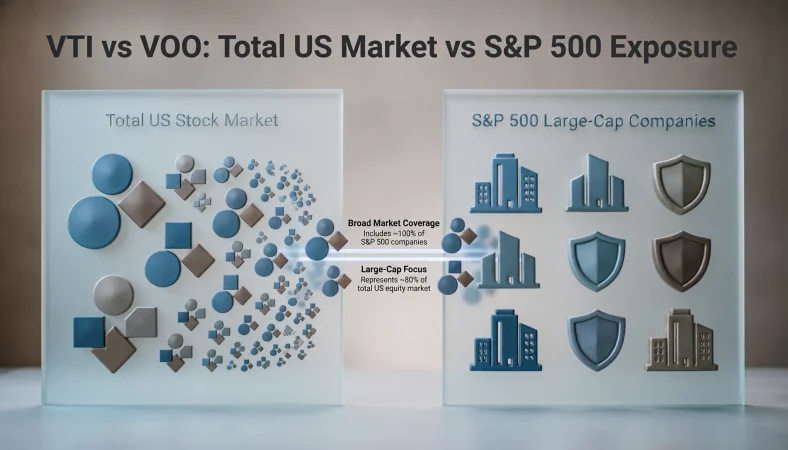
VTI and VOO are both low cost Vanguard index ETFs, but they track different parts of the US stock market. VTI follows the CRSP US Total Market Index and provides broad exposure across large, mid, and small companies, while VOO tracks the S&P 500 and focuses on 500 large US companies. The better choice depends on your desired market coverage, diversification, and portfolio strategy. (Vanguard)
When investors search for vti or voo, they’re usually trying to answer a deceptively simple question: which fund makes more sense for long term investing? The two ETFs look remarkably similar because both are inexpensive, diversified US stock funds dominated by large companies. Yet they aren’t identical. VTI owns thousands of US stocks across market capitalizations, while VOO concentrates on the largest companies represented in the S&P 500. (Vanguard)
That distinction matters because choosing between them isn’t simply a question of which ticker has performed better recently. An investor is choosing a particular definition of the US stock market. VTI gives you broader domestic equity exposure, while VOO gives you focused exposure to the large cap segment. Understanding that difference can help investors avoid choosing a fund based solely on popularity, recent returns, or a misleading assumption that the two ETFs are interchangeable.
VTI vs VOO: What’s the Difference?
VTI stands for Vanguard Total Stock Market ETF. It is an exchange traded fund designed to track the CRSP US Total Market Index. Vanguard describes the fund as providing exposure to large, mid, and small capitalization US companies. Its portfolio contains more than 3,500 domestic stocks. (Vanguard)
VOO stands for Vanguard S&P 500 ETF. It tracks the S&P 500 Index, which represents approximately 500 of the largest US companies. Rather than attempting to cover the entire domestic stock market, VOO focuses on large established businesses. (Vanguard)
| Feature | VTI | VOO |
| Full name | Vanguard Total Stock Market ETF | Vanguard S&P 500 ETF |
| Primary index | CRSP US Total Market Index | S&P 500 Index |
| Market coverage | Large, mid, and small companies | Large US companies |
| Number of holdings | More than 3,500 | About 500 |
| Expense ratio | 0.03% | 0.03% |
| Inception | May 24, 2001 | September 7, 2010 |
| Investment style | Broad US stock market | Large cap US stocks |
| Main advantage | Wider domestic diversification | Simple large cap exposure |
| Main limitation | Still heavily influenced by large companies | Less exposure to smaller companies |
The expense ratio figures above are based on Vanguard data dated April 28, 2026. Both funds currently list a 0.03% expense ratio. (Vanguard)
The simplest way to understand the distinction is this:
VTI attempts to represent nearly the entire US publicly traded stock market.
VOO represents the large company segment through the S&P 500.
Both are diversified, low cost, passive index ETFs.
The biggest difference is market coverage rather than investment philosophy.
Is VTI vs VOO a Fund, Strategy, or Diversification Issue?
The comparison is primarily an investment strategy and portfolio construction issue.
Both funds are ETFs. Both use passive index tracking. Also Both provide exposure to US equities. Both are designed for investors seeking long term capital appreciation rather than fixed income.
The difference comes from the indexes they follow.
VTI tracks a broad US stock market benchmark. Vanguard says the fund seeks to track the CRSP US Total Market Index and includes large, mid, and small companies across growth and value styles. (Vanguard)
VOO tracks the S&P 500. Vanguard describes it as investing in the stocks represented by that index, which consists of 500 of the largest US companies. (Vanguard)
Are VTI and VOO Interchangeable?
They are similar, but they are not identical.
For many long term investors, either can serve as a core US equity holding. However, the underlying exposure differs.
An investor choosing VTI receives exposure to companies outside the S&P 500. That includes mid cap and small cap stocks.
An investor choosing VOO accepts a narrower universe centered on large US corporations.
This difference can become more important when constructing a broader portfolio.
For example, someone holding VOO and separately adding a small cap ETF may be intentionally building exposure in layers. Someone holding VTI already receives exposure to smaller companies through the total market fund.
Formal Investment Analysis
In a professional investment discussion, describing VTI as simply “the same as VOO” would be incomplete.
The two funds overlap heavily, particularly because the largest US companies make up a substantial portion of the total US market. That overlap explains why their performance can often be quite similar.
However, similarity in historical performance doesn’t eliminate differences in portfolio composition.
Vanguard itself notes that an index fund should be evaluated against the index it tracks, because the fund’s objective is to replicate that benchmark rather than simply maximize returns independently of it. (Vanguard)
How VTI Works
VTI is designed to provide broad exposure to US equities.
Instead of selecting only the largest corporations, the fund reaches across different market capitalization categories. Vanguard specifically describes VTI as providing large, mid, and small cap exposure. (Vanguard)
That makes VTI attractive to investors who want a single fund representing a broad slice of the domestic stock market.
Workplace Example
Imagine an employee building a retirement portfolio through a workplace account.
The investor may not want to research individual companies or decide which industries will outperform. A broad market ETF can provide exposure to many companies through one security.
VTI fits that approach because its underlying index covers a broad range of US companies.
Academic Example
Suppose a finance student wants to study the performance of the US equity market rather than specifically studying large capitalization stocks.
A total market ETF provides a useful practical example of broad domestic equity exposure.
The student could then compare VTI with an S&P 500 fund to examine how differences in market coverage affect portfolio characteristics.
Technology Example
The technology sector provides a useful illustration of VTI’s structure.
Large technology corporations represent substantial portions of the US market, but VTI also includes smaller technology businesses.
This means an investor doesn’t have to decide in advance which technology companies will become major corporations. The fund’s broad market structure naturally includes companies across different sizes.
VTI Usage Recap
VTI is particularly relevant when your goal is broad US stock market exposure.
Its appeal comes from diversification across company sizes rather than concentration exclusively on the largest corporations.
It is still a US equity fund, so it doesn’t automatically provide international diversification or protection from stock market declines.
How VOO Works
VOO takes a different approach.
It tracks the S&P 500, an index focused on large US companies. Vanguard says the fund invests in the stocks represented by that index and is designed to closely track its return. (Vanguard)
Because the S&P 500 contains many of America’s largest and most influential corporations, VOO provides substantial exposure to the companies that dominate the US equity market.
Workplace Example
Consider an investor who wants a straightforward large company allocation in a retirement account.
VOO can serve that role because its benchmark is well known and its portfolio centers on established large capitalization companies.
The investor doesn’t need to select individual large companies one by one.
Academic Example
VOO is also useful when studying large cap US equities.
The S&P 500 is widely used as a benchmark for US large cap stocks, making VOO a straightforward ETF implementation of that investment exposure.
A student comparing market capitalization strategies could use VOO to represent large cap exposure and compare it with a broader total market fund.
Technology Example
Technology companies are an important part of the modern S&P 500.
Because some of the world’s largest technology businesses are among the largest US corporations, VOO can have substantial exposure to technology even though it is not technically a technology sector ETF.
This distinction is important.
VOO isn’t a technology fund. Its exposure comes from the composition of the S&P 500.
VOO Usage Recap
VOO focuses on large US companies.
Its simplicity is one of its major attractions.
However, investors who want meaningful exposure to smaller US companies may prefer a broader market approach.
VTI or VOO: Which One Is More Diversified?
On the narrow question of number and range of holdings, VTI is more diversified within the US stock market.
Vanguard states that VTI holds more than 3,500 domestic stocks and provides exposure across large, mid, and small capitalization companies. (Vanguard)
VOO contains roughly 500 companies because its benchmark is the S&P 500.
However, simply counting holdings doesn’t tell the entire story.
VTI is still heavily influenced by the largest companies because market capitalization weighting gives larger businesses larger positions.
That means VTI and VOO can have considerable overlap.
A common misconception is that owning thousands of stocks automatically makes VTI radically different from VOO in day to day behavior. In reality, the largest companies represent substantial portions of both funds.
The practical distinction is therefore better described as broader versus narrower US market exposure, not diversified versus undiversified.
VTI or VOO: Which Has Lower Fees?
As of April 28, 2026, Vanguard lists a 0.03% expense ratio for both VTI and VOO.
That means fees don’t provide a meaningful reason to choose one over the other.
On a hypothetical $10,000 investment, a 0.03% annual expense ratio corresponds to approximately $3 in annual fund expenses, although actual costs vary with the fund’s assets and returns.
Vanguard explains that an expense ratio represents the costs associated with operating and managing a fund and that lower expenses can leave more of an investor’s return in the portfolio.
The key point is simple:
Don’t choose VTI over VOO because you believe VTI currently has a lower expense ratio. The listed expense ratio is the same.
VTI or VOO: Which Has Better Performance?
There is no reliable rule saying that VTI will always outperform VOO or that VOO will always outperform VTI.
Their performance can differ because their underlying indexes differ.
When large companies outperform smaller companies, VOO can benefit from its concentration in large capitalization businesses.
When smaller and mid sized companies perform particularly well, VTI receives more direct exposure to those parts of the market.
Historical performance should therefore be treated as evidence of what happened, not a guarantee of what will happen next.
Vanguard emphasizes that past performance isn’t a guarantee of future results. (Vanguard)
For long term investors, the more useful question is often:
Which index exposure better matches the portfolio I want to hold for years?
That question is more durable than asking which ETF won over the previous twelve months.
When You Should NOT Choose VTI or VOO
Neither ETF is automatically appropriate for every investor.
1. Don’t choose either fund simply because it is popular
Popularity doesn’t establish suitability.
Your investment horizon, risk tolerance, asset allocation, and financial objectives matter more.
2. Don’t use VTI as if it were an international fund
VTI provides US stock market exposure.
It does not replace a dedicated international equity allocation if your strategy calls for one.
3. Don’t assume VOO is the entire US market
VOO focuses on the S&P 500.
It doesn’t provide the same direct coverage of mid cap and small cap companies as VTI.
4. Don’t buy either fund if you need guaranteed short term stability
Both are stock ETFs and are exposed to market volatility.
Vanguard explicitly notes that ETF investments are subject to market volatility and that investors can lose money.
5. Don’t choose based only on recent returns
A recent performance difference can result from temporary market conditions.
It doesn’t necessarily tell you which fund will perform better in the future.
6. Don’t assume owning both automatically improves diversification
Because VTI already contains many of the same large companies represented in VOO, holding both can create substantial overlap.
7. Don’t ignore your overall portfolio
An ETF should be evaluated within the context of your complete asset allocation.
8. Don’t confuse an ETF with a guaranteed investment
Neither fund guarantees a profit or protects investors from market declines.
Common Mistakes and Decision Rules
| Correct statement | Incorrect assumption | Explanation |
| VTI covers a broad range of US companies. | VTI contains only large companies. | VTI includes large, mid, and small companies. |
| VOO tracks the S&P 500. | VOO tracks every US stock. | VOO focuses on the S&P 500. |
| Both funds have a 0.03% expense ratio currently. | VTI is much cheaper than VOO. | Current listed expense ratios are the same. |
| VTI and VOO overlap substantially. | They have completely different portfolios. | VTI contains many large companies also found in VOO. |
| VTI offers broader domestic coverage. | VTI provides international diversification. | VTI focuses on US stocks. |
| VOO emphasizes large companies. | VOO is a technology ETF. | Technology exposure results from the S&P 500’s composition. |
| Both funds can fluctuate significantly. | Either ETF guarantees stable returns. | Equity ETFs are exposed to market volatility. |
Decision Rule Box
- If you want broader exposure across large, mid, and small US companies, VTI is the more direct fit.
- If you specifically want S&P 500 large cap exposure, VOO is the more direct fit.
- If you want international diversification, neither fund provides that by itself.
- If you’re considering both, examine their overlap before assuming that owning both creates substantially broader US exposure.
VTI and VOO in Modern Technology and AI Tools
Investment research increasingly involves online brokerages, portfolio analyzers, automated investing tools, financial calculators, and AI assistants.
These tools can make comparing VTI and VOO easier, but they can also encourage superficial comparisons.
An AI tool might summarize the funds by saying that VTI is more diversified and VOO tracks the S&P 500. That summary is directionally correct, but it doesn’t answer the more important portfolio question.
An investor needs to understand what the difference means for their overall allocation.
For example, if someone already owns a broad US market fund, adding VOO may increase exposure to large companies without adding as much diversification as expected.
Similarly, someone holding VOO may not need to replace it with VTI merely because VTI contains more stocks.
Technology can help with research, but it doesn’t remove the need to understand the investment objective.
Vanguard also emphasizes that ETFs are subject to market volatility and that investors should review the applicable prospectus before investing.
VTI and VOO Etymology: Understanding the Tickers
Unlike ordinary words, ETF tickers are identifiers rather than terms with conventional dictionary definitions.
VTI is the ticker symbol used by Vanguard for the Vanguard Total Stock Market ETF.
VOO is the ticker symbol used by Vanguard for the Vanguard S&P 500 ETF.
The names are therefore more important than trying to assign a literal linguistic meaning to every letter.
The fund names reveal the essential distinction.
Total Stock Market signals broad US market exposure.
S&P 500 signals exposure to the large company benchmark.
This is a useful habit when researching ETFs.
Instead of memorizing tickers alone, learn the fund’s full name, index, investment objective, and portfolio structure.
Authority and Trust: What Actually Matters When Comparing ETFs?
A high quality ETF comparison shouldn’t stop at performance charts.
Investors should consider the underlying index, expense ratio, holdings, concentration, risk, tax considerations, account type, and relationship with other investments.
Vanguard explains that index funds should be evaluated against their benchmarks and that an index fund will generally lag its index slightly because the index itself doesn’t incur fund expenses.
That point is especially useful when comparing two highly similar funds.
A difference in return doesn’t automatically mean one fund is better managed.
It may simply reflect differences in the indexes.
Case Study 1: The Broad Market Investor
Consider an investor who wants one US equity fund and values exposure beyond the largest corporations.
VTI directly matches that objective because its benchmark covers large, mid, and small US companies.
The concrete portfolio result is broader domestic market exposure through one ETF.
Case Study 2: The Large Cap Investor
Now consider an investor who specifically wants exposure to the S&P 500.
VOO directly matches that objective because it tracks that benchmark.
The concrete portfolio result is targeted exposure to the large US companies represented in the S&P 500.
These examples don’t establish that one fund will produce better future returns. They demonstrate how the choice should begin with the desired exposure.
Error Prevention Checklist
Always consider VTI when:
- You want broad US stock market exposure.
- You want large, mid, and small company exposure.
- You prefer a total market index approach.
- You want one broad domestic equity ETF.
- You understand that the fund remains concentrated toward larger companies because of market capitalization weighting.
Always consider VOO when:
- You specifically want S&P 500 exposure.
- You want a large cap US equity fund.
- You prefer an established large company benchmark.
- You want straightforward exposure to the S&P 500.
Never assume:
- VTI is guaranteed to outperform VOO.
- VOO is guaranteed to outperform VTI.
- VTI provides international diversification.
- VOO represents every publicly traded US company.
- Owning both automatically creates dramatically broader diversification.
- A lower recent expense ratio makes one fund universally superior.
- Past performance guarantees future results.
VTI or VOO for Different Types of Investors
For a Long Term Index Investor
Either fund can potentially serve as a core US equity holding.
The key difference is whether the investor prefers total market exposure or large cap exposure.
For a Beginner
The simpler conceptual choice may be the one that matches the investor’s understanding.
Someone who thinks of their goal as “owning the US stock market” may find VTI intuitive.
Someone who specifically wants the S&P 500 may find VOO intuitive.
For a Retirement Portfolio
Both can potentially be used as US equity components of a retirement portfolio.
However, retirement investing usually involves more than choosing one ETF. Investors may also need to consider international stocks, bonds, cash needs, account type, time horizon, and risk tolerance.
For an Investor Holding Both
Holding both isn’t automatically wrong.
The important question is why you’re holding both.
Because VTI already owns many of the companies in VOO, the combination can tilt the portfolio more heavily toward large companies rather than providing two completely independent sources of diversification.
Related Investment Comparisons You Should Understand
If you’re researching VTI and VOO, several related comparisons can help you understand index investing more deeply.
1. VTI vs VXUS
This compares broad US exposure with broad international exposure.
2. VOO vs SPY
Both provide S&P 500 exposure, but their fund structures, costs, and other characteristics can differ.
3. VTI vs QQQ
This contrasts broad US market exposure with a more concentrated Nasdaq oriented strategy.
4. VOO vs VTI vs VT
This comparison introduces the distinction between US large cap, total US, and global stock exposure.
5. ETF vs Mutual Fund
These products can track similar indexes while differing in trading structure and other characteristics.
6. Market Cap Weighting vs Equal Weighting
This explains why the largest companies can have a major influence on a market capitalization weighted index.
7. US Stocks vs International Stocks
Understanding geographic diversification helps put VTI and VOO into a complete portfolio context.
8. Growth vs Value
These styles help explain why different segments of the stock market can behave differently.
9. Large Cap vs Small Cap
This distinction is central to understanding why VOO and VTI aren’t identical.
10. Total Return vs Price Return
Investors should understand how dividends and price movements combine to produce investment returns.
FAQs.
Is VTI or VOO better for long term investing?
Neither is universally better. VTI provides broader US market exposure across large, mid, and small companies, while VOO focuses on the S&P 500 and large US companies. The better choice depends on the exposure an investor wants and how the fund fits into the overall portfolio.
Is VTI more diversified than VOO?
Yes, in terms of the range of US companies represented. VTI includes large, mid, and small companies and holds more than 3,500 domestic stocks. VOO focuses on approximately 500 companies in the S&P 500.
Is VOO cheaper than VTI?
No. As of April 28, 2026, Vanguard lists a 0.03% expense ratio for both funds.
Does VTI include the S&P 500?
Yes. Because VTI covers the broader US stock market, it includes the large companies represented in the S&P 500. This is one reason VTI and VOO have substantial overlap.
Does VOO include small cap stocks?
VOO focuses on the S&P 500, which represents large US companies. It therefore does not provide the same direct small cap exposure offered by VTI.
Can I own both VTI and VOO?
Yes, but whether it makes sense depends on your portfolio strategy. Since VTI already contains many companies held by VOO, owning both can increase your emphasis on large US companies rather than simply doubling your diversification.
Which is safer, VTI or VOO?
Neither should be considered safe in the sense of guaranteeing principal. Both are stock ETFs and can decline when the US equity market falls. Vanguard identifies both as equity funds exposed to market volatility.
Does VTI outperform VOO?
Not consistently. Their returns can differ because they track different indexes. VTI has additional exposure to mid and small companies, while VOO is concentrated in the large cap companies of the S&P 500.
Should beginners choose VTI or VOO?
A beginner should first decide what type of US stock exposure they want rather than choosing based solely on which ticker is more popular. VTI is broader, while VOO is more specifically focused on large US companies.
Is VTI or VOO better for diversification?
VTI provides broader diversification within the US stock market because it includes companies across multiple capitalization ranges. However, neither fund by itself provides global diversification because both focus on US equities.
Conclusion:
The vti or voo decision becomes much easier when you stop treating the two ETFs as competing versions of exactly the same investment.
VTI is the broader choice. It tracks the CRSP US Total Market Index and provides exposure to large, mid, and small US companies. Vanguard says the fund holds more than 3,500 domestic stocks.
VOO is the more focused choice. It tracks the S&P 500 and concentrates on approximately 500 large US companies.
Both currently carry a 0.03% expense ratio, so cost doesn’t create a meaningful advantage between them.
If your goal is broad US market exposure, VTI is the more direct match.
If your goal is S&P 500 large cap exposure, VOO is the more direct match.
Neither is automatically superior for every investor, and neither should be treated as a complete portfolio without considering international stocks, bonds, cash requirements, time horizon, risk tolerance, taxes, and other holdings.
The most useful decision rule is simple:
Choose the fund that matches the market exposure you actually want, rather than choosing the ticker with the most attention or the strongest recent performance.
Important Note
This article is educational information, not personalized investment, tax, or financial advice. ETF prices, holdings, distributions, expenses, and other fund characteristics can change. Investors should review current fund documents and consider their own circumstances before making investment decisions.











1 thought on “VTI Or VOO: Which Vanguard ETF Is Better For Long-Term Investing In 2026?”