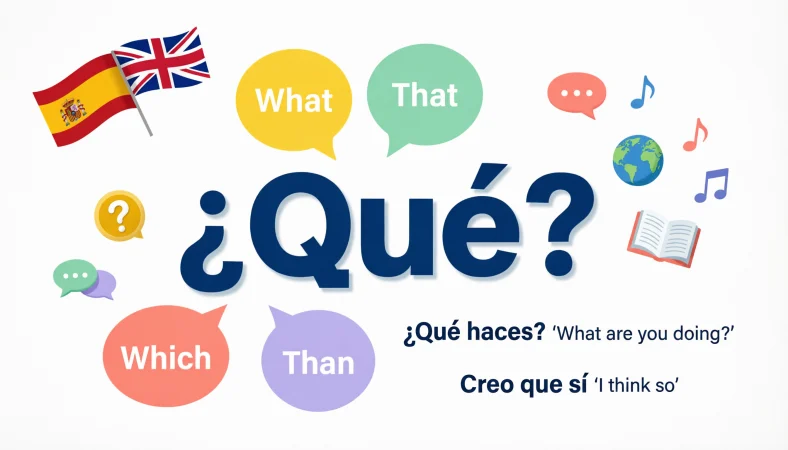
Que is one of the most common words in Spanish. Depending on context, it can mean “what,” “that,” “which,” “than,” or “because.” When written as ¿qué? with an accent mark, it usually means “what?” in questions or exclamations. Without the accent (que), it commonly functions as a conjunction or relative pronoun meaning “that” or “which.”
If you’ve ever watched a Spanish movie, listened to Latin music, or spoken with native Spanish speakers, you’ve almost certainly heard the word “que.” It appears in conversations constantly, making it one of the most important and frequently used words in the Spanish language.
But what does que mean in Spanish? The answer isn’t as simple as translating it into a single English word. Depending on the situation, que can mean what, that, which, than, because, or even be part of common expressions. Its meaning changes based on grammar, punctuation, pronunciation, and context.
Understanding que is essential for anyone learning Spanish because it appears in everyday conversations, books, songs, movies, and professional communication. Once you understand its different uses, you’ll recognize it almost everywhere.
The Spanish word que is incredibly versatile because it serves several grammatical purposes.
Here’s a quick overview:
| Spanish Word | English Meaning | Example |
| ¿Qué? | What? | ¿Qué haces? (What are you doing?) |
| Que | That | Creo que sí. (I think that yes.) |
| Que | Which | El libro que compré. (The book that I bought.) |
| Que | Than | Más grande que yo. (Bigger than me.) |
| Que | Because/So that (certain phrases) | Hay que estudiar. |
The biggest difference learners notice is:
- Qué (with an accent) = question word
- Que (without an accent) = connector or conjunction
This tiny accent mark completely changes how the word functions.
Origin
The word que comes from the Latin word quid and quod, which were commonly used in Classical Latin as interrogative and relative pronouns.
Over centuries, Spanish evolved from Latin, and que became one of its foundational words. Today, it is considered one of the most frequently used words in the Spanish language.
Because nearly every sentence needs connectors or question words, que naturally appears thousands of times in everyday speech.
Popularity
Few Spanish words are as common as que.
In fact:
- It ranks among the most frequently used Spanish words.
- Every Spanish learner encounters it within their first lessons.
- Native speakers use it dozens sometimes hundreds of times daily.
- It’s found in books, TV shows, social media, business emails, songs, and news articles.
Whether you’re speaking with someone from Spain, Mexico, Argentina, Colombia, Peru, or another Spanish-speaking country, you’ll hear que constantly.
Its popularity comes from its flexibility it performs multiple grammatical jobs that English often expresses using different words.
How It Is Used
The meaning of que depends entirely on context.
As “What”
When asking questions, qué has an accent.
Examples:
- ¿Qué haces?
- ¿Qué pasó?
- ¿Qué quieres comer?
- ¿Qué significa esto?
English:
- What are you doing?
- What happened?
- What do you want to eat?
- What does this mean?
As “That”
Without the accent, que often means that.
Examples:
- Creo que tienes razón.
- Pienso que llegará mañana.
- Ella dijo que estaba ocupada.
English:
- I think that you’re right.
- I think that he’ll arrive tomorrow.
- She said that she was busy.
As “Which”
Example:
El coche que compré es nuevo.
English:
The car that I bought is new.
As “Than”
Example:
Ella es más alta que yo.
English:
She is taller than me.
In Common Expressions
Spanish includes dozens of expressions using que.
Examples include:
- Hay que estudiar.
- Tengo que ir.
- Qué bueno.
- Qué lindo.
- Qué raro.
- Qué pena.
These phrases become second nature for native speakers.
Tone Differences
Depending on punctuation and voice, qué can express different emotions.
| Expression | Tone |
| ¿Qué? | Curious |
| ¿Qué pasa? | Concerned |
| ¡Qué bonito! | Admiring |
| ¡Qué sorpresa! | Excited |
| ¡Qué horror! | Shocked |
| ¿Qué dijiste? | Confused |
| ¿Qué quieres? | Can sound rude depending on tone |
Context matters more than the word itself.
Examples
Friendly Examples
These examples sound warm and natural.
- ¿Qué tal? 😊
- ¿Qué haces hoy?
- ¡Qué bueno verte!
- ¡Qué bonito!
- ¿Qué quieres comer?
- No sabía que venías.
- Espero que tengas un gran día.
Professional Examples
Formal situations also use que regularly.
- Confirmamos que su solicitud fue aprobada.
- Le informamos que la reunión comenzará a las 10.
- Es importante que complete el formulario.
- Creemos que este proyecto tendrá éxito.
- Agradecemos que nos haya contactado.
Funny Examples
Spanish speakers also use qué humorously.
- ¿Qué? ¿Ya es lunes otra vez? 😂
- ¡Qué desastre!
- ¡Qué hambre tengo!
- ¿Qué clase de magia fue esa?
- ¡Qué locura!
Memes often exaggerate these expressions for comedic effect.
Comparison with Similar Terms
Many Spanish learners confuse que with similar-looking words.
| Word | Meaning | Example |
| Qué | What | ¿Qué dices? |
| Que | That | Creo que sí. |
| Quien | Who | La persona quien llamó. |
| Cual | Which | ¿Cuál prefieres? |
| Como | How | ¿Cómo estás? |
| Porque | Because | Llegué tarde porque llovía. |
| Por qué | Why | ¿Por qué lloras? |
Qué vs Cuál
One common mistake is confusing qué and cuál.
Generally:
Use qué when asking for a definition.
Example:
¿Qué es un doctor?
Use cuál when choosing between options.
Example:
¿Cuál prefieres?
Qué vs Como
¿Qué? asks about identity or information.
¿Cómo? asks about manner or condition.
Examples:
¿Qué haces?
¿Cómo lo haces?
Alternate Meanings
Besides its standard grammar functions, que appears in countless expressions.
Examples:
¡Qué bien!
Meaning:
That’s great!
¡Qué mal!
Meaning:
That’s bad.
¡Qué rico!
Depending on the country, it may mean:
- Delicious
- Nice
- Pleasant
Tengo que…
Means:
I have to…
Example:
Tengo que trabajar.
(I have to work.)
Hay que…
Means:
One must…
Example:
Hay que respetar las reglas.
(One must respect the rules.)
Qué pasa
Means:
What’s happening?
or
What’s wrong?
Qué tal
Can mean:
- How are you?
- How’s it going?
- What’s up?
Professional or Polite Alternatives
Sometimes, repeating ¿Qué? by itself can sound abrupt.
Instead, native speakers often use more polite phrases.
| Direct | More Polite |
| ¿Qué? | ¿Perdón? |
| ¿Qué dijiste? | ¿Podría repetirlo? |
| ¿Qué quieres? | ¿En qué puedo ayudarle? |
| ¿Qué pasa? | ¿Hay algún problema? |
| ¿Qué necesitas? | ¿Cómo puedo ayudar? |
These alternatives sound more respectful in customer service, workplaces, and formal conversations.
Common Mistakes
Learning que is easier when you avoid these common errors.
Forgetting the Accent
Incorrect:
Que quieres?
Correct:
¿Qué quieres?
Using Qué Instead of Que
Incorrect:
Creo qué sí.
Correct:
Creo que sí.
Translating Literally Every Time
Don’t assume que always means “what.”
Sometimes it means:
- that
- than
- which
- because (within expressions)
Always read the whole sentence.
Ignoring Context
The sentence:
¿Qué?
is very different from:
Que sí.
Context changes everything.
Mispronouncing It
The pronunciation is simple.
Que sounds roughly like:
“keh”
The u is usually silent.
Examples:
que
quiero
queso
Quick Tips
Remember these simple rules:
- Qué with an accent usually asks questions.
- Que without an accent usually connects ideas.
- Context determines meaning.
- Don’t translate word-for-word.
- Learn common expressions instead of isolated vocabulary.
- Practice listening to native speakers.
- Read Spanish subtitles while watching TV.
- Notice how often que appears in conversations.
- Mastering que dramatically improves Spanish comprehension.
- Focus on understanding the sentence rather than a single word.
FAQ
1. What does que mean in Spanish?
It usually means what, that, which, or than, depending on context.
2. What’s the difference between que and qué?
Qué has an accent and is mainly used in questions and exclamations. Que without an accent is typically used as a conjunction or relative pronoun.
3. Is que the most common Spanish word?
It is among the most frequently used words in Spanish because it connects ideas and forms many common expressions.
4. Why does que have different meanings?
Spanish uses que for several grammatical functions, so its meaning depends entirely on the sentence.
5. How do you pronounce que?
It is pronounced approximately as “keh.” The letter u is silent in this combination.
6. What does “¿Qué pasa?” mean?
It usually means “What’s happening?”, “What’s wrong?”, or “What’s going on?” depending on context.
7. What does “Tengo que” mean?
It means “I have to.” For example, Tengo que estudiar means “I have to study.”
8. Can que be used in formal Spanish?
Yes. It appears constantly in professional emails, legal writing, business communication, academic papers, and everyday conversation.
Conclusion
Understanding what does que mean in Spanish is one of the biggest milestones for Spanish learners. Although it may look like a simple two-letter word, que performs many essential functions. It can mean what, that, which, than, or appear in countless everyday expressions. The key to mastering it is paying attention to accents, grammar, and context.
Rather than memorizing a single translation, focus on how native speakers naturally use que in conversations, books, songs, and media. Over time, you’ll recognize its different meanings instantly and use it confidently in both casual and professional Spanish. Since que appears in almost every type of communication, mastering it will significantly improve your Spanish reading, listening, speaking, and writing skills.
Read More Articles About:
- What Does Neat Mean in a Drink? Definition, Origin, Examples and How to Order Like a Pro in 2026
- What Does LOML Mean in Text? Meaning, Examples, Usage and When to Use It In 2026
- What Does Side Out Mean in Volleyball? Definition, Rules, Examples, and Why It Matters In 2026











1 thought on “What Does “Que” Mean In Spanish? Everything You Need to Know In 2026”