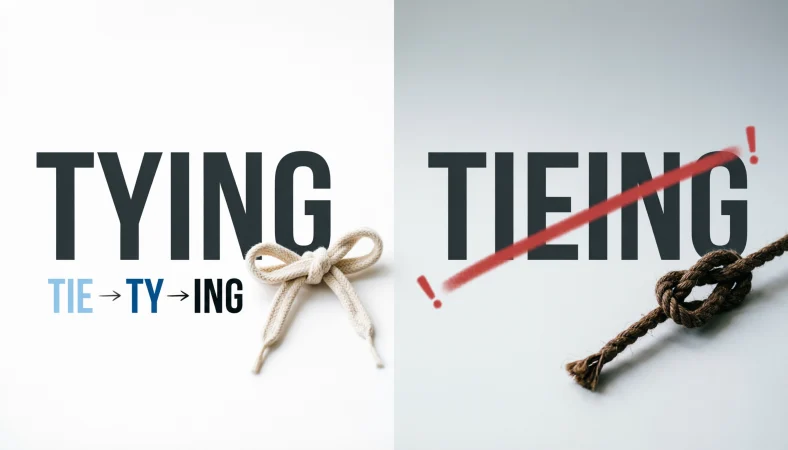
The correct spelling is tying. It is the present participle and gerund form of the verb “tie,” meaning to fasten, attach, secure, or connect something with a knot or other method. “Tieing” is generally considered a misspelling in standard English. The confusion happens because many verbs ending in “ie” change to “ying” when forming the present participle.
The question of tieing or tying often appears when writers try to add the “ing” ending to the verb “tie.” At first glance, “tieing” may seem logical because the base word is spelled “tie.” However, English spelling rules change the ending in this situation. The standard form is “tying,” not “tieing.” Understanding this small spelling pattern can prevent mistakes in school assignments, workplace writing, emails, captions, articles, and everyday communication.
Knowing why “tying” is correct also makes the rule easier to remember. The change is not random. English normally changes a final “ie” into “y” before adding “ing.” The same pattern appears in verbs such as “lie,” which becomes “lying,” and “die,” which becomes “dying.”
Tieing vs Tying: What’s the Difference?
The difference is straightforward: tying is the standard English spelling, while tieing is generally incorrect in modern standard English.
The word “tying” comes from the verb “tie.” The verb can describe fastening something with a knot, connecting objects, securing something in place, or forming a particular relationship. When “ing” is added, the spelling changes from “tie” to “ty,” producing “tying.”
| Word | Part of speech | Standard spelling | Meaning | Example |
| Tying | Verb form | Yes | Fastening, securing, or connecting | She is tying her shoes. |
| Tieing | Verb form | No | Intended as the form of “tie” | This spelling should normally be avoided. |
The important point is that “tying” is not a different verb from “tie.” It is simply the correct present participle and gerund form.
Consider these examples:
Present tense: I tie my shoes every morning.
Present participle: I am tying my shoes.
Gerund: Tying your shoes properly can prevent loose laces.
The spelling changes because English has a specific convention for verbs ending in “ie.”
The quick rule
When a verb ends in ie and needs the ing ending, the “ie” usually changes to “y.”
So:
tie → tying
lie → lying
die → dying
This makes “tying” easy to recognize once the pattern becomes familiar.
Quick recap:
“Tying” is the standard form.
“Tieing” is generally a spelling error.
The change happens because final “ie” becomes “y” before “ing.”
The rule also explains forms such as “lying” and “dying.”
Is Tieing vs Tying a Grammar, Vocabulary, or Usage Issue?
The question is primarily a spelling and word formation issue, rather than a vocabulary difference.
“Tieing” and “tying” do not normally represent two different meanings. A writer who uses “tieing” usually intends to write the present participle of “tie.” The problem is that the spelling does not follow standard English word formation.
This distinction matters because grammar tells us how words function in sentences, while spelling determines how those words are written. In the sentence “He is tying the rope,” the grammatical construction is correct. The word “tying” functions as the present participle of “tie.”
The problem appears when someone writes “He is tieing the rope.” The sentence structure is fine, but the spelling of the verb form is not standard.
Formal and informal writing
In formal writing, “tying” should always be preferred. This includes reports, essays, professional emails, academic papers, applications, business documents, and published content.
Informal digital communication can contain spelling mistakes without preventing readers from understanding the intended meaning. Someone may type “tieing” in a quick message and still be understood. That does not make the spelling standard.
Academic writing
Academic writing requires greater spelling accuracy. Using “tieing” in an essay may be treated as an ordinary spelling mistake. Because the correct form is simple and well established, there is little reason to use the nonstandard form.
Casual communication
In casual messages, people sometimes type words according to how they think they should be spelled. Autocorrect and spellcheck tools may correct the word automatically, but writers should still know the underlying rule.
The distinction is therefore simple. The two spellings are not competing vocabulary choices. One is the accepted spelling, while the other is generally an error.
How to Use Tying Correctly
The word “tying” can appear in many ordinary sentences because “tie” has several related meanings. The central idea is usually fastening, securing, connecting, or bringing something together.
Workplace example
Imagine an employee preparing equipment for an event:
The technician is tying the cables together before the presentation begins.
Here, “tying” describes an action happening at the moment of speaking.
Another workplace example is:
She spent the afternoon tying labels to the packages.
The word describes the process of attaching one thing to another.
Academic example
Students may encounter the word in descriptions of physical processes, relationships, or figurative connections:
The researcher is tying the two observations together to form a stronger argument.
In this sentence, “tying” has a figurative meaning. The writer is connecting ideas rather than physically fastening objects.
Technology example
The word can also appear in technology related writing:
The developer is tying the new feature to the existing user account.
Here, “tying” means connecting or associating two elements.
This broader meaning is important because “tie” does not always involve rope, string, or knots. English frequently uses the word figuratively.
Usage recap: Use “tying” whenever you need the present participle or gerund form of “tie.” The word can describe physical fastening or an abstract connection between ideas, systems, people, or events.
Why Tieing Is Usually Incorrect
The spelling “tieing” looks reasonable if you simply place “ing” after “tie.” That approach works with many verbs, but English has spelling changes that affect certain endings.
For verbs ending in “ie,” standard English generally changes “ie” to “y” before adding “ing.”
That produces:
tie → tying
Rather than:
tie → tieing
The reason is partly practical. If English kept “ie” before “ing,” the resulting sequence would be awkward and inconsistent with established spelling patterns.
This same principle helps explain several familiar words.
Lie becomes lying.
Die becomes dying.
Tie becomes tying.
Seeing these forms together makes the pattern much easier to remember.
When You Should NOT Use Tieing or Tying
There are several situations where writers commonly make mistakes with this spelling.
1. Do not write “tieing” when describing an action
Incorrect:
He is tieing his shoes.
Correct:
He is tying his shoes.
2. Do not assume every verb simply takes “ing”
English spelling sometimes changes when suffixes are added. The base form “tie” does not become “tieing.”
3. Do not use “tieing” in formal documents
Even though readers can usually understand it, the spelling is nonstandard.
4. Do not confuse “tying” with “tied”
“Tying” describes an ongoing action.
“Tied” normally describes a completed action or resulting condition.
For example:
She is tying the ribbon.
She tied the ribbon.
5. Do not change “tying” to “tieing” because of pronunciation
The pronunciation does not justify adding the extra letters.
6. Do not treat “tieing” as an alternative spelling with the same status
In ordinary contemporary standard English, “tying” is the form to use.
7. Do not rely entirely on automatic correction
Spellcheck can catch many errors, but understanding the rule helps you recognize mistakes before submitting important writing.
8. Do not apply unrelated spelling rules mechanically
The “ie” to “y” change is a specific pattern. It does not mean every word containing “ie” should change before every suffix.
Common Mistakes and Decision Rules
| Correct sentence | Incorrect sentence | Explanation |
| She is tying her shoes. | She is tieing her shoes. | “Tie” changes to “ty” before “ing.” |
| He is tying the rope securely. | He is tieing the rope securely. | The standard present participle is “tying.” |
| They are tying the packages together. | They are tieing the packages together. | The final “ie” changes to “y.” |
| Tying the knot requires practice. | Tieing the knot requires practice. | “Tying” is also the gerund form. |
| She is tying the ribbon. | She is tieing the ribbon. | The spelling rule applies in the same way. |
Decision Rule
If you mean the ongoing action of “tie,” use “tying.”
If you see “tieing” being used as the present participle of “tie,” replace it with “tying.”
This is one of those spelling rules that becomes much easier once you connect it to familiar examples. Remember:
tie → tying
lie → lying
die → dying
The shared pattern gives you a reliable mental shortcut.
Tieing and Tying in Modern Technology and AI Tools
Modern writing tools have made spelling questions like this easier to identify. Word processors, browsers, grammar applications, and artificial intelligence writing assistants can often recognize “tieing” as a likely spelling error when it is intended as the present participle of “tie.”
However, automated tools should support language knowledge rather than replace it.
An AI writing assistant may identify the correction, but understanding why the correction is necessary gives writers greater control. It also helps when software does not recognize an unusual sentence or when a writer is working in an environment without automatic spelling support.
For content creators, this matters because small spelling errors can affect perceived credibility. A reader may overlook one typo, but repeated errors can make professional content appear less carefully edited.
The safest approach is simple: learn the rule, recognize the pattern, and use technology as a final checking layer.
The Etymology Behind Tying
The word “tie” has a long history in English and is connected with the idea of binding or fastening. The verb developed through earlier forms of English and related Germanic languages, where words expressing connection, binding, and fastening were already established.
The modern spelling of “tying” reflects English spelling conventions rather than a change in meaning. The base verb remains “tie,” but the spelling changes when the present participle ending is added.
This illustrates an important feature of English. Word formation is not always a matter of attaching letters mechanically. Historical spelling conventions and established patterns influence how words appear in their inflected forms.
That is why “tying” may look surprising to someone learning English, even though it follows a recognizable pattern.
What Linguists and Editors Look For
A useful editorial principle is:
Choose the established inflected form rather than creating a spelling by simply attaching a suffix to the base word.
For “tie,” that means recognizing the standard transformation before adding “ing.”
This principle is particularly useful for learners because English contains many irregular or semi regular spelling patterns. Memorizing isolated words can work, but identifying families of related forms is usually more efficient.
Once you remember “tie becomes tying,” you can immediately recognize the same type of pattern in “lie becomes lying” and “die becomes dying.”
Two Practical Case Studies
Case Study 1: Workplace communication
Consider a workplace instruction:
Please make sure you are tying the cables securely before the equipment is moved.
The writer needs an ongoing action, so “tying” is appropriate.
If the same sentence used “tieing,” the meaning would remain understandable, but the spelling would appear incorrect. In a professional document, correcting the word produces a cleaner and more credible sentence.
Result: One spelling change converts a nonstandard form into the accepted standard form without changing the meaning of the sentence.
Case Study 2: Educational writing
Now consider a student writing:
Tying the observations together helped explain the results.
The word “tying” is used figuratively. It means connecting the observations into a coherent explanation.
Replacing it with “tieing” would introduce a spelling error into an otherwise grammatically sound sentence.
Result: Understanding the spelling pattern allows the student to preserve both grammatical accuracy and standard spelling.
These examples show why the distinction matters even though the incorrect spelling is usually easy to understand.
Error Prevention Checklist
Always use Tying when:
- ✓ You mean the present participle of “tie.”
- ✓ You are describing an action that is happening.
- ✓ You are using “tie” as a gerund.
- ✓ You are writing formally or academically.
- ✓ You are describing physical fastening.
- ✓ You are describing a figurative connection.
Never use Tieing when:
- ✓ You intend the standard present participle of “tie.”
- ✓ You are preparing professional content.
- ✓ You are writing an academic assignment.
- ✓ You are publishing an article or report.
- ✓ You are editing formal English.
The easiest memory trick is to think of the transformation visually:
TIE → TYING
The “ie” changes to “y,” and then “ing” is added.
Why Tying Is Easy to Confuse With Other Forms
English learners often expect spelling to behave consistently. If a verb such as “walk” becomes “walking,” it is natural to assume that “tie” should become “tieing.”
But English contains several spelling rules that alter the final letters of a word when a suffix is added.
The important thing is not to memorize “tying” as an isolated exception. Instead, connect it to the broader pattern involving verbs ending in “ie.”
Compare:
tie → tying
lie → lying
die → dying
Once these forms become familiar, the spelling becomes much more predictable.
There is also a useful contrast with words ending in “y.” A verb such as “play” becomes “playing,” while “tie” first changes its ending before “ing” is added.
This is why paying attention to the base word matters.
Related Grammar Confusions You Should Master
If you are working on spelling and word formation, several other commonly confused forms are worth learning:
- Lying or lieing: The standard form is “lying.”
- Dying or dieing: The standard form is “dying.”
- Trying or trieing: The standard form is “trying.”
- Studying or studieing: The standard form is “studying.”
- Making or makeing: The final “e” is removed before “ing.”
- Running or runing: The final consonant is doubled in the standard form.
- Writing or writeing: The final “e” is removed before “ing.”
- Coming or comeing: The final “e” is removed before “ing.”
- Beginning or begining: The final consonant is doubled.
- Hoping or hopeing: The final “e” is removed before “ing.”
Learning these patterns together is more useful than memorizing individual corrections.
FAQs
Is tying or tieing correct?
“Tying” is the correct standard spelling when you need the present participle or gerund form of “tie.” “Tieing” is generally considered a misspelling.
Why is tying spelled without the e?
The verb “tie” ends in “ie.” Before the “ing” ending is added, the “ie” changes to “y.” This produces “tying.”
Is tieing ever correct?
In ordinary contemporary standard English, “tieing” should not be used as the present participle of “tie.” Writers should use “tying.”
What is the past tense of tie?
The past tense is “tied.” For example, “She tied the ribbon yesterday.”
What is the present participle of tie?
The present participle is “tying.” For example, “She is tying the ribbon.”
Is tying a gerund?
Yes. “Tying” can function as a gerund when it acts as a noun in a sentence. For example, “Tying your shoes takes only a few seconds.”
Why does lie become lying?
“Lie” ends in “ie,” so the “ie” changes to “y” before “ing” is added. The result is “lying.”
Why does die become dying?
The same spelling pattern applies. “Die” becomes “dying” when the “ing” ending is added.
How can I remember the spelling of tying?
Remember the simple transformation tie becomes tying. You can reinforce the pattern by remembering “lie becomes lying” and “die becomes dying.”
Is tying grammatically correct?
Yes. “Tying” is the standard present participle and gerund form of “tie.” It can describe an ongoing physical action or a figurative act of connecting things.
Conclusion:
When choosing between tieing or tying, use tying. It is the standard present participle and gerund form of the verb “tie.” The spelling changes because a final “ie” becomes “y” before the “ing” ending is added.
The rule becomes easier when you remember related forms such as “lying” and “dying.” You do not need to treat “tying” as an arbitrary spelling. It follows a recognizable English word formation pattern.
Whether you are writing an academic assignment, professional email, technical explanation, social media caption, or everyday message, tying is the form you should choose. Once you remember “tie becomes tying,” this particular spelling problem becomes much easier to avoid.