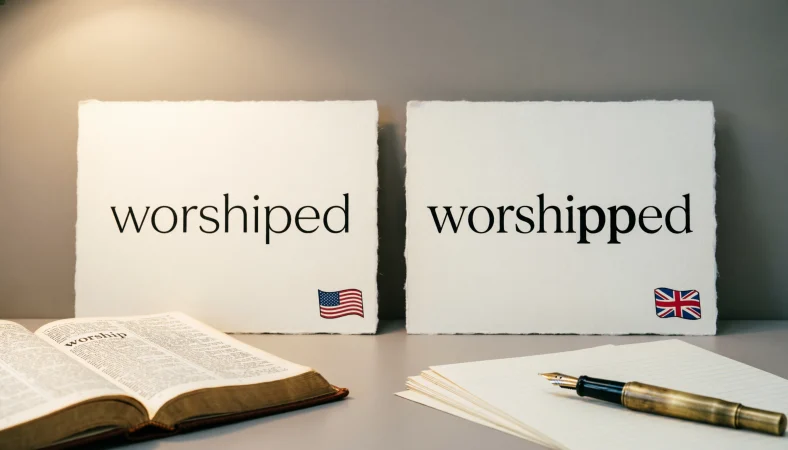
Both worshiped or worshipped are correct spellings of the past tense and past participle of the verb worship. The main difference is regional spelling. Worshiped is the standard spelling in American English, while worshipped is preferred in British English and many other varieties. Both forms have the same meaning and pronunciation.
The choice between worshiped or worshipped often confuses writers because English uses different spelling conventions for verbs ending in a stressed vowel followed by a consonant. American English commonly uses a single final consonant in this case, while British English often doubles it. Choosing the wrong form usually does not change the meaning, but it can make writing look inconsistent with its intended variety of English.
Worshiped vs Worshipped: What’s the Difference?
The difference between worshiped and worshipped is primarily a matter of spelling convention rather than meaning or grammar. Both words come from the verb worship, which means to show religious devotion or profound reverence toward a deity, sacred figure, or object.
Both forms can function as the simple past tense and past participle of worship.
For example:
The ancient people worshiped the sun.
The ancient people worshipped the sun.
Both sentences communicate the same idea.
The spelling depends mainly on the variety of English being used.
| Feature | Worshiped | Worshipped |
| Base verb | Worship | Worship |
| Part of speech | Verb form | Verb form |
| Tense | Past tense or past participle | Past tense or past participle |
| Meaning | Showed religious devotion or deep reverence | Showed religious devotion or deep reverence |
| Common variety | American English | British English |
| Pronunciation | Same | Same |
| Meaning difference | None | None |
| Standard spelling | Yes | Yes |
The simplest way to remember the distinction is this:
Worshiped is generally preferred in American English.
Worshipped is generally preferred in British English.
Neither spelling is inherently more correct than the other.
The important point is consistency. If you are writing for an American audience, worshiped will usually look more natural. If your audience follows British English conventions, worshipped is normally the better choice.
Is Worshiped vs Worshipped a Grammar, Vocabulary, or Usage Issue?
This is primarily a spelling and usage issue, not a difference in grammar or vocabulary.
The two forms belong to the same verb and carry exactly the same meaning. You are not choosing between two separate verbs. Instead, you are choosing between two accepted spelling conventions.
This distinction matters because English has several regional spelling differences. Words such as traveling and travelling, modeled and modelled, and canceled and cancelled can follow similar patterns.
Are Worshiped and Worshipped Interchangeable?
In meaning, yes. In regional spelling, they are not always interchangeable in terms of style.
An American publication would normally favor worshiped. A British publication would normally favor worshipped.
Consider these examples:
The villagers worshiped the deity.
The villagers worshipped the deity.
There is no difference in what the sentences mean.
However, mixing spelling systems within the same article can make your writing appear careless. For professional or academic work, consistency matters more than choosing one form as universally correct.
Formal and Informal Usage
Both forms are appropriate in formal and informal writing.
You can use either form in:
Academic writing
Religious writing
Historical writing
Journalism
Literary writing
Everyday communication
The determining factor is usually the spelling system expected by your audience.
Academic and Casual Usage
Academic writers should follow the style conventions required by their institution, publication, or target audience.
For example, a paper using American English may consistently use worshiped, while a British academic publication may use worshipped.
Casual writers have more flexibility, but regional consistency still improves readability.
When to Use Worshiped
Use worshiped when you are writing primarily in American English.
American English generally prefers a single final consonant when forming the past tense of worship.
Workplace Example
Imagine a museum employee writing a description of an ancient civilization for an American audience:
The civilization worshiped several gods associated with nature.
The spelling worshiped fits standard American English usage.
Academic Example
A university student writing a history paper in American English might write:
The community worshiped a deity believed to control rainfall.
Again, worshiped is the natural choice when the surrounding paper follows American spelling conventions.
Technology Example
Technology can also involve religious or historical content. A digital encyclopedia created for an American audience might contain a sentence such as:
The database explains how ancient communities worshiped different deities.
The spelling remains worshiped because the intended English variety has not changed.
Usage Recap
Choose worshiped when your content follows American English conventions. It is fully standard and has the same meaning as worshipped. The spelling does not indicate a different pronunciation or a different kind of religious practice.
When to Use Worshipped
Use worshipped when your writing follows British English conventions.
British English generally doubles the final consonant in certain verbs when forming the past tense or past participle. Worshipped follows this convention.
Workplace Example
A British museum guide might write:
The ancient population worshipped several gods.
This spelling fits British English naturally.
Academic Example
A British historian might write:
The people worshipped the goddess as a protector of the city.
The spelling is appropriate because the surrounding academic work uses British English.
Technology Example
A British educational website could explain:
The interactive exhibit shows how ancient communities worshipped their gods.
The double consonant does not alter the meaning. It simply reflects the spelling convention being followed.
Usage Recap
Choose worshipped when your writing follows British English conventions. It is standard, correct, and widely used outside the United States.
Worshiped or Worshipped in American and British English
Regional English is the key to understanding this spelling difference.
American English often simplifies certain doubled consonants when verbs take endings such as ed or ing. British English frequently retains the doubled consonant in comparable forms.
That difference creates pairs such as:
| American English | British English |
| Worshiped | Worshipped |
| Modeled | Modelled |
| Signaled | Signalled |
| Traveled | Travelled |
| Canceled | Cancelled |
These patterns are useful, but they should not be treated as an absolute rule for every English verb.
The most practical approach is simple. Decide whether your content uses American or British English, then maintain that choice throughout the article.
When You Should NOT Use Worshiped or Worshipped
There are several situations where writers can accidentally use one of these forms incorrectly.
1. Do Not Use Both Forms Randomly
Avoid switching between worshiped and worshipped without a reason.
For example, an article should not begin with worshiped and later switch to worshipped unless there is a deliberate quotation or regional context.
2. Do Not Treat Them as Different Words
The two spellings do not represent different meanings.
You do not need one spelling for religious worship and another for admiration.
Both can describe religious devotion or profound reverence.
3. Do Not Assume Worshipped Is More Correct
The extra consonant does not make the British form more grammatically correct.
It simply reflects a different spelling convention.
4. Do Not Assume Worshiped Is Incorrect
Likewise, worshiped is not a misspelling simply because you are accustomed to seeing worshipped.
It is standard American English.
5. Do Not Mix Regional Styles Without Purpose
If your article uses American spelling elsewhere, suddenly using British spelling can create an inconsistent style.
6. Do Not Change the Pronunciation
The spelling difference does not create a different pronunciation.
Both forms are pronounced the same way.
7. Do Not Confuse Worship With Worshiping Forms
The same regional spelling distinction appears in the present participle.
American English generally uses worshiping, while British English generally uses worshipping.
8. Do Not Apply the Rule Mechanically to Every Verb
English spelling contains many historical patterns and exceptions. Learning individual forms alongside broader spelling conventions is safer than assuming every verb behaves identically.
Common Mistakes and Decision Rules
The following examples show how writers commonly make mistakes when choosing between the two forms.
| Correct sentence | Incorrect sentence | Explanation |
| The people worshiped the sun. | The people worshipped the sun. | The first is preferred in American English. The second is not wrong in British English. |
| The people worshipped the sun. | The people worshiped the sun. | The first fits British English. The second is acceptable in American English. |
| The villagers worshiped the deity. | The villagers worshipped the deity. | American English generally uses the single consonant form. |
| The villagers worshipped the deity. | The villagers worshiped the deity. | British English generally uses the doubled consonant form. |
| The king was worshipped by his followers. | The king was worshiped by his followers. | The first matches British spelling conventions. |
| The king was worshiped by his followers. | The king was worshipped by his followers. | The first matches American spelling conventions. |
Decision Rule
If you are writing in American English, use worshiped.
If you are writing in British English, use worshipped.
This is a regional spelling decision, not a meaning based decision.
Worshiped or Worshipped in Modern Technology and AI Tools
Modern digital writing has made regional spelling differences more visible.
Search engines, grammar tools, word processors, translation systems, and artificial intelligence tools can encounter both worshiped and worshipped as legitimate forms. A good language system should recognize that the two spellings refer to the same verb form.
This matters for content creators because automated writing tools may follow the language variety selected in their settings. An American English setting may produce worshiped, while a British English setting may produce worshipped.
AI generated content also creates another important consideration: consistency.
Suppose an article begins with American spelling such as color, favorite, and center. Using worshipped later may introduce an unnecessary British spelling into the same piece.
The reverse is also true. An article using colour, favourite, and centre will generally look more consistent with worshipped.
The lesson is not to avoid one form. The lesson is to establish a clear regional style before producing substantial content.
The Etymology of Worship
The word worship has a long history in English.
It developed from Old English weorþscipe, a word associated with worthiness, honor, or the condition of being worthy of respect. Over time, its meaning became strongly associated with religious reverence and devotion.
This history also explains why worship can have a broader sense beyond formal religious practice.
A person may worship a deity in a religious context, but English can also use the word figuratively to describe extreme admiration.
For example:
Some fans practically worship the singer.
Here, the word does not necessarily describe formal religious activity. It expresses intense admiration.
The past forms worshiped and worshipped preserve the same basic meaning regardless of spelling convention.
What Does Worship Mean in Different Contexts?
Understanding the base verb makes the spelling choice easier.
Religious Context
In religious writing, worship commonly means expressing devotion, reverence, or honor toward a deity.
The community worshiped its traditional gods.
Historical Context
Historians often use the verb when describing religious practices of earlier civilizations.
Ancient Egyptians worshipped numerous deities.
Figurative Context
The word can also describe excessive admiration.
The fans worshiped the famous athlete.
In this figurative use, the word suggests unusually strong admiration rather than literal religious devotion.
The spelling remains determined by regional English rather than context.
An Expert Style Explanation
A useful way to understand the distinction is:
“Worshiped and worshipped represent the same verb form; the spelling difference primarily reflects the regional convention of the English being used.”
This principle applies to many spelling questions. Correct English is not always represented by one universal spelling. English exists in several established varieties, each with its own conventions.
For writers, matching the expected variety is often more important than deciding which form is universally right.
Two Practical Case Studies
Case Study One: An American History Article
Imagine an American educational publisher preparing an article about ancient civilizations.
The article consistently uses American spelling, including color, center, and favorite. The writer initially uses worshipped because that spelling is familiar from British historical sources.
An editor changes the form to worshiped throughout the article.
The factual content has not changed. The spelling has simply been aligned with the publication’s American English style.
The result is greater consistency and a more natural reading experience for the intended audience.
Case Study Two: A British Academic Essay
Now consider a British university student writing about ancient religious practices.
The essay follows British conventions throughout. The student uses colour, centre, and organised. The student also writes:
Ancient communities worshipped their gods through elaborate ceremonies.
Here, worshipped fits naturally with the rest of the essay.
Changing it to worshiped would not necessarily make the sentence grammatically wrong, but it would introduce a spelling convention associated more strongly with American English.
The practical result is the same in both cases: consistent regional spelling makes the writing feel deliberate and professionally edited.
Error Prevention Checklist
Always use Worshiped when
You are writing primarily in American English.
Your publication follows American spelling conventions.
Your audience expects American English.
You already use American spellings throughout the article.
Always use Worshipped when
You are writing primarily in British English.
Your publication follows British spelling conventions.
Your audience expects British English.
You already use British spellings throughout the article.
Never use either form when
- You mean the present tense and need the base verb worship.
- You are trying to distinguish two different meanings.
- You are switching between regional spellings without a clear reason.
Why Consistency Matters More Than Preference
Many spelling debates become unnecessarily complicated because writers ask which version is the single correct answer.
With regional English, that question often has no useful answer.
American English and British English are both established forms of English. They have different spelling conventions, vocabulary preferences, punctuation practices, and sometimes grammatical preferences.
The better question is:
Which English variety am I writing for?
Once that question is answered, the choice becomes straightforward.
For an American audience, select worshiped. For a British audience, select worshipped.
If your website serves an international audience, either spelling can work. The most important thing is to choose a consistent editorial style and apply it throughout your content.
Related Spelling Confusions You Should Master
If you are working on English spelling and usage, several related pairs are worth learning.
Modeled or Modelled
American English generally prefers modeled, while British English commonly uses modelled.
Canceled or Cancelled
American English commonly uses canceled, while British English generally uses cancelled.
Traveled or Travelled
American English commonly uses traveled, while British English generally uses travelled.
Signaled or Signalled
American English commonly uses signaled, while British English generally uses signalled.
Worshiping or Worshipping
The same regional distinction appears in the present participle of worship.
Labeled or Labelled
American English generally uses labeled, while British English commonly uses labelled.
Center or Centre
These forms illustrate a different type of American and British spelling difference.
Favorite or Favourite
American English generally uses favorite, while British English uses favourite.
Realized or Realised
American English generally favors realized, while British English commonly uses realised.
Offense or Offence
American English generally uses offense, while British English commonly uses offence.
Learning these patterns helps writers recognize that English spelling can vary without one form being inherently incorrect.
FAQs
Is worshiped or worshipped correct?
Both are correct. Worshiped is the standard American English spelling, while worshipped is the standard British English spelling. Both forms represent the past tense and past participle of worship.
Is worshipped British or American?
Worshipped is primarily associated with British English and is also common in other varieties influenced by British spelling conventions.
Is worshiped American English?
Yes. Worshiped is the standard spelling generally preferred in American English.
What is the past tense of worship?
The past tense is worshiped in American English and worshipped in British English.
Is worshiped spelled with one p?
Yes. American English generally spells the past form as worshiped, with one p before the ending.
Is worshipped spelled with two p’s?
Yes. British English generally spells the past form as worshipped, with two p letters before the ending.
Are worshiped and worshipped pronounced differently?
No. The two spellings normally have the same pronunciation. The difference is in spelling rather than pronunciation.
Should I use worshiped or worshipped in an American article?
Use worshiped if the article follows standard American English spelling conventions.
Should I use worshiped or worshipped in a British article?
Use worshipped if the article follows standard British English spelling conventions.
Is worshiped or worshipped more common?
Usage varies by region. Worshiped is more appropriate for American English, while worshipped is more appropriate for British English and related spelling systems.
Conclusion:
The choice between worshiped or worshipped is simple once you identify the English variety you are using. Both spellings are correct, both have the same meaning, and both function as the past tense and past participle of worship.
Use worshiped for standard American English.
Use worshipped for standard British English.
Neither form is universally superior. The best choice depends on your audience, publication style, and the spelling conventions used throughout your content. Most importantly, stay consistent. If the rest of your writing follows American English, choose worshiped. If it follows British English, choose worshipped.
Author Bio: Written by a language and SEO content specialist focused on clear English usage, spelling distinctions, search intent, and reader friendly educational content.