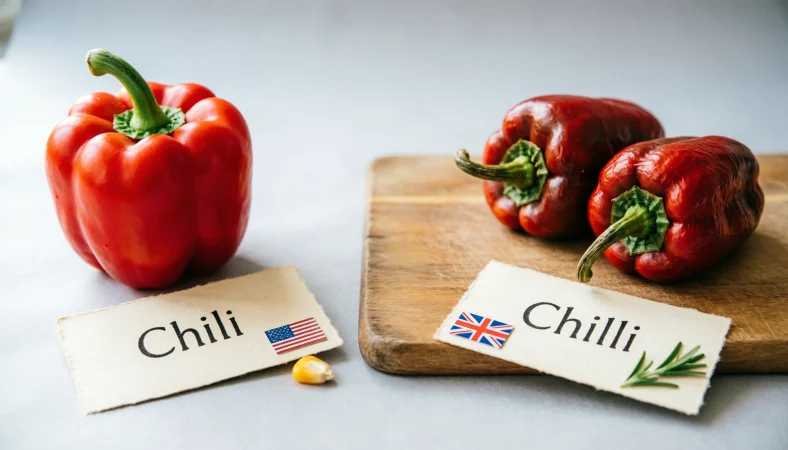
Both chilli or chili are correct spellings, but the choice depends mainly on regional English. Chili is the standard spelling in American English, while chilli is common in British English and many other varieties of English. The word can refer to a hot pepper or, in some contexts, a dish made with meat, beans, tomatoes, and spices.
If you’ve ever wondered whether you should write chili pepper, chilli pepper, or simply chilli, you’re dealing with a genuine difference between varieties of English rather than a simple spelling mistake. The confusion matters because the preferred spelling changes by country, publication style, and context. American dictionaries and publications generally favor chili, while British English commonly uses chilli for the pepper. As a result, both forms can be correct, but choosing the form that matches your audience makes your writing clearer, more consistent, and more authoritative.
Chilli or Chili: What’s the Difference?
The simplest answer is that chili and chilli usually refer to the same thing when they describe a hot pepper. The difference is primarily a matter of regional spelling.
In American English, chili is the normal spelling for the pepper. In British English, chilli is widely preferred. Other English speaking regions may follow British usage, American usage, or a mixture of both depending on local conventions.
The word can also have different meanings depending on context. In the United States, chili can refer not only to a pepper but also to a spicy stew or dish, particularly a dish often called chili con carne. British English generally uses chilli for the pepper while retaining chilli in expressions such as chilli sauce and chilli powder.
| Feature | Chili | Chilli |
| Common variety | American English | British English |
| Typical meaning | Hot pepper or spicy dish | Hot pepper |
| Part of speech | Usually noun or adjective | Usually noun or adjective |
| Common phrase | Chili pepper | Chilli pepper |
| US usage | Standard | Less common |
| UK usage | Less common | Standard |
| Plural for peppers | Chilies or chilis, depending on style | Chillies |
| Main difference | Regional spelling | Regional spelling |
Mini recap
Chili is the usual American English spelling.
Chilli is the usual British English spelling.
Both can be correct when used according to the appropriate regional convention.
The spelling should normally match the English variety used by your audience.
Is Chilli or Chili a Grammar, Vocabulary, or Usage Issue?
The difference between chilli or chili is primarily a spelling and usage issue, rather than a grammatical one.
Neither spelling is inherently more correct in every situation. Instead, the preferred form depends on the variety of English being used.
For example, an American food website would normally write:
Add one chopped chili pepper to the sauce.
A British food website would more naturally write:
Add one chopped chilli pepper to the sauce.
Both sentences communicate the same basic idea.
Are chili and chilli interchangeable?
In many contexts, yes. If you’re talking about the pepper, a reader who understands English will generally recognize both forms.
However, they aren’t always interchangeable stylistically. A British publication that consistently uses American spellings may look inconsistent, while an American publication using chilli may appear unusual to its intended audience.
Formal versus informal usage
There is no major difference in formality between the two spellings. The important distinction is geographical.
In formal American writing, use chili.
In formal British writing, use chilli.
The same principle applies to academic writing, journalism, professional websites, recipes, product descriptions, and educational materials.
Academic versus casual usage
Academic writers should follow the spelling conventions required by their institution, publisher, or style guide.
A British university paper may use chilli because British English is the expected variety. An American academic publication may use chili.
The key is consistency. Switching between chili and chilli without a reason can make otherwise polished writing appear careless.
How to Use Chili in American English
Chili is the preferred American English spelling when referring to a hot pepper.
For example:
The recipe calls for two fresh chili peppers.
You may also see chili used in food names and descriptions.
She ordered a bowl of chili for lunch.
This creates an important distinction in American English. Depending on the context, chili can refer to either a pepper or a prepared dish.
Workplace example
A workplace message might say:
Please add the chili sauce to the catering order.
Here, chili identifies the flavor or ingredient.
Academic example
A research paper about food chemistry might say:
Capsaicin is responsible for the characteristic heat associated with chili peppers.
Technology example
A recipe application designed primarily for American users might display:
Spicy Chili Chicken
rather than:
Spicy Chilli Chicken
The spelling reflects the application’s language convention rather than a difference in the food itself.
Usage recap
Use chili when writing for an American English audience.
It is especially appropriate for American recipes, food publications, educational materials, and websites.
Remember that American English also uses chili for a popular spicy dish.
How to Use Chilli in British English
Chilli is the standard British English spelling for the hot pepper.
For example:
Add one finely chopped chilli to the curry.
This spelling is also common in British recipes, restaurant menus, grocery descriptions, and food journalism.
Workplace example
A British restaurant menu might describe a dish as:
Grilled chicken with fresh chilli and lime.
Academic example
A British academic text discussing plant science might write:
The chilli plant belongs to the genus Capsicum.
Technology example
A British recipe website may display:
Chilli garlic noodles
instead of the American spelling:
Chili garlic noodles
Again, the difference is linguistic convention rather than a difference in ingredients.
Usage recap
Use chilli when following British English conventions.
It is particularly natural in British recipes, restaurant writing, educational content, and general publishing.
The plural is commonly written chillies.
When You Should NOT Use Chili or Chilli
The biggest mistake is assuming that one spelling is universally correct. Consider these common situations where choosing the wrong form can create confusion or inconsistency.
- Do not mix regional spelling without a reason. If an article is written in American English, consistently use chili unless discussing a quotation or official name.
- Do not change an established product name. A brand may deliberately use one spelling regardless of the English variety.
- Do not assume chilli always means a dish. In British English, chilli usually refers to the pepper unless the context indicates otherwise.
- Do not assume chili always means a pepper in American English. The word can also refer to the well known spicy dish.
- Do not change quoted material unnecessarily. If a source uses chilli, preserve its original spelling when quoting it.
- Do not switch between US and UK conventions randomly. Consistency matters more than choosing one spelling as universally superior.
- Do not use the spelling of another variety simply because it looks more familiar. Match the language convention of your intended readers.
- Do not confuse chilli or chili with unrelated words. Context should determine whether you’re discussing a pepper, a dish, a sauce, or another food product.
Common Mistakes and Decision Rules
| Correct sentence | Incorrect or inconsistent sentence | Explanation |
| I bought three chili peppers. | I bought three chilli peppers. | The first is preferred in American English. |
| I bought three chillies. | I bought three chilis. | The first is common British usage. |
| She made a bowl of chili. | She made a bowl of chilli. | American English commonly uses chili for the dish. |
| Add one chopped chilli. | Add one chopped chili. | British English generally prefers chilli. |
| This sauce contains fresh chili peppers. | This sauce contains fresh chillies. | The first matches American English conventions. |
Decision Rule Box
- If you’re writing in American English, use chili.
- If you’re writing in British English, use chilli.
- If you’re describing an American dish, retain its established American spelling.
If you’re writing for a mixed international audience, choose one English variety and use it consistently.
Chilli or Chili in Modern Technology and AI Tools
Modern technology has made spelling differences more visible because people now publish content for international audiences.
Search engines, grammar checkers, word processors, translation systems, recipe applications, and AI writing tools may recognize both chili and chilli. However, recognition doesn’t necessarily mean that both forms are equally appropriate for every audience.
For example, an AI tool generating content for a US food website should generally favor chili. The same tool preparing content for a British publication should normally favor chilli.
This distinction is particularly important for SEO. Search engines can understand that chili and chilli are closely related terms, but writers should still use the spelling naturally expected by their target readers.
A good content strategy does not force one spelling everywhere. Instead, it identifies the audience, determines the appropriate language variety, and maintains consistency throughout the page.
Where Did the Word Chili Come From?
The history of the word helps explain why spelling variations exist.
The English word ultimately comes from Indigenous American languages associated with the pepper native to the Americas. Spanish forms of the word influenced its development in European languages, and English later adopted related forms.
The pepper itself belongs to the genus Capsicum in the nightshade family, Solanaceae. It originated in the Americas and became widely distributed around the world after European contact.
As the word entered different English varieties and developed different culinary associations, spelling conventions diverged.
This is why chili, chilli, and related forms appear across dictionaries, recipes, scientific texts, and food cultures.
Expert style quotation
Regional spelling does not change the ingredient. It changes the linguistic convention used to name it.
That distinction is useful whenever you’re deciding between chili and chilli.
Two Practical Case Studies
Case Study 1: American food website
Imagine an American recipe website publishing a recipe for spicy chicken.
The site’s audience primarily consists of readers in the United States. Its editorial policy follows American English.
The recipe uses:
2 fresh chili peppers
and:
1 teaspoon chili powder
Using chili consistently reinforces the site’s regional language style.
If the same article repeatedly switched to chilli, the recipe would still be understandable, but its language would appear less consistent with the publication’s stated English variety.
Case Study 2: British educational website
Now consider a British educational website explaining how spicy peppers are used in cooking.
The article writes:
Chilli peppers contain capsaicin, which produces their characteristic heat.
The site uses British English throughout its educational content.
In this context, chilli is the natural editorial choice. Replacing it throughout with chili would introduce an American spelling into otherwise British English.
The concrete result in both cases is greater linguistic consistency, clearer audience targeting, and fewer unnecessary spelling corrections.
Author expertise
This article is written from a language and SEO perspective, with attention to regional English conventions, lexical usage, search intent, and reader clarity.
Error Prevention Checklist
Always use chili when
- You’re writing primarily for American readers.
- Your publication follows American English.
- You’re describing an American dish called chili.
- Your organization’s style guide specifies American spelling.
- Your product or brand terminology officially uses chili.
Always use chilli when
- You’re writing primarily for British readers.
- Your publication follows British English.
- You’re using standard British food terminology.
- Your educational material follows British spelling conventions.
- Your organization has specifically adopted British English.
Chilli or Chili for Different English Speaking Audiences
The spelling question becomes easier when you think about the reader rather than the word itself.
For a US audience, chili is generally the safest choice.
Reader from a UK audience, chilli is generally the safest choice.
For readers in countries such as Australia and New Zealand, British influenced spelling conventions commonly make chilli the familiar form, although individual organizations may establish their own style.
For an international audience, either spelling can work. What matters most is choosing a consistent convention and avoiding unnecessary switching.
If you’re writing SEO content, audience targeting should guide your choice. A US focused recipe page can naturally target phrases such as chili pepper and chili powder. A British focused page may naturally use chilli pepper and chilli powder.
Is Chili the Same as Chilli Pepper?
In ordinary usage, yes, when the word refers to the hot pepper.
The phrase chili pepper is especially common in American English.
The phrase chilli pepper is especially common in British English.
Both identify peppers from the Capsicum group.
However, context matters. In American English, chili without pepper may refer to the spicy dish rather than the pepper.
That is one reason writers sometimes choose the longer expression chili pepper when clarity is important.
Chili, Chilli, and Chili Powder
Another common source of confusion is chili powder versus chilli powder.
American English generally uses chili powder.
British English generally uses chilli powder.
There can also be a culinary difference between products described by these terms. In the United States, chili powder can refer to a spice blend containing ground chili peppers alongside ingredients such as cumin, garlic, and other seasonings.
In other culinary traditions, chilli powder may simply mean ground dried chilli peppers.
Therefore, the spelling difference is regional, but the exact product can also depend on culinary tradition and labeling.
Related Grammar Confusions You Should Master
Understanding regional spelling can help you recognize other English differences. Here are several useful comparisons to study:
- Color or colour
- Flavor or flavour
- Center or centre
- Theater or theatre
- Organize or organise
- Traveling or travelling
- Program or programme
- License or licence
- Practice or practise
- Check or cheque
These examples demonstrate a broader principle: English is not a single fixed system. American, British, Canadian, Australian, and other varieties have their own conventions.
FAQs
Is chili or chilli correct?
Both are correct. Chili is generally preferred in American English, while chilli is generally preferred in British English.
Is chilli British or American?
Chilli is primarily associated with British English and other English varieties influenced by British spelling conventions. American English generally uses chili.
Why do Americans spell chilli as chili?
American English developed its own spelling conventions, and chili became the standard American form. It is now widely established in American dictionaries, recipes, and publications.
Why does British English use chilli?
British English commonly uses chilli as the established spelling for the hot pepper. The form became standardized through British usage and remains common in modern British writing.
What is the plural of chili?
In American English, both chilies and chilis can be encountered, although usage varies by dictionary and editorial style. The spelling chilies is especially common when the word follows the traditional change from a consonant followed by y to ies.
What is the plural of chilli?
The common British English plural is chillies.
Is chili and chilli the same thing?
When referring to the pepper, they normally mean the same thing. The difference is primarily regional spelling. However, American English also uses chili for a particular spicy dish.
Should I use chili or chilli for SEO?
Use the spelling that matches your target audience and search intent. For a US audience, prioritize chili. For a British audience, prioritize chilli. If you’re targeting both, naturally address both forms rather than forcing one spelling throughout.
Is chili con carne spelled with chili or chilli?
The traditional name chili con carne is commonly written with chili, especially in American English. British sources may use chilli con carne depending on their regional spelling conventions.
Which spelling should I use in academic writing?
Follow the English variety and style guide required by your institution or publisher. American academic writing normally favors chili, while British academic writing normally favors chilli.
Final Verdict:
The answer to chilli or chili is straightforward once you identify your audience. Chili is the standard American English spelling, while chilli is the standard British English spelling. Neither is universally better than the other.
If you’re writing for Americans, choose chili. If you’re writing for British readers, choose chilli. For international content, either can work as long as you establish a consistent English variety and use it throughout the article.
The most important lesson is that this isn’t really a question of right versus wrong. It’s a question of regional English, context, and consistency. Knowing that distinction helps you write naturally for different audiences and avoid unnecessary spelling mistakes.











11 thoughts on “Chilli Or Chili: Meaning, Spelling, Differences & Correct Usage For 2026”