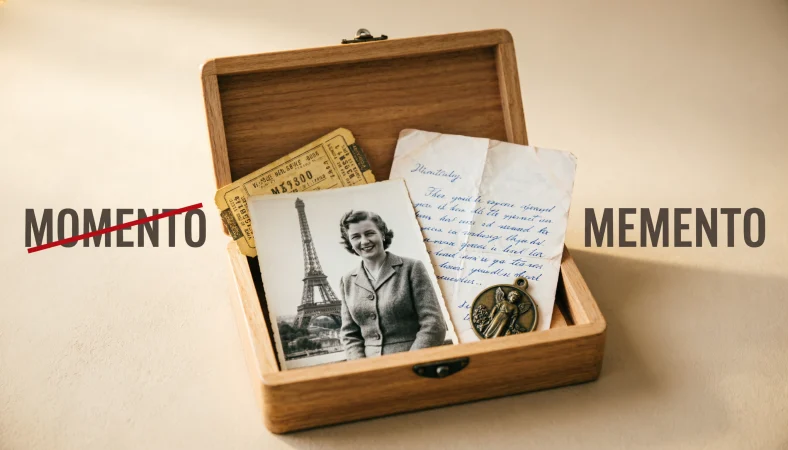
Momento or memento is a common spelling confusion, but only memento is the standard English word for a keepsake or object that helps someone remember a person, place, or event. Momento is generally a misspelling, although it can appear as a proper name or in other language contexts. Knowing the difference helps you avoid errors in formal writing.
If you’ve ever written a sentence such as “I bought a small momento of my trip,” you’re not alone. The confusion between momento or memento happens because the words look and sound remarkably similar. However, they do not have the same status in standard English. A memento is a noun meaning something kept as a reminder of a person, place, experience, or occasion. Momento, by contrast, is not the standard English spelling for this meaning. That small spelling difference can matter in school assignments, professional documents, published writing, and online content where accuracy affects credibility.
Momento or Memento: What’s the Difference?
The simplest answer is straightforward: memento is the correct standard English word when you mean a keepsake or reminder.
The word memento is a noun. It refers to an object that reminds someone of a particular person, place, event, or experience. A photograph, souvenir, letter, medal, or small gift can all serve as mementos.
Momento is generally considered a misspelling when someone intends to write memento. It is not the standard English noun for a keepsake.
| Word | Part of speech | Standard English meaning | Correct for a keepsake? | Example |
| Memento | Noun | An object kept as a reminder | Yes | She kept the photograph as a memento. |
| Momento | Noun or name in other contexts | Not the standard English spelling for a keepsake | No | Use memento instead. |
Quick recap
Memento is the standard English spelling.
It means something kept to remember a person, place, event, or experience.
Momento is normally an incorrect spelling when used with this meaning.
For formal, academic, and professional writing, choose memento.
Is Momento or Memento a Grammar, Vocabulary, or Usage Issue?
This is primarily a vocabulary and spelling issue, rather than a grammatical one.
Grammar determines how words function within sentences. In this case, the problem is choosing the correct word form. If you write “She kept a memento from the trip,” the grammar is fine. If you write “She kept a momento from the trip,” the sentence structure is still grammatical, but the spelling of the intended word is incorrect.
The distinction is especially important because memento has a specific meaning in English. It describes something that serves as a reminder.
Are the two words interchangeable?
No. They should not be treated as interchangeable in standard English.
If you mean a keepsake, use memento.
For example:
He gave me a watch as a memento of our friendship.
Writing momento in the same sentence would normally be regarded as a spelling mistake.
Formal versus informal usage
There is no standard informal version in which momento replaces memento. People may occasionally type or write momento because they have heard the word but have not seen its spelling, but that does not make the spelling standard.
In formal writing, the distinction becomes even more important.
Academic versus casual writing
Academic essays, reports, articles, applications, and professional correspondence should use memento when referring to a keepsake.
In casual messaging, a spelling mistake might go unnoticed. Even so, learning the standard form is worthwhile because the word can easily appear in contexts where accuracy matters.
What Does Memento Mean?
A memento is something that serves as a reminder.
The word can refer to something physical, such as a photograph or souvenir, but it can also carry emotional significance. A person might keep an old letter because it reminds them of someone important. Another person might preserve a ticket from a memorable concert.
The object itself does not have to be valuable in financial terms. Its value can be sentimental.
Consider these examples:
She kept the necklace as a memento of her grandmother.
The museum displayed several mementos from the explorer’s journey.
He brought home a small shell as a memento of his vacation.
The handwritten note became a treasured memento of their friendship.
In each example, the central idea is memory.
Workplace example
A company might present an employee with a plaque as a memento of years of service.
The retiring manager received a plaque as a memento of her time at the company.
Here, memento describes something preserved as a reminder of a significant period or achievement.
Academic example
In an academic essay about historical objects, the word can describe an item associated with a past event.
The diary became an important memento of life during the expedition.
The word works naturally in historical, literary, cultural, and biographical writing.
Technology example
Digital objects can sometimes function as mementos too.
The old video became a digital memento of their first family vacation.
Although the traditional image of a memento is a physical keepsake, modern usage can extend the idea to photographs, videos, recordings, and other digital memories.
Usage recap
Use memento when an object, image, document, or other item preserves a memory.
The object may be valuable emotionally rather than financially.
The word is especially useful when discussing memories, travel, relationships, history, and significant occasions.
What Does Momento Mean?
When someone writes momento while referring to a keepsake, they almost always intend memento.
For standard English writing, momento should therefore be corrected to memento.
The confusion is understandable. English contains many words whose spellings do not perfectly match their pronunciation, and memento has an unusual spelling pattern. Someone who hears the word may naturally assume that it contains the familiar sequence found in words such as moment.
That connection is misleading, however.
For example:
Incorrect:
I bought a momento to remember the trip.
Correct:
I bought a memento to remember the trip.
The second sentence uses the standard English spelling.
Workplace example
Incorrect:
The company gave him a momento after his retirement.
Correct:
The company gave him a memento after his retirement.
Academic example
Incorrect:
The artifact served as a momento of the ancient ceremony.
Correct:
The artifact served as a memento of the ancient ceremony.
Technology example
Incorrect:
The video became a special momento of the event.
Correct:
The video became a special memento of the event.
Usage recap
When the intended meaning is a keepsake or reminder, momento should normally be replaced with memento.
The problem is spelling rather than sentence structure.
When You Should NOT Use Momento or Memento
Even when you know that memento is the correct spelling, it is useful to understand situations where the word may not be appropriate.
1. When you simply mean a memory
You do not always need memento when talking about remembering something.
I have wonderful memories of college.
This is more natural than forcing memento into a sentence that simply describes recollection.
2. When you mean a souvenir in every context
A souvenir can be a memento, but the words are not perfect synonyms in every situation.
A souvenir is generally something acquired as a reminder of a place or occasion. A memento has a broader connection with remembrance.
3. When describing an ordinary object without sentimental significance
Not every object associated with an event is automatically a memento.
I bought a blue shirt in London.
The shirt could become a memento if you specifically keep it to remember the trip, but the word does not automatically apply.
4. In highly technical writing where a more precise term is available
If a document needs to identify a photograph, artifact, record, or archival object precisely, use the specific term where appropriate.
5. When you mean the passage of time
The word memento is not related in meaning to the ordinary noun moment.
Wait a moment.
Here, moment means a short period of time.
6. When you are discussing the word as a spelling error
If your subject is the spelling mistake itself, you can mention momento while explaining that memento is the standard form.
7. When a proper name is involved
A capitalized name, title, brand, place, or other proper noun may have its own spelling. Such cases should not automatically be treated as ordinary English vocabulary.
Common Mistakes and Decision Rules
| Correct sentence | Incorrect sentence | Explanation |
| She kept the letter as a memento. | She kept the letter as a momento. | Memento is the standard spelling. |
| He bought a memento from the museum. | He bought a momento from the museum. | Use memento for a keepsake. |
| The photograph became a treasured memento. | The photograph became a treasured momento. | Momento is normally a spelling error here. |
| The medal served as a memento of his achievement. | The medal served as a momento of his achievement. | The correct noun is memento. |
| This necklace is a memento of my childhood. | This necklace is a momento of my childhood. | Use memento for an object associated with remembrance. |
Decision Rule Box
- If you mean an object kept as a reminder, use memento.
- If you mean a short period of time, use moment.
- Do not use momento as the standard English spelling for a keepsake.
This rule resolves most instances of the confusion immediately.
Memento and Moment: Why People Confuse Them
One reason people misspell memento is its visual similarity to moment.
The two words are historically connected. The English noun memento comes from Latin and literally relates to the idea of remembering. The Latin word memento means “remember,” and it developed into a noun in English referring to something that reminds a person of something else.
Moment, however, developed along a different semantic path. Modern English uses it to refer to a brief period of time or a particular point in time.
Compare:
Please wait a moment.
She kept the photograph as a memento.
The words may look somewhat similar, but their meanings are different.
Memento in Modern Technology and AI Tools
The concept of a memento has adapted naturally to digital life.
People now preserve memories through cloud photographs, videos, voice recordings, social media posts, scanned letters, digital artwork, and personal archives. Any of these can function as a memento if their purpose is to preserve a meaningful memory.
AI tools can also interact with digital memories by helping users organize photographs, identify dates, create captions, restore old images, or produce personalized memory collections. The technology changes the format, but the underlying concept remains familiar: something is preserved because it helps people remember.
For example:
The restored photograph became a digital memento of her childhood.
The phrase works because the photograph has a commemorative function.
The Etymology of Memento
The history of memento provides a useful memory trick.
The English word comes from Latin memento, meaning “remember.” It is associated with the Latin verb meminisse, meaning to remember.
This history explains why the word has a connection with memory and remembrance.
It also explains why memento is not simply an alternative spelling of moment. The two words have distinct histories and meanings.
A helpful way to remember the spelling is to associate memento with memory.
Memento means something that helps you remember.
That association can make the spelling much easier to recall.
An Expert Style Explanation
“When a word refers to something preserved as a reminder, the standard English noun is memento. The spelling momento should not be substituted for it in careful writing.”
This distinction is particularly useful for editors, teachers, students, professional writers, and anyone producing published content.
Two Practical Case Studies
Case Study 1: Academic writing
Imagine a student writing about historical artifacts:
The artifact was a momento of the community’s past.
The meaning is understandable, but the spelling undermines the quality of the sentence.
Changing it to:
The artifact was a memento of the community’s past.
solves the problem without changing the meaning.
The practical lesson is simple: unfamiliar words deserve a spelling check before they appear in formal academic work.
Case Study 2: Professional communication
Consider a company preparing a retirement message:
Please accept this momento as a token of our appreciation.
The intended word is memento.
A polished version reads:
Please accept this memento as a token of our appreciation.
The correction is small, but it matters because professional communications often represent an organization publicly.
Error Prevention Checklist
Always use memento when
- You mean a keepsake.
- You mean an object preserved to remember someone.
- You are discussing a souvenir as a reminder.
- You are describing an artifact associated with a memorable event.
- You are writing an academic, professional, or published text.
Never use momento when
- You mean a standard English keepsake.
- You are submitting formal academic writing.
- You are preparing professional correspondence.
- You are editing published content.
- You are writing for an audience that expects standard English spelling.
How to Remember the Correct Spelling
A simple memory association can prevent the mistake.
Think:
Memento = memory
Both begin with mem.
That is not the full etymological explanation, but it is an effective spelling aid.
You can also connect the word with the phrase:
A memento helps me remember.
Once that association becomes familiar, momento tends to look noticeably wrong.
Memento vs Souvenir vs Keepsake
These three words overlap, but they are not identical.
| Word | Main idea | Typical context |
| Memento | Something kept as a reminder | Memories, relationships, occasions |
| Souvenir | Something acquired to remember a place or experience | Travel and tourism |
| Keepsake | Something retained because of sentimental value | Personal memories and relationships |
A souvenir can be a memento. A keepsake can also be a memento. However, memento emphasizes the object’s role as a reminder.
For example:
The shell was a souvenir from the beach.
The shell became a memento of their first vacation together.
The second sentence adds a stronger emotional or commemorative meaning.
Related Vocabulary Confusions You Should Master
If you’re working on commonly confused English words, these distinctions are also worth learning:
- Affect and effect
- Advice and advise
- Compliment and complement
- Principal and principle
- Stationary and stationery
- Dessert and desert
- Practice and practise
- Discreet and discrete
- Personal and personnel
- Then and than
Learning these pairs improves both spelling accuracy and vocabulary precision.
FAQs
Is memento the correct spelling?
Yes. Memento is the standard English spelling when you mean something kept as a reminder of a person, place, event, or experience.
Is momento a word in English?
Momento is not the standard English spelling for a keepsake. In ordinary English writing, it is generally treated as a misspelling of memento.
What does memento mean?
A memento is an object kept as a reminder of someone, somewhere, something, or a particular experience.
What is the difference between momento and memento?
Memento is the standard English word for a keepsake or reminder. Momento is normally a spelling error when used with that meaning.
How do you pronounce memento?
Memento is commonly pronounced with the stress on the second syllable, roughly like muh MEN toh. Pronunciation can vary somewhat by accent.
Is memento formal or informal?
Memento works in both everyday and formal English. It is especially common in writing about memories, travel, history, relationships, ceremonies, and personal possessions.
Is a souvenir a memento?
A souvenir can be a memento when it is kept as a reminder of a person, place, or experience. However, the two words emphasize slightly different ideas.
What is a good synonym for memento?
Depending on context, possible alternatives include keepsake, reminder, souvenir, token, remembrance, or memorial object.
Why do people spell memento as momento?
The spelling confusion probably arises from the word’s pronunciation and its visual similarity to moment. People may also assume that the word is related directly to moment, even though its history is tied to the Latin idea of remembering.
Conclusion:
When choosing between momento or memento, the correct standard English form for a keepsake is memento. It refers to something preserved as a reminder of a person, place, event, or experience. Momento is generally a misspelling in this context.
The easiest way to remember the correct spelling is to connect memento with memory. If you’re writing an essay, article, professional message, or other polished content, choosing memento will keep your vocabulary accurate and credible.









7 thoughts on “Momento Or Memento? Simple Spelling Rules, Meaning & Usage Explained For 2026”