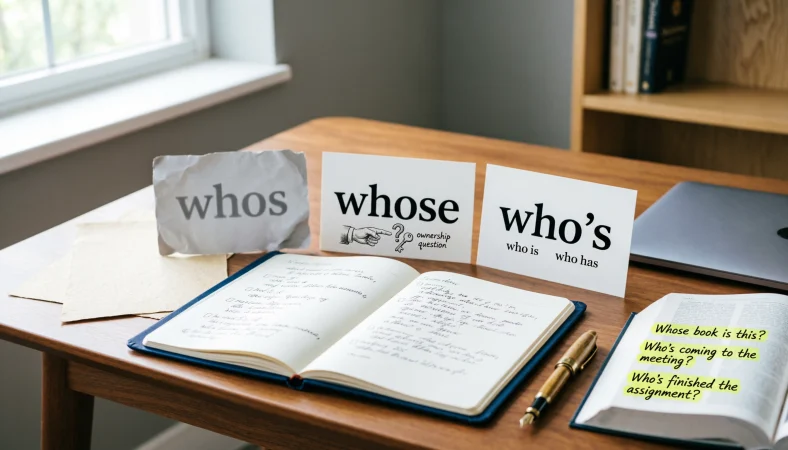
Whos or whose is a common English spelling and grammar confusion. “Whose” is the correct word when asking about possession or showing that something belongs to someone. “Whos” is not a standard English word. The confusion usually happens because writers omit the apostrophe or mistakenly treat “whose” as a contraction, much like “who’s.”
Knowing the difference between whos and whose is simple once you connect each form with its grammatical function. The real difficulty comes from the fact that who’s is also a valid word, creating three visually similar forms that have completely different meanings.
This distinction matters in emails, essays, social media posts, professional documents, and everyday messages. A single missing or misplaced apostrophe can change the intended meaning or make otherwise polished writing look careless.
The good news is that there is a reliable test you can use every time. If you mean “belonging to whom” or “of whom,” use whose. If you mean “who is” or “who has,” use who’s. Whos without an apostrophe is generally not correct in standard English.
Whos vs Whose: What’s the Difference?
The most important distinction is grammatical rather than stylistic. Whose is a standard English pronoun and determiner used to ask about or indicate possession. Whos, without an apostrophe, is not normally accepted as a standard English spelling.
| Form | Part of speech | Meaning | Example |
| Whose | Possessive pronoun or determiner | Belonging to whom or belonging to which person | Whose phone is ringing? |
| Whos | Not standard English | No standard grammatical meaning | Whos phone is this? |
| Who’s | Contraction | Who is or who has | Who’s coming to dinner? |
The difference becomes clearer when you expand the meaning.
Consider this sentence:
Whose jacket is on the chair?
The speaker is asking who owns the jacket. Therefore, whose is correct.
Now consider:
Who’s waiting outside?
Here, who’s means who is. The sentence could be rewritten as:
Who is waiting outside?
That substitution test is one of the easiest ways to avoid mistakes.
A quick recap
Whose expresses possession or ownership.
Who’s means who is or who has.
Whos is generally not a standard English word.
The apostrophe in who’s is meaningful because it signals a contraction.
Is Whos vs Whose a Grammar, Vocabulary, or Usage Issue?
This is primarily a grammar and spelling issue involving possessive forms and contractions. It isn’t simply a matter of choosing whichever spelling looks more familiar.
The three forms have different grammatical jobs.
Whose can function as a possessive determiner:
Whose car did you borrow?
It can also function independently as a possessive pronoun:
Whose is this?
In both cases, possession is involved.
Who’s, by contrast, is a contraction. It combines who with either is or has.
Who’s responsible for the report?
means:
Who is responsible for the report?
Likewise:
Who’s finished the assignment?
means:
Who has finished the assignment?
The form whos does not perform either of these standard functions.
Are they interchangeable?
No. Whose and who’s cannot normally replace one another without changing the meaning.
Compare:
Whose laptop is this?
with:
Who’s laptop is this?
The second sentence is incorrect because who is laptop makes no grammatical sense.
Now compare:
Who’s coming to the meeting?
with:
Whose coming to the meeting?
The second version is incorrect because the sentence requires who is, not a possessive form.
Formal versus informal usage
The distinction applies in both formal and informal English. Professional writing, academic writing, journalism, personal correspondence, and casual conversation all use whose and who’s according to their grammatical functions.
Informal digital writing sometimes produces whos because people type quickly or omit apostrophes. That doesn’t make the spelling standard.
Academic versus casual usage
In academic writing, accuracy is particularly important because grammatical errors can distract readers from the argument. In casual messaging, readers may understand “whos” from context, but understanding does not make it grammatically standard.
For polished writing, use whose for possession and who’s for the appropriate contraction.
How to Use Whose Correctly
Whose is used when you want to identify the person connected with ownership, association, or possession.
It often appears before a noun.
- Whose notebook is on the desk?
- Whose idea was this?
- Whose responsibility is it?
- Whose keys are these?
In each example, the question concerns the person associated with something.
Importantly, whose doesn’t necessarily refer to literal ownership. It can express a broader relationship.
The student whose essay won the prize was absent.
Here, the essay belongs to the student in the grammatical sense. Whose introduces a relative clause connecting the student with the essay.
Workplace example
Do you know whose report was submitted this morning?
This sentence asks which person produced or is responsible for the report.
A more formal example would be:
The manager whose department exceeded its target received recognition.
Here, whose connects the manager with the department.
Academic example
Researchers whose findings contradict the original hypothesis must explain the discrepancy.
The word whose establishes a relationship between researchers and their findings.
Notice that possession doesn’t have to mean physical ownership. The researchers don’t necessarily own the findings. Rather, the findings are associated with them.
Technology example
Whose account is connected to this device?
The question asks which person is associated with the account.
Another example is:
The user whose password was reset must verify the account.
Again, whose establishes a relationship between the user and the password.
Usage recap
Use whose when possession, association, responsibility, or connection is involved. It works both in direct questions and in relative clauses.
How to Use Who’s Correctly
Who’s is a contraction of who is or who has.
The easiest way to determine whether it belongs in a sentence is to expand it.
If who is works, who’s may work.
Who’s at the door?
becomes:
Who is at the door?
If who has works, who’s may also work.
Who’s finished the project?
becomes:
Who has finished the project?
This substitution method is especially useful because the apostrophe can be easy to overlook while typing.
Workplace example
Who’s responsible for updating the spreadsheet?
Expansion:
Who is responsible for updating the spreadsheet?
Therefore, who’s is correct.
Academic example
Who’s responsible for interpreting these results?
This is grammatical, although academic writing may sometimes favor the full form who is, especially in particularly formal prose.
Technology example
Who’s logged into this computer?
This can mean:
Who is logged into this computer?
Another example:
Who’s already installed the update?
This can mean:
Who has already installed the update?
The surrounding sentence determines whether who’s means who is or who has.
Usage recap
Use who’s only when you can replace it with who is or who has without changing the meaning.
When You Should NOT Use Whos or Whose
Several recurring mistakes make this topic more confusing than it needs to be.
1. Don’t use whos to mean whose
Incorrect:
Whos car is parked outside?
Correct:
Whose car is parked outside?
The sentence asks about ownership, so whose is required.
2. Don’t use whose when you mean who is
Incorrect:
Whose coming to the party?
Correct:
Who’s coming to the party?
The sentence asks about a person’s action or presence, not ownership.
3. Don’t treat who’s as a possessive form
Incorrect:
Who’s book is this?
Correct:
Whose book is this?
The apostrophe in who’s does not indicate possession. It marks a contraction.
4. Don’t assume every apostrophe shows possession
English apostrophes have several functions. One important function is marking contractions.
In who’s, the apostrophe represents omitted letters.
5. Don’t judge spelling only by pronunciation
Whose and who’s sound alike in most varieties of English. Their identical or near identical pronunciation doesn’t make them interchangeable in writing.
6. Don’t use whos simply because the apostrophe feels unnecessary
The absence of an apostrophe isn’t the issue here. Whos is not the standard possessive form of who.
7. Don’t confuse whose with other possessive words
Words such as whose, your, their, and its can indicate possession without necessarily using an apostrophe.
8. Don’t rely solely on autocorrect
Spellcheck can identify many errors, but it may not recognize a grammatical mistake when both forms are legitimate words.
Common Mistakes and Decision Rules
| Correct sentence | Incorrect sentence | Explanation |
| Whose phone is this? | Who’s phone is this? | The sentence asks about ownership. |
| Who’s calling me? | Whose calling me? | The intended meaning is who is calling. |
| Whose idea was it? | Who’s idea was it? | The idea is associated with a person. |
| Who’s responsible for this? | Whose responsible for this? | The intended meaning is who is responsible. |
| Whose shoes are these? | Whos shoes are these? | The possessive form is whose. |
| Who’s already finished? | Whose already finished? | The intended meaning is who has finished. |
The decision rule
- If you mean “belonging to whom,” use whose.
- If you mean “who is” or “who has,” use who’s.
- If you have written whos, stop and check the sentence. In standard English, it is almost certainly the wrong form.
This rule is more reliable than simply asking whether an apostrophe looks appropriate.
Whos or Whose in Modern Technology and AI Tools
Digital communication has made spelling and grammar distinctions both easier and harder to notice.
Grammar checkers can often identify obvious errors, but contextual systems must determine what the writer intended. A sentence such as:
Whos account is connected?
contains a form that looks close to several legitimate English patterns. A good writing assistant should recognize that the sentence is asking about possession and recommend whose.
Artificial intelligence tools can also explain the difference contextually. However, writers should still understand the grammar rather than depending entirely on automated correction.
This is especially important for professional communication. An AI writing assistant can suggest a correction, but the writer needs to know why the correction is appropriate.
The distinction also matters in search queries. People frequently type forms such as whos or whose because search engines recognize common spelling uncertainty. Search intent in this area is usually educational: users want to know which spelling is correct and when each form should be used.
Etymology and the History Behind Whose
The word whose has a long history in English. It developed from older forms associated with the possessive form of who.
English has traditionally distinguished between interrogative and relative forms while also developing possessive constructions. Whose survived as the standard possessive form connected with who.
The contraction who’s is much more transparent in modern English. It combines who with is or has, following the broader English pattern of shortening common auxiliary constructions.
The visual similarity between the two forms is therefore accidental from a modern writer’s perspective. Their grammatical functions are different even though their pronunciation is generally the same.
An expert style explanation
A useful way to think about the distinction is this:
Whose asks about possession, while who’s expresses a contraction.
That short explanation captures the central grammatical difference without relying on spelling alone.
Two practical case studies
Case study one: professional email
Imagine a project coordinator writes:
Who’s proposal was selected?
The reader can probably understand the intended meaning, but the sentence is grammatically incorrect because the writer is asking which person’s proposal was selected.
The corrected version is:
Whose proposal was selected?
The change involves only one character, but it restores the correct grammatical relationship.
Case study two: classroom writing
Suppose a student writes:
Whose going to present the findings?
The intended meaning is clearly who is going to present the findings.
The correct sentence is:
Who’s going to present the findings?
Again, the substitution test immediately reveals the answer.
These examples demonstrate an important point: the error isn’t simply spelling. The wrong form represents the wrong grammatical function.
Author expertise: This guide applies principles of English grammar, possessive forms, contractions, usage, and editorial clarity to help writers make accurate choices in professional, academic, and everyday communication.
Error Prevention Checklist
Always use whose when:
- You are asking who owns something.
- You are identifying the person associated with something.
- You can paraphrase the sentence as “belonging to whom.”
- You are introducing a relative clause involving possession.
Examples include:
Whose coat is this?
The author whose book became popular gave an interview.
Whose responsibility is this?
Always use who’s when:
- You mean who is.
- You mean who has.
Examples include:
- Who’s at the meeting?
- Who’s responsible for the decision?
- Who’s already completed the task?
Never use whos when:
- You mean possession.
- You mean who is.
- You mean who has.
- You are writing formal, academic, professional, or edited English.
The safest approach is to eliminate whos from your standard writing vocabulary.
Related Grammar Confusions You Should Master
Understanding this distinction can make other commonly confused English forms easier to recognize.
- Its or it’s: possession versus a contraction of it is or it has.
- Your or you’re: possession versus you are.
- Their or they’re: possession versus they are.
- There or their: location versus possession.
- Whose or who’s: possession versus who is or who has.
- Who or whom: subject versus object functions in traditional grammar.
- Whoever or whomever: related pronoun choices involving grammatical role.
- Affect or effect: commonly confused words with different grammatical and semantic functions.
- Then or than: time or sequence versus comparison.
- Its or their: possessive choices that depend on the noun being modified.
Learning these pairs as grammatical systems rather than isolated spelling rules makes them much easier to remember.
FAQs
Is whos a correct English word?
No. Whos is not normally recognized as a standard English word. If you are trying to express possession, use whose. If you mean who is or who has, use who’s.
Is whose the correct spelling?
Yes. Whose is the standard possessive form associated with who. It can be used in questions such as “Whose bag is this?” and in relative clauses such as “The person whose car was damaged called the police.”
What is the difference between whose and who’s?
Whose expresses possession or association. Who’s is a contraction meaning who is or who has. They may sound the same, but they perform different grammatical functions.
Is whos ever correct?
In standard English, whos without an apostrophe is generally not correct. Writers who produce this form usually intend either whose or who’s.
How can I remember whether to use whose or who’s?
Use the substitution test. Replace who’s with who is or who has. If the expanded version works, who’s is appropriate. If the sentence asks about possession, choose whose.
Is whose a possessive pronoun?
Yes, whose can function as a possessive pronoun, as in “Whose is this?” It can also function as a possessive determiner before a noun, as in “Whose book is this?”
Can whose be used for people and things?
Yes. Whose is commonly associated with people, but it can also occur in relative clauses involving organizations, animals, and other entities.
For example:
The company whose website crashed issued an announcement.
Is whose formal or informal?
Whose is standard in both formal and informal English. It is appropriate in professional writing, academic work, journalism, conversation, and everyday messages.
Why do people write whos instead of whose?
The error usually results from pronunciation, typing quickly, uncertainty about apostrophes, or confusion with who’s. Because whose and who’s are normally pronounced alike, writers cannot rely on sound to distinguish them.
Conclusion:
The choice between whos or whose becomes straightforward once you focus on meaning rather than appearance. Whose is the standard form for possession or association, while who’s is the contraction of who is or who has. Whos is not normally a standard English spelling.
When you aren’t sure, use the substitution test. If the sentence can use who is or who has, choose who’s. If the sentence asks who something belongs to or identifies an association with someone, choose whose.
For example, “Whose bag is this?” asks about possession, while “Who’s carrying the bag?” means “Who is carrying the bag?” Once you recognize that difference, this common English error becomes much easier to avoid.










4 thoughts on “Whose Or Whos: Which Spelling Is Correct? Meaning, Grammar & Usage For 2026”