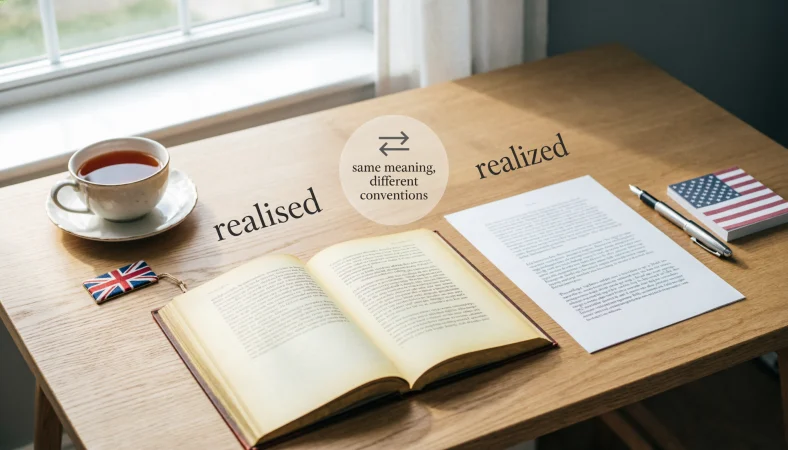
Realised or realized are both correct spellings of the past tense and past participle of realise or realize. The difference is regional rather than grammatical. Realised is the standard spelling in British English and many other varieties, while realized is standard in American English. Neither spelling is inherently more correct than the other.
English speakers often hesitate over these forms because the only visible difference is the letter s versus z. The confusion becomes important when writing for an international audience, preparing academic work, editing professional documents, or following a particular style guide.
Choosing the appropriate form depends mainly on which variety of English you are using and whether you need consistent spelling throughout a document.
Realised vs Realized: What’s the Difference?
Realised and realized have exactly the same basic meaning and grammatical function. Both forms come from the verb realise or realize, which can mean to become aware of something, to understand something clearly, or to achieve something that was previously only an idea or possibility.
The important distinction is spelling convention.
Realised uses s and is preferred in British English. It is also common in related varieties of English used in countries such as Australia and New Zealand.
Realized uses z and is preferred in American English.
Both forms can function as the past tense or past participle of the verb.
For example:
I realised that I had forgotten my keys.
I realized that I had forgotten my keys.
The meaning remains unchanged.
| Feature | Realised | Realized |
| Part of speech | Verb form | Verb form |
| Base form | Realise | Realize |
| Past tense | Realised | Realized |
| Past participle | Realised | Realized |
| Main spelling convention | British English | American English |
| Meaning | Became aware or achieved | Became aware or achieved |
| Pronunciation | Usually the same | Usually the same |
Quick recap
Realised is standard in British English.
Realized is standard in American English.
Both forms have the same meaning and grammatical function.
The choice is mainly a matter of regional spelling convention.
Consistency matters more than choosing one form as universally correct.
Is Realised vs Realized a Grammar, Vocabulary, or Usage Issue?
This is primarily a spelling and usage issue, not a difference in grammar or vocabulary.
Both spellings represent the same verb. They can appear in the same grammatical structures, and neither changes the meaning of the sentence.
Consider:
She realised the mistake immediately.
And:
She realized the mistake immediately.
The grammar is identical. The only difference is the spelling convention.
Are the two forms interchangeable?
In terms of meaning, yes. In terms of writing style, not always.
A British English document will normally use realised, while an American English document will normally use realized. Mixing them within the same piece of writing can make the document look inconsistent.
For example, a British English article might naturally contain:
She realised that the figures were incorrect.
But if the same article later says:
He realized that the deadline had changed.
the change from s to z may look like an editing error.
Formal versus informal writing
The distinction applies in both formal and informal writing.
British professionals can use realised in business reports, emails, academic papers, books, and everyday messages. American writers can use realized in the same situations.
Neither spelling is specifically formal or informal.
Academic versus casual usage
Academic writers should follow the spelling convention required by their institution, publication, or chosen style guide.
If the paper follows British English, use realised consistently. If it follows American English, use realized consistently.
Casual communication usually allows greater flexibility, but the underlying regional distinction remains the same.
How to Use Realised Correctly
Realised is the preferred spelling when writing in British English. It can describe a moment of understanding, recognition, or awareness.
For example:
I realised that the meeting had already started.
Here, the speaker became aware of a fact.
The word can also describe achieving something:
The company realised its long term goal.
In this sense, realised means brought something into reality or achieved a particular result.
Workplace example
A British English workplace document might say:
The team realised that the original schedule was unrealistic.
The spelling fits a British English context.
Another example is:
We realised that the report contained an error.
The word describes the moment when someone became aware of the problem.
Academic example
Academic writing frequently uses this verb when describing discoveries or changes in understanding.
The researchers realised that the initial assumption required further investigation.
A British academic publication may consistently use realised alongside other British spellings.
Technology example
The word also appears naturally in technology discussions:
The developer realised that the software was using an outdated library.
Again, realised is appropriate when the surrounding text follows British spelling conventions.
Usage recap
Use realised when your writing follows British English conventions. It works in formal, academic, professional, and casual contexts and has the same meaning as the American spelling.
How to Use Realized Correctly
Realized is the preferred spelling in American English. It has exactly the same meanings as realised.
For example:
I realized that I had left my phone at home.
Here, the speaker became aware of something.
It can also describe achieving an objective:
The company realized its full potential.
The context determines the meaning, not the letter z.
Workplace example
An American business report might state:
The management team realized that the original strategy needed revision.
This follows standard American spelling.
Another example is:
We realized that the figures did not match the previous report.
Academic example
An American academic paper could say:
The researchers realized that the results required additional analysis.
The spelling is appropriate for American English.
Technology example
In technical writing, you might encounter:
The engineer realized that the system had a configuration problem.
American technical documentation commonly uses realized.
Usage recap
Use realized when following American English spelling conventions. The word works in exactly the same grammatical positions as realised.
When You Should NOT Use Realised or Realized
The two forms are correct in their respective spelling systems, but several mistakes can still cause problems.
1. Do not mix regional spellings unnecessarily
If a document uses British English throughout, switching from realised to realized creates inconsistency.
2. Do not assume one form is universally correct
Neither spelling should automatically be labeled wrong. The appropriate choice depends on the English variety being used.
3. Do not change spelling halfway through a document
Consistency matters in professional and academic writing. Pick the appropriate convention and maintain it.
4. Do not confuse spelling with pronunciation
The difference between realised and realized is primarily visual. In many varieties of English, the forms have the same pronunciation.
5. Do not choose based only on the audience’s nationality
A multinational organization may have its own editorial standard. Always consider the publication, institution, client, or style guide.
6. Do not switch conventions simply because a word processor suggests another spelling
Software may be configured for American English, British English, or another variety. A red underline does not automatically mean your chosen form is incorrect.
7. Do not change every s to z in British English
British spelling involves several conventions, and not every spelling distinction follows the same pattern. The choice should follow an established English variety rather than an isolated rule.
8. Do not treat realized as a different word
The s and z forms represent the same verb and meaning. The distinction is regional spelling, not vocabulary.
Common Mistakes and Decision Rules
Because both forms are grammatically valid, the main decision involves identifying the spelling convention used by the document.
| Correct sentence | Incorrect or inconsistent sentence | Explanation |
| I realised the problem immediately. | I realized the problem immediately. | The second form is not wrong in American English, but it conflicts with a British English spelling system. |
| She realized the answer was obvious. | She realised the answer was obvious. | The second form conflicts with American English if the document consistently follows American spelling. |
| We realised that the plan needed revision. | We realized that the plan needed revision. | Choose one regional convention and maintain it. |
| He realized what had happened. | He realised what had happened. | Use the z spelling in American English. |
| They realised their mistake. | They realized their mistake. | Use the s spelling in British English. |
Decision Rule Box
If your document follows British English, use “realised.”
If your document follows American English, use “realized.”
The meaning and grammar stay the same. The key is regional spelling consistency.
This rule works in most ordinary writing situations.
Why British English Uses Realised and American English Uses Realized
The difference comes from broader spelling traditions surrounding words ending in ise and ize.
British English commonly uses s in words such as:
realise
organise
recognise
American English commonly uses z:
realize
organize
recognize
However, British English is not completely uniform. Some British dictionaries and publishing systems accept or prefer ize spellings for certain words. As a result, the relationship between British English and the letters s and z deserves more nuance than the simple statement that British English always uses s.
For everyday writing, however, realised is widely recognized as the conventional British form, while realized is the standard American form.
The most important practical principle is consistency. A document that consistently follows one accepted spelling system will generally look more polished than one that switches between conventions without reason.
Realised or Realized in Modern Technology and AI Tools
Modern writing technology has made regional spelling differences easier to notice.
Word processors, grammar checkers, content management systems, and AI writing assistants often have language settings that determine whether they prefer British or American spelling.
For example, an editor configured for British English may recommend realised, while an American English setting may recommend realized.
AI tools can generally understand both forms because they represent the same verb. They may also adapt their suggestions based on the surrounding writing style.
This matters for businesses serving international audiences. A company might produce one version of its content for British readers and another for American readers. The underlying message remains the same, but spelling conventions can change.
Human proofreading still matters. Automated systems can recognize spelling variants, but writers and editors must decide which regional standard best suits the intended audience.
Etymology and Language History
The verb behind these forms has a long history connected to the idea of making something real or becoming aware of something.
Realize developed through French and ultimately connects with the Latin word realis, meaning real or relating to reality.
English later developed the verb with meanings associated with making real, achieving, understanding, or becoming aware of something.
The spelling difference developed within broader English spelling traditions. British and American English gradually established different preferences for words containing particular letter sequences, including forms ending in ise and ize.
This historical development explains why the two spellings can coexist without representing two separate vocabulary items.
An expert perspective
“Regional spelling does not necessarily signal a difference in meaning. In many cases, it reflects the editorial tradition that shaped the writer’s English.”
That principle applies particularly well here. The spelling changes, but the underlying verb remains the same.
Two Practical Case Studies
Case Study 1: A British academic paper
Imagine a university student writing an essay in British English. Throughout the paper, the student uses forms such as organised, recognised, and realised.
During proofreading, one sentence appears as:
The researcher realized that the original hypothesis was incomplete.
The sentence is understandable, but the z spelling does not match the surrounding British spelling convention.
The student changes it to:
The researcher realised that the original hypothesis was incomplete.
The concrete result is greater consistency throughout the paper. The correction does not alter the meaning or grammar. It simply aligns the spelling with the chosen variety of English.
Case Study 2: An American technology report
Now consider an American software company preparing technical documentation. The document consistently uses American spellings such as organized, recognized, and realized.
One sentence contains:
The engineer realised that the configuration was incorrect.
The editor changes it to:
The engineer realized that the configuration was incorrect.
Again, the meaning remains exactly the same. The concrete improvement is consistency with the document’s established American English style.
These examples demonstrate why identifying the intended English variety before proofreading can save unnecessary corrections.
Error Prevention Checklist
Always use the appropriate form when
- ☑ Use realised in writing that follows British English conventions.
- ☑ Use realized in writing that follows American English conventions.
- ☑ Follow the spelling preferences of your publisher or organization.
- ☑ Check the language settings of your writing software.
- ☑ Maintain the same spelling convention throughout a document.
- ☑ Consider the expectations of your primary audience.
Never switch forms when
- ☒ Do not randomly alternate between realised and realized.
- ☒ Do not call one form universally incorrect.
- ☒ Do not change the spelling simply because a software tool uses another regional setting.
- ☒ Do not assume that spelling determines pronunciation.
- ☒ Do not treat the two forms as different vocabulary words.
Related Grammar Confusions You Should Master
Once you understand regional spelling differences, several other commonly confused forms become easier to recognize.
Organised or organized: Another common British and American spelling difference.
Recognised or recognized: The same regional pattern appears here.
Apologised or apologized: British English commonly uses s, while American English commonly uses z.
Colour or color: A broader British and American spelling distinction.
Centre or center: Another familiar regional difference.
Travelling or traveling: British and American English can differ in doubled consonants.
Behaviour or behavior: British English commonly retains the u.
Licence or license: British English distinguishes certain noun and verb forms differently from American English.
Practise or practice: British English commonly distinguishes the noun and verb, while American English generally uses practice for both.
Learned or learnt: A usage distinction involving regional preference and style.
Understanding these patterns helps writers see that English contains multiple established standards. Regional variation isn’t automatically an error.
FAQs.
Is realised or realized correct?
Both spellings are correct. Realised is widely used in British English, while realized is standard in American English. The two forms have the same meaning and grammatical function.
Is realized American or British spelling?
Realized is the standard American spelling. British English commonly uses realised, although some British dictionaries and style systems also recognize forms ending in ize.
Is realised British English?
Yes. Realised is a common standard spelling in British English and is also widely used in other English varieties influenced by British spelling conventions.
Does realised mean the same as realized?
Yes. They have the same meaning and grammatical function. Both are past tense and past participle forms of realise or realize.
Which spelling should I use in academic writing?
Use the spelling required by your institution, instructor, publisher, or chosen style guide. If your academic work follows British English, realised is generally appropriate. If it follows American English, realized is generally appropriate.
Is realised more correct than realized?
No. Neither form is universally more correct. Each belongs to an established regional spelling tradition. The best choice depends on the variety of English used in your writing.
Can I use realized in British English?
You can encounter realized in British English, particularly in systems and publications that favor the ize convention. However, realised remains a very common British spelling. Always follow the style standard required for your specific writing.
Why does British English use s instead of z?
British English has traditionally used s in many words such as realise, organise, and recognise. However, British spelling also accepts ize in some established style systems, so the rule is more flexible than a simple British equals s formula.
How do you spell the past tense of realize?
In American English, the past tense is realized. In British English, the common corresponding spelling is realised. Both forms represent the same grammatical tense.
Should I use realised or realized on a website?
Choose the form that matches your website’s target audience and editorial style. A site aimed primarily at American readers will normally use realized, while a site following British English will commonly use realised. Most importantly, maintain consistency across the site.
Conclusion:
The choice between realised or realized depends primarily on regional English conventions. Realised is widely associated with British English, while realized is the standard American form. Both describe the same action and function grammatically as the past tense and past participle of the verb.
The spelling difference does not create a difference in meaning. Instead, it reflects the wider variation between British and American English. If you’re writing for a British audience, realised will usually be the natural choice. For American readers, realized will normally be expected.
The most useful rule is simple: choose the spelling convention that matches your audience, style guide, and document, then use it consistently. Once you understand that principle, this common spelling question becomes much easier to resolve.