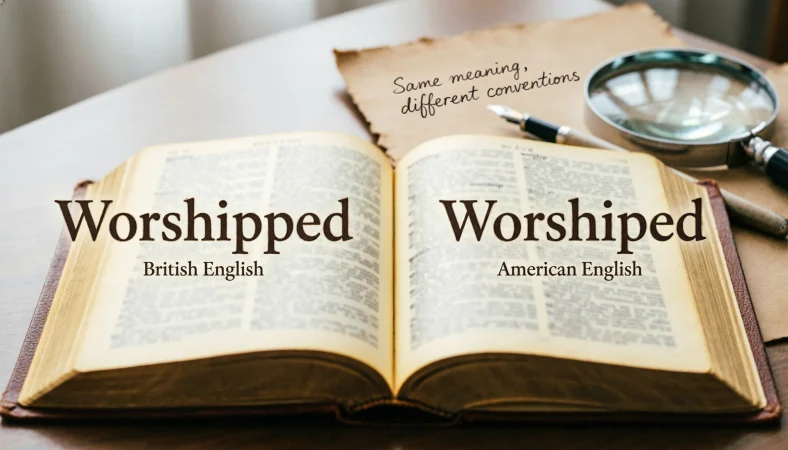
Both worshipped or worshiped are correct spellings of the past tense and past participle of the verb worship. The difference is mainly regional. Worshipped is the preferred spelling in British English and many other varieties, while worshiped is standard in American English. Neither spelling changes the meaning or pronunciation of the word.
The spelling worshipped or worshiped often causes confusion because English uses different rules for doubling the final consonant before adding endings such as ed. British and American English developed slightly different conventions for words ending in a single consonant after a vowel. As a result, writers may see both forms in dictionaries, books, newspapers, and online content and wonder which one is actually correct.
The good news is that this isn’t a case where one spelling is grammatically wrong. Both forms describe the same action: showing religious devotion, deep reverence, or intense admiration toward someone or something. The important question is which variety of English you’re writing in.
Worshipped vs Worshiped: What’s the Difference?
The main difference between worshipped and worshiped is spelling convention, not meaning. Both are forms of the verb worship, and both can function as the simple past tense or past participle.
| Feature | Worshipped | Worshiped |
| Base verb | Worship | Worship |
| Part of speech | Verb | Verb |
| Form | Past tense and past participle | Past tense and past participle |
| Main usage | British English | American English |
| Meaning | Showed worship or deep reverence | Showed worship or deep reverence |
| Pronunciation | Same | Same |
| Meaning difference | None | None |
Consider these two sentences:
The ancient people worshipped several gods.
The ancient people worshiped several gods.
The meaning is identical. The first sentence follows the spelling convention commonly associated with British English, while the second follows the convention commonly associated with American English.
This distinction matters most when you’re writing for a particular audience. A British newspaper, academic paper, or school assignment will generally favor worshipped. An American publication or educational document will normally use worshiped.
A quick recap
Worshipped is generally preferred in British English.
Worshiped is generally preferred in American English.
Both forms are grammatically correct.
The pronunciation and meaning remain the same.
Consistency within a document is more important than choosing one form universally.
Is Worshipped or Worshiped a Grammar, Vocabulary, or Usage Issue?
This is primarily a spelling and regional usage issue, rather than a difference in grammar or vocabulary.
Grammar determines how worship functions in a sentence. For example, the base form appears after certain auxiliary verbs, while the past form is used to describe something that happened previously.
- They worship their deity.
- They worshipped their deity.
- They have worshipped their deity for generations.
In American English, the corresponding forms are:
- They worship their deity.
- They worshiped their deity.
- They have worshiped their deity for generations.
The grammatical structure hasn’t changed. Only the spelling of the past tense and past participle differs.
Are the two forms interchangeable?
In terms of meaning, yes. In terms of regional spelling preference, not always.
A British reader will understand worshiped, and an American reader will understand worshipped. However, each version can look less familiar to readers accustomed to the other spelling system.
This is similar to other British and American spelling differences. English contains many pairs where one variety traditionally keeps an additional letter while the other uses a shorter form.
Formal versus informal usage
Neither spelling is inherently more formal.
If you’re writing a formal British document, worshipped is appropriate. If you’re writing a formal American document, worshiped is appropriate.
The same principle applies to informal writing. The regional spelling preference doesn’t disappear simply because the context becomes conversational.
Academic versus casual usage
Academic writers should generally follow the spelling system required by their institution, publisher, style guide, or intended audience.
For example, a British history paper might say:
The population worshipped several deities associated with nature.
An American history paper could write:
The population worshiped several deities associated with nature.
Both sentences are academically acceptable.
When Should You Use Worshipped?
Use worshipped when you’re following British English spelling conventions or another variety that generally follows British spelling patterns.
This form is particularly common in writing produced in the United Kingdom and is also familiar in countries and institutions influenced by British English.
Workplace example
Imagine a British organization preparing educational material about religious history:
The community worshipped at the temple for generations.
The spelling fits the expected British English convention.
Academic example
A British university student writing about ancient religion might write:
The society worshipped a group of gods associated with agriculture.
Here, worshipped is simply the past tense of worship.
Technology example
Digital content can also use the British form:
The website explains how different civilizations worshipped their gods.
A content management system, search engine, or writing application doesn’t make the spelling incorrect simply because it uses one regional convention rather than another.
Usage recap
Choose worshipped when your audience or publication follows British English.
It is particularly suitable for British academic, educational, editorial, and professional writing.
It has exactly the same meaning as worshiped.
When Should You Use Worshiped?
Use worshiped when you’re following American English spelling conventions.
This spelling is especially common in American newspapers, books, educational materials, websites, and professional writing.
Workplace example
An American museum might describe an ancient civilization this way:
The people worshiped a number of gods connected with the natural world.
The spelling follows standard American usage.
Academic example
An American history essay could state:
Ancient communities worshiped deities that they believed controlled the harvest.
There is no grammatical problem with this construction.
Technology example
An American educational website might publish:
Early civilizations worshiped gods associated with the sun and moon.
Again, the spelling reflects the variety of English being used.
Usage recap
Choose worshiped for American English.
Use it consistently throughout an American English document.
The word has the same pronunciation, grammatical function, and meaning as worshipped.
When You Should NOT Use Worshipped or Worshiped
There are several situations where choosing the wrong form can create unnecessary inconsistency.
1. Do not mix regional spelling styles without a reason
A document written primarily in American English should not randomly switch to British spelling.
For example, using worshiped in one paragraph and worshipped in another can make the writing look poorly edited.
2. Do not assume one spelling is universally correct
It is inaccurate to claim that worshipped is always correct or that worshiped is always correct.
Both are established English spellings.
3. Do not change the spelling based on meaning
The meaning does not determine the spelling.
Whether someone worshipped a deity or worshiped a deity, the intended meaning remains the same.
4. Do not use the past form when you need the base form
The sentence:
They worshipped the deity every morning.
describes a past action.
But:
They worship the deity every morning.
describes a present or habitual action.
The choice between worship and its past form is grammatical. The choice between worshipped and worshiped is primarily regional spelling.
5. Do not treat the extra consonant as a pronunciation difference
The double p in worshipped does not create a different pronunciation from worshiped.
6. Do not change forms simply to sound more formal
Neither spelling is more sophisticated or authoritative.
7. Do not switch spelling conventions halfway through a publication
If your publication follows American English, keep American spelling throughout. If it follows British English, maintain British spelling.
8. Do not mark the alternative as a spelling error automatically
A spell checker configured for one variety of English may flag the other form. That doesn’t necessarily mean the word itself is incorrect.
Common Mistakes and Decision Rules
| Correct sentence | Incorrect sentence | Explanation |
| The people worshipped the goddess. | The people worshipped the goddess in an American English document that otherwise uses American spelling. | The spelling is not grammatically wrong, but it may be inconsistent with the document’s regional style. |
| The people worshiped the goddess. | The people worshiped the goddess in a British English publication that requires British spelling. | American spelling may conflict with the publication’s preferred style. |
| They worshipped the deity for centuries. | They worshipped the deity yesterday and worship the deity yesterday. | The second version incorrectly mixes present and past time references. |
| They have worshiped the deity for generations. | They have worshiped the deity for generations yesterday. | The present perfect does not normally work with a completed past time expression such as yesterday. |
| The community worships there every week. | The community worshiped there every week. | If the action is habitual and still occurring, the present form may be needed. |
Decision Rule
If you are writing in British English, choose worshipped. If you are writing in American English, choose worshiped.
The choice is about regional spelling, not a difference in definition.
Why Does English Have Worshipped and Worshiped?
The difference comes from broader spelling conventions in British and American English.
When English words receive endings such as ed, spelling conventions can differ depending on the variety of English. British English frequently retains a doubled consonant in certain forms, while American English often simplifies the spelling.
The pattern can be seen in several familiar words.
British English commonly uses forms such as:
travelled
cancelled
labelled
American English commonly uses:
traveled
canceled
labeled
The situation with worship follows a similar regional pattern, producing worshipped and worshiped.
It is important not to reduce the difference to a simple rule saying that British English always doubles consonants and American English never does. English spelling is more complicated than that. The historical origin of the word, its pronunciation, syllable structure, and established spelling conventions can all matter.
That is why individual words are often best learned as established spelling patterns rather than through one universal formula.
Worshipped or Worshiped in British and American English
Regional consistency is the easiest way to make the correct choice.
British English generally prefers worshipped.
American English generally prefers worshiped.
This distinction becomes especially useful when editing content for international audiences.
Suppose a website uses British spelling throughout:
The ancient population worshipped several gods.
Changing only this word to worshiped can create an inconsistent appearance.
Now consider an American publication:
The ancient population worshiped several gods.
Using worshipped in that setting isn’t necessarily incomprehensible or grammatically incorrect, but it doesn’t match the publication’s preferred spelling convention.
For professional writers, consistency is often the most practical rule.
Worshipped and Worshiped in Different Contexts
The verb worship has a broad range of uses. Its most traditional sense concerns religious devotion, but the word can also describe intense admiration.
Religious context
The community worshipped at the temple.
The community worshiped at the temple.
Both sentences describe religious activity.
Historical context
Ancient people worshipped gods connected with the sea.
Ancient people worshiped gods connected with the sea.
Again, the spelling changes according to regional convention, not historical meaning.
Figurative context
The verb can sometimes be used figuratively to describe excessive admiration.
Fans worshipped the famous musician.
Fans worshiped the famous musician.
The same spelling distinction applies.
Literary context
Authors may choose either form according to their preferred variety of English.
The surrounding language can therefore provide clues about which spelling is appropriate. If a novel consistently uses British spelling, worshipped will usually fit better. If it follows American conventions, worshiped is likely to appear.
X and Y in Modern Technology and AI Tools
Modern writing software can make regional spelling differences more noticeable.
Word processors, grammar checkers, search engines, publishing platforms, and artificial intelligence tools may be configured for British English, American English, or another English variety. As a result, an application may recommend worshiped while a British writer expects worshipped, or the reverse.
This doesn’t necessarily mean the writer made an error.
For AI assisted writing, the important principle is contextual consistency. An AI tool may generate either form depending on the language settings, training patterns, prompt context, or surrounding vocabulary.
For example, if an article uses colour, favour, and travelled, then worshipped is likely to create better regional consistency.
If an article uses color, favor, and traveled, then worshiped is generally the better match.
This makes regional spelling particularly important for publishers targeting a specific country.
The Etymology of Worship
The history of worship helps explain why the modern word can have both religious and figurative meanings.
The word developed from Old English forms associated with the idea of worthiness or honor. Over time, its meaning became strongly connected with acts of religious reverence and devotion.
The modern verb can therefore describe religious practice as well as, in some contexts, extreme admiration.
The spelling difference between worshipped and worshiped is not caused by different word origins. Both forms come from the same English verb.
That point is worth remembering because it eliminates a common misconception. These aren’t two separate words that happen to look similar. They are two regional spellings of the same inflected form.
Two Practical Editorial Case Studies
Case Study 1: A British history article
Imagine an educational publisher preparing an article for readers in the United Kingdom. The article uses British spellings throughout, including colour, favour, and organised.
The editor encounters this sentence:
Ancient communities worshiped several gods.
The editor changes it to:
Ancient communities worshipped several gods.
The change does not alter the meaning. Instead, it brings the spelling into line with the article’s established British English style.
The concrete editorial result is greater spelling consistency across the document.
Case Study 2: An American educational article
Now consider an American publisher preparing a classroom resource. The document uses American forms such as color, favor, and organized.
The original sentence says:
Ancient communities worshipped several gods.
The editor changes it to:
Ancient communities worshiped several gods.
Again, the meaning remains unchanged. The concrete result is consistency with the publication’s American English style.
These examples demonstrate the central principle: regional consistency matters more than treating one spelling as universally superior.
Expert Style Explanation
A useful way to approach this distinction is:
“When two spellings carry the same meaning, regional consistency is usually the clearest guide.”
That principle applies well beyond worshipped and worshiped. English contains many regional spelling pairs, and effective writing depends on choosing a convention and applying it consistently.
For editors, teachers, students, and content writers, this approach is more reliable than memorizing isolated claims about which spelling is supposedly correct.
Error Prevention Checklist
Always use worshipped when
- ☑ Your document follows British English.
- ☑ Your publisher requires British spelling.
- ☑ Your surrounding vocabulary follows British conventions.
- ☑ You are maintaining consistency with an established British style guide.
- ☑ Your target audience primarily uses British English.
Always use worshiped when
- ☑ Your document follows American English.
- ☑ Your publisher requires American spelling.
- ☑ Your surrounding vocabulary follows American conventions.
- ☑ Your target audience primarily uses American English.
Never treat either spelling as universally wrong
- ☑ Both forms are established.
- ☑ Neither form changes the meaning.
- ☑ Neither form changes pronunciation.
- ☑ The regional variety determines the preferred spelling.
How to Remember the Difference Easily
A simple memory technique is to connect the spelling with the broader regional spelling pattern.
Think of worshipped as the form that fits naturally with British spellings such as travelled and labelled.
Think of worshiped as the form that fits naturally with American spellings such as traveled and labeled.
You don’t need to memorize a complicated grammar rule every time you encounter the word.
Instead, ask one question:
Which variety of English am I using?
If the answer is British English, use worshipped. If the answer is American English, use worshiped.
Related Grammar Confusions You Should Master
Understanding regional spelling can make other commonly confused forms easier to recognize. Here are several useful comparisons worth studying:
- Travelling or traveling: A British and American spelling difference involving the doubled consonant.
- Cancelled or canceled: Another common regional spelling distinction.
- Labelled or labeled: British English generally retains the doubled consonant.
- Favour or favor: A difference involving the letter combination used in British and American English.
- Colour or color: One of the most recognizable regional spelling differences.
- Organised or organized: A common difference involving verbs ending in ize or ise.
- Realised or realized: Another spelling variation found between British and American English.
- Learned or learnt: A distinction involving both regional preference and usage patterns.
- Worshiping or worshipping: The present participle also has regional spelling variation.
- Practice or practise: A distinction involving noun and verb usage in British English, while American English generally uses practice for both.
These comparisons show why spelling questions often cannot be answered without considering regional English.
FAQs:
Is worshipped or worshiped correct?
Both are correct. Worshipped is generally preferred in British English, while worshiped is generally preferred in American English. The two forms have the same meaning and pronunciation.
Is worshipped British or American spelling?
Worshipped is generally associated with British English and other varieties that follow British spelling conventions.
Is worshiped American spelling?
Yes. Worshiped is the standard form generally preferred in American English.
Why does British English spell worshipped with two p letters?
British English commonly retains the doubled consonant in this form. This reflects broader spelling conventions involving consonant doubling when certain endings are added.
Why does American English spell worshiped with one p?
American English commonly simplifies the spelling in this form, producing worshiped.
Does worshipped mean something different from worshiped?
No. The two forms have the same meaning. The difference is primarily regional spelling.
Is worshipped more correct than worshiped?
No. Neither is universally more correct. The appropriate choice depends on the variety of English being used.
How do you spell worship in the past tense?
You can write worshipped in British English or worshiped in American English.
Is worshipped pronounced differently from worshiped?
No. The two spellings are generally pronounced the same way.
Which spelling should I use in an SEO article?
Use the spelling that matches your target audience and the regional English used throughout the article. Consistency is more important than choosing one form as universally correct.
Conclusion:
The choice between worshipped or worshiped is straightforward once you recognize the regional spelling difference. Worshipped is generally preferred in British English, while worshiped is generally preferred in American English. Both forms are correct, both refer to the same action, and neither has a different pronunciation or grammatical function.
For writers, editors, students, and publishers, the best approach is to identify the intended variety of English before choosing a spelling. If the surrounding content uses British conventions, choose worshipped. If it follows American conventions, choose worshiped.
The most important rule is consistency. Don’t switch between the two forms simply because both appear in dictionaries or online sources. Choose the spelling that matches your audience, publication style, and regional English convention, then use it consistently throughout your work.