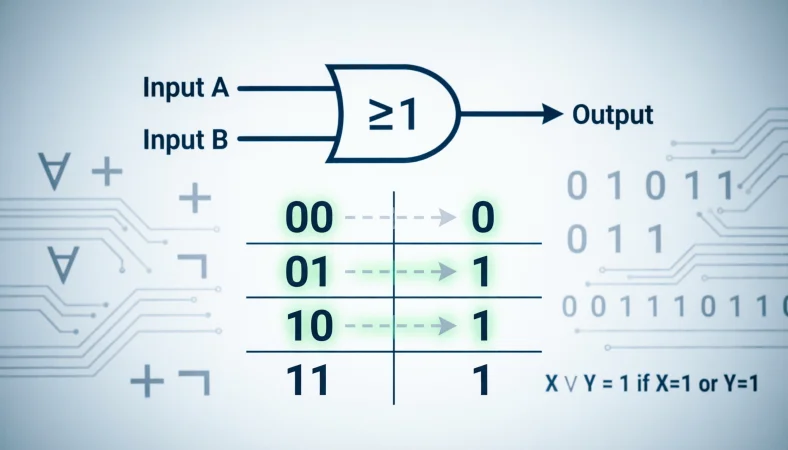
An OR truth table shows every possible combination of input values for the logical OR operation and gives the resulting output. For two inputs, OR produces a true result when at least one input is true. It produces false only when both inputs are false, making it fundamental to Boolean logic and digital circuits.
The phrase or truth table usually refers to the truth table used to represent the logical OR operator. It appears in mathematics, computer science, digital electronics, programming, and formal logic. Although the idea is simple, confusion often arises because the everyday word “or” does not always behave exactly like logical OR. Understanding the formal rule makes it much easier to construct, read, and apply an OR truth table correctly.
In ordinary conversation, “or” can sometimes suggest an exclusive choice, such as choosing one option but not both. In formal Boolean logic, however, OR normally means that one or both propositions can be true. That small distinction matters when solving logic problems, designing circuits, evaluating conditions in code, or interpreting mathematical expressions.
OR Truth Table: What Does It Mean?
An OR truth table is a systematic representation of the logical OR operation. It lists every possible combination of input values and shows the corresponding output.
In Boolean logic, the two possible values are usually represented as True and False, or as 1 and 0.
The logical OR operation is commonly written using the symbol ∨. In Boolean algebra, it may also be represented by +, although this should not be confused with ordinary arithmetic addition.
For two propositions, A and B, the expression can be written as:
A ∨ B
The result is true whenever at least one input is true.
| A | B | A OR B |
| False | False | False |
| False | True | True |
| True | False | True |
| True | True | True |
The most important row is the first one. OR is false only when both inputs are false.
This gives us a simple rule:
OR is true when at least one input is true.
When both inputs are true, the result remains true.
Quick recap
OR accepts two or more logical conditions.
At least one true input produces a true result.
Two true inputs still produce a true result.
Only two false inputs produce a false result.
This rule remains consistent across Boolean algebra, formal logic, and digital electronics.
How to Read an OR Truth Table
Reading an OR truth table becomes straightforward once you understand what the columns represent.
The first columns contain the possible input values. The final column contains the result of the OR operation.
Suppose we have two propositions:
A: The server is online.
B: The backup server is online.
The expression is:
A OR B
There are four possible combinations.
If neither server is online, A is false and B is false. Therefore, the OR result is false.
If only the backup server is online, A is false and B is true. The OR result is true.
If only the primary server is online, A is true and B is false. The OR result is also true.
If both servers are online, both inputs are true. The OR result remains true.
| Primary server A | Backup server B | A OR B |
| False | False | False |
| False | True | True |
| True | False | True |
| True | True | True |
The easiest way to remember this is to ask:
Is at least one input true?
If the answer is yes, the output is true.
Why OR Is Different From Everyday “Or”
One of the most important concepts in understanding an OR truth table is the difference between logical OR and everyday language.
In ordinary conversation, someone might say:
You can have tea or coffee.
Depending on the context, this may imply that you should choose one rather than both.
Formal logical OR does not automatically carry that restriction.
If A means “I have tea” and B means “I have coffee,” then:
A OR B
is true when you have tea, coffee, or both.
This is sometimes called inclusive OR because both conditions are allowed to be true simultaneously.
That distinction is especially important in mathematics and computer science. Students sometimes assume that OR means exactly one condition must be true. That assumption produces an incorrect truth table.
For logical OR:
| A | B | OR |
| 0 | 0 | 0 |
| 0 | 1 | 1 |
| 1 | 0 | 1 |
| 1 | 1 | 1 |
Notice that the final row is 1, not 0.
If the requirement is that exactly one condition must be true, the appropriate operation is usually exclusive OR, commonly called XOR.
OR Truth Table and Boolean Logic
Boolean logic is a system in which variables have two possible values, traditionally 0 and 1.
The OR operation is one of the basic Boolean operations, alongside AND and NOT.
For two Boolean variables A and B:
A ∨ B = 1
when A or B or both are equal to 1.
The only situation in which the result is 0 is:
A = 0 and B = 0
This makes OR especially useful for representing alternatives in logical expressions.
For example:
A ∨ B ∨ C
is true if at least one of A, B, or C is true.
A three input OR operation therefore has eight possible combinations.
| A | B | C | A OR B OR C |
| 0 | 0 | 0 | 0 |
| 0 | 0 | 1 | 1 |
| 0 | 1 | 0 | 1 |
| 0 | 1 | 1 | 1 |
| 1 | 0 | 0 | 1 |
| 1 | 0 | 1 | 1 |
| 1 | 1 | 0 | 1 |
| 1 | 1 | 1 | 1 |
The pattern is easy to recognize. Only the row containing all zeros produces a zero output.
Is OR a Logical Operator, Boolean Operation, or Both?
OR can be described in several closely related ways.
In formal logic, OR is a logical connective or logical operator. It connects propositions and determines whether their combined statement is true.
- In Boolean algebra, OR is a Boolean operation.
- In programming, OR is generally treated as a logical operator, although programming languages use different symbols or keywords to represent it.
- In digital electronics, OR describes the behavior of an OR gate.
These descriptions are related rather than contradictory.
The underlying rule remains the same:
If at least one relevant input is true, logical OR produces a true result.
The surrounding field simply changes how the operation is represented and applied.
How to Construct an OR Truth Table
Creating an OR truth table is easier when you follow a fixed process.
Step 1: Identify the inputs
Suppose the expression is:
A OR B
There are two inputs.
Step 2: Determine the number of rows
For two binary inputs, the number of possible combinations is:
2² = 4
Therefore, the table requires four rows.
Step 3: List every combination
The combinations are:
00
01
10
11
Step 4: Apply the OR rule
Check each row and ask whether at least one input equals 1.
| A | B | Result |
| 0 | 0 | 0 |
| 0 | 1 | 1 |
| 1 | 0 | 1 |
| 1 | 1 | 1 |
This method works for any two input OR operation.
For three inputs, there are:
2³ = 8
possible combinations.
For four inputs:
2⁴ = 16
possible combinations.
The general formula is:
2ⁿ
where n represents the number of binary inputs.
OR Truth Table Compared With AND and NOT
Understanding OR becomes much easier when you compare it with the other fundamental Boolean operations.
| A | B | A OR B | A AND B |
| 0 | 0 | 0 | 0 |
| 0 | 1 | 1 | 0 |
| 1 | 0 | 1 | 0 |
| 1 | 1 | 1 | 1 |
OR requires at least one true input.
AND requires every input to be true.
That difference is crucial.
For example:
A OR B
means the output is true if A is true, B is true, or both are true.
A AND B
means the output is true only if A and B are both true.
NOT works differently because it reverses a single input:
| A | NOT A |
| 0 | 1 |
| 1 | 0 |
Together, OR, AND, and NOT form the foundation of many more complicated logical expressions.
When You Should Not Use OR as XOR
A common mistake is treating OR and XOR as interchangeable.
They are not.
OR allows both inputs to be true.
XOR produces true when exactly one input is true.
| A | B | OR | XOR |
| 0 | 0 | 0 | 0 |
| 0 | 1 | 1 | 1 |
| 1 | 0 | 1 | 1 |
| 1 | 1 | 1 | 0 |
The final row reveals the difference.
If A and B are both true, OR returns true, while XOR returns false.
Consider a system where a user can authenticate using a password or a security key.
If the system allows both methods to be available, ordinary logical OR may accurately describe the condition.
If the requirement specifically says exactly one method must be selected, XOR may be more appropriate.
Therefore, do not automatically interpret everyday “either this or that” language as logical XOR.
Common Mistakes With the OR Truth Table
Several errors appear repeatedly when students first learn Boolean logic.
| Correct statement | Common mistake | Explanation |
| 0 OR 0 = 0 | 0 OR 0 = 1 | No input is true. |
| 0 OR 1 = 1 | 0 OR 1 = 0 | One input is true. |
| 1 OR 0 = 1 | 1 OR 0 = 0 | One input is true. |
| 1 OR 1 = 1 | 1 OR 1 = 0 | OR permits both inputs to be true. |
| OR is true when at least one input is true | OR means exactly one input is true | That describes XOR, not ordinary OR. |
Decision rule
If at least one input is true, OR produces true.
If both inputs are false, OR produces false.
This single rule is enough to construct a standard two input OR truth table.
OR Truth Tables in Digital Electronics
The OR operation has a direct physical representation in digital electronics through the OR gate.
An OR gate receives multiple binary inputs and produces a binary output.
For a two input OR gate:
| Input A | Input B | Output |
| 0 | 0 | 0 |
| 0 | 1 | 1 |
| 1 | 0 | 1 |
| 1 | 1 | 1 |
The circuit therefore behaves exactly like the logical OR operation.
Imagine a warning system with two sensors.
Sensor A detects excessive temperature.
Sensor B detects excessive pressure.
The alarm should activate if either condition occurs.
The logical expression could be:
Alarm = Temperature OR Pressure
- If neither dangerous condition exists, the alarm remains off.
- If either condition occurs, the alarm activates.
- If both occur, the alarm also activates.
This is a practical example of how a truth table can describe real electronic behavior.
OR Truth Tables in Programming
Programming languages also use OR logic to combine conditions.
The exact syntax varies between programming languages, but the underlying idea remains familiar.
Suppose a website allows access when either condition is satisfied:
The user is an administrator OR the user owns the resource.
The condition is true when either statement is true.
| Administrator | Owner | Access condition |
| False | False | False |
| False | True | True |
| True | False | True |
| True | True | True |
This is directly equivalent to the standard OR truth table.
Logical OR is useful for:
- Combining search conditions
- Checking multiple eligibility requirements
- Validating alternative inputs
- Controlling program decisions
- Building complex conditional expressions
However, programmers must also understand how their specific language handles logical operators, because syntax and evaluation behavior can differ.
OR Truth Tables in Mathematics and Formal Logic
In formal logic, propositions are statements that can be evaluated as true or false.
Consider:
A: The number is greater than 10.
B: The number is even.
The expression:
A OR B
is true if either condition holds.
Take the number 12.
A is true because 12 is greater than 10.
B is also true because 12 is even.
Therefore:
A OR B = True
Now consider the number 7.
A is false because 7 is not greater than 10.
B is false because 7 is odd.
Therefore:
A OR B = False
The truth table allows us to evaluate the logical structure independently from the particular subject matter.
That is one reason truth tables are so useful in formal reasoning.
OR and Modern Technology
OR logic appears throughout modern computing.
Search systems use combinations of conditions to identify alternatives. Database queries can use logical OR to retrieve records matching one condition or another. Digital circuits use OR gates to combine signals. Software uses logical OR to control decisions.
Artificial intelligence systems also rely on logical operations at various levels, particularly in rule based systems, data filtering, symbolic reasoning, and computational models.
The important point is that modern technology does not change the fundamental truth table.
Whether the inputs represent electrical signals, mathematical propositions, database conditions, or programming variables, the ordinary logical OR operation follows the same basic rule.
Authority and Trust: Why Truth Tables Matter
Truth tables are valuable because they make logical reasoning explicit.
Instead of relying on intuition about words such as “and” or “or,” a truth table lists every possible input combination. This eliminates ambiguity and provides a reproducible method for checking the result.
An expert style explanation would be:
“A truth table turns a logical rule into a complete record of every possible input and output combination.”
That completeness is what makes truth tables especially useful in education, software development, circuit design, and formal reasoning.
They also help identify mistakes. If an expression produces an unexpected result, examining its truth table can reveal exactly where the logical assumption went wrong.
Error Prevention Checklist
Always remember
- OR is true when at least one input is true.
- OR is false only when every input is false.
- Two true inputs still produce a true OR result.
- A two input truth table has four possible combinations.
- A three input truth table has eight possible combinations.
- The number of combinations for n binary inputs is 2ⁿ.
- OR and XOR are different operations.
- OR is represented by different symbols depending on the field.
- Boolean values are commonly represented as 0 and 1.
- A truth table should include every possible input combination.
Never assume
- OR means exactly one condition must be true.
- 1 OR 1 equals 0.
- OR and AND follow the same rule.
- Everyday conversational “or” always has the same interpretation as logical OR.
- A truth table is limited to digital electronics.
Related Logic Concepts You Should Master
Once you understand an OR truth table, several related concepts become much easier.
- AND truth table
- NOT truth table
- XOR truth table
- NAND logic
- NOR logic
- Boolean algebra
- Logical operators
- Boolean expressions
- Logic gates
- Propositional logic
Learning these concepts together gives you a stronger understanding of how logical systems work.
For example, AND and OR can be combined to create complex Boolean expressions. NOT can reverse a condition. NAND and NOR can be used to construct other logical operations. XOR becomes particularly important when exactly one condition should be true.
FAQs
What is an OR truth table?
An OR truth table lists every possible combination of input values for the logical OR operation and shows the resulting output. For two inputs, it has four rows and produces a false result only when both inputs are false.
What is the rule for an OR truth table?
The rule is simple: the OR result is true when at least one input is true. It is false only when all inputs are false.
Why is 1 OR 1 equal to 1?
Logical OR asks whether at least one input is true. When both inputs are 1, both are true, so the OR result is also 1.
Is OR the same as XOR?
No. OR is true when one or both inputs are true. XOR is true only when exactly one input is true. Therefore, when both inputs are true, OR returns 1 while XOR returns 0.
How many rows does a three input OR truth table have?
A three input truth table has eight rows because three binary inputs create 2³, or eight, possible combinations.
What is the difference between OR and AND?
OR produces true when at least one input is true. AND produces true only when all inputs are true. For two inputs, OR has three true output rows, while AND has only one.
What does OR mean in Boolean logic?
In Boolean logic, OR is an operation that produces a true value when at least one of its inputs is true. It is one of the fundamental operations used in Boolean algebra and digital logic.
Where are OR truth tables used?
OR truth tables are used in formal logic, mathematics, computer science, programming, digital electronics, circuit design, databases, and systems that require multiple alternative conditions.
Conclusion: Or Truth Table
The or truth table represents one of the most fundamental operations in Boolean logic. Its rule is straightforward: if at least one input is true, the OR result is true. The only false combination occurs when every input is false.
For two inputs, the four possible combinations are 00, 01, 10, and 11. Their OR results are 0, 1, 1, and 1 respectively.
The biggest conceptual mistake is confusing OR with XOR. Ordinary logical OR allows both inputs to be true, whereas XOR requires exactly one true input. Once that distinction is clear, truth tables become much easier to construct and interpret.
Whether you encounter OR in mathematics, programming, digital circuits, or formal reasoning, the underlying rule remains the same. Learn that rule first, then use the truth table to verify every possible case.