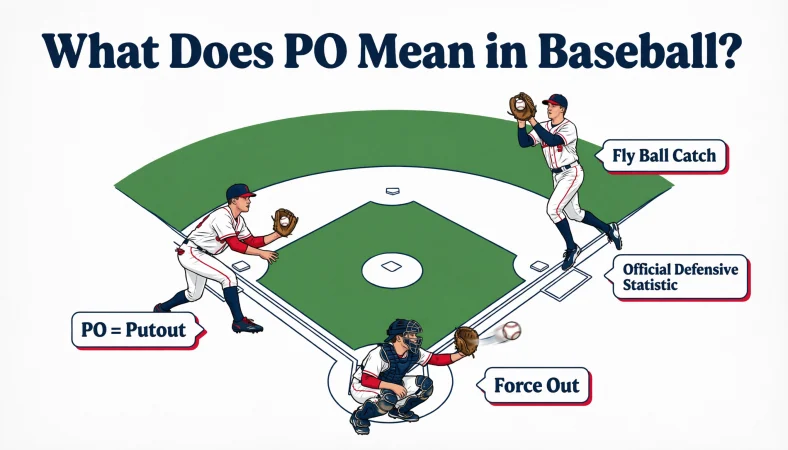
Definition: PO in baseball stands for Putout. A putout is awarded to the defensive player who directly records an out. Examples include catching a fly ball, catching a third strike, tagging a runner, or touching a base before a runner arrives on a force play. Putouts are one of baseball’s official defensive statistics and are commonly listed in box scores and player fielding records.
If you’ve ever looked at a baseball box score, player statistics, or scorecard, you’ve probably come across the abbreviation “PO.” Whether you’re a new fan, a fantasy baseball player, or someone learning how baseball statistics work, it’s natural to wonder: What does PO mean in baseball?
The answer is simple but important. PO stands for “Putout,” one of the most fundamental defensive statistics in baseball. A putout is credited to the defensive player who records an out directly, such as catching a fly ball, tagging a runner, or stepping on a base to complete a force out.
Although it may seem like a basic statistic, putouts play a major role in evaluating defensive performance and understanding how fielders contribute during a game. Certain positions such as first basemen and catchers naturally accumulate far more putouts than others because of their responsibilities on the field.
In this complete guide, you’ll learn exactly what PO means in baseball, how putouts are recorded, examples of different types of putouts, how PO compares to other defensive statistics, common misconceptions, practical tips for reading baseball stats, and answers to frequently asked questions.
Here’s a quick overview:
| Abbreviation | Meaning | What It Measures |
| PO | Putout | Defensive outs recorded directly by a player |
| A | Assist | Helping another player complete an out |
| E | Error | Defensive mistake allowing advancement |
| DP | Double Play | Two outs on one continuous play |
| FPCT | Fielding Percentage | Overall defensive efficiency |
Unlike offensive statistics such as batting average or home runs, PO measures defensive contributions.
Origin
The statistic Putout (PO) has existed almost as long as organized baseball scoring itself.
In the mid-to-late 1800s, official scorers began recording defensive plays to better evaluate players’ fielding abilities. Along with assists and errors, putouts became one of the three core defensive statistics used to summarize a player’s performance.
As baseball evolved and official scorekeeping became standardized, PO remained an essential part of every box score and scorebook. Today, Major League Baseball (MLB), college baseball, high school leagues, and youth organizations all use putouts as a standard defensive statistic.
Because every out in baseball must ultimately be completed by a defensive player, putouts remain one of the sport’s most fundamental metrics.
Popularity
Although casual fans often focus on batting statistics, PO is widely used by:
- Baseball coaches
- Scouts
- Statisticians
- Broadcasters
- Fantasy baseball players
- Sports journalists
- Official scorers
You’ll commonly see PO listed in:
- Box scores
- Player stat pages
- Defensive leaderboards
- Baseball scorecards
- Team statistics
- Historical records
Learning what PO means makes it much easier to understand defensive performance and follow baseball statistics more confidently.
How It Is Used
A putout is credited whenever a defensive player is directly responsible for recording an out.
Catching a Fly Ball
This is one of the most common putouts.
Example:
A center fielder catches a fly ball before it touches the ground.
Result:
- Center fielder receives 1 PO.
Force Outs
A first baseman frequently records putouts.
Example:
The shortstop throws to first base after fielding a ground ball.
Result:
- Shortstop receives 1 assist (A).
- First baseman receives 1 putout (PO).
Catching a Third Strike
Catchers receive putouts when they catch a third strike without the batter reaching first safely.
Example:
The pitcher throws strike three.
The catcher catches it cleanly.
Result:
- Catcher earns 1 PO.
Tagging a Runner
If a fielder tags a runner before they reach the base safely:
Result:
- The player making the tag receives the putout.
Stepping on a Base
During force plays, simply touching the base before the runner arrives records the out.
Example:
A second baseman steps on second base to force out the runner.
Result:
- Second baseman receives 1 PO.
Examples
Friendly Examples
These examples make PO easy to understand.
- “The first baseman finished the inning with three putouts.”
- “The outfielder made an incredible diving catch for the PO.”
- “The catcher earned another putout on strike three.”
- “That ground ball resulted in an easy putout at first.”
- “He leads the league in putouts among first basemen.”
Professional Examples
Baseball commentators commonly use PO in statistical discussions.
Examples:
- “The first baseman recorded 14 putouts during today’s game.”
- “The catcher finished with two putouts and one assist.”
- “Defensive metrics show the player consistently ranks among league leaders in putouts.”
- “Official scoring credited the second baseman with the putout.”
Funny Examples
Baseball fans sometimes joke about putouts.
⚾ “The first baseman gets more putouts than my phone gets notifications.”
😂 “Fly ball? Free PO.”
🤣 “First base is basically the headquarters for putouts.”
😄 “One throw, one catch, one PO. Easy day’s work.”
Comparison with Similar Terms
Many defensive baseball abbreviations are closely related.
| Abbreviation | Meaning | Difference |
| PO | Putout | Player records the out directly |
| A | Assist | Helps another player record the out |
| E | Error | Defensive mistake |
| DP | Double Play | Two outs on one play |
| TP | Triple Play | Three outs on one play |
| FPCT | Fielding Percentage | Measures defensive success |
PO vs Assist (A)
These two statistics often work together.
Example:
Shortstop fields the ball.
Throws to first.
Result:
- Shortstop = Assist
- First baseman = Putout
PO vs Error (E)
A putout records successful defense.
An error records a defensive mistake that allows a batter or runner to advance when they ordinarily would have been retired.
PO vs Double Play
A double play is a sequence resulting in two outs.
Each individual out still receives its own putout.
Example:
6-4-3 double play
- Second baseman earns one PO.
- First baseman earns another PO.
Alternate Meanings
Outside baseball, PO can mean many different things.
| Context | Meaning |
| Baseball | Putout |
| Business | Purchase Order |
| Law Enforcement | Police Officer |
| Military | Post Office |
| Shipping | Postal Order |
| Medicine | Per Os (by mouth) |
| Gaming | Player Opponent (occasionally) |
Always consider the context before interpreting the abbreviation.
Professional or Polite Alternatives
When writing for readers unfamiliar with baseball terminology, it’s often helpful to spell out the abbreviation.
Examples include:
- Putout
- Defensive out
- Recorded out
- Fielding putout
- Defensive statistic
Using the full term improves readability, especially for beginners.
Common Mistakes
Many new baseball fans misunderstand PO.
Thinking Every Defensive Player Gets a Putout
Only the player who directly completes the out receives the putout.
Other players may receive assists.
Confusing Putouts with Assists
Example:
Ground ball.
Shortstop fields it.
Throws to first.
Result:
- Shortstop = Assist
- First baseman = Putout
The throw itself does not earn the putout.
Comparing Putouts Across All Positions
First basemen and catchers naturally accumulate more putouts than outfielders or shortstops because of the nature of their defensive roles.
Raw PO totals should always be considered alongside player position.
Ignoring Other Defensive Metrics
Putouts are important but don’t tell the whole story.
Modern defensive evaluation also considers:
- Range
- Defensive Runs Saved (DRS)
- Outs Above Average (OAA)
- Assists
- Errors
- Fielding Percentage
Assuming More Putouts Always Mean Better Defense
A higher PO total often reflects position and opportunity rather than superior defensive skill alone.
Quick Tips
If you’re learning baseball statistics, remember these tips:
- PO stands for Putout.
- A putout records a defensive out.
- First basemen usually lead teams in putouts.
- Catchers also record many putouts.
- Assists and putouts often occur on the same play.
- Don’t compare PO totals across different positions without context.
- Read assists, errors, and fielding percentage together for a fuller picture.
- Watch live games to see how putouts are recorded.
- Practice keeping score to better understand defensive statistics.
- Remember that every recorded out includes a putout.
FAQ
1. What does PO mean in baseball?
PO stands for Putout, a defensive statistic awarded to the player who directly records an out.
2. Who gets credited with a putout?
The defensive player who completes the out receives the putout. This could be by catching a fly ball, tagging a runner, catching a third strike, or touching a base for a force out.
3. What’s the difference between a putout and an assist?
A putout is awarded to the player who records the out directly, while an assist goes to a player who helps make that out by fielding or throwing the ball.
4. Which position gets the most putouts?
First basemen usually record the most putouts because they complete many force outs on throws from infielders. Catchers also accumulate numerous putouts by catching third strikes and making tags at home plate.
5. Do pitchers receive putouts?
Yes. Pitchers can receive putouts by catching pop-ups, covering first base on certain plays, tagging runners, or catching line drives.
6. Does every out count as a putout?
Yes. Every recorded out is credited as a putout to one defensive player, although assists may also be awarded to teammates involved in the play.
7. Is PO important in baseball statistics?
Yes. Putouts are one of the official defensive statistics used to evaluate fielding performance and are included in virtually every baseball box score.
8. Can an outfielder receive a putout?
Absolutely. Outfielders earn putouts by catching fly balls, line drives, or tagging runners when necessary.
Conclusion
Understanding what does PO mean in baseball is essential for anyone learning the sport or reading baseball statistics. PO, short for Putout, represents one of the game’s most fundamental defensive metrics, recognizing the player who directly records an out. Whether it’s a first baseman catching a throw, an outfielder securing a fly ball, or a catcher handling a third strike, putouts highlight the critical role defenders play in every inning.
While PO is an important statistic, it should be interpreted alongside assists, errors, fielding percentage, and advanced defensive metrics for a complete picture of a player’s fielding ability. By understanding how putouts are recorded and why they matter, you’ll be better equipped to follow games, analyze player performance, and appreciate the defensive side of baseball.
Read More Articles About:
- ERA Meaning In Baseball: Earned Run Average Explained In 2026
- What Is a Redshirt In College Football? Complete NCAA Guide for 2026
- What Does Side Out Mean In Volleyball? Definition, Rules, Examples, and Why It Matters In 2026