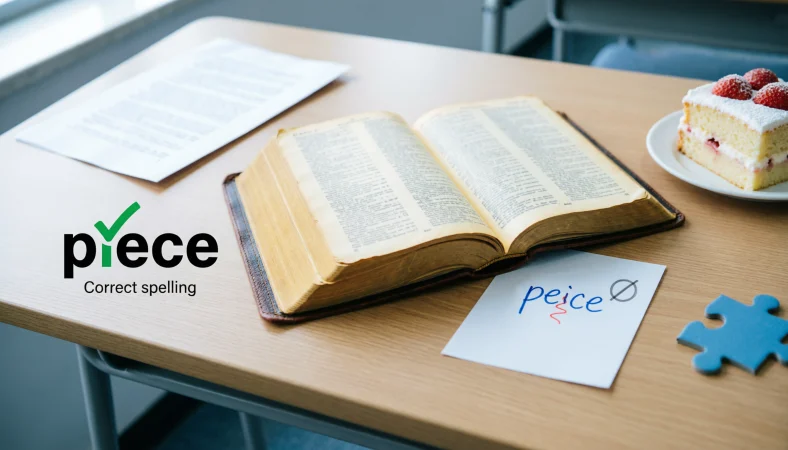
Peice or piece is a common spelling confusion, but piece is the correct spelling in standard English. It means a part of something, an individual item, or a portion of a whole. Peice is a misspelling and does not function as a standard English word. Remember the spelling pattern: piece, with ie after the first consonant.
When writing quickly, many people reverse the letters ie and ei, producing peice instead of piece. This mistake can appear in school assignments, workplace emails, online posts, and everyday messages. Understanding the correct spelling, meaning, pronunciation, and usage makes it easier to avoid the error consistently.
Peice or Piece: What’s the Difference?
The main difference is simple: piece is a correctly spelled English word, while peice is a spelling error. Although the two forms look almost identical, only piece belongs in standard written English.
The word piece functions primarily as a noun, although it also appears in several established expressions and can have specialized meanings in different contexts.
Piece can mean a single part of something larger:
I ate a piece of cake.
It can also describe an individual object:
She bought a beautiful piece of furniture.
In writing and journalism, piece can refer to an article or other work:
He wrote a piece about modern education.
The misspelling peice does not have an independent standard meaning. If you see it in an email, essay, message, or document, it is almost certainly an accidental rearrangement of the letters in piece.
Quick recap
Piece is the correct spelling.
Peice is a common misspelling.
The correct letter order is ie, as in piece.
The word can describe a part, item, portion, or written or artistic work.
A useful memory trick is to look at the middle of the word: p ie ce.
Is Peice or Piece a Grammar, Vocabulary, or Usage Issue?
This is primarily a spelling and vocabulary issue, rather than a grammar issue.
Grammar determines how words function within sentences. Spelling determines how those words appear in written form. Someone can understand the grammar of a sentence perfectly and still spell piece incorrectly.
For example:
I need a peice of paper.
The sentence structure is grammatically understandable. The problem is the spelling of peice. Standard written English requires:
I need a piece of paper.
The two forms are not interchangeable. Piece should be used in formal writing, academic work, professional communication, publications, and careful everyday writing. Peice should not be treated as an informal alternative.
Formal versus informal usage
The correct spelling remains piece regardless of how formal the situation is.
In a casual text, a person might accidentally type peice. A reader will usually understand what the writer means, but that doesn’t make the spelling acceptable in edited English.
In professional writing, spelling mistakes can affect perceived accuracy and attention to detail. In academic writing, repeated spelling errors can also distract readers from the actual argument.
Academic versus casual usage
Students should always write piece, especially in essays, reports, examinations, research assignments, and presentations.
Casual digital communication is more forgiving because people frequently type quickly and rely on autocorrect. Even so, learning the correct spelling helps prevent the mistake from appearing in important documents.
How to Use Piece Correctly
Piece has several common meanings, which explains why it appears frequently in everyday English. Knowing these meanings can make the word easier to recognize and spell.
Piece as a part of something
One of the most common meanings refers to a portion of a larger thing.
She gave me a piece of chocolate.
Please cut the paper into three pieces.
Here, piece identifies an individual portion separated from a larger whole.
Workplace example
In professional communication, piece often describes a part of a project, document, equipment, or task.
I finished my piece of the project before the deadline.
Another example is:
Please review this piece of the report before the meeting.
Using piece correctly helps professional writing remain clear and polished.
Academic example
Students and researchers commonly use piece when referring to writing, evidence, or individual portions of something.
This piece of evidence supports the researcher’s conclusion.
The word can also refer to an individual work:
The professor assigned a short piece of writing.
Technology example
Technology provides many examples of piece in ordinary usage.
The technician replaced a broken piece of hardware.
You might also hear:
The software is one piece of a larger system.
In these examples, piece describes an individual component or part.
Usage recap
Use piece when you mean a part, portion, item, component, or work. The spelling remains piece in both casual and formal contexts.
How Peice Is Used and Why It Is Incorrect
Unlike piece, peice has no standard meaning in contemporary English. It generally appears because someone remembers the correct letters but places e and i in the wrong order.
For example:
Incorrect: Please give me one peice of paper.
Correct: Please give me one piece of paper.
Workplace example
A rushed email might contain:
I attached the missing peice of information.
The intended word is clearly piece:
I attached the missing piece of information.
Academic example
A student might accidentally write:
This peice of evidence is important.
The corrected version is:
This piece of evidence is important.
Technology example
A technical document could contain:
Replace the damaged peice of equipment.
The standard spelling is:
Replace the damaged piece of equipment.
Usage recap
Do not deliberately use peice as an alternative spelling. It is best understood as a typographical or spelling error that should be corrected to piece.
When You Should NOT Use Peice or Piece
Although piece is the correct spelling, you should also make sure it actually fits the meaning you intend. The word has several meanings, but it isn’t suitable for every situation.
1. Do not write peice when you mean piece
This is the most obvious mistake. The letters ie belong in the middle of piece.
2. Do not treat peice as a variant spelling
English sometimes has legitimate spelling variants, but peice is not a standard variant of piece.
3. Do not use piece when you mean peace
Piece and peace sound similar in many varieties of English, but they have completely different meanings.
We need peace in the community.
I found a piece of glass.
4. Do not use piece when you mean peace of mind
The expression is peace of mind, not piece of mind.
Meditation gives her peace of mind.
5. Do not confuse piece with part in every context
The words can overlap, but they aren’t always interchangeable.
This is an important part of the plan.
Although piece can sometimes describe a component, part may sound more natural when discussing abstract structures or relationships.
6. Do not assume pronunciation reveals the spelling
Because piece has a pronunciation that can resemble other words, listening alone may not help you remember its spelling.
7. Do not rely entirely on autocorrect
Spell checkers can catch many instances of peice, but not every writing environment provides reliable correction. Building the correct spelling into your own memory is more dependable.
8. Do not ignore repeated spelling errors
A single typo is usually harmless. Repeatedly writing peice in professional or academic material can make otherwise strong writing appear less polished.
Common Mistakes and Decision Rules
The easiest way to understand this spelling issue is to compare common incorrect sentences with their corrected versions.
Decision Rule Box
If you mean a part, portion, individual item, component, or work, use “piece.”
Never use “peice” as the spelling of that word.
A simple visual memory device is:
P + IE + CE = PIECE
The middle sequence is IE, not EI.
Why People Spell Piece as Peice
The error happens because English spelling doesn’t always follow a simple relationship between letters and sounds.
Many learners remember the general spelling pattern ie but occasionally reverse it. Words containing similar letter combinations can reinforce the confusion.
For piece, it helps to memorize the word as a visual unit rather than trying to reconstruct the spelling each time.
Think of:
PIE + CE
The first four letters of piece spell pie. That provides a useful memory connection:
PIE + CE = PIECE
This method isn’t a universal spelling rule, but it works well as a specific memory aid.
Peice or Piece in Modern Technology and AI Tools
Digital writing has made spelling correction easier, but it has not eliminated spelling mistakes.
Word processors, browsers, messaging platforms, and AI writing tools can often recognize peice as a likely misspelling of piece. Autocorrection may automatically replace it, while grammar and writing assistants may flag it for review.
AI tools can also recognize the intended meaning from context. For example, if a user enters:
I need a peice of paper.
An AI writing assistant will normally understand that piece was intended.
However, technology should support language knowledge rather than replace it. Automated correction can occasionally miss errors, particularly when unusual names, specialized terminology, or context dependent vocabulary appears nearby.
For reliable writing, the best approach combines spell checking with a basic understanding of standard spelling.
The Etymology of Piece
The history of piece helps explain why its modern spelling may look less intuitive than some English words.
The word entered English through Anglo Norman and Old French forms related to a word meaning a portion or part. Its history ultimately connects with Latin terminology associated with a portion or part.
Over time, the spelling developed into the modern English piece. The pronunciation and spelling changed as English evolved, but the core idea of an individual portion or part remained.
This long history is another reason not to assume that English spelling always provides a straightforward pronunciation guide.
An expert perspective
“When two spellings differ by only one letter sequence, the safest strategy is to connect the correct form with its meaning and a memorable visual pattern.”
For piece, the visual pattern PIE + CE provides a particularly useful spelling cue.
Two Practical Case Studies
Case Study 1: Academic writing
Consider a student preparing an essay about historical evidence. The student repeatedly writes:
This peice of evidence demonstrates the change.
A spelling review identifies the repeated error and replaces every occurrence with piece.
The concrete result is not a change in the argument itself. Instead, the paper becomes more polished and consistent, allowing the reader to focus on the student’s ideas rather than repeated spelling mistakes.
The lesson is straightforward: correcting one recurring spelling pattern can improve the overall presentation of otherwise strong academic writing.
Case Study 2: Workplace communication
Imagine an employee preparing a report that repeatedly uses the phrase piece of information. During proofreading, the employee notices several instances of peice and corrects them to piece.
The concrete result is a consistent final document with the standard spelling throughout. The correction also prevents the same error from being copied into later reports or shared documents.
These examples illustrate an important writing principle: small spelling errors can become more noticeable when they occur repeatedly.
Error Prevention Checklist
Always use X when
Because the correct form is piece, remember these situations:
- ☑ Use piece for a portion of something.
- ☑ Use piece for an individual item or object.
- ☑ Use piece for a component when the context supports that meaning.
- ☑ Use piece for a written, musical, artistic, or journalistic work.
- ☑ Use piece in academic and professional writing.
- ☑ Remember the spelling pattern IE.
Never use Y when
- ☒ Never use peice as the standard spelling.
- ☒ Never treat peice as an accepted informal variant.
- ☒ Never assume that reversing ie to ei creates another English spelling.
- ☒ Never rely solely on pronunciation to determine the spelling.
Related Grammar Confusions You Should Master
Learning one spelling distinction can lead naturally to other commonly confused English words. These pairs and groups are worth mastering:
- Peace or piece
- Receive or recieve
- Believe or beleive
- Their or there
- Your or you’re
- Affect or effect
- Advice or advise
- Practice or practise
- Than or then
- Lose or loose
The broader lesson is that English spelling often requires attention to both meaning and letter order. Memorizing isolated corrections helps, but recognizing recurring patterns makes accurate writing easier over time.
FAQs
Is piece the correct spelling?
Yes. Piece is the correct standard English spelling. Peice is a misspelling and should be corrected whenever it appears in formal, academic, professional, or carefully edited writing.
Is peice a word in English?
Peice is not a standard English word in the sense intended by people who write it instead of piece. It is normally an accidental spelling error.
Why do people spell piece as peice?
People commonly reverse the letters ie and ei when spelling words. Because the two forms look very similar, peice can appear as a typing or spelling mistake even when the writer knows the intended word.
How do you remember the spelling of piece?
A useful memory trick is PIE + CE = PIECE. The beginning of the word contains pie, which can help you remember that the correct sequence is ie, not ei.
What is the difference between piece and peace?
Piece refers to a part, portion, item, component, or work. Peace refers to calm, harmony, or the absence of conflict.
She ate a piece of bread.
They hoped to live in peace.
Is peice ever acceptable in formal writing?
No. If you intend the standard word meaning a part or portion, use piece. The spelling peice should not appear in polished academic, professional, or formal writing.
What part of speech is piece?
Piece is primarily a noun. It can describe a part or portion of something, an individual object, a work of writing or art, or a component depending on context.
Is piece an irregularly spelled word?
Its spelling may feel irregular because the pronunciation does not make the letter order obvious. English contains many words whose historical development makes their modern spelling less predictable. Memorizing piece as a complete word is therefore useful.
How do you spell piece correctly?
Spell it P I E C E. The key detail is the IE sequence after the initial P.
Should I use piece or peice in an essay?
Use piece. It is the standard spelling and works in academic, professional, and everyday writing. Peice is a spelling mistake and should be corrected before submitting an essay.
Conclusion:
The answer to peice or piece is straightforward: piece is the correct spelling, while peice is a misspelling. The word piece commonly means a part, portion, individual item, component, or work, depending on context. The easiest way to remember it is to focus on the IE sequence and use the visual cue PIE + CE.
Whether you’re writing an essay, preparing a report, sending an email, or posting online, choosing piece keeps your writing accurate and professional. Once you associate the correct spelling with its meaning and visual pattern, this common spelling mistake becomes much easier to avoid.