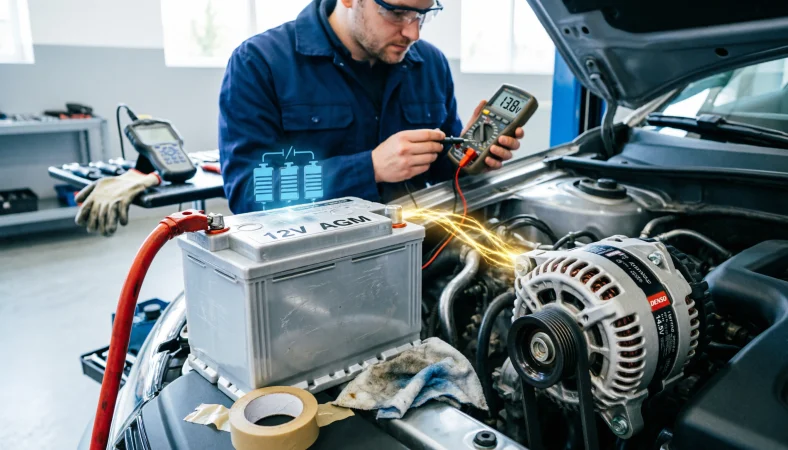
When deciding between a battery or alternator problem, remember that the battery stores electrical energy and supplies power for starting, while the alternator generates electricity and recharges the battery while the engine runs. A weak battery usually causes starting problems, whereas a failing alternator can cause repeated battery drain, warning lights, dimming lights, or an engine that eventually stops.
A car that suddenly refuses to start can leave you wondering whether the battery has failed or the alternator is responsible. The confusion is understandable because both parts belong to the same charging system and can produce similar symptoms. Knowing the difference between a battery and an alternator matters because replacing the wrong component can waste money and leave the original problem unresolved.
The battery provides electrical power when the engine is off and delivers the strong burst of current needed by the starter motor. The alternator works after the engine starts, producing electrical power for the vehicle’s electrical systems while replenishing the battery.
That distinction provides the foundation for diagnosing the problem correctly.
Battery or Alternator: What’s the Difference?
The battery and alternator perform different jobs, even though they work closely together.
A battery is an electrical storage device. It stores chemical energy and converts it into electrical energy when the vehicle needs power. During starting, the battery supplies substantial current to the starter motor. It also powers electrical accessories when the engine isn’t running.
An alternator is an electrical generator driven by the engine. Once the engine is running, it produces electrical power for the vehicle and maintains the battery’s state of charge. The alternator therefore plays a central role in the vehicle charging system.
| Feature | Battery | Alternator |
| Main function | Stores electrical energy | Generates electrical energy |
| Primary starting role | Supplies power to starter | Does not normally start the engine directly |
| Works with engine off | Yes | No |
| Works with engine running | Yes | Yes |
| Recharges battery | No | Yes |
| Common failure result | Weak or no start | Charging problems and battery drain |
| Typical warning signs | Slow cranking, clicking, weak electronics | Battery warning light, dim lights, repeated battery discharge |
| Location | Usually under the hood, sometimes elsewhere | Mounted to the engine |
| Power source | Stores energy chemically | Uses engine rotation |
| Replacement need | Common with age and wear | Usually replaced when charging performance fails |
Mini Recap
The battery stores electricity and provides starting power.
The alternator produces electricity while the engine runs.
A bad battery can prevent the vehicle from starting.
A bad alternator can stop the battery from receiving enough charge.
Because the two components depend on each other, one failure can sometimes make the other appear faulty.
Is Battery or Alternator a Mechanical, Electrical, or Diagnostic Issue?
The battery or alternator question is primarily an electrical diagnosis issue, although the components are part of a larger mechanical system.
The battery and alternator aren’t interchangeable. They perform separate functions. A new battery won’t permanently solve a charging problem caused by a defective alternator. Likewise, replacing an alternator won’t necessarily fix a battery that has reached the end of its useful life.
The distinction becomes especially important when a vehicle repeatedly needs a jump start.
Suppose the car starts normally after someone gives it a jump. That doesn’t automatically prove that the battery is bad. A jump start supplies temporary electrical energy, allowing the engine to start. If the alternator isn’t charging correctly afterward, the battery can become depleted again.
The reverse can also happen. An alternator may charge correctly, but an old battery may no longer hold enough energy to start the engine reliably.
Formal and Practical Terminology
In automotive writing, battery and alternator have precise meanings. Mechanics, technicians, vehicle manufacturers, and automotive service literature generally use the terms consistently.
Casual conversation can create confusion. Someone might say, “My battery died,” when the actual problem is that the alternator stopped charging the battery. The statement describes the symptom rather than the underlying cause.
That distinction matters when explaining a vehicle problem to a technician. Saying that the battery is dead doesn’t necessarily identify which component failed.
Academic and Technical Context
In technical education, the charging system is usually explained as a relationship between energy storage, electrical generation, starting, and power distribution.
The battery acts as a storage source. The alternator acts as the generator. The starter motor uses electrical energy from the battery to turn the engine during starting.
This system explains why a vehicle can have enough electrical energy to start once after a jump but later develop the same problem if charging remains inadequate.
How a Car Battery Works
A car battery is designed to store electrical energy and release it when needed.
When you turn the key or press the start button, the vehicle’s starting system calls for a large amount of electrical current. The battery supplies that energy to the starter system, which turns the engine until combustion can keep it running independently.
The battery also supplies power when the engine isn’t running. Interior lights, headlights, entertainment systems, electronic controls, and other accessories can draw energy from it.
When the engine runs, the alternator normally supplies the electrical demand and replenishes the energy used from the battery.
Workplace Example
Imagine a delivery driver arriving at work in the morning and discovering that the vehicle cranks slowly. The driver reports that the car has a “bad battery.”
A technician shouldn’t automatically replace the battery. The technician can test the battery’s condition and then verify the charging system. If the alternator isn’t maintaining proper charging performance, installing another battery may only provide a temporary improvement.
Academic Example
In an automotive technology course, a student might describe the battery as an energy storage component. The student could explain that the battery provides electrical energy to the starter and other electrical systems, particularly when the engine isn’t operating.
Technology Example
Modern vehicles use extensive electronic systems, including computers, sensors, communication modules, safety systems, and entertainment equipment. These systems increase the importance of a stable electrical supply.
A healthy battery and charging system therefore support far more than engine starting.
Battery Usage Recap
A battery stores electrical energy.
It provides the major electrical supply needed during engine starting.
It can power vehicle electronics when the engine is off.
A weak battery may cause slow cranking, clicking, or complete failure to start.
How an Alternator Works
The alternator converts mechanical energy from the running engine into electrical energy.
Engine rotation drives the alternator through a belt system. Inside the alternator, electromagnetic principles allow it to generate electrical power. The vehicle’s charging system regulates that output so the electrical system receives appropriate power and the battery can be recharged.
This is why the alternator becomes particularly important after the engine starts.
If the alternator stops producing sufficient electrical power, the vehicle may initially continue running because the battery still contains stored energy. However, that stored energy can gradually disappear as the vehicle continues operating.
Eventually, the battery may become too depleted to support the vehicle.
Workplace Example
Consider a company vehicle that repeatedly requires jump starts after short trips. The driver may believe the battery is simply old.
A charging system inspection could reveal that the alternator isn’t replenishing the battery adequately. In that situation, replacing the battery alone doesn’t address the root cause.
Academic Example
A student studying vehicle electrical systems might describe the alternator as the component responsible for generating electrical power after engine operation begins.
That explanation distinguishes it from the battery, which stores electrical energy rather than generating electricity through engine driven mechanical rotation.
Technology Example
Modern vehicles can place considerable electrical demand on the charging system. Lighting, climate control, safety features, infotainment, navigation, computers, and electronic driver assistance systems all depend on reliable electrical power.
When alternator output becomes inadequate, electronic symptoms can become noticeable before the engine actually stops.
Alternator Usage Recap
The alternator generates electrical power while the engine runs.
It helps supply the vehicle’s electrical systems.
It replenishes energy used from the battery.
A charging problem can eventually leave the battery too weak to start the engine.
When You Should NOT Assume the Battery or Alternator Is Bad
One of the biggest diagnostic mistakes is treating every no start condition as proof of a failed battery or alternator.
Several other problems can produce similar symptoms.
1. The starter may be faulty
A battery can have adequate charge while a defective starter prevents the engine from cranking properly.
2. A loose battery connection may interrupt power
Corroded, damaged, or loose battery terminals can restrict current flow and create symptoms that resemble battery failure.
3. A parasitic electrical drain may discharge the battery
An electrical component that continues drawing power after the vehicle is turned off can gradually drain a healthy battery.
4. A damaged charging system connection can mimic alternator failure
The alternator itself may function correctly while wiring, connections, or related charging components create an electrical problem.
5. A worn drive belt can affect alternator operation
Because the alternator depends on engine driven mechanical rotation, problems with the drive system can interfere with charging.
6. Extreme temperatures can affect battery performance
Very cold conditions can make starting more difficult, while heat can accelerate battery deterioration over time.
7. A vehicle may simply have an aging battery
A battery can gradually lose its ability to store sufficient energy. In that situation, the alternator may still be working correctly.
8. Electronic accessories can consume stored power
Leaving lights or other accessories operating can discharge the battery without any alternator fault.
The key lesson is simple: symptoms point toward a diagnosis, but testing confirms it.
Common Battery or Alternator Mistakes
| Correct sentence | Incorrect sentence | Explanation |
| The battery is weak and cannot provide enough starting power. | The alternator stores the starting power. | The battery stores electrical energy. |
| The alternator is not charging the battery properly. | The battery generates electricity for the engine. | The alternator generates electrical power while the engine runs. |
| The battery was discharged by an electrical drain. | The alternator automatically fixes every dead battery. | A charging system cannot repair a battery that has been discharged or damaged. |
| The battery may need testing before replacement. | A jump start proves the battery is bad. | A jump start only provides temporary starting energy. |
| The charging system should be checked. | Replacing the battery always solves repeated starting problems. | Repeated failures can result from charging problems or other electrical faults. |
Decision Rule Box
If the vehicle cannot hold or deliver enough stored electrical energy, investigate the battery. If the battery repeatedly loses charge while the engine runs, investigate the alternator and the rest of the charging system.
This rule isn’t a substitute for testing, but it provides a useful starting point.
Symptoms of a Bad Battery
Battery problems often become most obvious during starting.
A slow engine crank is one of the classic signs. Instead of turning the engine with its normal speed, the starter may sound sluggish.
A clicking sound can also occur when the battery cannot provide sufficient current to the starting system. However, clicking isn’t exclusive to battery problems because connections and starter components can also cause similar sounds.
Other possible signs include weak interior lighting, electrical accessories that behave abnormally, or a vehicle that repeatedly needs jump starts.
Battery age also matters. A battery can lose capacity gradually rather than failing instantly.
The important point is that a symptom alone doesn’t establish the exact cause. Proper testing can distinguish a weak battery from a problem elsewhere in the electrical system.
Symptoms of a Bad Alternator
Alternator problems tend to become more noticeable while the engine is running.
A battery or charging warning light may appear on the dashboard. Headlights or interior lights may become unusually dim or fluctuate. Electrical accessories may behave inconsistently.
A vehicle can also experience repeated battery discharge. The battery may appear to be the problem because it becomes weak, but the underlying issue can be inadequate charging.
In more serious cases, the vehicle may eventually stop running after the available electrical energy becomes insufficient.
This is why a recently replaced battery doesn’t necessarily eliminate the possibility of a charging problem.
How to Tell Whether the Battery or Alternator Is Failing
A sensible diagnosis usually involves checking the entire starting and charging system rather than guessing from one symptom.
A technician can inspect the battery, terminals, wiring, charging components, and related systems. Electrical measurements can help determine whether the battery can hold an appropriate charge and whether the charging system produces the expected electrical output.
A useful diagnostic sequence starts with the simplest questions.
Does the engine crank?
If it cranks slowly, is the battery sufficiently charged?
Are the battery connections clean and secure?
Does the battery pass a condition test?
Does the charging system maintain appropriate voltage while the engine operates?
Are there warning lights or other electrical symptoms?
Does the problem return after the vehicle receives a jump start?
These questions help separate a starting problem from a charging problem.
A professional diagnosis can also prevent unnecessary parts replacement.
Can a Bad Alternator Damage a Battery?
A failing alternator can contribute to battery problems because the battery depends on the charging system to replenish energy during vehicle operation.
If the alternator doesn’t charge sufficiently, the battery can repeatedly become discharged. Repeated deep discharge can place additional stress on a starting battery and may shorten its useful life.
However, this doesn’t mean every alternator problem automatically destroys a battery.
The condition of the battery depends on several factors, including its age, design, discharge history, temperature exposure, and overall condition.
For this reason, when an alternator problem is confirmed, the battery should also be evaluated rather than automatically assumed to be healthy.
Can a Bad Battery Cause Alternator Problems?
A weak battery doesn’t necessarily mean the alternator has failed.
The alternator is designed to provide electrical power and recharge the battery during operation. If the battery has deteriorated internally or cannot retain energy effectively, the vehicle can continue experiencing starting problems even when the charging system works correctly.
This is why replacing one component without testing the other can produce frustrating results.
For example, imagine a vehicle receives a new battery and works normally for a short period. If the alternator is not charging properly, the replacement battery may become depleted again.
Now consider the opposite situation. An alternator is replaced, but an old battery still cannot retain enough energy. Starting problems can continue despite the charging system working properly.
The two components should therefore be considered together during diagnosis, but they should never be treated as the same component.
Battery or Alternator: Which One Usually Needs Replacement?
There is no universal answer because both components can fail, and the symptoms can overlap.
Battery replacement becomes more likely when the battery has poor capacity, fails testing, struggles to provide starting power, or has reached the end of its service life.
Alternator replacement or repair becomes more likely when testing shows insufficient charging performance, mechanical failure, internal electrical failure, or another alternator related defect.
The most economical approach is not to guess. Test first, then replace the component that actually failed.
That approach can save money and prevent a new battery from being installed into a vehicle with an unresolved charging problem.
Battery or Alternator in Modern Technology and AI Tools
Modern vehicles rely heavily on electronic control systems, and many newer models contain numerous computers, sensors, cameras, communication systems, and software controlled functions.
Artificial intelligence and advanced software can help technicians analyze diagnostic information, identify patterns in vehicle data, and support troubleshooting. However, technology does not eliminate the importance of physical electrical testing.
A diagnostic system might identify a charging related fault code, but a fault code doesn’t necessarily mean that the alternator itself needs replacement. The underlying cause still requires interpretation.
The same principle applies to battery monitoring systems. A vehicle may report battery related information, but technicians must consider the wider electrical system when diagnosing a fault.
Modern diagnostic technology is therefore a useful tool, not a replacement for sound mechanical and electrical reasoning.
Etymology and Automotive Meaning
The word battery has a long history connected with the idea of a group or collection of things acting together. In electrical terminology, it came to describe a collection of electrical cells that work together to provide power.
The word alternator comes from the idea of alternating electrical current. In automotive use, it refers to the generator that produces alternating current and works with the vehicle’s electrical system to provide usable electrical power and recharge the battery.
Although the terms have different histories, their modern automotive meanings are very specific.
Expert Style Explanation
“The simplest way to understand the system is to remember that the battery stores energy, while the alternator supplies electrical energy and replenishes the battery during engine operation.”
That distinction makes many confusing symptoms easier to understand.
Two Practical Case Studies
Case Study One: The Morning No Start
A vehicle owner notices that the engine turns slowly in the morning. After receiving a jump start, the vehicle starts normally and continues driving.
The owner assumes the battery has failed.
A proper inspection finds that the battery has reduced capacity and does not hold sufficient charge. The charging system performs normally.
In this situation, the battery is the more likely source of the starting problem.
The important lesson is that the vehicle should not receive an alternator replacement simply because a jump start was necessary.
Case Study Two: The Repeated Dead Battery
Another vehicle receives a new battery but develops starting problems again after several days of normal driving.
The owner assumes the replacement battery is defective.
Testing instead shows that the charging system isn’t replenishing the battery adequately while the engine operates.
The new battery became discharged because the underlying charging problem remained.
The concrete result is important: replacing the battery alone failed to resolve the complaint, while diagnosing the charging system identified the actual problem.
These examples show why component testing matters more than guessing based on a single symptom.
Error Prevention Checklist
Always Investigate the Battery When
- The engine cranks slowly.
- The battery repeatedly struggles to start the vehicle.
- The battery fails a proper condition test.
- Electrical power becomes weak when starting.
- The battery is old and has lost significant capacity.
Always Investigate the Alternator When
- The charging warning light appears.
- The battery repeatedly becomes discharged after driving.
- Electrical systems become weaker while the engine runs.
- Charging measurements indicate inadequate alternator output.
- A replacement battery repeatedly loses its charge.
Never Assume
- A jump start proves the battery is defective.
- A dead battery automatically means the alternator failed.
- A new battery guarantees that the charging system works.
- A dashboard warning automatically identifies the failed component.
- One symptom is enough to justify replacing an expensive part.
Related Automotive Confusions You Should Master
Understanding the battery and alternator becomes easier when you also know the difference between related vehicle components and symptoms.
Battery vs Starter
The battery supplies electrical energy, while the starter uses that energy to turn the engine during starting.
Alternator vs Starter
The alternator generates electrical power during engine operation. The starter’s primary job is to turn the engine during startup.
Charging System vs Starting System
The charging system maintains electrical energy during operation. The starting system gets the engine turning.
Dead Battery vs Discharged Battery
A discharged battery may simply lack available charge. A dead battery can also refer informally to a battery that has failed or can no longer perform adequately.
Warning Light vs Component Failure
A dashboard warning indicates that the vehicle detected a problem or abnormal condition. It doesn’t always identify the exact failed component.
Slow Crank vs No Crank
A slow crank means the engine turns but does so sluggishly. A no crank condition means the engine doesn’t turn through the starter system.
Jump Start vs Repair
A jump start provides temporary electrical assistance. It doesn’t repair the underlying cause of the starting problem.
Battery Replacement vs Charging System Repair
Installing a new battery addresses a battery condition problem. It doesn’t repair a faulty charging system.
Voltage vs Battery Health
An electrical voltage reading can provide useful information, but a single reading doesn’t necessarily reveal the complete condition or capacity of a battery.
Electrical Problem vs Mechanical Problem
Electrical symptoms can sometimes originate from wiring, connections, sensors, or components rather than the battery or alternator themselves.
FAQs
What is the difference between a battery and an alternator?
The battery stores electrical energy and provides power for starting the vehicle. The alternator generates electrical power while the engine runs and replenishes the battery.
How do I know if it is my battery or alternator?
Look for the overall pattern of symptoms, but don’t rely on symptoms alone. A weak battery often causes slow or difficult starting, while alternator problems commonly cause charging warnings, dimming electrical systems, or repeated battery discharge.
Can a car run with a bad alternator?
A vehicle may continue running temporarily after an alternator fails because the battery still contains stored electrical energy. Once that energy becomes depleted, the vehicle may stop running.
Can a bad battery cause the car not to start?
Yes. A battery that lacks sufficient charge or has lost its ability to provide adequate starting current can prevent the starter from turning the engine properly.
Will a new battery fix a bad alternator?
No. A new battery may temporarily improve the situation, but it cannot correct an alternator that isn’t charging the vehicle properly.
Can a bad alternator drain a new battery?
A charging system problem can leave a new battery inadequately charged during normal driving. The battery may then become discharged and eventually develop problems from repeated deep discharge.
How long can a car run with a failing alternator?
There is no reliable universal time. It depends on the battery’s remaining charge, electrical demand, vehicle design, and severity of the charging problem. Continuing to drive with a known charging problem can leave the vehicle stranded.
Does a jump start mean I need a new battery?
Not necessarily. A jump start only shows that the vehicle needed additional electrical energy to start. The battery, charging system, starter, connections, or another component could be responsible.
Should I replace the battery or alternator first?
Neither should be replaced based only on symptoms. Test the battery and charging system first. Replace the component that the testing identifies as defective.
Conclusion:
The battery and alternator work together, but they have completely different jobs. The battery stores electrical energy and provides the power needed to start the vehicle. The alternator generates electrical power while the engine runs and replenishes the battery.
When a car refuses to start, don’t automatically blame either component. Slow cranking often points toward a battery or starting system issue, while repeated battery discharge during normal driving can indicate a charging problem. However, wiring, connections, the starter, electrical drains, and other faults can create similar symptoms.
The best approach is straightforward: test the battery, check the charging system, inspect the connections, and diagnose the complete starting system before buying replacement parts. Understanding the difference between a battery and alternator can help you communicate symptoms more clearly and avoid unnecessary repairs.