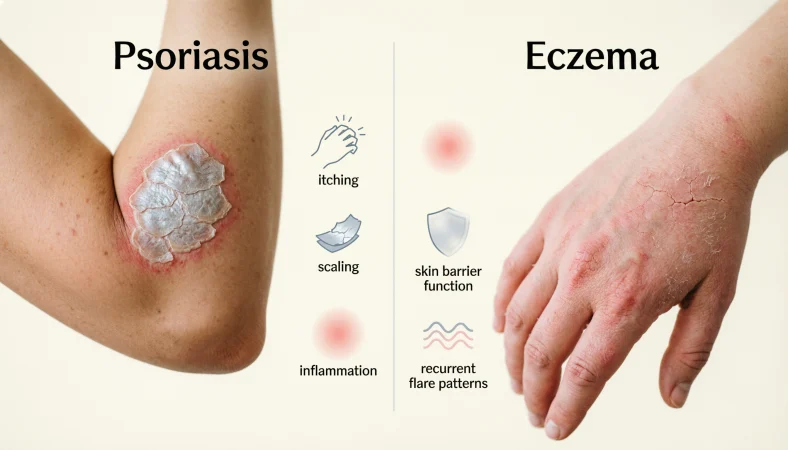
Psoriasis and eczema are both common inflammatory skin conditions, but they are not the same. Psoriasis is an immune mediated condition that often causes sharply defined, thicker plaques with silvery scale, while eczema commonly causes itchy, dry, inflamed skin. Their symptoms can overlap, so appearance alone may not always provide a reliable diagnosis.
If you’re trying to understand psoriasis or eczema, the most important point is that neither condition is simply another name for the other. Both can cause redness, itching, irritation, and changes in the skin barrier, yet they differ in their underlying mechanisms, typical patterns, triggers, and treatment approaches.
That distinction matters because treating the wrong condition can be frustrating. A product that helps one person may do little for another, and some skin conditions can resemble psoriasis or eczema without actually being either. A persistent, severe, spreading, painful, infected, or otherwise unusual rash deserves assessment by a qualified healthcare professional.
Understanding the basic differences can help you describe your symptoms more accurately and know when professional evaluation is appropriate.
Psoriasis or Eczema: What’s the Difference?
Psoriasis and eczema are inflammatory skin disorders, but they develop through different biological processes.
As Psoriasis is a chronic immune mediated disease in which immune system activity contributes to inflammation and an accelerated buildup of skin cells. The result can be thick, raised, well defined patches covered with scale.
Eczema is a broad term commonly used for inflammatory skin conditions that cause itching, dryness, irritation, and a weakened skin barrier. Atopic dermatitis is the most common form of eczema.
Although both conditions can appear red and inflamed, their patterns often provide useful clues.
| Feature | Psoriasis | Eczema |
| Main nature | Immune mediated inflammatory disease | Inflammatory skin condition involving skin barrier dysfunction and immune activity |
| Common appearance | Thick, raised, clearly defined plaques with scale | Dry, itchy, inflamed, sometimes cracked or weeping skin |
| Common locations | Elbows, knees, scalp, lower back, nails | Hands, face, neck, skin folds, and areas that bend |
| Itching | Can occur and may be significant | Often a prominent symptom |
| Scaling | Often thicker and more noticeable | Usually finer or associated with dryness |
| Typical course | Often chronic with periods of improvement and worsening | Can flare repeatedly, especially with triggers |
| Contagious | No | No |
| Diagnosis | Clinical assessment, sometimes supported by additional evaluation | Usually clinical assessment |
These differences are useful, but they are not absolute.
Psoriasis can occur in unusual locations and may itch intensely.
Eczema can become thickened after prolonged scratching.
Both conditions can affect the hands and scalp.
A healthcare professional may need to examine the skin closely before determining the diagnosis.
Is Psoriasis or Eczema a Diagnosis, Symptom, or Usage Issue?
Unlike spelling comparisons, this is a medical distinction rather than a language problem. The two terms describe different groups of inflammatory skin conditions.
They are not interchangeable.
Saying that someone has eczema does not mean that they have psoriasis, and saying that someone has psoriasis does not mean that they have eczema.
The confusion happens because inflammation produces overlapping visible symptoms. Redness, itching, dryness, scaling, irritation, and skin discomfort can occur with both conditions.
Why appearance can be misleading
Skin conditions do not always follow textbook descriptions. A mild case of psoriasis may not have dramatic plaques. Eczema can become thickened and scaly after repeated scratching. Certain infections, allergic reactions, seborrheic dermatitis, and other inflammatory disorders can also resemble either condition.
For that reason, a comparison chart should be viewed as a guide rather than a diagnostic tool.
Formal and everyday language
In medical writing, the distinction between psoriasis and eczema needs to remain precise.
In everyday conversation, people may describe any itchy or flaky rash as eczema. Others may call any scaly patch psoriasis. Those shortcuts can create confusion.
A better approach is to describe what you actually observe.
For example:
The skin is red, very itchy, dry, and cracked.
That description gives a clinician more useful information than simply guessing which condition you have.
Understanding Psoriasis
Psoriasis is a chronic inflammatory disease involving abnormal immune activity. In affected skin, immune signals can cause skin cells to develop and accumulate more rapidly than normal.
This can produce raised plaques with visible scale.
Common forms include plaque psoriasis, guttate psoriasis, inverse psoriasis, pustular psoriasis, and erythrodermic psoriasis. These forms can look quite different from one another.
Workplace example
Consider someone who develops thick, scaly patches on the elbows while working in an office. The patches may become more noticeable during periods of stress.
A useful description would be:
I have raised patches on both elbows that become thicker and more noticeable at times.
The location and appearance may lead a clinician to consider psoriasis, but an examination is still necessary.
Academic example
In an educational or medical context, a writer might say:
Psoriasis is a chronic inflammatory disease associated with immune system activity and characteristic changes in skin growth.
This wording is more precise than simply calling psoriasis a rash.
Technology example
Modern healthcare technology can assist with documentation, patient education, image comparison, and symptom tracking. However, an app or artificial intelligence system should not be treated as a substitute for a professional diagnosis.
A photograph may fail to capture texture, scale, distribution, or subtle clinical features. Lighting can also change how redness appears.
Usage recap
Psoriasis often produces well defined, thicker plaques.
It can affect the scalp, elbows, knees, lower back, and nails.
Its severity can vary over time.
It is not contagious.
Professional evaluation is important when the diagnosis is uncertain.
Understanding Eczema
Eczema refers to a group of inflammatory skin conditions. Atopic dermatitis is the form most people mean when they use the term eczema.
Eczema commonly involves itching, dryness, irritation, and a compromised skin barrier. Scratching can further damage the skin and create a cycle of itching and inflammation.
The appearance can vary depending on age, skin tone, location, duration, and severity.
Workplace example
Someone who frequently washes their hands at work may develop dry, cracked, irritated skin. Repeated exposure to soaps, detergents, chemicals, or water can aggravate certain forms of hand eczema.
A useful description might be:
My hands become dry, itchy, red, and cracked after repeated washing.
That information can help a healthcare professional consider possible causes and triggers.
Academic example
A medical explanation could state:
Eczema commonly involves inflammation, itching, dryness, and disruption of the skin barrier.
This captures the general nature of the condition without suggesting that every case looks identical.
Technology example
Digital health tools can help people record possible triggers, symptoms, environmental conditions, and flare patterns. Such records can be useful during a clinical appointment.
However, tracking symptoms does not establish a diagnosis. A person may assume that a rash is eczema when another condition is responsible.
Usage recap
Eczema commonly causes significant itching.
Dryness and irritation are frequent features.
Triggers can vary considerably between individuals.
Scratching can worsen inflammation and damage the skin.
Different forms of eczema can have different appearances.
Psoriasis or Eczema on Different Parts of the Body
Location can provide useful clues, although it cannot establish a diagnosis by itself.
Scalp
Psoriasis commonly affects the scalp and may produce thicker, clearly defined areas of scale. Eczema can also affect the scalp, particularly when associated with conditions such as seborrheic dermatitis.
Elbows and knees
Psoriasis frequently affects the outer surfaces of the elbows and knees. Thick plaques in these locations are a classic pattern.
Eczema can affect these areas too, particularly in children or people with certain forms of dermatitis.
Face
Eczema frequently affects the face, especially in children. Facial psoriasis is also possible, but its appearance and distribution may differ.
Hands
Both conditions can affect the hands. Eczema may produce dryness, cracking, irritation, and itching. Psoriasis can produce sharply defined plaques and may also affect the nails.
Hand dermatitis can have several causes, including irritants and allergies, so diagnosis may require careful evaluation.
Skin folds
Inverse psoriasis tends to affect skin folds and can appear smooth and inflamed rather than heavily scaly because moisture in these areas reduces visible scale.
Eczema can also affect folds, particularly in people with atopic dermatitis.
How Psoriasis and Eczema Differ in Symptoms
Symptoms can overlap, but certain patterns are more characteristic of one condition.
Psoriasis often produces plaques that feel thicker than surrounding skin. The borders may be clearly visible. Scale can appear white or silvery on some skin tones, although appearance varies with pigmentation and inflammation.
Eczema often produces intense itching, dryness, irritation, cracking, and sometimes oozing or crusting during active inflammation.
The word “itchy” therefore does not automatically mean eczema.
Likewise, “scaly” does not automatically mean psoriasis.
This is one of the most important distinctions for anyone comparing the two conditions.
Skin color can also affect how inflammation appears. On lighter skin, inflammation may look pink or red. On darker skin, affected areas can appear brown, purple, gray, or darker than surrounding skin. After inflammation improves, temporary changes in pigmentation may remain.
A good comparison should therefore consider texture, distribution, duration, symptoms, and history rather than color alone.
When You Should NOT Assume You Have Psoriasis or Eczema
There are several situations in which self diagnosis is particularly unreliable.
1. When the rash appeared suddenly
A sudden rash can have many causes, including infection, allergy, irritation, medication reactions, and other conditions.
2. When the rash is painful rather than mainly itchy
Pain, warmth, swelling, or rapidly worsening redness may require prompt medical assessment.
3. When there are signs of infection
Pus, increasing warmth, significant swelling, spreading redness, fever, or rapidly worsening symptoms can indicate infection.
4. When the rash affects the eyes
Skin inflammation around the eyes requires particular care because the area is delicate and inappropriate treatments can cause harm.
5. When the entire body becomes extensively red
Widespread inflammation can sometimes represent a serious condition and should receive urgent medical attention.
6. When a treatment makes the rash worse
A worsening reaction may indicate irritation, allergy, an incorrect diagnosis, or another problem.
7. When the condition repeatedly returns without a clear explanation
Recurring symptoms deserve evaluation, particularly when they interfere with sleep, work, or daily activities.
8. When you are uncertain about the diagnosis
If you cannot confidently distinguish between eczema, psoriasis, infection, or another skin condition, professional assessment is the safest approach.
Common Mistakes and Decision Rules
| Correct approach | Incorrect assumption | Explanation |
| Describe the rash before naming it | Every itchy rash is eczema | Itching has many possible causes |
| Consider psoriasis when thick plaques appear | Every scaly rash is psoriasis | Scaling can occur with several conditions |
| Seek assessment for persistent symptoms | Keep changing products indefinitely | Repeated experimentation can irritate the skin |
| Follow an appropriate treatment plan | Use another person’s prescription | Treatments should match the individual’s condition |
| Consider location and pattern | Diagnose by one symptom | Diagnosis relies on multiple features |
| Mention triggers and duration | Ignore the history | Timing and triggers can provide important clues |
Decision rule
If the skin is persistently inflamed, unusually thickened, severely itchy, painful, spreading, infected, or difficult to identify, focus on getting an accurate diagnosis rather than choosing a condition based on appearance alone.
There is no reliable rule that says one symptom always means psoriasis and another always means eczema.
Psoriasis or Eczema in Modern Technology and AI Tools
Artificial intelligence has made visual health information easier to access, but it has also created new risks.
An AI system can compare descriptions, organize symptoms, identify questions to discuss with a clinician, and explain general medical terminology. However, a generated answer is not the same as a clinical diagnosis.
Images can be particularly deceptive.
A photograph may have unusual lighting. Skin texture may not be visible. The camera may alter color. A rash may also change substantially from one day to another.
AI tools should therefore be treated as educational aids rather than definitive diagnostic systems.
A sensible use of technology is to record when symptoms appear, where they occur, possible triggers, treatments already tried, and changes over time. Bringing that information to a healthcare professional can make the consultation more productive.
Causes and Triggers: Psoriasis Versus Eczema
The causes and triggers are another important distinction.
Psoriasis is strongly associated with immune system activity and genetic susceptibility. Environmental factors can contribute to flare ups in people who are predisposed to the condition. Potential triggers can include stress, skin injury, certain infections, smoking, alcohol, and some medications.
Eczema has a different pattern. Atopic dermatitis is associated with skin barrier dysfunction, immune activity, genetics, and environmental factors. Possible aggravating factors include soaps, detergents, dry air, heat, sweating, fragrances, irritants, and certain allergens.
Not every person reacts to the same trigger.
That is why keeping a symptom record can sometimes help identify patterns.
Treatment Differences Between Psoriasis and Eczema
Treatment depends on the specific diagnosis, severity, affected body areas, age, medical history, and other factors.
For eczema, management often focuses on restoring and protecting the skin barrier, reducing inflammation, controlling itching, and avoiding relevant triggers. Moisturizers are commonly an important part of routine skin care. Healthcare professionals may recommend prescription anti inflammatory treatments when appropriate.
Psoriasis treatment can involve topical medicines, light based treatment, oral medicines, injectable medicines, or combinations depending on severity and type. Treatment aims to reduce inflammation and control excessive skin cell growth.
Because the treatments differ, identifying the correct condition matters.
A person should not assume that a treatment prescribed for someone else will be appropriate for their own skin.
Some medicines also require specific precautions, especially when used on sensitive areas such as the face, skin folds, or around the eyes.
Etymology and Medical Meaning
The terms psoriasis and eczema have different linguistic histories.
Psoriasis comes from a Greek root associated with itching and a condition affecting the skin.
Eczema also comes from Greek and is connected with a word describing something that boils or bubbles over, reflecting the historical description of inflamed skin.
Their histories illustrate how medical terminology often developed from descriptions of visible symptoms rather than modern explanations of disease mechanisms.
Today, both terms have specific clinical meanings, and neither should be treated as a generic word for any rash.
Two Practical Clinical Scenarios
Scenario one: Thick plaques on the elbows
Imagine an adult develops recurring, raised patches on both elbows. The areas are sharply defined and covered with noticeable scale. They improve and worsen over time.
This pattern may make psoriasis an important possibility. However, a clinician would still consider the person’s history, other affected areas, nail changes, scalp involvement, medications, and possible alternative diagnoses.
The useful lesson is that pattern matters more than a single symptom.
Scenario two: Persistent itching and cracked skin
Now imagine a person develops intensely itchy, dry, cracked skin on the hands. Symptoms worsen after frequent exposure to soaps and cleaning products.
Eczema or contact dermatitis could be considered, but the distinction requires proper evaluation.
The useful lesson is that triggers and exposure history can be as important as appearance.
These are illustrative clinical scenarios rather than diagnostic case reports. Real patients can present differently.
Error Prevention Checklist
Always remember
- Psoriasis and eczema are different conditions.
- Both can cause inflammation and itching.
- Psoriasis often produces thicker, well defined plaques.
- Eczema commonly produces itching, dryness, and irritation.
- Location can provide useful clues.
- Skin color can change how inflammation appears.
- A diagnosis may require professional examination.
- Persistent or severe symptoms deserve appropriate medical attention.
Never assume
- Every itchy rash is eczema.
- Every scaly rash is psoriasis.
- A photograph can always establish the diagnosis.
- A product that helped another person will help you.
- An AI tool can replace a qualified healthcare professional.
- A skin condition is contagious simply because it looks unusual.
Related Skin Conditions You Should Know
Understanding related conditions can make skin terminology less confusing.
Contact dermatitis
This occurs when the skin reacts to an irritant or allergen. It can resemble eczema and may require identifying the exposure responsible.
Seborrheic dermatitis
This commonly affects areas containing many oil glands, including the scalp and parts of the face. Flaking and inflammation can make it resemble other conditions.
Ringworm
Despite its name, ringworm is a fungal infection rather than a worm. Its appearance can overlap with inflammatory skin conditions.
Hives
Hives usually produce raised, itchy areas that can appear and disappear relatively quickly.
Rosacea
Rosacea commonly affects the face and can cause persistent redness, flushing, and other skin changes.
Dry skin
Simple dryness can cause scaling and itching without representing eczema or psoriasis.
Fungal infections
Certain fungal infections can cause scaly or inflamed patches and may require antifungal treatment rather than treatment for eczema or psoriasis.
Sebopsoriasis
This term is sometimes used when features overlap between psoriasis and seborrheic dermatitis, particularly around the scalp and face.
Lichenification
Repeated scratching or rubbing can cause skin to become thicker and more textured. This can make eczema look very different from its earlier appearance.
Contact allergy
An allergic reaction to a substance can cause inflammation that resembles eczema, making exposure history especially important.
FAQs
How can you tell the difference between psoriasis and eczema?
Psoriasis often produces thicker, sharply defined plaques with scale, while eczema commonly causes intense itching, dryness, irritation, and cracking. However, the conditions can overlap, and appearance alone cannot always establish a diagnosis.
Is psoriasis more itchy than eczema?
Eczema is often strongly associated with itching, but psoriasis can also itch significantly. The intensity of itching varies from person to person, so itching alone cannot reliably distinguish the two.
Can eczema turn into psoriasis?
Eczema does not normally transform into psoriasis. They are separate conditions with different underlying mechanisms. However, someone can have different inflammatory skin conditions at different times, and some rashes can be difficult to distinguish without professional assessment.
Can you have psoriasis and eczema at the same time?
Yes. A person can have more than one skin condition. When symptoms do not fit neatly into one pattern, a healthcare professional can evaluate the skin and determine the most appropriate diagnosis.
Which is worse, psoriasis or eczema?
Neither condition is automatically worse. Severity depends on the individual case, affected body areas, symptoms, extent of inflammation, impact on daily life, and response to treatment.
Does psoriasis itch like eczema?
Psoriasis can itch, although eczema often causes especially prominent itching. Some people with psoriasis experience considerable itch, while others experience relatively little.
Is psoriasis contagious like an infection?
No. Psoriasis is not contagious and cannot be spread through ordinary physical contact.
Is eczema contagious?
No. Eczema itself is not contagious. However, some infections can resemble eczema, which is one reason an uncertain or rapidly changing rash should be evaluated appropriately.
Can stress make psoriasis or eczema worse?
Stress can contribute to flare ups in some people with psoriasis or eczema. The relationship is individual, and stress is only one of many possible contributing factors.
When should I see a doctor for psoriasis or eczema?
Consider professional evaluation when symptoms are persistent, severe, recurrent, spreading, painful, infected, affecting sleep or daily activities, involving sensitive areas, or difficult to identify. Urgent medical attention may be appropriate for rapidly worsening or widespread symptoms or signs of serious infection.
Conclusion:
Understanding the difference between psoriasis or eczema starts with recognizing that they are separate inflammatory skin conditions. Psoriasis commonly produces thicker, clearly defined plaques with scale, while eczema often causes prominent itching, dryness, irritation, and skin barrier problems.
Even so, there is no single symptom that can reliably distinguish them in every person. Their appearances can overlap, and other skin disorders can produce similar changes. Location, texture, duration, triggers, medical history, and associated symptoms all matter.
The safest approach is to use general information to understand possibilities rather than attempting to diagnose a persistent rash from appearance alone. If symptoms are severe, recurring, spreading, painful, infected, or interfering with everyday life, professional evaluation can help determine what is actually causing them and which treatment is appropriate.









2 thoughts on “Psoriasis Or Eczema: How To Tell the Difference, Symptoms, Causes & Treatment In 2026”