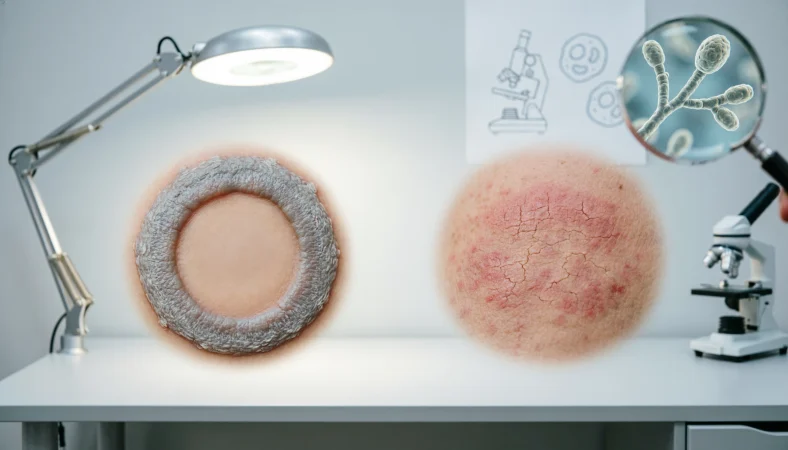
Ringworm and eczema can look similar, but they are different skin conditions. Ringworm is a contagious fungal infection that often causes a circular, scaly rash, while eczema is an inflammatory skin condition that commonly causes dry, itchy, irritated skin. Because their symptoms can overlap, appearance alone may not always be enough to identify the cause, so a healthcare professional can provide an accurate diagnosis.
Is that itchy, red patch ringworm or eczema? The two conditions can sometimes look surprisingly alike, yet they have different causes and treatments. Ringworm is caused by a fungus and can spread through contact, while eczema involves skin inflammation and is not contagious. In this guide, we’ll explain the key differences in symptoms, appearance, causes, and typical treatment approaches using clear, evidence based health information to help you understand what may be behind a rash and when professional medical advice is appropriate.
Introduction: Ringworm or Eczema.
The question of ringworm or eczema comes up whenever an itchy, dry, scaly, or circular patch appears on the skin. The confusion is understandable. Both conditions can cause itching, redness, scaling, irritation, and changes in skin texture, and some forms of eczema can produce round patches that resemble ringworm.
But the two conditions are fundamentally different.
Ringworm is a fungal infection. Despite its name, it has nothing to do with worms. On many areas of the body, it produces a ring shaped rash with a raised, scaly edge and a center that may become clearer as the rash expands. The American Academy of Dermatology notes that ringworm can occur almost anywhere on the skin and can spread to other parts of the body or to other people.
Eczema, by contrast, describes inflammatory skin conditions. Atopic dermatitis is one of the best known types. It commonly causes intense itching, dry skin, inflammation, scaling, cracking, and recurrent flare ups. Eczema is not contagious.
Getting the distinction right matters because the treatments are different. Antifungal medication is used for ringworm, whereas eczema treatment commonly focuses on restoring the skin barrier, reducing inflammation, controlling itching, and avoiding triggers.
Ringworm vs Eczema: What’s the Difference?
The biggest difference is the underlying cause.
Ringworm is caused by fungi known as dermatophytes. Eczema is not a fungal infection. Instead, it involves inflammation and problems with the skin barrier, depending on the specific type of eczema.
| Feature | Ringworm | Eczema |
| Basic condition | Fungal infection | Inflammatory skin condition |
| Contagious | Yes | No for atopic dermatitis |
| Common appearance | Ring shaped, scaly patch | Dry, inflamed, itchy patch |
| Border | Often raised and scaly | Usually less distinctly raised |
| Center | May clear as the rash expands | Usually does not show classic central clearing |
| Itching | Common and sometimes intense | Often intense |
| Spread | Can gradually expand and spread to other areas | Can flare in different areas |
| Typical treatment | Antifungal medicine | Moisturizers and anti inflammatory treatment |
| Cause | Fungal organisms | Depends on eczema type |
| Diagnosis | Clinical examination and sometimes testing | Usually clinical examination |
Quick recap
Ringworm is an infection caused by fungus.
Eczema is an inflammatory skin condition rather than a fungal infection.
Ringworm can spread from person to person.
Eczema itself isn’t contagious.
Because several skin conditions can look alike, appearance alone isn’t always enough for a confident diagnosis.
Is Ringworm vs Eczema a Grammar, Vocabulary, or Usage Issue?
This comparison is not a grammar issue. It is a medical terminology and identification issue.
The terms describe different conditions, and they should not be treated as interchangeable.
Calling eczema ringworm can lead someone to use an inappropriate treatment. Calling ringworm eczema can delay antifungal treatment and allow an infection to spread.
The distinction is particularly important because nummular eczema can produce round or coin shaped patches that resemble ringworm. The American Academy of Dermatology specifically notes that nummular eczema, ringworm, and atopic dermatitis can produce similar looking itchy patches, making accurate diagnosis important.
Are ringworm and eczema interchangeable?
No.
Ringworm refers to a fungal infection.
Eczema refers to a group of inflammatory skin conditions.
There can be visual overlap, but the underlying processes are different.
Formal versus informal usage
In everyday conversation, someone might describe almost any itchy rash as eczema, ringworm, dermatitis, or an allergy.
Medical professionals use these terms more precisely.
That precision matters because treatment depends on the diagnosis.
Academic and medical usage
Medical writing distinguishes between different fungal infections and different forms of eczema.
For example, ringworm affecting the body is commonly called tinea corporis, while fungal infections affecting other areas have different medical names.
Eczema is also an umbrella term that includes conditions such as atopic dermatitis, nummular eczema, and dyshidrotic eczema.
Ringworm: Symptoms, Causes, and Typical Appearance.
Ringworm often produces a recognizable pattern, although it doesn’t always look like a perfect ring.
On the body, it commonly appears as a round or oval patch with a raised, scaly border. The center can become clearer as the lesion expands outward. The color can also differ depending on skin tone.
Common signs include:
Itching
A scaly border
A gradually enlarging patch
A round or ring shaped appearance
Central clearing
Dry or flaky skin
Multiple patches in some cases
Ringworm can occur on many parts of the body.
On the feet, it can cause athlete’s foot. In the groin, it is commonly called jock itch. It can also affect the hands, nails, beard area, and scalp.
Scalp ringworm can be particularly important to recognize because it may cause scaling, crusting, intense itching, and hair loss. It requires prescription treatment rather than relying solely on topical treatment.
Workplace example
Imagine someone develops a slowly expanding, scaly patch on the arm after working closely with another person who has a similar rash.
Because ringworm is contagious, sharing close contact or contaminated items can increase the possibility of transmission.
The appropriate response isn’t to assume the rash is eczema. A healthcare professional can determine whether fungal infection testing or treatment is appropriate.
Academic example
A medical student might describe ringworm as a superficial dermatophyte infection rather than simply calling it a rash.
That terminology communicates both the cause and the type of condition.
Technology example
A health application might ask about whether a rash is circular, scaly, spreading, or itchy. Those questions can help organize information, but an application or AI tool shouldn’t be treated as a substitute for a clinical diagnosis.
Usage recap
Think of ringworm as an infection.
A slowly expanding ring shaped rash with a raised, scaly border can be a clue.
Ringworm can spread to other areas and other people.
Confirmation may require a healthcare professional, particularly when the appearance is atypical or treatment isn’t working.
Eczema: Symptoms, Causes, and Typical Appearance.
Eczema isn’t a single disease. It is a broad term used for several inflammatory skin conditions.
Atopic dermatitis is one of the most common types.
The American Academy of Dermatology describes atopic dermatitis as intensely itchy and notes that scratching can lead to a rash. Symptoms can include dry, scaly skin, redness, rough bumps, swelling, raw skin, cracking, thickening, and areas that ooze or crust.
Eczema can flare and improve repeatedly.
That recurring pattern is one feature that can distinguish it from an untreated fungal infection, although no single symptom is enough to diagnose a rash.
Workplace example
A person might notice dry, itchy skin repeatedly flaring after exposure to irritating soaps, cleaning products, or frequent hand washing.
That pattern can occur with eczema or contact dermatitis.
Rather than assuming the rash is fungal, the person should consider the timing, triggers, affected areas, and previous history with a healthcare professional.
Academic example
An academic description might distinguish atopic dermatitis from nummular eczema.
Nummular eczema is particularly relevant to the ringworm comparison because it can produce coin shaped raised spots.
Technology example
A digital health system may use terms such as “eczema,” “dermatitis,” “itching,” or “dry skin” to categorize symptoms.
Those labels are useful for organizing information, but they don’t establish a diagnosis.
Usage recap
Eczema is inflammatory rather than fungal.
It often causes itching and dry or irritated skin.
Some types can produce circular or coin shaped patches.
Eczema can recur and flare over time.
When You Should NOT Use Ringworm or Eczema.
There are several situations where assuming one condition without professional evaluation can be misleading.
1. Don’t call every circular rash ringworm
Some forms of eczema can be round.
Nummular eczema is a particularly important example.
2. Don’t call every itchy rash eczema
Many skin conditions cause itching, including fungal infections.
3. Don’t assume a steroid cream will treat ringworm
Ringworm requires antifungal treatment. Using an inappropriate medication can complicate the situation.
4. Don’t assume all fungal infections look like textbook rings
Ringworm can look different on the feet, hands, scalp, nails, groin, and beard area.
5. Don’t assume eczema is contagious
Atopic dermatitis itself isn’t contagious.
6. Don’t assume every rash can be diagnosed from a photograph
Several skin conditions overlap visually.
7. Don’t stop treatment simply because symptoms improve quickly
With ringworm, dermatologists recommend completing treatment for the period directed, even when symptoms begin to improve.
8. Don’t ignore a persistent or spreading rash
A rash that grows, spreads, becomes painful, affects the scalp or nails, or fails to improve deserves professional evaluation.
Common Mistakes and Decision Rules.
| Correct statement | Incorrect assumption | Explanation |
| Ringworm is a fungal infection. | Ringworm is caused by worms. | The name is misleading. |
| Eczema is inflammatory. | Eczema is a fungal infection. | Eczema and fungal infections are different conditions. |
| Ringworm can spread. | Ringworm is never contagious. | Ringworm can spread between people and from one body area to another. |
| Atopic dermatitis isn’t contagious. | Eczema always spreads between people. | Atopic dermatitis isn’t contagious. |
| Nummular eczema can be round. | Every ring shaped rash is ringworm. | Appearance can overlap. |
| Ringworm is treated with antifungal medicine. | All itchy rashes need steroid treatment. | Treatment depends on diagnosis. |
| Scalp ringworm needs medical treatment. | Any scalp rash can be treated at home. | Scalp ringworm generally requires prescription antifungal treatment. |
Decision Rule Box
- If the rash is caused by a fungus, it is ringworm and requires antifungal treatment.
- If the rash is caused by an inflammatory skin condition such as eczema, antifungal treatment won’t address the underlying condition.
- If the appearance is uncertain, don’t rely on the shape alone. Seek an appropriate medical evaluation.
Ringworm or Eczema in Modern Technology and AI Tools.
Artificial intelligence and digital health tools can make it easier to find information about skin conditions, but they also introduce an important limitation.
A photograph can contain useful clues, yet many dermatological conditions share visual characteristics.
An AI tool may describe a rash as potentially consistent with eczema, ringworm, psoriasis, contact dermatitis, or another condition. That information can help someone understand terminology, but it should not be treated as confirmation.
This is especially important when treatment choices differ.
A dermatologist can examine the skin and, when necessary, collect a skin, hair, or nail sample for laboratory examination. The American Academy of Dermatology notes that samples can be examined under a microscope to identify fungi that cause ringworm.
AI is best viewed as an educational aid rather than a diagnostic replacement.
Authority and Trust: Why Accurate Diagnosis Matters.
The central lesson in the ringworm and eczema comparison is that similar appearance does not mean identical cause.
Dermatologists often diagnose these conditions by examining the skin, considering the patient’s history, and evaluating the pattern of symptoms. In some cases, testing is necessary.
For ringworm, the AAD explains that dermatologists may scrape affected skin or collect hair or nail material for laboratory analysis when needed.
For atopic dermatitis, diagnosis is generally based on examination and clinical history. Treatment is then tailored to the person’s symptoms and condition.
Expert style quotation
“When two rashes look alike, the cause matters more than the shape alone.”
That principle is especially valuable when distinguishing a fungal infection from an inflammatory skin condition.
Etymology: Why Is It Called Ringworm?
The name ringworm is misleading.
There is no worm involved.
The name comes from the characteristic ring shaped appearance that ringworm can produce on the skin. The American Academy of Dermatology explains that the raised, scaly border can create a ring like pattern.
The medical terminology is more precise.
Ringworm affecting the body is called tinea corporis.
The word tinea refers to a fungal infection caused by dermatophytes, while corporis refers to the body.
Eczema has a different terminology history and represents a family of inflammatory skin disorders rather than a single infectious disease.
Understanding the terminology can help prevent one of the most common misconceptions: ringworm is not a parasitic worm infection.
Two Practical Case Studies.
Case Study One: A circular patch on the arm
Suppose a person notices an itchy, circular patch on the forearm.
The patch has a scaly raised border and appears to be getting larger.
At first glance, someone might call it eczema because it is itchy and dry.
However, the expanding circular pattern with a raised scaly edge can be consistent with ringworm. The AAD identifies this type of appearance as a common sign of ringworm on the skin.
The practical result of getting the diagnosis right is that the person can receive appropriate antifungal treatment instead of treating the condition as ordinary dry skin.
Case Study Two: A coin shaped eczema patch
Now consider someone who develops itchy, round patches on the legs.
The patches are raised and coin shaped, but they don’t have the classic advancing scaly border associated with ringworm.
Nummular eczema is one possibility.
The AAD explains that nummular eczema produces coin shaped raised spots and can be mistaken for other itchy skin conditions.
The practical lesson is that a circular shape alone doesn’t establish ringworm.
Accurate diagnosis prevents unnecessary antifungal treatment and helps the person receive appropriate eczema care.
Error Prevention Checklist
Always consider ringworm when
- A patch gradually expands outward.
- There is a raised, scaly border.
- The rash has a ring shaped appearance.
- Similar lesions appear elsewhere.
- There has been possible exposure to an infected person or animal.
- The rash occurs on areas commonly affected by fungal infections.
Always consider eczema when
- The skin is persistently dry and itchy.
- Symptoms repeatedly flare and improve.
- There is a history of eczema or dermatitis.
- The skin becomes cracked, thickened, or irritated.
- Certain environmental or product exposures trigger symptoms.
Never assume
- Every circular rash is ringworm.
- Every itchy rash is eczema.
- A photograph can always establish a diagnosis.
- One treatment works for every rash.
- A rash that is spreading should simply be ignored.
Related Skin Conditions You Should Understand.
The ringworm versus eczema question becomes easier when you know about other conditions that can produce similar symptoms.
Contact dermatitis
This inflammatory condition can occur after exposure to an irritating substance or allergen.
Psoriasis
Psoriasis can produce well defined, scaly patches and may resemble other inflammatory skin conditions.
Nummular eczema
This form of eczema creates round or coin shaped lesions and is particularly easy to confuse with ringworm.
Athlete’s foot
This is a form of dermatophyte infection affecting the feet and is medically known as tinea pedis.
Jock itch
This fungal infection affects the groin and is known medically as tinea cruris.
Scalp ringworm
This fungal infection affects the scalp and can cause scaling and hair loss.
Dyshidrotic eczema
This type of eczema can cause intensely itchy or painful small fluid filled blisters, particularly on the hands and feet.
Atopic dermatitis
This is a common type of eczema characterized by itching, inflammation, and dry or irritated skin.
FAQs.
How can you tell if a rash is ringworm or eczema?
Ringworm often causes a raised, scaly ring, while eczema causes itchy, dry, inflamed skin. Because they can look similar, professional diagnosis may be needed.
Does ringworm itch more than eczema?
Both can itch intensely, so itching alone cannot distinguish them. The rash pattern, border, location, and progression are more useful clues.
Can eczema look like ringworm?
Yes. Nummular eczema can produce round or coin shaped patches that resemble ringworm. This is one reason a circular rash should not automatically be assumed to be fungal.
Is ringworm contagious while eczema is not?
Ringworm is contagious because it is a fungal infection. Atopic dermatitis itself isn’t contagious.
Can ringworm go away without treatment?
Ringworm tends to persist and may slowly expand without appropriate treatment. Treating it also helps reduce the possibility of spreading the infection to other areas or people.
What treatment is used for ringworm?
Ringworm is treated with antifungal medicine. Depending on its location and severity, treatment may include topical or oral medication.
What treatment is used for eczema?
Treatment depends on the type and severity of eczema. Atopic dermatitis care commonly includes moisturizers, gentle skin care, and medications that reduce inflammation when needed.
Can steroid cream make ringworm worse?
Yes. Steroid creams can alter the appearance of ringworm and make diagnosis more difficult. If ringworm is suspected, seek appropriate medical advice rather than treating it blindly.
When should I see a doctor for a rash?
See a doctor if a rash spreads, persists, becomes painful, affects the scalp or nails, causes hair loss, or doesn’t improve with appropriate care.
Can AI diagnose ringworm or eczema from a picture?
AI can suggest possible conditions, but it cannot reliably replace a professional diagnosis. Similar-looking rashes may require a clinician’s examination or testing.
Final Thoughts:
The difference between ringworm or eczema ultimately comes down to cause.
Ringworm is a fungal infection that can produce an expanding, scaly, ring shaped rash and can spread to other people or parts of the body. Eczema is a group of inflammatory skin conditions that commonly cause itching, dryness, irritation, scaling, and recurring flare ups.
The most useful visual clue is often the pattern. A raised, scaly border with central clearing can point toward ringworm, while dry, inflamed, repeatedly irritated skin may suggest eczema. But these clues aren’t definitive.
Nummular eczema is an important example of why appearance alone can be misleading. Its round or coin shaped patches can resemble ringworm closely.
The treatment difference makes accurate identification especially important. Ringworm requires antifungal treatment, while eczema treatment focuses on controlling inflammation, supporting the skin barrier, reducing itching, and managing triggers.
If you aren’t sure which condition you have, don’t rely solely on a photograph or a single symptom. A dermatologist or other qualified healthcare professional can determine whether the rash is fungal, inflammatory, or caused by another condition.