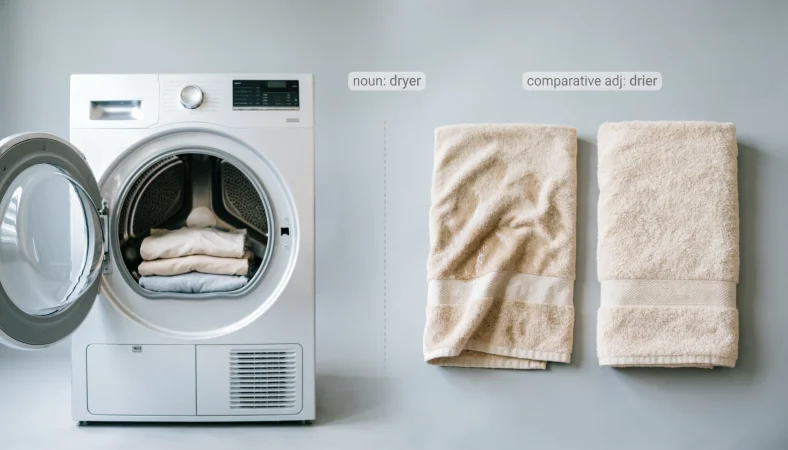
When deciding between dryer or drier, the correct choice depends on what you mean. Dryer is usually a noun for a machine that removes moisture, such as a clothes dryer, while drier is normally the comparative form of the adjective dry, meaning something has less moisture than another thing. Knowing the difference prevents common spelling and usage mistakes.
The question of dryer or drier often appears simple, but the two words have different grammatical jobs. They share the same base word, dry, yet their meanings are not identical. This small spelling difference can change the meaning of a sentence, especially when you’re writing about household appliances, weather, food, clothing, soil, or anything related to moisture.
Consider these two sentences:
The clothes are drier today.
I put the clothes in the dryer.
The first sentence compares the condition of the clothes. The second identifies a machine. Both sentences are correct, but replacing one word with the other would create a meaning problem.
The confusion becomes even more understandable because dry can function as an adjective, verb, noun, and part of several related expressions. English also allows both regular comparative forms and noun forms to develop from the same word. As a result, learners sometimes assume that drier and dryer are simply alternative spellings.
They aren’t interchangeable in standard English.
The simplest distinction is this: drier usually describes something that is more dry, while dryer usually names something that makes another thing dry. Once that relationship becomes familiar, choosing the right spelling becomes much easier.
This distinction matters in everyday communication. A person describing laundry, a kitchen appliance, a climate, a towel, or a piece of wood needs to know whether they are describing a condition or naming a device. In professional writing, accurate word choice also makes instructions and explanations clearer.
The rest of this guide explains the difference in detail, shows how each word works in real sentences, and gives practical rules you can use whenever the spelling causes hesitation.
Dryer or Drier: What’s the Difference?
The two words come from dry, but they serve different purposes.
Drier is generally the comparative form of the adjective dry. It means that something has less moisture than another thing or that a condition is becoming less wet.
For example:
This towel is drier than the other one.
Here, drier compares two towels.
Dryer is most commonly a noun. It refers to a machine or device used to remove moisture from something.
For example:
The new dryer finishes the clothes quickly.
Here, dryer identifies an appliance.
The distinction becomes clearer when we examine their grammatical roles.
| Word | Part of speech | Main meaning | Example |
| Drier | Adjective | More dry or less moist | This shirt is drier now. |
| Dryer | Noun | A device that makes something dry | The dryer is running. |
| Dryer | Sometimes a descriptive form | Something designed to dry | The dryer system works efficiently. |
| Dry | Adjective | Having little or no moisture | The towel is dry. |
| Dry | Verb | To remove moisture | Please dry the dishes. |
The word drier follows the normal comparative pattern used with many short adjectives. The base adjective is dry, and the comparative form changes the final y to i before adding er.
Thus:
dry → drier
By contrast, dryer comes from dry plus the noun forming ending er. In this use, the ending identifies something that performs an action.
Thus:
dry → dryer
This distinction is similar to the difference between describing something and naming something that performs an action.
Quick Recap
Drier normally means more dry or less moist.
Dryer normally refers to a machine or device that removes moisture.
Use drier when comparing conditions.
Use dryer when naming an appliance or drying device.
The spelling depends on the meaning, not simply on personal preference.
Is Dryer or Drier a Grammar, Vocabulary, or Usage Issue?
The difference is primarily a vocabulary and word formation issue, although grammar plays an important role.
The words are related, but they are not normally interchangeable. Their meanings come from two different uses of the ending er.
In drier, the ending creates a comparative adjective. It tells us that something is more dry than something else.
In dryer, the ending creates a noun referring to something that performs the action of drying.
This distinction can be seen through simple questions.
Ask:
Am I comparing how dry something is?
If yes, drier is usually correct.
Ask:
Am I naming a machine or object that dries something?
If yes, dryer is usually correct.
Formal and Informal Usage
Both words are completely standard in formal English. Neither is an informal spelling.
In professional writing, however, precision becomes particularly important. A product manual should identify a dryer when referring to an appliance. A scientific or academic description might use drier when comparing moisture levels.
For example:
The sample became drier after exposure to heat.
This describes a change in moisture.
Meanwhile:
The laboratory uses a specialized dryer.
This identifies equipment.
Academic Usage
Academic writing often uses drier in comparative descriptions.
The eastern region is drier than the western region.
In contrast, technical and engineering writing may use dryer when discussing equipment.
The industrial dryer operates at a controlled temperature.
The distinction therefore remains meaningful regardless of the level of formality.
How to Use Drier Correctly
Drier is the comparative form of dry. It describes something that contains less moisture or has become less wet compared with another condition.
You can use it when comparing two things directly.
This towel is drier than mine.
You can also use it when describing a change over time.
The ground became drier after several sunny days.
The comparison does not always need to be expressed with the word than. The comparative meaning can be understood from context.
The air feels drier today.
The implied comparison might be with yesterday or with the usual conditions.
Workplace Example
The storage room is drier than the production area.
Here, drier compares two environments.
Another example is:
The material needs to become drier before packaging.
The word describes the desired condition of the material.
Academic Example
The southern region has a drier climate than the coastal area.
This is a typical comparative construction. The writer is discussing climate conditions, not a machine.
Technology Example
The updated system keeps the internal chamber drier.
Again, drier describes a condition.
Usage Recap
Use drier when you mean more dry, less moist, or less wet.
It commonly appears with words such as than, become, feel, remain, and keep.
It describes a condition rather than naming an appliance.
How to Use Dryer Correctly
Dryer most commonly functions as a noun that names a machine or device used to remove moisture.
The most familiar example is a clothes dryer.
I put the wet clothes in the dryer.
The machine performs the drying action.
The word can also refer to specialized equipment used in industrial, laboratory, agricultural, and food processing settings.
The factory installed a new grain dryer.
Here, the dryer is a piece of equipment designed to reduce moisture in grain.
Workplace Example
The maintenance team inspected the industrial dryer.
The word identifies equipment in a workplace.
Academic Example
The experiment used a laboratory dryer to remove moisture from the sample.
This sentence refers to a specific piece of equipment.
Technology Example
The smart dryer automatically adjusts its drying cycle.
The word clearly identifies an appliance with technology based features.
Usage Recap
Use dryer when you mean a machine, appliance, or device that dries something.
The word usually functions as a noun.
Common examples include clothes dryer, hair dryer, industrial dryer, food dryer, and laboratory dryer.
When You Should NOT Use Drier or Dryer
Understanding when not to use each word can prevent many common errors.
1. Do not use dryer for a comparison
Incorrect:
This towel is dryer than that one.
Correct:
This towel is drier than that one.
The sentence compares moisture levels, so drier is needed.
2. Do not use drier for an appliance
Incorrect:
Put the clothes in the drier.
Correct:
Put the clothes in the dryer.
The intended meaning is a machine, so dryer is correct.
3. Do not confuse a condition with a device
If you’re saying something has lost moisture, use drier.
If you’re naming the object that removes moisture, use dryer.
4. Do not assume both spellings are regional alternatives
The difference is not simply a matter of American versus British spelling. The two words can carry different meanings.
5. Do not choose based only on pronunciation
In ordinary speech, the words can sound very similar. Written English requires you to identify the intended meaning.
6. Do not use dryer when discussing climate
For example:
The desert is drier than the rainforest.
Here, drier describes climate.
7. Do not use drier when discussing an appliance
For example:
The new dryer uses less energy.
Here, dryer names the appliance.
8. Do not treat the spelling as interchangeable
Although readers may understand the intended meaning from context, standard writing should use the form that matches the intended function.
Common Mistakes and Decision Rules
The easiest way to master the distinction is to look at common sentence patterns.
| Correct sentence | Incorrect sentence | Explanation |
| The clothes are drier now. | The clothes are dryer now. | The sentence describes their condition. |
| Put the clothes in the dryer. | Put the clothes in the drier. | The sentence refers to an appliance. |
| The soil became drier. | The soil became dryer. | The soil has less moisture. |
| The dryer stopped working. | The drier stopped working. | The word names a machine. |
| Today feels drier than yesterday. | Today feels dryer than yesterday. | The sentence compares conditions. |
| We bought a new hair dryer. | We bought a new hair drier. | The word identifies equipment. |
| The wood is drier than before. | The wood is dryer than before. | The wood has less moisture. |
| The food dryer uses controlled heat. | The food drier uses controlled heat. | The word refers to equipment. |
Decision Rule Box
If you mean more dry or less moist, use drier.
If you mean a machine or device that dries something, use dryer.
This rule covers the vast majority of everyday situations.
A useful memory trick is to connect drier with comparison and dryer with equipment.
If you can naturally say more dry, you probably need drier.
If you can replace the word with drying machine, you probably need dryer.
Dryer and Drier in Modern Technology and AI Tools
Modern technology has created more situations where both words appear in technical descriptions.
Smart appliances may include dryers with moisture sensors, automatic programs, temperature controls, and energy monitoring. In these contexts, dryer identifies the machine.
For example:
The smart dryer detects moisture levels before ending the cycle.
Meanwhile, software, sensors, and data systems may describe environmental conditions using drier.
The sensor detected drier conditions inside the chamber.
Artificial intelligence can also encounter the distinction when generating product descriptions, technical instructions, or educational material. Because the words are visually similar, an automated system may select the wrong form if the surrounding context is weak.
Human review still matters. A sentence about a machine requires a different word from a sentence describing moisture.
This is particularly important for technical content, product documentation, educational material, and search optimized writing. Correct terminology makes the meaning immediately clear.
Etymology and Word Formation
Both words are connected to the Old English word associated with dry and the absence of moisture. Modern English developed several forms from this basic adjective.
The comparative form follows a familiar English spelling pattern.
dry → drier
The final y changes to i before the comparative ending.
The noun follows another pattern.
dry → dryer
Here, the ending creates a word that identifies something performing the action of drying.
This is why the spelling difference has a meaningful grammatical explanation rather than being a random variation.
The same general pattern appears elsewhere in English. A word can gain an ending that changes its grammatical function while retaining a connection to the original meaning.
An Expert View of the Difference
A useful way to understand this distinction is to focus on function rather than spelling:
“Choose the word that matches the meaning you intend, not simply the spelling that looks familiar.”
The central issue is whether you are describing the state of something or identifying something that performs the drying action.
That approach is more reliable than trying to memorize isolated spellings.
Two Practical Case Studies
Case Study One: Laundry Instructions
Imagine a workplace creates instructions for handling uniforms.
An employee writes:
Place wet uniforms in the drier.
The intended meaning is clear to many readers, but the standard word for the appliance is dryer.
The improved instruction is:
Place wet uniforms in the dryer.
Now the sentence clearly identifies the machine.
If the same document says:
Check that the uniforms are drier before folding them.
The spelling changes because the sentence now describes their condition.
One small spelling difference therefore communicates two different ideas within the same workplace process.
Case Study Two: Climate Description
Consider a student writing about regional weather.
The student writes:
The inland region is dryer than the coastal region.
The intended meaning is understandable, but the comparative adjective should be drier.
The corrected sentence is:
The inland region is drier than the coastal region.
If the student later writes:
The research facility uses a climate controlled dryer.
The correct form becomes dryer because the sentence identifies equipment.
The two case studies demonstrate the same principle. Context determines the correct form.
Author Expertise
Author: Language and SEO Content Specialist
This guide applies practical English grammar, vocabulary, word formation, and usage principles to common spelling questions, with a focus on clear explanations that help readers make accurate choices in everyday and professional writing.
Error Prevention Checklist
Always use Drier when:
- You are comparing moisture levels.
- You mean more dry.
- You mean less wet.
- You describe a climate with lower moisture.
- You describe something becoming less moist.
- You use a comparison such as “drier than.”
Always use Dryer when:
- You mean a clothes appliance.
- You mean a hair appliance.
- You mean a machine that removes moisture.
- You mean industrial drying equipment.
- You mean specialized drying equipment in a laboratory or production setting.
Never use Dryer when:
- You are comparing how dry two things are.
- You are describing a climate condition.
- You are saying something has become less moist.
Never use Drier when:
- You are naming a machine.
- You are talking about a clothes appliance.
- You are referring to equipment designed to remove moisture.
Related Grammar Confusions You Should Master
Learning this distinction can also make other confusing word pairs easier to understand.
- dryer or drier
Understand the difference between a drying device and a comparative adjective.
- lay or lie
Learn which word describes placing something and which describes resting.
- affect or effect
Separate the common verb from the common noun.
- further or farther
Understand the difference between figurative extension and physical distance.
- fewer or less
Learn when countable and uncountable nouns require different comparative forms.
- fewer or less
Pay attention to whether you are discussing individual items or an amount.
- older or elder
Understand their different patterns of use when describing age.
- farther or further
Recognize how modern usage allows overlap while preserving useful distinctions.
- laying or lying
Connect each form to its underlying verb before choosing the spelling.
- advice or advise
Distinguish the noun from the verb through pronunciation and grammatical function.
FAQs:
What is the difference between dryer and drier?
Drier is normally the comparative form of dry, meaning more dry or less moist. Dryer is usually a noun referring to a machine or device that removes moisture.
Is it drier or dryer for clothes?
Use drier when describing the clothes themselves.
The clothes are drier now.
Use dryer when referring to the appliance.
Put the clothes in the dryer.
Is a hair dryer or hair drier correct?
Hair dryer is the standard spelling when referring to the electrical appliance used to dry hair.
Is it drier or dryer than yesterday?
The correct form is drier than yesterday when describing weather or another condition.
For example:
The air is drier than yesterday.
Why is dry spelled drier instead of dryer?
Drier is formed from the adjective dry by changing the final y to i before adding the comparative ending.
Thus:
dry → drier
Dryer has a different function and normally refers to a device.
Is dryer a noun or an adjective?
Dryer is most commonly a noun when it refers to an appliance or device. In some technical contexts, related forms can appear in descriptive compounds, but the appliance meaning is by far the most familiar.
Is drier always the correct comparative of dry?
Yes, drier is the standard comparative form of dry.
For example:
The climate is drier here.
The spelling reflects the normal rule for adjectives ending in y.
Can dryer and drier mean the same thing?
They can overlap in meaning only in unusual contexts, but they should not normally be treated as interchangeable. Drier describes a condition, while dryer normally names something that performs the drying action.
Which is correct, clothes dryer or clothes drier?
Clothes dryer is the standard form for the appliance.
How can I remember the difference between dryer and drier?
Think of drier as a comparison and dryer as equipment. If you can replace the word with more dry, choose drier. If you can replace it with drying machine, choose dryer.
Conclusion:
The difference between dryer or drier becomes straightforward once you focus on meaning. Drier is the comparative form of dry, so it describes something that is more dry or less moist. Dryer is usually a noun for a machine or device that removes moisture.
The easiest rule is simple: use drier for a comparison or changing condition, and use dryer for an appliance or drying device.
Remember the two examples:
The clothes are drier now.
The clothes are in the dryer.
The first describes the clothes. The second names the machine. Keeping that distinction in mind will help you avoid one of the most common spelling mistakes involving the word dry.