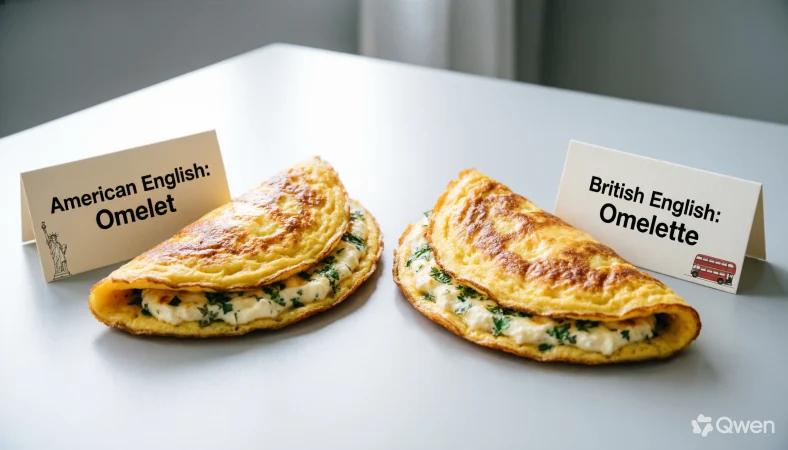
Both omelet or omelette are correct spellings of the same egg dish. “Omelet” is the standard spelling in American English, while “omelette” is preferred in British English and many other varieties of English. The difference is mainly regional spelling, not meaning, pronunciation, or the food itself.
The question omelet or omelette often causes unnecessary confusion because both forms appear in dictionaries, cookbooks, restaurant menus, school assignments, and online writing. If you have seen both spellings, you may wonder whether one is incorrect or whether they describe slightly different dishes. They do not. Both words refer to a dish made by cooking beaten eggs, usually in a pan, often with ingredients such as cheese, vegetables, herbs, or meat.
The important distinction is geographical. American English generally uses omelet, while British English generally uses omelette. Canadian, Australian, and other varieties may use either form, although “omelette” is common outside the United States. Choosing the right spelling therefore depends mostly on your audience, publication style, or preferred variety of English.
Omelet vs Omelette: What’s the Difference?
At first glance, the difference between omelet and omelette looks like a spelling mistake. In reality, both forms are established English words. They have the same basic meaning and normally refer to the same dish.
Omelet is a noun. It refers to a dish prepared from beaten eggs cooked until set, often folded around a filling.
Omelette is also a noun. It has the same meaning and describes the same general preparation.
The main difference is the variety of English in which each spelling is preferred.
| Feature | Omelet | Omelette |
| Part of speech | Noun | Noun |
| Meaning | A dish made from cooked beaten eggs | A dish made from cooked beaten eggs |
| Main spelling preference | American English | British English and many other varieties |
| Pronunciation | Generally the same | Generally the same |
| Refers to a different food | No | No |
| Formal writing | Correct | Correct |
| Casual writing | Correct | Correct |
| Best choice for US audiences | Yes | Less common |
| Best choice for UK audiences | Less common | Yes |
The two forms aren’t competing words with different definitions. They are spelling variants that developed through different English language traditions.
For an American publication, omelet will usually look more natural. For a British publication, omelette is generally the expected choice.
Quick Recap
Omelet is the preferred American English spelling.
Omelette is the preferred British English spelling.
Both words describe the same type of egg dish.
Neither spelling is inherently wrong.
Your audience should determine which spelling you choose.
Is Omelet vs Omelette a Grammar, Vocabulary, or Usage Issue?
This is primarily a spelling and regional usage issue, rather than a grammar problem.
Grammar determines how a word functions within a sentence. Both omelet and omelette function as nouns, so there is no major grammatical distinction between them.
Vocabulary is also not the main issue because both spellings represent the same vocabulary item. The difference lies in conventional spelling.
Usage matters because English has several regional standards. American English often removes letters that remain in traditional British spellings. Similar differences appear in words such as color and colour, favorite and favourite, and center and centre.
The same principle applies here.
Are They Interchangeable?
In meaning, yes. In regional style, not always.
You could write:
I ordered an omelet for breakfast.
Or:
I ordered an omelette for breakfast.
The meaning remains clear in both sentences.
However, a publication following American English style will generally prefer omelet. A British English publication will normally choose omelette.
Formal vs Casual Usage
Both spellings work in formal and casual writing. There is no rule saying that omelet is informal or that omelette is more sophisticated.
A formal American article can use omelet. A formal British newspaper can use omelette.
The spelling itself does not determine the level of formality.
Academic vs Casual Usage
Academic writing should follow the spelling conventions of the English variety being used.
For example, an American nutrition paper might refer to an “egg omelet,” while a British educational text might use “egg omelette.”
The key is consistency. Switching between the two forms without a reason can make your writing look poorly edited.
How to Use Omelet Correctly
The spelling omelet is especially useful when writing for an American audience.
American English commonly favors the shorter spelling, which contains one final letter t after the vowel sequence. You will see this form frequently in American menus, recipes, newspapers, educational materials, and general online content.
Consider these examples:
Workplace example:
The cafeteria added a vegetable omelet to the breakfast menu.
Here, omelet names a food item available at the workplace.
Academic example:
The study compared the protein content of an omelet prepared with whole eggs and vegetables.
The word works naturally in formal informational writing.
Technology example:
The recipe app recommends a cheese omelet based on the ingredients in your kitchen.
Here, the spelling fits an American English interface or digital product.
When Should You Choose Omelet?
Choose omelet when your content follows American English conventions. This is particularly useful when writing for readers in the United States or when your publication follows an American style guide.
It is also a sensible choice when consistency with other American spellings matters. If your article uses color, favorite, and center, using omelet creates a consistent regional style.
Usage Recap
Use omelet for American English.
- It is fully correct in standard English.
- It works in professional, academic, culinary, and casual contexts.
- It does not describe a different food from omelette.
How to Use Omelette Correctly
The spelling omelette is traditionally associated with British English and is also widely used in other English speaking regions.
If you are writing for a British audience, omelette is usually the natural choice. The same applies when following a style system that uses British spelling conventions.
Consider these examples:
Workplace example:
The hotel serves a freshly prepared cheese omelette during breakfast.
The spelling fits naturally in British English.
Academic example:
The researchers examined how cooking temperature affected the texture of an omelette.
This sentence could appear in formal British English writing without any spelling concern.
Technology example:
The cooking app suggests an omelette recipe using mushrooms and fresh herbs.
Again, the spelling reflects the regional English standard rather than a different recipe.
When Should You Choose Omelette?
Choose omelette when your intended audience primarily uses British English or another variety in which the spelling is conventional.
It can also be the better choice when your website, publication, institution, or client consistently uses British spelling.
For example, if the rest of your content uses favourite, colour, and centre, switching to omelet may create an inconsistent editorial style.
Usage Recap
Use omelette in British English.
- It is fully standard and correct.
- It can appear in casual or highly formal writing.
- It refers to the same dish as omelet.
When You Should NOT Use Omelet or Omelette
The biggest mistake is not choosing one spelling over the other. The bigger problem is assuming that one form is universally correct and the other is a spelling error.
Here are several situations where careless usage can create problems.
1. Do Not Call Omelette Incorrect
If you are writing American English, omelet may be your preferred spelling, but that doesn’t make omelette incorrect English.
2. Do Not Treat Them as Different Foods
The extra letters do not indicate a different recipe, cooking technique, or ingredient.
3. Do Not Mix Regional Spellings Randomly
If your article consistently follows American English, suddenly using omelette can make your editorial style look inconsistent.
4. Do Not Assume British English Is Less Formal
Omelette is not a fancy or excessively formal version of omelet. It is simply the conventional spelling in certain varieties of English.
5. Do Not Change the Spelling Based on the Recipe
A cheese omelet and a cheese omelette can refer to the same preparation. The spelling does not depend on the filling.
6. Do Not Change Forms Within One Publication Without a Reason
Consistency matters in professional content. Pick the regional standard that matches your audience and stick with it.
7. Do Not Assume Searchers Always Expect One Form
People search using both spellings. If you are writing SEO content, natural discussion of both variants can help clarify the question without treating either form as wrong.
8. Do Not Use Both Forms as Though They Have Different Meanings
The distinction is geographical and stylistic, not semantic.
Common Mistakes and Decision Rules
Understanding a spelling difference is easier when you see the mistake in context.
| Correct sentence | Incorrect sentence | Explanation |
| I made an omelet for breakfast. | I made an omelett for breakfast. | Omelett is not the standard spelling. |
| She ordered an omelette. | She ordered an omlette. | The standard British form includes the first e after the m. |
| He prefers an American style omelet. | He prefers an American style omelette. | The second version is not grammatically wrong, but omelet better matches American spelling conventions. |
| The British recipe calls it an omelette. | The British recipe calls it an omelet. | The second form can occur, but omelette is the conventional British choice. |
| I cooked a mushroom omelet. | I cooked a mushroom omlet. | Omlet is a misspelling. |
Decision Rule
If you are writing American English, use “omelet.”
If you are writing British English, use “omelette.”
This rule solves most usage questions immediately.
Omelet and Omelette in Modern Technology and AI Tools
Digital platforms have made regional spelling differences more visible.
Recipe applications, search engines, voice assistants, food delivery platforms, and AI writing tools may encounter both omelet and omelette. Modern language systems generally recognize them as spelling variants with the same core meaning.
This matters for content creators because users don’t always search with the spelling preferred by the writer.
An American user might search for:
how to make an omelet
A British user might search for:
how to make an omelette
Both searches express essentially the same intent.
AI systems also need to understand context. If a user asks for British English, an AI writing assistant should generally prefer omelette. If the user requests American English, omelet is normally the better choice.
For SEO, this means writers shouldn’t force both spellings into every paragraph. Instead, explain the distinction naturally and use the appropriate primary spelling for the intended audience.
The Etymology of Omelet and Omelette
The history of the word helps explain why English has two established spellings.
The English word comes from French omelette, which refers to the familiar egg dish. English borrowed many culinary terms from French, and this spelling became established in English usage.
Over time, American English developed its own spelling preferences. In many cases, American spelling simplified or shortened forms that remained longer in British English. Omelet became the common American form, while omelette remained established in British English.
This pattern is not unusual. English contains many regional spelling pairs that developed through historical and editorial differences rather than differences in meaning.
The result is a word that looks different across regions while continuing to refer to the same food.
••
An Expert Perspective on Omelet vs Omelette
A useful way to understand the distinction is to separate correctness from regional preference.
“A spelling difference does not necessarily create a difference in meaning.”
That principle applies particularly well here. Both spellings are recognized forms. The writer’s responsibility is to choose the form that fits the intended variety of English.
For editors, consistency usually matters more than trying to identify one spelling as universally superior.
If the target audience uses American English, omelet is the logical editorial choice. If the target audience uses British English, omelette is generally more appropriate.
Two Practical Case Studies
Case Study 1: An American Recipe Website
Imagine an American recipe website publishing a breakfast recipe for eggs, cheese, peppers, and onions.
The site’s existing content uses American spellings such as color, favorite, and center. The editor chooses omelet throughout the recipe.
The result is a consistent regional voice:
Favorite Vegetable Omelet
Add the colorful vegetables to the center of the pan.
In this context, omelet fits the site’s established spelling system.
The concrete editorial result is regional consistency. Readers encounter one coherent American English standard rather than a mixture of regional forms.
Case Study 2: A British Hotel Menu
Now consider a hotel in the United Kingdom preparing a breakfast menu.
The menu uses British spellings and terminology throughout. The chef lists:
Cheese and Mushroom Omelette
Using omelette fits the language conventions expected by the hotel’s primary audience.
The concrete result is style consistency and audience alignment. The spelling feels natural within the surrounding British English environment.
These examples demonstrate an important point: neither spelling needs to be eliminated. The best choice depends on context.
Error Prevention Checklist
Always use Omelet when
- ☑ You are writing primarily for an American audience.
- ☑ Your publication follows American English.
- ☑ Your surrounding content uses American spelling conventions.
- ☑ You want the standard American dictionary form.
- ☑ You are maintaining consistency with other American spelling choices.
Always use Omelette when
- ☑ You are writing primarily for a British audience.
- ☑ Your publication follows British English.
- ☑ Your surrounding content uses British spelling conventions.
- ☑ You are following a British editorial style.
- ☑ You want the spelling most familiar to many British readers.
Never Treat These as Different Foods
Both forms can describe the same egg dish.
The spelling does not tell you whether the omelet contains cheese, vegetables, meat, herbs, or other ingredients.
Related Grammar Confusions You Should Master
Understanding regional spelling differences can help with many other commonly confused forms.
- Color or colour
American English usually prefers color, while British English generally uses colour. - Favorite or favourite
American English usually uses favorite, while British English uses favourite. - Center or centre
American English generally uses center, while British English uses centre. - Catalog or catalogue
Both forms are established, with regional preferences. - Theater or theatre
American English commonly uses theater, while British English often uses theatre. - Realized or realised
American English usually uses realized, while British English commonly uses realised. - Defense or defence
American English prefers defense, while British English generally uses defence. - Modeling or modelling
American English generally uses modeling, while British English often uses modelling. - Aging or ageing
American English commonly uses aging, while British English frequently uses ageing. - Worshiped or worshipped
American English generally prefers worshiped, while British English commonly uses worshipped.
The broader lesson is simple: English spelling can vary by region without changing the underlying meaning of a word.
FAQs:
What is the correct spelling, omelet or omelette?
Both omelet and omelette are correct. Omelet is the standard American English spelling, while omelette is the preferred spelling in British English and is also common in several other English varieties.
Is omelet American or British English?
Omelet is primarily associated with American English. British English generally prefers omelette.
Is omelette spelled correctly?
Yes. Omelette is a standard and widely accepted English spelling. It is especially common in British English.
Is omelet spelled correctly?
Yes. Omelet is a standard English spelling and is especially common in American English.
Are omelet and omelette the same thing?
Yes. In ordinary English usage, both words refer to the same type of egg dish. The difference is primarily spelling and regional convention.
Why does American English spell omelette as omelet?
American English often favors shorter spellings in certain words. Omelet became the established American form, while omelette remained common in British English.
Which is correct for a US audience, omelet or omelette?
For a US audience, omelet is generally the better choice because it follows standard American English spelling conventions.
Which is correct for a UK audience, omelet or omelette?
For a UK audience, omelette is generally preferred. It matches conventional British English spelling.
Should I use omelet or omelette in an SEO article?
Use the spelling that matches your primary audience and regional English standard. You can mention both forms naturally when the article specifically explains the spelling difference.
Conclusion:
The choice between omelet or omelette is not a question of right versus wrong. Both spellings are correct, and both refer to the same familiar egg dish. The real distinction is regional usage.
Choose omelet for American English. Choose omelette for British English and contexts that follow British spelling conventions.
If you’re writing for a specific audience, consistency should guide your decision. A US focused website will normally look more natural with omelet, while a UK focused publication will generally benefit from omelette. Neither form is more intelligent, formal, or authentic than the other.
Once you recognize this as a regional spelling difference, the choice becomes straightforward. Match the spelling to your audience, keep your editorial style consistent, and you won’t need to second guess the word again.