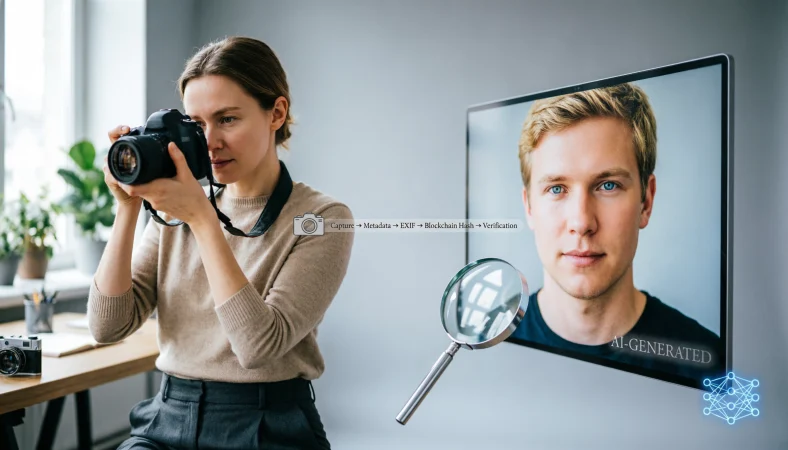
AI or real asks whether a piece of content, such as an image, video, audio clip, or text, was created by artificial intelligence or by a person. AI generated content can look and sound highly realistic, so appearance alone may not provide enough evidence.
Checking context, source information, inconsistencies, metadata, and reliable verification methods can help you make a more informed judgment.
Is that photo, video, voice recording, or piece of writing AI or real? As generative AI becomes increasingly capable, distinguishing human created content from AI generated material has become more difficult. A realistic appearance doesn’t automatically prove that something is authentic, and a few unusual details don’t necessarily prove AI involvement.
This guide explains practical ways to evaluate content, recognize common clues, understand the limitations of AI detection tools, and make more informed judgments using reliable digital literacy principles.
AI vs Real: What’s the Difference?
The terms “AI” and “real” are not technically opposite categories.
AI stands for artificial intelligence. In this context, it usually refers to content produced or significantly transformed using an artificial intelligence system.
Real generally means that the content represents something that actually existed, happened, or was created through ordinary human activity rather than being entirely synthesized by an AI system.
The distinction becomes more complicated when human and AI contributions overlap.
A person might take a real photograph and use AI to remove an object. Another person might write an article themselves and use AI to improve grammar. Someone else might generate an entirely fictional image from a text prompt.
All three examples involve different degrees of human and machine involvement.
| Aspect | AI generated content | Human created or real content |
| Main creator | AI system | Human creator or real world event |
| Source | Generated from learned patterns or supplied instructions | Human activity, observation, recording, or creation |
| Examples | Synthetic image, generated voice, AI written passage | Original photograph, human written essay, live recording |
| Authenticity | May depict something that never existed | Usually connected to an actual creator or event |
| Verification | Often requires contextual or technical evidence | Can sometimes be verified through original sources |
| Human involvement | May range from minimal to extensive | Primarily human controlled |
The important distinction
AI generated does not automatically mean fake.
Human created does not automatically mean accurate.
A real photograph can document a false claim.
An AI generated image can accurately illustrate an imaginary concept.
The most useful question is therefore not simply whether something is AI or real. It is what was created, how was it created, and what does it claim to represent?
Is AI or Real a Technology, Authenticity, or Verification Issue?
The question is primarily an authenticity and verification issue, although technology plays a major role.
People often assume that AI content has a recognizable appearance. That assumption is becoming less reliable. Modern generative systems can produce realistic images, natural sounding speech, convincing text, and sophisticated video.
There is also an important middle category: AI assisted content.
For example, suppose a writer creates an article from personal research and then uses an AI tool to reorganize paragraphs. Calling the final article simply “AI generated” would leave out important information about the human contribution.
Likewise, an artist might create an illustration manually and use an AI tool for background experimentation. The finished work does not necessarily belong neatly in a human versus AI binary.
Is AI content always fake?
No.
AI can generate fictional material, but it can also summarize real information, transform existing material, translate text, enhance images, and assist with legitimate creative work.
The term “AI generated” describes a production method. It does not automatically describe whether the information is true.
Is real content always trustworthy?
No.
A genuine photograph can be presented with a misleading caption. A real video can be edited to remove important context. A real person’s statement can be quoted inaccurately.
Authenticity and truth are related but separate concepts.
A piece of content can be completely real while supporting a false interpretation.
Formal versus casual usage
In casual conversation, people may say:
“Is this AI or real?”
In professional or academic settings, more precise questions are preferable:
“Was this image synthetically generated?”
“Is this photograph an original recording?”
“Was this text generated or substantially assisted by an AI system?”
“Can the source of this media be independently verified?”
The more specific the question, the easier it becomes to evaluate the answer.
How to Identify AI Generated Content
There is no single visual clue that proves something was generated by AI.
Instead, several clues can be considered together.
Examine unusual details
AI generated images have historically been associated with strange hands, inconsistent text, unusual objects, distorted jewelry, unrealistic reflections, and inconsistent physical structures.
However, these clues should not be treated as proof. Generative systems continue to improve, and human created images can also contain editing mistakes.
Look at text inside images
Synthetic images sometimes struggle with signs, labels, packaging, menus, screens, and other written material.
Look for:
“Almost correct” words
Letters that appear merged
Unusual spelling
Inconsistent fonts
Text that changes between parts of the same object
These clues can raise suspicion, but they are not definitive.
Examine lighting and reflections
Ask whether shadows, reflections, and highlights behave consistently.
For example, if a person appears in front of a reflective surface, check whether the reflection corresponds correctly with the person’s position.
Again, a mistake does not automatically prove AI generation because photography and editing can create similar problems.
Consider the context
Context is often more valuable than appearance.
Ask:
Who published it?
When was it published?
Where did it first appear?
Is there an original source?
Do reputable independent sources show the same event?
Does the claimed location exist?
Can the person or organization be verified?
A visually convincing image with no credible source deserves more scrutiny than a similar image accompanied by a traceable original record.
Usage recap
Treat visual artifacts as clues, not proof. Stronger verification comes from combining appearance, source information, metadata when available, and independent evidence.
How to Evaluate Real Human Created Content
Determining that something was created by a human does not automatically establish that it is authentic or accurate.
Consider a photograph posted with the caption:
“This happened yesterday.”
The image may be a genuine photograph taken years ago.
The content itself is real, but the claim attached to it is misleading.
Workplace example
Imagine an employee receives an unusual email supposedly from a company executive.
The message might be written by a person, generated by AI, or produced through a combination of both. Instead of focusing only on writing style, the employee should verify the sender and request confirmation through an established communication channel.
Academic example
A student submits an essay that appears polished and well structured.
Rather than assuming it is either completely human or completely AI generated, an instructor might examine the student’s research process, drafts, citations, writing history, and understanding of the material.
The important question becomes authorship and learning, not merely whether a detector produces a particular score.
Technology example
Suppose a screenshot claims to show a new feature in a popular application.
The screenshot may be genuine, edited, or AI generated. Checking the application’s actual documentation or independently reproducing the feature is more reliable than judging the screenshot alone.
Usage recap
Human appearance, natural writing, or realistic photography does not establish authenticity by itself. Evidence should be evaluated in context.
When You Should NOT Assume Content Is AI Generated
One of the biggest mistakes in modern media analysis is treating unusual content as automatic evidence of artificial intelligence.
1. Do not assume polished writing is AI
Experienced writers can produce clean, organized, natural prose.
2. Do not assume mistakes prove human authorship
People make mistakes, and AI systems can also intentionally or unintentionally produce imperfect text.
3. Do not assume strange images are AI
Poor photography, compression, editing, unusual lenses, and image manipulation can create visual anomalies.
4. Do not rely on one AI detector
Automated detection systems can produce false positives and false negatives.
5. Do not assume a watermark proves authenticity
Watermarks can be added, removed, copied, or manipulated.
6. Do not assume metadata is permanent proof
Metadata can be altered or removed during editing, uploading, conversion, or redistribution.
7. Do not treat social media comments as verification
A large number of people claiming that something is AI does not establish that it is AI.
8. Do not confuse AI assistance with complete AI generation
Human and AI contributions can exist together.
Common Mistakes and Decision Rules
| Correct approach | Incorrect assumption | Explanation |
| Check the original source | It looks real, so it is real | Appearance does not establish provenance |
| Compare independent sources | Many people shared it, so it is authentic | Popularity is not verification |
| Examine context | The image has strange details, so it must be AI | Human editing can produce anomalies |
| Consider multiple clues | One detector says AI, so it is definitely AI | Detection systems can be imperfect |
| Ask how the content was produced | AI was involved, so the content is fake | AI assistance does not necessarily make content false |
| Verify the claim separately | The photograph is real, so the caption is true | Real media can carry misleading claims |
| Look for provenance | No watermark means it is fake | Watermarks are not universal authenticity markers |
Decision Rule Box
If you are evaluating authenticity, verify the source and context rather than relying on appearance alone.
If you are evaluating authorship, determine how much human and AI involvement occurred rather than forcing everything into two categories.
AI or Real in Modern Technology and AI Tools
Modern AI tools make the distinction between synthetic and human content more complicated because they can operate at many different levels.
An AI system can create content from nothing.
- It can modify an existing photograph.
- It can rewrite human text.
- It can translate a document.
- It can clone or synthesize a voice.
- It can enhance an existing recording.
- It can generate an image based on a real person’s appearance.
These scenarios have different implications.
AI generated
The system produces the primary content.
AI assisted
A human creates the underlying material but uses AI to help with part of the process.
AI edited
Existing human created content is modified using AI.
Human created
The content is primarily produced through human activity without generative AI playing a substantial creative role.
These categories are more informative than simply asking whether something is “AI or real.”
Why AI Detection Tools Are Not Perfect
AI detection sounds simple in theory.
A system examines text or media and attempts to determine whether an AI model produced it.
In practice, this is difficult.
Human writing varies enormously. Different people have different vocabulary, sentence structures, levels of formality, and writing habits.
AI systems can also generate text with considerable variation.
A detector therefore cannot simply identify one universal “AI style.”
There is another problem: AI assisted writing can be indistinguishable from ordinary human editing in some cases.
For example, a person might write:
“I think the main reason this happened is because the project lacked clear planning.”
An AI tool could produce a very similar sentence.
That does not mean the sentence contains a reliable fingerprint revealing its origin.
For this reason, detection results are best treated as one piece of evidence rather than an absolute verdict.
Etymology and Meaning of AI and Real
The abbreviation AI comes from “artificial intelligence.” The term refers broadly to computational systems designed to perform tasks associated with forms of intelligence, such as learning from data, recognizing patterns, generating language, or making predictions.
The word artificial comes through Latin roots associated with something made or produced by human skill.
The word real has a different history. It developed through French and Latin forms associated with things that are actual, existing, or relating to reality.
The contrast between artificial and real therefore predates modern computer technology.
What has changed is the ability of artificial systems to produce representations that closely resemble photographs, voices, conversations, artwork, and other forms of human created material.
Two Practical Case Studies: AI or Real in Everyday Situations
Case Study 1: A suspicious photograph
Imagine a photograph circulating online showing an unusual event.
At first glance, it appears completely authentic.
A viewer notices that one person’s hand looks unusual and concludes that the photograph must be AI generated.
That conclusion may be wrong.
The image could instead be a real photograph affected by compression, motion blur, unusual lighting, or digital editing.
A stronger investigation would examine the original uploader, publication date, related photographs, location, and independent reports about the event.
The result is a more defensible conclusion because it is based on multiple forms of evidence.
Case Study 2: A suspicious voice recording
Suppose someone receives an audio recording that appears to contain a familiar person’s voice.
The voice sounds convincing.
Instead of trusting the recording immediately, the listener contacts the person through a known phone number.
The person confirms that they never made the recording.
The important lesson is that audio realism is not enough to establish authenticity.
The verification process matters more than the listener’s first impression.
Expert Style Explanation
“Authenticity is not determined by how realistic content looks or sounds. It is established through evidence about its source, creation, context, and provenance.”
This principle is useful because technology constantly changes what synthetic content can imitate. A detection method that works well today may become less dependable as generation systems improve.
The safest approach is therefore evidence based rather than appearance based.
Error Prevention Checklist
Always do these things when evaluating content
- Check where the content originated.
- Look for an original version.
- Compare important claims with independent sources.
- Consider when and where the content supposedly appeared.
- Separate the authenticity of the media from the truth of its caption.
- Consider whether AI assistance could have been involved without replacing the human creator.
- Treat automated detection as supporting evidence rather than absolute proof.
Never do these things
- Never assume polished content is automatically AI generated.
- Never assume imperfect content is automatically human.
- Never treat one detector result as conclusive.
- Never assume a realistic image is necessarily authentic.
- Never confuse AI assistance with complete AI authorship.
- Never use appearance alone to determine provenance.
Related Digital Literacy Questions You Should Master
Understanding AI authenticity becomes easier when you also understand related concepts.
- AI generated or AI assisted: Learn why these terms describe different levels of machine involvement.
- Deepfake or real: Understand how synthetic video and audio can imitate real people.
- Edited or original: Learn why manipulation does not necessarily mean an image was generated from nothing.
- Synthetic media or authentic media: Understand the broader terminology used for generated content.
- Human written or AI written: Consider authorship, assistance, editing, and provenance.
- AI image or photograph: Look beyond visual appearance and investigate source information.
- AI voice or real voice: Consider whether the recording can be independently verified.
- AI video or real footage: Evaluate both the media and the context surrounding the claimed event.
- Fake news or real news: Separate media authenticity from the accuracy of the underlying claim.
- AI detector accuracy: Understand why automated classification should not automatically be treated as a final verdict.
FAQs.
What does AI or real mean?
“AI or real” is a question about whether a piece of content was generated or significantly created using artificial intelligence or whether it originated from a human creator or an actual real world event.
How can you tell if a picture is AI or real?
Look at visual details such as text, hands, reflections, shadows, and object consistency, but do not treat any single clue as proof. Source information, original files, publication history, and independent evidence can provide stronger verification.
Can AI generated images look completely real?
Yes. Modern image generation systems can produce highly realistic images. Because visual realism is not proof of authenticity, examining the source and context is important.
Can AI detectors tell if something is AI generated?
AI detection systems can provide an indication, but their results should not automatically be treated as definitive. False positives and false negatives are possible, and AI assisted content can make classification particularly difficult.
Is AI generated content fake?
Not necessarily. AI generated content can be fictional, illustrative, educational, creative, or informational. Whether something is fake depends on what it claims to represent and whether that representation is misleading.
What is the difference between AI generated and AI assisted content?
AI generated content has a substantial portion of its primary content produced by an AI system. AI assisted content involves a human creator who uses AI for a particular part of the process, such as editing, brainstorming, translation, or restructuring.
Can real photos be edited with AI?
Yes. A genuine photograph can be modified using AI tools. This creates a category that is neither simply an untouched photograph nor an entirely synthetic image.
How do I know if a video is AI generated?
Look for inconsistencies in faces, movement, lighting, speech synchronization, reflections, and context, but verify the source as well. Don’t consider a convincing video authentic solely because it looks realistic.
Why is it becoming harder to tell AI from real content?
Generative AI systems are becoming better at reproducing realistic visual details, language, voices, and movement. At the same time, conventional editing tools can also create highly convincing alterations. This makes provenance and independent verification increasingly important.
Is AI or real the same as fake or real?
No. “AI or real” refers to how someone created the content, while “fake or real” refers to whether the content is authentic, genuine, or misleading. AI generated content can be truthful in some contexts, while human created content can still be misleading.
Conclusion:
The question of whether something is AI or real sounds straightforward, but modern technology has made the answer considerably more nuanced. Content can be completely human created, entirely AI generated, or produced through a combination of human creativity and artificial intelligence.
The most important lesson is that appearance alone is not enough.
A realistic image can be synthetic. A strange image can be genuine.People can write polished articles. AI can generate natural sounding passages. Someone can even pair a real photograph with a false caption.
Instead of asking only whether content looks real, examine its source, creation process, context, and supporting evidence. When possible, find the original version and compare the claim with independent information.
As AI technology continues to develop, digital literacy will become less about spotting one obvious visual clue and more about understanding provenance, context, authorship, and evidence. That approach provides a much stronger answer whenever you encounter the question of AI or real content.







2 thoughts on “AI or Real: How To Tell Whether Content Is AI Generated Or Authentic In 2026.”