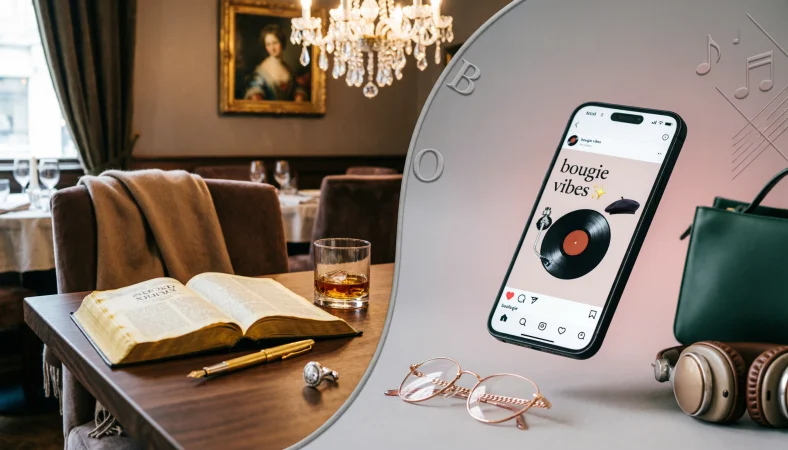
Bougie is the more established spelling, while boujee is a popular stylized variant associated with modern slang, hip hop, social media, and pop culture. Both can describe someone or something perceived as luxurious, upscale, sophisticated, or overly concerned with status. The spelling and tone differ more than the basic meaning.
If you’ve seen both boujee or bougie, you’re not imagining the confusion. The two forms are closely related, and people often use them interchangeably in casual conversation. However, they can carry slightly different cultural and stylistic associations. Understanding the distinction helps you choose the form that fits your audience, whether you’re writing a text, social media caption, workplace message, article, or academic discussion.
The word itself has an interesting history. Its modern slang meaning ultimately connects to bourgeois, a French term associated with the middle class and later with conventional material comfort, social status, and respectability. Over time, English speakers shortened and reshaped the word into the familiar slang forms used today.
Boujee vs Bougie: What’s the Difference?
The simplest answer is that bougie is the more established spelling, while boujee is a modern informal variant that became especially prominent in popular culture.
Both forms can function as adjectives in contemporary slang. They generally describe something that appears luxurious, upscale, fashionable, expensive, sophisticated, or associated with a comfortable lifestyle.
| Term | Part of speech | General meaning | Typical tone | Common setting |
| Bougie | Adjective and slang noun | Upscale, sophisticated, luxurious, status conscious | Informal, sometimes playful or critical | Conversation, writing, culture |
| Boujee | Adjective and slang noun | Fancy, luxurious, stylish, often extravagantly so | Highly informal, playful, contemporary | Social media, music, texting, pop culture |
The distinction isn’t as simple as saying that one is correct and the other is incorrect.
Bougie has a longer history in English and is closer to the original form connected with bourgeois.
Boujee developed as a stylized spelling that became strongly associated with contemporary popular culture.
Both can communicate the idea of being fancy or upscale.
The spelling you choose should depend on context, audience, and the tone you want.
Is Boujee vs Bougie a Grammar, Vocabulary, or Usage Issue?
This is primarily a spelling, vocabulary, and usage issue, rather than a grammar problem.
The two forms don’t represent two different grammatical concepts. Instead, they are different spellings of a slang term whose meaning has evolved over time.
In casual speech, there is usually no meaningful pronunciation distinction between them. The difference becomes visible when the word is written.
That distinction matters because spelling can communicate tone.
Writing boujee can make a sentence feel more playful, contemporary, humorous, or connected to internet and pop culture language.
Writing bougie can feel more established and conventional, although it remains informal in many contexts.
Are Bougie and Boujee Interchangeable?
In casual conversation, they often are.
For example:
That restaurant is so bougie.
and:
That restaurant is so boujee.
Both can communicate the idea that the restaurant feels expensive, stylish, sophisticated, or somewhat extravagant.
However, the forms aren’t always interchangeable stylistically.
If you’re writing an article about language, culture, sociology, or the history of the term, bougie is generally the safer choice.
If you’re writing a humorous social media caption, meme, text message, or deliberately playful sentence, boujee may better match the intended voice.
Formal vs Informal Usage
Neither spelling is ideal for highly formal professional writing unless you’re discussing the word itself.
Instead of writing:
The company introduced a bougie office environment.
a formal writer might say:
The company introduced a more luxurious and upscale office environment.
But if the purpose of the article is to discuss slang, the word itself is completely appropriate.
For example:
The term bougie is commonly used to describe perceived luxury or status consciousness.
Here, the word is the subject of discussion, so there is no problem using it in an educational context.
Academic vs Casual Usage
Academic writing requires additional care because the term can be subjective.
Calling someone bougie may express judgment rather than provide an objective description.
For instance:
She has a bougie lifestyle.
sounds conversational and potentially judgmental.
A more neutral academic description might be:
She participates in a lifestyle associated with luxury consumption and social status.
The difference illustrates an important point. Bougie carries attitude and cultural meaning that a neutral phrase may not.
How to Use Bougie Correctly
Bougie is useful when you want to describe something as upscale, expensive, sophisticated, fashionable, or associated with a particular image of luxury.
The word can be positive, negative, teasing, or neutral depending on context.
Workplace Example
Imagine coworkers discussing an expensive restaurant chosen for a business dinner.
Someone might say:
This place is pretty bougie.
The speaker could mean that the restaurant is elegant and expensive. Depending on tone, the statement might be admiration, humor, or mild criticism.
In a professional email, however, a more precise description would usually be preferable.
Instead of:
We booked a bougie restaurant.
you could write:
We booked an upscale restaurant for the client dinner.
Academic Example
In cultural analysis, the term can be useful when discussing language and social identity.
For example:
The word bougie can describe a lifestyle associated with luxury, consumption, and perceived social status.
Here, the writer isn’t necessarily calling a person bougie. The term itself is being analyzed.
Technology Example
Social media has played a major role in spreading and reshaping slang vocabulary.
Someone might post:
My new home office is looking bougie.
The word communicates more than simple expense. It can suggest an aesthetic involving stylish furniture, attractive lighting, premium accessories, and an intentionally luxurious appearance.
Usage Recap
Use bougie when you want the established modern spelling.
It works well for discussing upscale lifestyles, luxury, fashion, food, interiors, and social status.
Its meaning depends heavily on tone, so it can be complimentary, humorous, or critical.
How to Use Boujee Correctly
Boujee is best understood as a highly informal and stylized spelling.
Its popularity is closely connected to contemporary music and internet culture. The spelling can make a sentence sound more playful or deliberately slangy.
Workplace Example
In a private message between coworkers who have a relaxed relationship, someone might write:
We’re getting boujee with the new office coffee machine.
The speaker isn’t necessarily making a serious socioeconomic observation. They’re using slang humorously to suggest that the new machine feels fancy.
In official workplace documents, however, the word would usually be unnecessary.
Academic Example
An academic writer might use boujee when analyzing contemporary slang or popular culture.
For example:
The spelling boujee reflects the creative orthographic patterns common in digital communication.
Here, the spelling is relevant because the researcher is examining the form itself.
Technology Example
On social media, boujee can be used as a humorous label for premium technology.
For example:
This little desk setup is getting boujee.
The meaning could involve expensive equipment, attractive design, or simply an exaggerated sense of luxury.
Usage Recap
Use boujee when you want a deliberately casual and contemporary tone.
It works particularly well in social media, texting, memes, entertainment writing, and playful conversation.
It is less appropriate when neutral or formal language is required.
The Cultural Meaning Behind Bougie
The meaning of bougie goes beyond simply saying that something is expensive.
The term can refer to social identity and perceived status.
Someone may call a restaurant bougie because it has expensive food, elegant decorations, complicated menus, and an exclusive atmosphere.
But the word can also be used ironically.
Someone might buy a relatively ordinary item and joke:
Look at me being bougie today.
In that context, the speaker may not genuinely consider the purchase luxurious. The humor comes from exaggerating the sense of sophistication.
This flexibility is one reason the word became so useful in modern slang.
It can simultaneously communicate admiration, criticism, irony, and self awareness.
When You Should NOT Use Boujee or Bougie
There are several situations where using either spelling can weaken your writing.
1. Formal business communication
If you’re preparing a contract, business proposal, official report, or formal workplace announcement, choose precise descriptive language instead.
2. Academic writing without explanation
If your audience may not know the term, introduce and explain it before relying on it.
3. Objective descriptions
Calling something bougie can express an opinion. If neutrality matters, describe the actual characteristics instead.
4. Legal or technical documents
The slang term can introduce ambiguity. Words such as luxurious, premium, upscale, or status oriented may be more precise.
5. Professional news reporting
If the word is not part of a quotation or cultural analysis, a neutral description may be clearer.
6. When discussing socioeconomic groups
Be careful about using bougie as a label for people. It can carry judgment and stereotypes depending on context.
7. When you need historical precision
Don’t assume that modern bougie and bourgeois have exactly the same meaning. Their relationship is historical and linguistic, but their modern usage differs.
8. When the tone doesn’t support slang
A serious sentence can sound unintentionally humorous if an informal slang word is inserted without a clear reason.
Common Mistakes and Decision Rules
| Correct sentence | Incorrect or weaker sentence | Explanation |
| That hotel looks bougie. | That hotel looks bourgeois. | Bougie is the natural modern slang choice for casual discussion of perceived luxury. |
| Her apartment is very bougie. | Her apartment is very bourgeois. | The first sounds contemporary and conversational. The second has a different historical and social meaning. |
| This is a boujee little setup. | This is a bougie little setup. | Both can work, but boujee creates a more playful stylized tone. |
| The article examines the term bougie. | The article examines the term boujee. | Either can be discussed, but bougie is generally the more established form. |
| The restaurant feels upscale. | The restaurant feels bougie. | The first is more neutral and suitable for formal description. |
| That luxury apartment is bougie. | That luxury apartment is cheap. | The words communicate very different evaluations. |
Decision Rule Box
- If you want the established modern slang spelling, choose bougie.
- If you want a playful, highly informal, stylized spelling associated with contemporary pop culture, choose boujee.
- If you need neutral formal language, use a precise term such as upscale, luxurious, premium, or sophisticated instead.
Boujee or Bougie in Modern Technology and AI Tools
Modern digital communication has accelerated the spread of slang.
Social media platforms make spelling variations particularly visible because users constantly create shortened, humorous, exaggerated, or phonetic forms of existing words.
AI tools also encounter both forms because modern language datasets contain conversations, social media language, entertainment content, articles, dictionaries, and other forms of written communication.
An AI system may recognize both bougie and boujee as referring to the same broad concept. However, context still matters.
For example, an AI writing assistant generating a formal business report should probably avoid both terms unless the subject specifically concerns slang.
A social media caption, on the other hand, can intentionally use boujee because the playful spelling contributes to the voice.
This illustrates an important principle of modern language technology: correctness isn’t always about selecting one universally correct spelling. It can also involve selecting the form that matches audience, purpose, and tone.
The Etymology of Bougie
The history of bougie is connected with the word bourgeois.
Bourgeois comes from French and historically referred to a person associated with the middle class or a town based social group. The word eventually acquired broader economic, political, and cultural meanings.
English speakers later developed the shortened slang form bougie.
The modern slang meaning developed around ideas associated with middle class comfort, material consumption, sophistication, and social aspiration.
The word therefore has a fascinating semantic history. A term that originally related to social class eventually became a casual way of describing something that appears fancy, expensive, or status conscious.
The spelling boujee represents a later popularized variation rather than an entirely separate word with an unrelated origin.
How Popular Culture Changed the Word
One of the most important developments in the modern history of the term came from popular music.
The 2016 Migos song “Bad and Boujee” played a major role in bringing the spelling boujee into mainstream popular culture. The song became a major commercial and cultural success, and the phrase spread widely through social media, memes, music discussions, and everyday slang.
This is an excellent example of how popular culture can influence spelling.
Before widespread mainstream exposure, bougie was already an established form. The popularity of boujee helped make the alternate spelling highly recognizable to a much larger audience.
The result was not simply the creation of a new word. Instead, an existing slang concept gained a highly visible alternate spelling and a stronger association with contemporary youth culture and music.
Two Cultural Case Studies
Case Study 1: The Rise of Bougie in Everyday English
The development of bougie illustrates semantic expansion.
The term moved beyond a narrow reference to social class and became a flexible adjective for restaurants, clothing, vacations, homes, food, beauty products, and personal habits.
A person could call an expensive coffee bougie, a luxury hotel bougie, or an elaborate skincare routine bougie.
The concrete result was increased flexibility. The term could describe not only a person’s social identity but also an individual object, experience, or aesthetic.
Case Study 2: The Popularity of Boujee Through Music
The mainstream success of “Bad and Boujee” gave the spelling boujee enormous cultural visibility.
The result was a noticeable expansion of the spelling into memes, captions, jokes, merchandise references, and casual digital communication.
This case demonstrates how entertainment can influence vocabulary and orthography. A spelling variation can become recognizable not because it follows traditional spelling conventions, but because millions of people repeatedly encounter and reproduce it.
Is Bougie a Compliment or an Insult?
It can be either.
Consider:
Her wedding was so bougie.
This might mean the wedding was luxurious, elegant, and impressive.
But someone else might say:
He’s too bougie for this place.
That sentence may criticize someone for appearing overly concerned with luxury or status.
Tone is therefore essential.
A word can describe the same behavior while communicating very different attitudes.
Context, speaker intention, and relationship all influence interpretation.
Is Boujee More Correct Than Bougie?
No.
Boujee isn’t simply the “correct” replacement for bougie.
The two spellings serve different stylistic functions.
Bougie is the more established spelling and is generally the better choice when discussing the word in educational, linguistic, or explanatory writing.
Boujee is a widely recognized informal variant with strong associations with modern popular culture.
Neither needs to be treated as a grammatical error when used appropriately.
Error Prevention Checklist
Always use bougie when:
- You want the more established modern spelling.
- You’re writing an educational article about the term.
- You’re discussing slang in a relatively neutral way.
- You want a contemporary but less deliberately stylized spelling.
- You’re explaining the relationship between modern slang and bourgeois.
Use boujee when:
- You’re intentionally using a playful slang style.
- You’re writing a social media caption.
- You’re referencing contemporary pop culture.
- You’re trying to create a humorous or exaggerated tone.
- The spelling itself is relevant to the discussion.
Avoid both when:
- The context requires highly formal language.
- You need an objective socioeconomic description.
- The reader may misunderstand the term.
- A precise word such as luxurious, upscale, premium, or sophisticated would communicate the idea more clearly.
Related Grammar and Vocabulary Confusions You Should Master
Language learners frequently encounter other pairs where spelling, pronunciation, meaning, or register creates uncertainty.
- Gray or grey, where regional spelling conventions differ.
- Color or colour, where American and British spelling conventions differ.
- Canceled or cancelled, where spelling conventions vary by regional English.
- Favorite or favourite, another American and British spelling distinction.
- Toward or towards, where both forms are standard but regional preferences vary.
- Among or amongst, where usage and register can influence the choice.
- Learned or learnt, where regional and stylistic preferences differ.
- While or whilst, where register plays an important role.
- Everyday or every day, where meaning depends on grammatical function.
- Advice or advise, where pronunciation and grammatical category distinguish the words.
FAQs
Is bougie or boujee the correct spelling?
Bougie is the more established spelling, while boujee is a widely recognized informal variant. Both are used in contemporary English, but boujee has a stronger association with popular culture and playful slang.
What does bougie mean?
Bougie generally means luxurious, upscale, sophisticated, fashionable, or associated with material comfort and social status. It can be complimentary, humorous, ironic, or critical depending on context.
What does boujee mean?
Boujee has essentially the same broad modern meaning as bougie. It is often used to describe something fancy, luxurious, stylish, or perceived as status conscious.
Is boujee a real word?
Yes. Boujee is a widely recognized slang spelling used in contemporary English, particularly in casual conversation, social media, entertainment, and popular culture.
Why are there two spellings, bougie and boujee?
The two spellings developed through different stages of slang usage. Bougie has a longer established history, while boujee became especially prominent as a stylized spelling through contemporary popular culture.
Is bougie short for bourgeois?
Bougie is historically connected with bourgeois, although the modern slang word does not have exactly the same meaning. Bougie developed as a shortened slang form associated with ideas of luxury, comfort, status, and sophistication.
Is calling someone bougie an insult?
Not necessarily. It depends on context and tone. Someone may use bougie positively to describe sophistication or luxury, or negatively to criticize perceived materialism or excessive concern with status.
Should I use bougie in formal writing?
Usually, no, unless you’re discussing the term itself. In formal writing, alternatives such as luxurious, upscale, premium, sophisticated, or status conscious may be more precise.
Why did boujee become popular?
The spelling became especially visible through popular culture, including the 2016 Migos song “Bad and Boujee.” Its mainstream success helped spread the spelling widely through music, social media, memes, and everyday slang.
Conclusion:
The choice between boujee or bougie is mostly a matter of spelling, style, and context rather than a difference in basic meaning. Bougie is the more established modern form and is generally the safer choice when discussing the term objectively. Boujee is a highly recognizable informal variant with strong associations with contemporary popular culture.
Both can describe something perceived as luxurious, upscale, stylish, sophisticated, or status conscious. The important difference is the tone each spelling can suggest.
Choose bougie for established slang usage and explanatory writing. Choose boujee when you deliberately want a playful, contemporary, or pop culture influenced style. When precision and formality matter most, replace either one with a neutral term such as upscale, luxurious, premium, or sophisticated.
Ultimately, the best choice isn’t simply about spelling. It’s about understanding what your audience will hear in the word and what attitude you want your writing to communicate.










1 thought on “Boujee Or Bougie: Meaning, Spelling, Difference & Correct Usage For 2026”