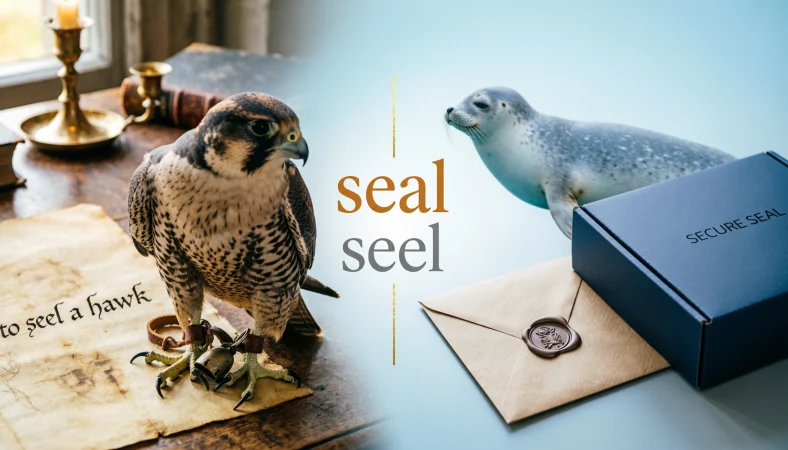
Seel or seal are not simply two alternative spellings of the same everyday word. Seal is the common English word meaning to close securely, confirm, protect, or refer to a marine mammal. Seel is a rare word with specialized historical meanings, especially the practice of sewing or closing a bird’s eyelids. For most ordinary writing, seal is the correct choice.
If you’ve searched for seel or seal, you’re probably wondering whether one spelling is a common mistake or whether both words are legitimate. The answer depends on context. Seal is an extremely common noun and verb, while seel is a rare English word that appears mainly in historical, literary, falconry, and specialized contexts. Confusing them can lead to obvious spelling errors, especially when writing about sealing an envelope, closing a container, confirming an agreement, or referring to a seal animal.
Understanding the distinction is useful because these words may look almost identical but have very different meanings. In modern everyday English, seal is overwhelmingly the form you will need. Seel should generally be reserved for the rare contexts in which its specialized meaning is intended.
Seel vs Seal: What’s the Difference?
The most important distinction is simple: seal is a common modern English word, while seel is a rare word with specialized meanings.
Seal can function as both a noun and a verb.
As a noun, seal can refer to an official mark, a fastening device, a marine mammal, or something that confirms authenticity.
The envelope had an official seal.
As a verb, seal means to close something securely or firmly.
Please seal the package before shipping it.
Seel is primarily a rare verb. In historical falconry terminology, to seel means to close or sew a bird’s eyelids, traditionally to keep a trained bird calm. The word can also appear in older literary usage.
| Feature | Seel | Seal |
| Word type | Mainly verb | Noun and verb |
| Frequency | Very rare | Extremely common |
| Main modern meaning | Specialized historical term involving a bird’s eyes | Close, secure, confirm, official mark, or marine mammal |
| Everyday English | Rarely used | Very common |
| Example | The falconer’s practice was to seel the bird’s eyes. | She sealed the envelope. |
| Recommended general usage | Only in specialized contexts | Standard choice in ordinary writing |
Quick recap
Seal is the normal word used in modern everyday English.
Seel is a rare and specialized verb.
- Use seal for packages, envelopes, containers, agreements, and official marks.
- Use seal when referring to the marine mammal.
- Use seel only when its specialized historical meaning is actually intended.
Is Seel vs Seal a Grammar, Vocabulary, or Usage Issue?
This is primarily a vocabulary and spelling distinction, although grammar also matters because seal has several grammatical uses.
The two words are not interchangeable simply because they look and sound similar.
If you write:
Please seal the envelope.
you are using the ordinary verb meaning to close something securely.
Writing:
Please seel the envelope.
would be incorrect because seel does not mean “close an envelope” in modern standard English.
The problem becomes especially interesting because seel is not completely fictional. It is a genuine English word, but its rarity makes it easy to misunderstand.
Are seel and seal interchangeable?
No.
In ordinary modern English, they should not be treated as interchangeable spellings.
For example:
The bottle was sealed tightly.
is correct.
The bottle was seeled tightly.
is not a normal alternative.
Similarly:
We need to seal the agreement.
is correct.
We need to seel the agreement.
is incorrect.
The existence of seel does not make it a general variant of seal.
Formal versus informal usage
Seal appears in virtually every level of modern English, from casual conversation to legal, academic, scientific, business, and technical writing.
Seel, by contrast, is highly specialized and uncommon.
A historical discussion of falconry might legitimately use seel, while a business email almost certainly would not need it.
Academic versus casual usage
Academic writing can use either word when the context requires it.
For example:
The historical text describes the practice of seeling a trained bird.
Here, seel is appropriate because the writer is discussing a specialized historical practice.
But in an academic paper about document authentication, you might write:
The official seal was examined by researchers.
In casual writing, seal is overwhelmingly more likely to appear.
How to Use Seal Correctly
Seal is one of the most versatile words in English. It can function as a noun or verb and has several related meanings.
As a verb, seal often means to close something so that it cannot easily be opened or so that its contents are protected.
Seal the box before moving it.
She sealed the envelope.
The workers sealed the container.
The word can also describe making something airtight, watertight, or otherwise secure.
The material helps seal the opening.
Another important meaning is to finalize or confirm something.
The agreement sealed the partnership.
The phrase seal the deal is also common and means to finalize an agreement or make an arrangement certain.
Workplace example
The manager signed the document and sealed the envelope.
Here, seal has its ordinary physical meaning of closing something securely.
It can also be used figuratively:
The successful presentation sealed the deal.
In this sentence, sealed means helped finalize the agreement.
Academic example
Researchers used a sealed container to prevent contamination.
Here, sealed describes a container that has been closed securely.
Another example is:
The document carried the official seal of the institution.
In this sentence, seal is a noun referring to an official mark.
Technology example
Technology uses seal in several ways.
A manufacturer may describe a device as having a sealed enclosure.
A software system might refer to a process that permanently confirms or finalizes an operation.
Technical writing can also use phrases such as weather seal, water seal, or security seal.
Usage recap
Use seal when you mean to close, secure, confirm, finalize, authenticate, or refer to an official mark. It is also the correct word for the animal commonly called a seal.
How to Use Seel Correctly
Seel is a rare word, so most people will never need to use it in ordinary conversation or general writing.
Its best known historical meaning comes from falconry. Traditionally, to seel a bird meant to close or sew its eyelids, a practice intended to keep the trained bird calm and prevent visual stimulation.
Because this meaning is highly specialized, the word appears mainly in historical discussions, dictionaries, literary works, and writing about falconry.
For example:
The historical account describes how falconers would seel certain birds.
This is a legitimate use because the specialized meaning is relevant.
Another example might be:
The manuscript refers to the seeling of hawks during training.
Here, seeling is the participial form of seel.
Workplace example
A normal modern workplace email is unlikely to need seel.
If a historian, museum curator, or researcher is discussing an old falconry manuscript, however, the word could be completely appropriate.
The curator explained the manuscript’s references to seeling.
The unusual word is justified by the subject matter.
Academic example
A scholarly paper about medieval falconry might state:
The author describes the practice of seeling birds during training.
Here, seel accurately identifies a specialized historical practice.
Using seal in this context would change the intended word and could create confusion.
Technology example
Modern technology has little ordinary need for seel. An artificial intelligence system, digital dictionary, or language processing tool might encounter it in historical text, specialized corpora, or literary material.
A language model should therefore recognize seel as a legitimate but uncommon lexical item rather than automatically treating every occurrence as a spelling error.
Usage recap
Use seel only when discussing its rare historical or specialized meaning. If you’re talking about closing something, securing a package, finalizing an agreement, or referring to the animal, use seal.
When You Should NOT Use Seel or Seal
Knowing the difference becomes easier when you recognize situations where seel would be inappropriate.
1. Don’t use seel for closing an envelope
Write:
Seal the envelope.
Not:
Seel the envelope.
2. Don’t use seel for closing a package
The standard verb is seal.
Seal the package carefully.
3. Don’t use seel for confirming an agreement
The expression is:
seal the agreement
or:
seal the deal
4. Don’t use seel when referring to the marine animal
The animal is a seal.
We saw a seal near the shore.
5. Don’t assume seel is an alternative spelling
It is a separate, rare word with a specialized meaning.
6. Don’t use seal when the historical falconry meaning is intended
If you’re specifically discussing the historical practice of closing a bird’s eyelids, seel may be the appropriate term.
7. Don’t choose based only on pronunciation
Similar sounding words can have completely different meanings and spellings.
8. Don’t use rare vocabulary simply to sound sophisticated
In general writing, seal is clear and natural. Using seel unnecessarily can make your sentence look like it contains a spelling mistake.
Common Mistakes and Decision Rules
The most frequent error is treating seel as though it were a misspelled form of seal or assuming that it can replace seal whenever the meaning involves closing.
| Correct sentence | Incorrect sentence | Explanation |
| Please seal the envelope. | Please seel the envelope. | Closing an envelope requires seal. |
| The package was sealed securely. | The package was seeled securely. | Seal is the standard verb for securing a package. |
| The agreement sealed the partnership. | The agreement seeled the partnership. | Seal can mean finalize or confirm. |
| We saw a seal at the beach. | We saw a seel at the beach. | The marine mammal is a seal. |
| The official seal appeared on the document. | The official seel appeared on the document. | An official mark is a seal. |
| The historical text describes seeling a hawk. | The historical text describes sealing a hawk. | Seel has a specialized falconry meaning. |
| The container has a watertight seal. | The container has a watertight seel. | The noun for a protective closure is seal. |
Decision Rule Box
If you mean close, secure, finalize, authenticate, or the marine animal, use “seal.”
If you specifically mean the rare historical falconry practice involving a bird’s eyelids, use “seel.”
For ordinary modern writing, “seal” is almost always the word you need.
Seal as a Noun and Verb
One reason seal can cause confusion is that it has several grammatical and semantic functions.
As a noun, it can refer to a physical closure:
The seal on the bottle was intact.
It can refer to an official symbol:
The document bears the university seal.
It can refer to the animal:
The seal swam through the water.
As a verb, it can mean to close:
Seal the container.
It can mean to make something secure:
The coating seals the surface.
It can also mean to finalize something:
The vote sealed the decision.
This range of meanings makes seal a high frequency and highly flexible English word.
By contrast, seel has a much narrower lexical field.
That difference in frequency is useful when you’re editing or proofreading. If the sentence concerns packaging, documents, animals, agreements, surfaces, containers, or security, seal will almost certainly be the correct choice.
Seel or Seal in Modern Technology and AI Tools
Modern digital systems rarely require the word seel in ordinary interface language.
A website might tell users to seal a package before returning an item. A software system might describe a document as sealed, meaning its contents have been protected or finalized.
AI writing systems may encounter seel when processing historical documents, specialized dictionaries, or literary texts. In those cases, the system needs to understand context rather than automatically correcting the word.
For example, if an AI tool encounters:
The falconer would seel the hawk.
it should recognize that seel is deliberate specialized vocabulary.
But if it encounters:
Please seel the box before shipping.
the intended word is almost certainly seal.
This distinction illustrates an important principle in modern language technology: spelling cannot always be judged independently of meaning. Rare words can be correct, and common words can be incorrect when placed in the wrong context.
For content creators, the practical lesson is straightforward. Use seal in ordinary modern writing unless your subject genuinely requires the specialized word seel.
The Etymology of Seel and Seal
The histories of seel and seal are separate, even though their spellings are remarkably similar.
Seal, in its various senses, has roots that entered English through different historical pathways. The word associated with an official mark is connected to Old French and Latin traditions involving signs, marks, and authentication. The word for the marine animal has a different Germanic history.
Seel, in the falconry sense, is a specialized historical term associated with the closing of a bird’s eyelids. Its unusual meaning has survived primarily through historical and literary usage.
This is an excellent example of why similar spelling doesn’t necessarily indicate identical origins or meanings.
English contains many pairs that look or sound similar but have different histories. Learning their meanings in context is often more reliable than trying to infer one word from another.
Expert style guidance
“When two words look almost identical, meaning and context should determine the choice, not spelling similarity alone.”
For seal and seel, that principle is particularly important. One is a familiar everyday word, while the other belongs largely to specialized vocabulary.
Two Practical Case Studies
Case Study 1: Packaging and ecommerce
Imagine an online retailer giving customers return instructions.
The instruction reads:
Seal the package securely before sending it back.
This is the natural modern usage.
If the retailer accidentally writes:
Seel the package securely before sending it back.
readers will probably interpret seel as a spelling mistake.
The concrete result of using seal is immediate clarity. Customers understand that they should close and secure the package.
This example also shows why common words should generally be preferred in customer facing content. A rare historical word creates unnecessary uncertainty when an ordinary word already communicates the meaning perfectly.
Case Study 2: Historical research
Now imagine a researcher studying an old falconry manuscript.
The manuscript describes a practice involving the temporary closing of a trained bird’s eyelids. The researcher writes:
The text describes the falconer as seeling the bird during training.
Here, seel is appropriate because the researcher is discussing its specialized historical meaning.
Replacing it with seal could obscure the intended terminology.
The concrete result is greater historical accuracy. Specialized vocabulary is valuable when it identifies a specific practice that has no equally precise everyday substitute.
Together, these cases demonstrate the central rule: seal belongs to ordinary modern English, while seel belongs primarily to specialized historical vocabulary.
Error Prevention Checklist
Always use seal when
- ☑ You mean to close an envelope.
- ☑ You mean to secure a package.
- ☑ You mean to close a container.
- ☑ You mean an official mark.
- ☑ You mean a watertight or airtight closure.
- ☑ You mean to finalize an agreement.
- ☑ You mean the marine animal.
- ☑ You are writing ordinary modern English.
Use seel only when
- ☑ You’re discussing historical falconry.
- ☑ You’re describing the specialized practice involving a bird’s eyelids.
- ☑ You’re quoting or analyzing historical language.
- ☑ You’re writing about specialized terminology where the word is genuinely relevant.
Never assume
- ☒ That seel is simply a misspelling in every context.
- ☒ That seal and seel have the same meaning.
- ☒ That rare vocabulary is automatically more formal.
- ☒ That a spelling checker alone can determine the intended word.
Context remains the most reliable guide.
Related Spelling and Vocabulary Confusions You Should Master
The distinction between seel or seal belongs to a wider group of English words that are easy to confuse.
Sole or soul: These words sound alike but have completely different meanings.
See or sea: One concerns vision, while the other refers to a large body of salt water.
Sell or cell: One is primarily a verb involving commerce, while the other is a noun with several meanings.
Steel or steal: One refers to a metal, while the other means to take something unlawfully.
Heal or heel: One means to recover or make healthy, while the other refers to the back part of a foot or certain other structures.
Allowed or aloud: These words sound alike but differ in meaning and grammatical function.
Principal or principle: Both are common words, but their meanings and uses are different.
Stationary or stationery: One describes something that is not moving, while the other refers to writing materials.
Advice or advise: These related words differ in grammatical category and pronunciation.
Affect or effect: These frequently confused words require attention to both meaning and grammatical role.
Studying such pairs builds a broader vocabulary skill: don’t decide between similar looking words until you understand what the sentence is trying to say.
FAQs:
Is seel or seal correct?
Seal is correct for almost all ordinary modern uses involving closing, securing, confirming, official marks, or the marine animal. Seel is also a real English word, but it has a rare specialized meaning associated especially with historical falconry.
Is seel a real word?
Yes. Seel is a genuine but uncommon English word. In historical falconry terminology, it refers to closing or sewing a bird’s eyelids. Because the word is rare, most modern writers will have little reason to use it.
Is seel a misspelling of seal?
Not necessarily. Seel is a legitimate word with its own specialized meaning. However, if someone writes seel when they mean to close a package, envelope, container, or agreement, it is almost certainly a spelling error.
Should I say seal or seel an envelope?
You should say seal an envelope. The verb seal means to close something securely. Seel does not have this ordinary modern meaning.
Is a seal an animal or a closure?
Both meanings are correct. Seal can refer to a marine mammal, and it can also refer to something that closes or protects an opening. The intended meaning depends on context.
What does seel mean in falconry?
In historical falconry, seel means to close or sew a bird’s eyelids, traditionally as part of training and handling practices. It is a specialized historical term rather than a common modern verb.
What does seal mean as a verb?
As a verb, seal can mean to close something securely, make something airtight or watertight, confirm something, or finalize an agreement.
For example:
Seal the container tightly.
What does seal mean as a noun?
As a noun, seal can refer to a closure, an official mark, a confirmation, or a marine mammal.
For example:
The document carried the official seal.
Can seel and seal be pronounced the same way?
In many varieties of English, seel and seal are pronounced alike or very similarly. This makes context especially important when distinguishing them in writing.
Which word should I use in everyday English?
Use seal. It is the standard modern word for closing or securing something, referring to an official mark, finalizing something, or naming the marine animal. Seel should generally be limited to specialized historical contexts.
Conclusion:
The difference between seel or seal comes down to meaning, frequency, and context. Seal is the standard word for nearly all ordinary modern situations. You seal an envelope, seal a package, seal a container, seal an agreement, and observe a seal swimming in the ocean.
Seel is a legitimate but rare word. Its best known specialized meaning comes from historical falconry, where it describes the practice of closing or sewing a bird’s eyelids. That specialized meaning explains why the word appears in historical texts but rarely in everyday communication.
For most writers, the decision is therefore straightforward. If you’re talking about closing, securing, confirming, authenticating, or the marine animal, choose seal.
Only choose seel when the specialized historical meaning is genuinely intended.
A useful memory rule is:
Seal is the everyday word. Seel is the rare historical word.
Once you remember that distinction, this confusing pair becomes much easier to handle. You won’t need to rely on spelling intuition alone. Instead, look at the meaning of the sentence and choose the word that fits the context.