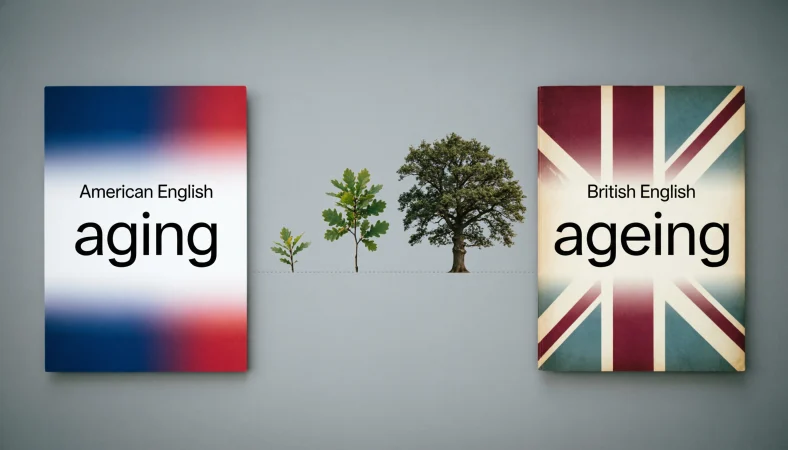
Aging and ageing are both correct spellings of the process of growing older or becoming older. Aging is the standard spelling in American English, while ageing is preferred in British English and many other varieties. The meaning and pronunciation are essentially the same, so choose the spelling that matches your audience or preferred style guide.
Have you ever wondered whether to write aging or ageing? Both spellings are correct, but the extra e can cause confusion when switching between American and British English. Aging is generally preferred in American English, while ageing is common in British English and related varieties.
This guide explains the spelling difference, regional usage, meaning, and practical examples based on established English conventions so you can choose the right form confidently.
Aging or Ageing: What’s the Difference?
The choice between aging and ageing is not a difference in meaning. Both words describe the process of becoming older, developing characteristics associated with age, or causing something to become older in appearance or condition. The spelling depends primarily on the variety of English being used.
The most important distinction is geographical. American English generally prefers aging, while British English generally prefers ageing. Canadian, Australian, and other English varieties may use ageing, although actual usage can vary according to context, publication style, and regional preference.
Both forms come from the verb age. When the verb takes the present participle or gerund form, English speakers add ing. This produces the two accepted spellings.
| Feature | Aging | Ageing |
| Part of speech | Verb form, gerund, or adjective | Verb form, gerund, or adjective |
| Basic meaning | Growing older or becoming older | Growing older or becoming older |
| American English | Preferred | Less common |
| British English | Less common | Preferred |
| Meaning | Same | Same |
| Example | Aging is a natural process. | Ageing is a natural process. |
| Main distinction | Regional spelling | Regional spelling |
The spelling difference becomes especially noticeable in formal writing. An American newspaper, university, government publication, or medical organization will generally use aging. A British publication or institution will generally use ageing.
Neither spelling is inherently more correct than the other. The best choice is the one that matches the English variety and style guide you are following.
A quick recap
Aging is the usual American English spelling.
Ageing is the usual British English spelling.
Both forms have the same pronunciation and meaning.
Your choice should remain consistent throughout a document.
Is Aging or Ageing a Grammar, Vocabulary, or Usage Issue?
The difference between aging and ageing is primarily a spelling and usage issue rather than a grammatical one.
The two forms are grammatically equivalent. You can use either one as a gerund, present participle, or adjective, depending on the sentence.
Consider these examples:
Aging populations can create new demands on healthcare systems.
Ageing populations can create new demands on healthcare systems.
The grammatical structure remains unchanged. Only the spelling varies.
This distinction matters because English has many regional spelling differences. Words such as color and colour, center and centre, and organize and organise can function in the same way. The preferred form depends on the variety of English.
American English
American English normally uses aging.
For example:
The country has an aging population.
Aging infrastructure requires significant investment.
Researchers are studying the effects of aging.
British English
British English normally uses ageing.
For example:
The country has an ageing population.
Ageing infrastructure requires significant investment.
Researchers are studying the effects of ageing.
Formal versus informal writing
Both spellings can appear in formal writing. The issue is not whether one sounds formal and the other informal.
If you are writing an academic paper in American English, aging is appropriate. If you are writing for a British academic audience, ageing is normally the better choice.
The same principle applies to professional reports, journalism, government documents, websites, educational materials, and books.
Academic versus casual usage
Academic writing should follow a consistent regional standard. A paper written in American English should generally use aging throughout. A paper written in British English should normally use ageing throughout.
In casual communication, either spelling may be understood easily, particularly because the words are pronounced the same way. However, consistency still makes writing look more polished.
Why Do Aging and Ageing Have Different Spellings?
The difference comes from broader spelling conventions in English.
The verb age ends with the letter e. When English forms the present participle, the final e is removed before ing is added.
This gives us:
age + ing = aging
British English commonly preserves an additional e in this particular word:
age + ing = ageing
The spelling ageing follows a pattern that can make the relationship with the base word age visually obvious. American English, meanwhile, generally favors the shorter spelling aging.
This is not evidence that one form is old fashioned or incorrect. Both spellings have established histories in English usage.
The important point is that regional spelling conventions developed differently. Modern dictionaries and style guides recognize the regional distinction rather than treating one form as an error.
When Should You Use Aging?
Use aging when you are writing primarily for an American English audience or following an American English style guide.
This spelling appears naturally in discussions about health, demographics, technology, economics, materials, architecture, and everyday life.
Workplace example
The company is developing new services for an aging workforce.
Here, aging functions as an adjective describing a workforce that is becoming older.
Another example is:
Aging equipment has increased maintenance costs.
The word describes equipment that has become older and may require additional attention.
Academic example
The study examines how aging affects memory and cognitive performance.
In this sentence, aging functions as a gerund and refers to the process of becoming older.
Academic writing frequently uses this form in research involving demographics, psychology, biology, sociology, economics, and public policy.
Technology example
Engineers are developing sensors that can identify aging components before they fail.
Here, aging describes components that are becoming older or deteriorating over time.
Technology writing also uses aging when discussing computer systems, infrastructure, batteries, software systems, and equipment.
Usage recap
Choose aging when your audience expects American English.
It is particularly appropriate for American academic, professional, technical, and general writing.
When Should You Use Ageing?
Use ageing when you are writing primarily for a British English audience or following a British English style guide.
The meaning remains exactly the same. Only the regional spelling changes.
Workplace example
The organization is preparing for an ageing workforce.
This sentence is completely natural in British English.
Another example is:
The ageing building requires extensive renovation.
The adjective describes a building that is becoming older or showing the effects of age.
Academic example
The researchers investigated the relationship between ageing and social participation.
The word ageing refers to the process of becoming older.
This spelling is especially common in British academic publications and other writing influenced by British English conventions.
Technology example
The engineers designed a system to monitor ageing infrastructure.
The sentence could refer to bridges, electrical systems, transportation networks, buildings, or other structures that are becoming older.
Usage recap
Choose ageing when British English is your intended variety.
It is suitable for formal, academic, professional, technical, and everyday writing.
When You Should NOT Use Aging or Ageing
Although both forms are correct, there are situations in which choosing between them carelessly can weaken the quality or consistency of your writing.
1. Do not switch spelling randomly
Avoid using aging in one paragraph and ageing in another unless you are discussing quoted material or intentionally comparing regional usage.
Consistency signals editorial control.
2. Do not assume one spelling is universally correct
American readers will usually expect aging, while British readers will usually expect ageing. Calling the alternative spelling incorrect oversimplifies the issue.
3. Do not mix regional spelling conventions unnecessarily
If a document otherwise follows American English, suddenly using ageing can make the text look inconsistent.
The same applies when British English writing suddenly switches to aging.
4. Do not change a quotation
If a source uses ageing, do not silently change it to aging when reproducing a direct quotation. Preserve the original wording unless your editorial system specifically requires another treatment.
5. Do not use a regional spelling without considering your audience
A website aimed specifically at American readers will normally benefit from aging. A publication targeting British readers will generally be better served by ageing.
6. Do not treat the difference as a pronunciation issue
The two spellings are generally pronounced the same way. The distinction is written rather than a difference in ordinary pronunciation.
7. Do not create a meaning distinction
Aging and ageing do not represent two different stages or processes. They are spelling variants.
8. Do not change the spelling simply to sound more professional
Neither spelling is inherently more sophisticated. Audience and editorial consistency are the deciding factors.
Common Mistakes and Decision Rules
Because the two forms look different but mean the same thing, writers sometimes wonder whether one should be used in particular grammatical situations. It does not work that way.
The spelling normally depends on regional English rather than grammatical function.
| Correct sentence | Incorrect or inconsistent sentence | Explanation |
| The aging population needs additional services. | The ageing population needs additional services. | The second sentence is not grammatically wrong, but aging is preferred in American English. |
| The ageing population needs additional services. | The aging population needs additional services. | The second sentence is not grammatically wrong, but ageing is preferred in British English. |
| Aging is a natural process. | Ageing is a natural process. | Both are correct. Regional spelling determines the preference. |
| Ageing infrastructure requires investment. | Aging infrastructure requires investment. | Both forms are possible, but British English normally prefers ageing. |
| The researchers studied aging. | The researchers studied ageing. | Both are acceptable depending on the English variety. |
Decision Rule Box
- If you are writing in American English, use aging.
- If you are writing in British English, use ageing.
- If your organization has a specific style guide, follow that guide consistently.
This is the most reliable rule for everyday writing.
Aging or Ageing in Different Contexts
The choice becomes easier when you consider the audience and subject matter.
In healthcare writing, American publications commonly use phrases such as aging population, aging process, and healthy aging. British publications commonly use ageing population, ageing process, and healthy ageing.
In demographics, the distinction is equally clear. An American report might discuss an aging population, while a British report might discuss an ageing population.
In discussions about materials and infrastructure, both forms are used:
Aging concrete can develop cracks over time.
Ageing concrete can develop cracks over time.
The meaning is unchanged.
The same applies to technology:
The company is replacing aging servers.
The company is replacing ageing servers.
The spelling tells readers something about the intended regional variety, but it does not change what the servers are doing or how old they are.
Aging or Ageing in Modern Technology and AI Tools
Modern technology has made regional spelling differences more visible.
Search engines, grammar checkers, word processors, translation systems, and AI writing tools can recognize both aging and ageing. However, the preferred form may depend on the language setting selected by the user.
For example, an AI writing system asked to produce American English may naturally generate aging, while a system instructed to write in British English may choose ageing.
This distinction matters for content creators because spelling consistency can influence how professional a website feels. A publication targeting readers in the United States should normally establish American spelling conventions. A publication targeting the United Kingdom should establish British conventions.
AI tools can also make the difference more confusing because they may adapt to the vocabulary and spelling patterns found in the user’s prompt. If you begin with one regional convention and later switch conventions, the generated content may contain both forms.
For editorial work, the safest approach is to establish the target variety before generating or editing large amounts of content.
The Etymology of Aging and Ageing
Both forms ultimately come from the verb age, which is connected to the idea of a period of life or a stage of existence.
The word age has a long history in English and can function as both a noun and a verb. As a noun, it can refer to a period of time or a person’s length of life. As a verb, it means to become older or to cause something to become older.
The forms aging and ageing developed from this verb.
The spelling difference reflects the broader history of British and American English. Over time, American English developed preferences for a number of shorter spellings, while British English retained or developed alternative conventions in several cases.
The distinction therefore belongs to the history of English spelling rather than to a difference in meaning.
An expert style explanation
A useful way to think about the distinction is:
“Aging and ageing describe the same process; the spelling primarily tells you which regional variety of English the writer is following.”
That simple principle resolves most questions about the pair.
Two Practical Case Studies
Case Study 1: An American healthcare article
Imagine a healthcare organization publishing an educational article for patients in the United States.
The article uses terms such as American healthcare, behavior, center, and aging. If the organization suddenly changes to ageing, the spelling may look inconsistent with the rest of the content.
In this situation, aging is the natural editorial choice because the publication follows American English.
The decision is not about medical accuracy. It is about maintaining a consistent language standard.
Case Study 2: A British academic report
Now imagine a British university publishing a report about demographic change.
The report uses ageing population, organisation, centre, and other British spellings. Using aging population in the middle of the document would introduce an unnecessary regional variation.
In this situation, ageing is the stronger choice.
Again, the underlying meaning remains identical. The improvement comes from maintaining a consistent English variety throughout the document.
Error Prevention Checklist
Always use aging when:
- You are writing in American English.
- Your publication targets primarily American readers.
- Your organization’s style guide specifies American English.
- Your document already uses American spelling conventions.
- You are writing terms such as aging population, healthy aging, or aging process for an American audience.
Always use ageing when:
- You are writing in British English.
- Your publication primarily targets British readers.
- Your organization’s style guide specifies British English.
- Your document consistently follows British spelling conventions.
- You are writing terms such as ageing population, healthy ageing, or ageing process for a British audience.
Avoid these mistakes:
- Do not alternate between the two spellings without a reason.
- Do not claim that ageing is simply a misspelling of aging.
- Do not claim that aging is always wrong outside the United States.
- Do not create a different definition for each spelling.
- Do not let an AI writing tool change your regional spelling conventions unexpectedly.
Related Grammar Confusions You Should Master
Learning the difference between aging and ageing can also help you recognize other regional spelling variations.
Here are several useful comparisons:
- Color or colour: American English generally prefers color, while British English generally prefers colour.
- Center or centre: American English generally prefers center, while British English generally prefers centre.
- Favorite or favourite: American English generally prefers favorite, while British English generally prefers favourite.
- Organize or organise: Both forms are established, with organize strongly associated with American usage and organise common in British usage.
- Realize or realise: Both forms are widely recognized, although regional style determines the preferred form.
- Traveling or travelling: American English commonly uses traveling, while British English commonly uses travelling.
- Labeled or labelled: American English generally uses labeled, while British English generally uses labelled.
- Canceled or cancelled: American English commonly uses canceled, while British English commonly uses cancelled.
- Modeled or modelled: American English commonly uses modeled, while British English commonly uses modelled.
- Practice or practise: This distinction is more complicated because British English traditionally uses practice as a noun and practise as a verb, while American English generally uses practice for both.
Understanding these patterns makes regional spelling easier to recognize and apply.
FAQs
Is aging or ageing correct?
Both are correct. Aging is the standard spelling in American English, while ageing is generally preferred in British English and several other varieties.
Is ageing British or American?
Ageing is primarily associated with British English. It is also used in other English varieties influenced by British spelling conventions.
Is aging American English?
Yes. Aging is the standard and most common spelling in American English.
Do aging and ageing mean the same thing?
Yes. They have the same meaning. Both refer to the process of becoming older or the effects associated with increasing age.
Is ageing more grammatically correct than aging?
No. Neither spelling is more grammatically correct. They are regional spelling variants of the same word.
Which is correct in academic writing, aging or ageing?
Either can be correct. Academic writers should follow the English variety and style guide required by their institution, journal, publisher, or intended audience.
Should I use aging or ageing on an American website?
Aging is generally the better choice when the website primarily targets American readers and follows American English spelling.
Should I use ageing or aging for a British audience?
Ageing is generally the preferred choice for British English writing.
Why do Americans spell aging without the extra e?
American English generally prefers aging, while British English commonly uses ageing. The difference reflects regional spelling conventions rather than a difference in meaning.
Can I use both aging and ageing in the same article?
It is better to choose one spelling and use it consistently. Mixing them can make the article appear poorly edited unless you are deliberately discussing regional differences or quoting sources.
Conclusion:
The choice between aging or ageing is straightforward once you identify your target variety of English. Aging is the standard American English spelling, while ageing is the standard preference in British English. Both forms describe the same process and perform the same grammatical functions.
For most writers, the best rule is simple: identify your audience, follow the appropriate regional spelling convention, and remain consistent. If you’re writing for American readers, choose aging. If you’re writing for British readers, choose ageing.
Neither spelling is universally superior, and neither should be treated as a grammatical error. The real goal is clear, consistent communication that matches the expectations of your readers.