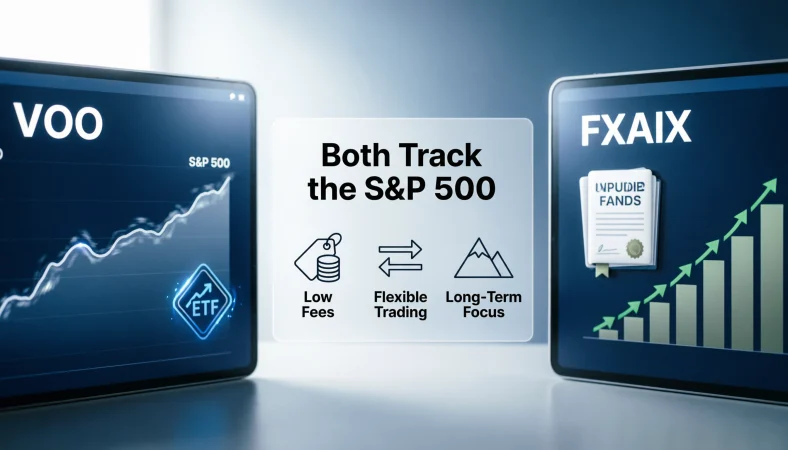
VOO and FXAIX are both low cost investment options that track the S&P 500 Index, giving investors exposure to many of the largest publicly traded U.S. companies. VOO is an exchange traded fund (ETF) from Vanguard that trades throughout the day like a stock, while FXAIX is a Fidelity mutual fund that generally processes purchases and sales at the end of the trading day.
VOO may suit investors who prefer ETF flexibility, while FXAIX may appeal to those who invest through Fidelity mutual fund accounts. The better choice depends on your brokerage, investment preferences, and account requirements.
Choosing between VOO or FXAIX can be confusing, especially because both funds aim to track the same benchmark, the S&P 500 Index.
They provide access to large U.S. companies through a single investment, but their structures, trading methods, minimum investment requirements, and account compatibility can differ. Understanding these details can help you compare the funds beyond their similar investment goals.
In this guide, you will learn how VOO and FXAIX compare in expense ratios, investment structure, trading flexibility, dividends, and long term investing considerations.
We will explain their key similarities and differences in straightforward language so you can evaluate which fund better fits your financial goals and investing approach.
Your decision should also account for your time horizon, risk tolerance, and the features available through your brokerage or retirement account.
VOO vs FXAIX: What’s the Difference?
VOO and FXAIX offer a way to invest in hundreds of large United States companies through a single fund. Both aim to track the S&P 500 Index, so their holdings and long term performance tend to be similar, although expenses and tracking differences can cause small variations.
The main distinction is how each fund operates. VOO is an exchange traded fund, or ETF, that trades on the stock market throughout the trading day. FXAIX is a mutual fund that generally processes transactions at its net asset value after the market closes.
What Is VOO?
VOO is the ticker symbol for Vanguard S&P 500 ETF. It gives investors exposure to companies represented in the S&P 500, which includes large businesses across technology, healthcare, financial services, consumer goods, and other sectors.
As an ETF, VOO trades on an exchange like an individual stock. Investors can place orders during market hours, and its market price changes throughout the day. Depending on the brokerage, investors may also be able to buy fractional shares or schedule recurring purchases.
VOO is commonly considered by people building long term portfolios because it offers broad exposure to large United States companies at a relatively low annual expense ratio. However, it remains a stock investment and can lose value when the market declines.
What Is FXAIX?
FXAIX is the ticker symbol for Fidelity 500 Index Fund. It is a mutual fund that seeks to track the S&P 500 Index by holding a portfolio designed to reflect the benchmark.
Rather than trading on an exchange throughout the day, FXAIX generally processes purchase and sale orders at the fund’s net asset value calculated after the market closes. This structure can make it convenient for investors who want to invest a specific dollar amount or automate regular contributions through an eligible Fidelity account.
FXAIX is also designed to provide broad exposure to large American companies without requiring investors to purchase each stock individually. Its suitability depends on the investor’s account options, goals, time horizon, and tolerance for stock market risk.
VOO and FXAIX at a Glance
| Feature | VOO | FXAIX |
| Official fund name | Vanguard S&P 500 ETF | Fidelity 500 Index Fund |
| Investment structure | Exchange traded fund | Mutual fund |
| Benchmark | S&P 500 Index | S&P 500 Index |
| Investment style | Passive index tracking | Passive index tracking |
| Published expense ratio | 0.03% | 0.015% |
| Trading | Throughout market hours | Generally priced after market close |
| Automatic investing | Depends on brokerage features | Available through eligible accounts |
| Fractional investing | Depends on brokerage features | Dollar based purchases may be available |
| Main advantage | ETF flexibility | Low expenses and mutual fund convenience |
| Main risk | Stock market risk | Stock market risk |
Expense ratios and brokerage features can change. Check the latest fund information before making an investment decision.
Quick recap: VOO and FXAIX both track the S&P 500, so their investment exposure is similar.
VOO is an ETF that trades throughout the day. FXAIX is a mutual fund that generally trades at its end of day net asset value.
FXAIX has a lower published expense ratio in the figures shown above, but the difference is small.
Your account type, investing habits, and overall financial goals may matter more than the difference in annual fund expenses.
Is VOO vs FXAIX a Fund Structure, Cost, or Investment Strategy Issue?
The comparison involves all three factors, but the most important distinction is fund structure. VOO and FXAIX pursue essentially the same investment strategy, which means investors should focus on how each fund works, what it costs, and how it fits their accounts.
Are VOO and FXAIX Interchangeable?
They are similar investment options, but they are not identical products. Both aim to follow the S&P 500, a market capitalization weighted index of large United States companies.
Their returns will usually move in similar directions because their underlying investments overlap substantially. Small differences can arise from fund expenses, cash holdings, index tracking, and the timing of transactions.
For many long term investors, choosing one fund is sufficient to gain S&P 500 exposure. Holding both generally does not provide much additional diversification because they follow the same benchmark.
Which Fund Has Lower Fees?
The published expense ratio for FXAIX is 0.015%, while VOO’s published expense ratio is 0.03%. The figures should be verified before investing because fund expenses can change.
Here is what those percentages mean for a hypothetical $10,000 balance:
| Expense calculation | VOO | FXAIX |
| Annual expense ratio | 0.03% | 0.015% |
| Approximate annual fund expense on $10,000 | $3.00 | $1.50 |
| Approximate annual difference | $1.50 |
These are illustrations, not separate bills. Fund expenses are reflected in fund performance and can vary with the value of the investment.
The difference is only $1.50 annually on an unchanged $10,000 balance. Over a long period, costs can accumulate, but investors should also consider account features, taxes, and the ease of making regular contributions.
Which Fund Is Better for Long Term Investing?
Neither fund is automatically better for every investor. Both can serve as a core holding for someone seeking long term exposure to large American companies.
FXAIX may be convenient for someone who already uses Fidelity and wants to invest a fixed dollar amount on a recurring schedule. VOO may suit someone who prefers ETFs or wants the ability to trade throughout market hours.
Neither fund guarantees a positive return. Both can decline substantially during a stock market downturn, and their concentration in large United States companies means they do not represent every part of the global investment market.
How to Use VOO in an Investment Plan
VOO can serve as a core stock holding in a long term portfolio. It gives investors exposure to large United States companies without requiring them to buy each company’s shares individually.
Workplace Example
Imagine an employee contributing to a retirement account through a brokerage platform. The employee wants broad exposure to large American businesses and finds VOO among the available investment choices.
Before purchasing, the employee compares its expenses, confirms that the account supports ETF purchases, and reviews whether the portfolio already contains similar investments.
VOO may fit the employee’s plan if the fund matches their investment goals and tolerance for market fluctuations. The employee should still consider other assets, such as international stocks or bonds, if broader diversification is part of the plan.
Academic Example
A finance student studying index funds could examine VOO’s expense ratio, historical total returns, holdings, and tracking difference relative to the S&P 500.
To make a fair comparison, the student would use matching dates and account for reinvested dividends. Comparing one fund’s price change with another fund’s total return would produce a misleading result.
Technology Example
A brokerage application may allow users to buy VOO during market hours, view its current market price, and track its performance. Some platforms support fractional shares or recurring ETF purchases, while others may offer different features.
Investors should check the brokerage’s order rules and fees before assuming these options are available.
Usage recap: VOO may suit investors who value ETF flexibility and have access to the features they need through their brokerage. Its suitability still depends on their goals, costs, and risk tolerance.
How to Use FXAIX in an Investment Plan
FXAIX may suit investors who prefer mutual funds and want S&P 500 exposure through a straightforward investment arrangement. Its structure can be especially convenient for regular contributions through an eligible account.
Workplace Example
Consider an employee reviewing investment options in a retirement account. The plan offers an S&P 500 mutual fund, a bond fund, and several other investment choices.
If FXAIX is available, the employee can compare its expense ratio, investment objective, and role within the retirement portfolio. The employee should also consider how the fund complements other holdings rather than evaluating it in isolation.
The fact that a fund is inexpensive does not automatically make it the right choice. The investment must fit the employee’s time horizon and willingness to accept stock market risk.
Academic Example
A student researching mutual funds might compare FXAIX’s annual expenses with its benchmark’s performance over several periods.
The student could examine one year, five year, and ten year results, ensuring that all figures use consistent dates and return definitions. This helps distinguish long term performance patterns from short term market movements.
Technology Example
An investment platform may let an eligible account holder set up recurring dollar based purchases of FXAIX. This can help someone invest regularly without calculating how many whole shares to purchase.
The exact process depends on the account and platform. Investors should review minimums, transaction rules, and dividend reinvestment options before setting up automatic investing.
Usage recap: FXAIX may appeal to investors who prefer mutual funds and recurring dollar based contributions. Confirm its availability and suitability for your account before investing.
When You Should NOT Choose VOO or FXAIX
Both funds offer broad exposure to large United States companies, but neither is suitable for every purpose.
When You Need the Money Soon
Avoid assuming that either fund is appropriate for money you will need in the near future. Stock market values can fall at inconvenient times, potentially forcing you to sell at a loss.
When You Expect Guaranteed Returns
Neither VOO nor FXAIX guarantees a profit. Both track a stock index, and both can lose value when the companies in that index decline.
When You Want Complete Global Diversification
Both funds focus on the S&P 500. They do not independently provide comprehensive exposure to international stocks, bonds, small companies, or every other asset class.
When Your Account Does Not Support the Fund
Some retirement plans limit investments to a selected list of funds. Do not assume that VOO or FXAIX is available in every account.
When You Are Ignoring Tax Considerations
Tax treatment depends on the account type, your tax residence, distributions, and individual circumstances. Do not assume that the two fund structures will have identical tax consequences in every situation.
When You Are Choosing Only by Recent Performance
A fund that performed better over one period may not do so over another. Recent returns alone do not establish which fund will perform better in the future.
When You Believe the Lowest Fee Must Win
FXAIX has a lower published expense ratio in the figures compared here, but fees are only one factor. Account availability, trading features, and your investing habits may also influence the decision.
When Your Portfolio Already Has the Same Exposure
If you already own an S&P 500 index fund, adding VOO or FXAIX may increase your investment in the same companies without significantly improving diversification.
Common Mistakes and Decision Rules
Investors sometimes treat VOO and FXAIX as entirely different investments because they have different names and fund structures. In reality, their exposure to the S&P 500 is very similar.
| Correct approach | Incorrect assumption | Explanation |
| Compare current expense ratios | Assume the published fees can never change | Fund expenses may be updated |
| Compare matching total return periods | Choose from one recent return figure | Different periods can give misleading results |
| Check your account’s available funds | Assume every brokerage offers both | Account features and fund access vary |
| Consider diversification | Assume owning both provides broad new exposure | Their holdings overlap substantially |
| Review market risk | Assume index funds cannot lose money | Both are exposed to stock market declines |
| Consider account and tax rules | Assume ETFs and mutual funds work identically | Trading and tax details can differ |
| Choose according to your plan | Buy the fund with the most popular name | Popularity does not establish suitability |
The Simple Decision Rule
Consider VOO if you prefer an ETF, want to trade during market hours, and your brokerage supports the features you need.
Consider FXAIX if you prefer a mutual fund, want convenient dollar based investing, and have access to it through your account.
Compare the total picture by checking current expenses, account rules, tax considerations, and how the fund fits your wider portfolio.
Remember: Both funds track the S&P 500. Choosing one over the other does not remove stock market risk.
This is general investment education, not individualized financial advice.
VOO and FXAIX in Modern Technology and AI Tools
Modern brokerage platforms and AI financial assistants can help investors compare fund expenses, holdings, historical returns, and trading features. They can also calculate hypothetical fee differences over time.
However, these tools depend on the accuracy and date of their data. A comparison that uses an outdated expense ratio or mismatched performance periods can lead to an incorrect conclusion.
AI tools can explain the difference between an ETF and a mutual fund, but they cannot reliably predict which fund will outperform in the future. Any projection depends on assumptions and should not be treated as a promise.
Before acting on an automated comparison, verify the fund name, ticker, current prospectus, expense ratio, and account requirements. Use calculations to understand possible outcomes, not to guarantee them.
The Background of VOO and FXAIX
VOO and FXAIX represent two different ways of packaging an index investment.
VOO belongs to the exchange traded fund structure. ETFs trade on stock exchanges, allowing investors to buy and sell shares throughout the trading session. The market price may fluctuate during the day.
FXAIX belongs to the mutual fund structure. Mutual funds generally process purchases and redemptions at the net asset value calculated after the market closes. This means investors do not normally choose an intraday trading price for their mutual fund transaction.
Both funds follow the S&P 500 Index, which is designed to represent large United States companies. The index uses market capitalization weighting, so companies with larger market values generally have more influence on its performance.
The important distinction is not that one fund follows a completely different investment strategy. Rather, the two funds use different structures to provide similar market exposure.
An Expert Principle for Comparing Index Funds
A useful investment principle is:
Compare the investment objective, total costs, account features, and risks before choosing a fund based on its name.
This matters because VOO and FXAIX pursue similar investment objectives. Although their expense ratios differ, both remain exposed to the performance of large American companies.
Investors should also distinguish between historical performance and future expectations. A fund that performed better over one period may not outperform over another.
A thoughtful comparison considers the whole investing experience, including recurring contributions, trading flexibility, tax circumstances, and whether the fund fits the investor’s broader financial plan.
Case Study One: A Long Term Retirement Investor
Consider an illustrative investor who plans to contribute $300 each month to a retirement account for 20 years. The investor has access to FXAIX and wants exposure to large United States companies.
The investor reviews the fund’s expense ratio, account rules, and options for recurring purchases. They also examine whether the rest of the retirement portfolio needs international stock exposure or bonds.
If FXAIX is available and matches the investor’s goals and risk tolerance, its mutual fund structure may make regular contributions convenient.
Result: The investor makes a more informed decision by considering costs, account access, and diversification rather than choosing solely on recent performance.
This is an illustrative scenario, not a measured investment study. It does not predict future returns or guarantee the value of the investor’s contributions.
Case Study Two: An ETF Investor Using a Brokerage Account
Imagine another investor who uses a standard brokerage account and prefers exchange traded funds. The investor wants S&P 500 exposure and compares VOO with FXAIX.
They check VOO’s expense ratio, trading features, fractional share availability, and the brokerage’s recurring purchase options. They also consider how the fund fits alongside other investments.
If the investor values intraday trading and the brokerage supports the necessary features, VOO may fit their preferred workflow. If regular dollar based mutual fund purchases matter more, FXAIX may deserve closer consideration.
Result: The investor identifies which fund structure better matches their account and investing habits without assuming one will always produce superior returns.
This is an illustrative example, not a measured investment study. Actual results depend on market performance, expenses, taxes, and investor decisions.
Error Prevention Checklist
Use this checklist before purchasing either fund.
Always Check These Details
- Confirm the official fund name and ticker.
- Compare the current expense ratios.
- Check whether your account supports the fund.
- Compare total returns over matching time periods.
- Understand that both funds can lose value.
- Review how much of your portfolio is already invested in large United States companies.
- Consider whether you need international stocks or other asset classes for diversification.
- Understand the account’s tax treatment and transaction rules.
Never Assume These Things
- A lower expense ratio guarantees a higher return.
- An S&P 500 fund covers every asset class.
- Historical returns predict future performance.
- ETFs and mutual funds operate identically.
- Owning both funds automatically improves diversification.
- A popular fund is suitable for every investor.
Related Investment Comparisons You Should Understand
Investors comparing VOO and FXAIX may also benefit from learning about these related investment choices.
- VOO vs VFIAX: Compare Vanguard’s S&P 500 ETF with its S&P 500 mutual fund.
- FXAIX vs FSKAX: Compare Fidelity’s S&P 500 fund with its total United States stock market index fund.
- VOO vs VTI: Compare S&P 500 exposure with a broader United States stock market fund.
- FXAIX vs SPY: Compare two funds tracking the S&P 500 with different expenses and trading characteristics.
- Index funds vs actively managed funds: Understand passive index tracking and active investment selection.
- ETF vs mutual fund: Learn how trading, pricing, and transactions differ.
- Expense ratio vs total investment cost: Understand why the annual fund expense is only one part of the overall cost.
- S&P 500 vs total market index: Compare large company exposure with broader stock market coverage.
- Capital gains vs dividends: Distinguish changes in investment value from cash distributions.
- Taxable brokerage vs retirement account: Understand how account type can affect taxes and investment decisions.
These comparisons help investors evaluate a fund as part of a wider financial plan rather than making a decision in isolation.
FAQs
What is the difference between VOO and FXAIX?
VOO is an S&P 500 ETF that trades throughout the day, while FXAIX is a Fidelity index mutual fund that generally trades at its end of day net asset value.
Is FXAIX better than VOO?
FXAIX has a lower expense ratio, while VOO offers ETF trading; the better choice depends on account access, costs, preferences, and taxes.
Which has a lower expense ratio, VOO or FXAIX?
VOO’s expense ratio is 0.03%, while FXAIX’s is 0.015%, but verify current fees and consider brokerage costs and account rules before investing.
Can I invest in both VOO and FXAIX?
You can own both if your account allows it, but their overlapping holdings mean combining them usually adds little diversification.
Which is better for long term investing, VOO or FXAIX?
Both offer long term exposure to large US companies, but the better choice depends on costs, account features, taxes, investing habits, and portfolio goals. Neither guarantees returns.
Is VOO an ETF or a mutual fund?
VOO is an exchange traded fund. Investors can buy and sell its shares on a stock exchange during market hours, and its market price can fluctuate throughout the trading session.
Is FXAIX an ETF or a mutual fund?
FXAIX is a mutual fund. Purchases and sales generally execute at the fund’s net asset value calculated after the market closes. Its account features depend on the brokerage or retirement plan.
Are VOO and FXAIX safe investments?
Both S&P 500 funds carry market risk and can lose value, so they suit investors whose time horizon and risk tolerance align with stock market investing.
Should I switch from VOO to FXAIX to save on fees?
For modest balances, cost differences may be small, so consider account rules, taxes, transaction requirements, and potential benefits before switching.
Conclusion:
When comparing VOO or FXAIX, remember that both funds aim to track the S&P 500. Their market exposure is therefore very similar, but their fund structures and trading methods differ.
VOO may appeal to investors who prefer ETFs and intraday trading. FXAIX may suit those who prefer mutual funds and convenient dollar based contributions. FXAIX has a lower published expense ratio in the figures discussed, although the actual difference should be checked against current fund information.
The best choice depends on your account, investing habits, costs, risk tolerance, and wider financial goals. Neither fund guarantees positive returns, and owning both usually adds little diversification because their investments overlap substantially.