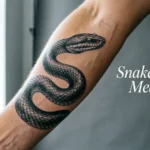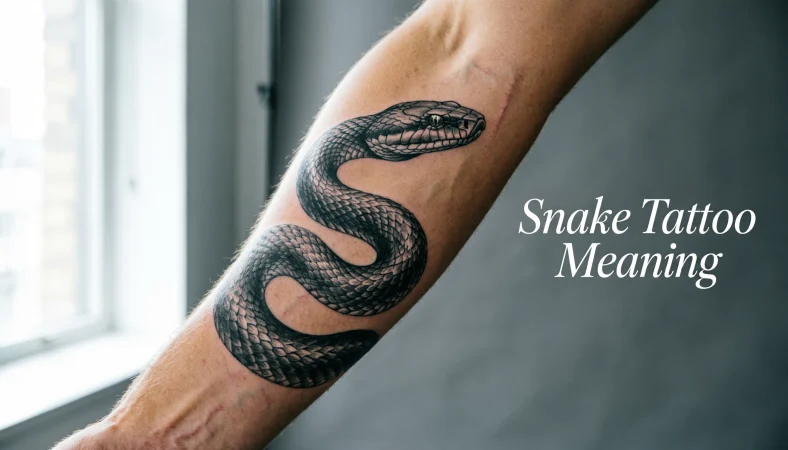
A snake tattoo commonly symbolizes transformation, rebirth, wisdom, protection, temptation, or personal power. Because snakes shed their skin, they often represent leaving the past behind and beginning a new chapter.
In some cultures, they symbolize healing and spiritual knowledge, while in others, they are linked to danger or deception. The design, cultural background, and personal experiences of the wearer determine its deeper meaning.
Few tattoo designs carry as many contrasting interpretations as the snake. It can look elegant and mysterious, fierce and intimidating, or calm and protective, depending on how the artist depicts it. For some people, the image represents a major life change. For others, it reflects independence, survival, wisdom, or the ability to recognize danger.
Part of the appeal comes from the animal itself. Snakes shed their skin as they grow, move quietly through their surroundings, and defend themselves when threatened. These natural behaviors have inspired symbolic associations across different societies for centuries. A snake tattoo can therefore communicate a personal message without requiring words, although its meaning is never identical for everyone.
Whether you are considering a small snake wrapped around your wrist or a detailed serpent extending across your back, understanding the symbolism can help you choose artwork that feels authentic to your story.
Table of Contents
- What Does a Snake Tattoo Symbolize?
- Snake Symbolism Across Different Cultures
- Popular Snake Tattoo Designs and Their Meanings
- The Natural Traits Behind Snake Symbolism
- Snake Tattoos Compared With Other Animal Tattoos
- Choosing the Right Design and Placement
- Frequently Asked Questions
What Does a Snake Tattoo Symbolize?
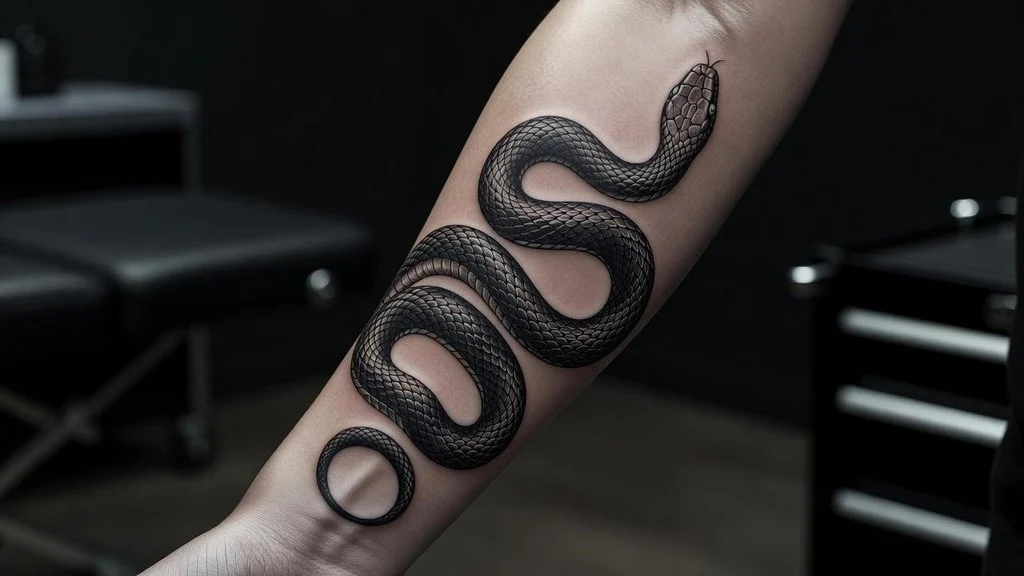
A snake tattoo can communicate several ideas at once. Its posture, surrounding imagery, and artistic style often influence how people interpret it.
Transformation and Rebirth
One of the most familiar associations is transformation. Snakes periodically shed their outer skin through a process called ecdysis, which allows them to grow and replace worn skin.
This process has made the snake a natural symbol of renewal. A person might choose this tattoo after leaving a difficult relationship, recovering from a major setback, changing careers, or reaching a new stage of life.
The message is not necessarily that the past has disappeared. Instead, it suggests that a person can move forward without remaining defined by earlier experiences.
A snake shown emerging from an old skin can make this idea especially clear. The image represents change as an ongoing process rather than a single moment.
Wisdom and Knowledge
Snakes also appear in stories and traditions associated with knowledge, observation, and hidden truths. Their quiet movements and ability to remain still have helped shape their image as mysterious, watchful creatures.
For a tattoo wearer, this symbolism may represent learning from experience, thinking carefully before acting, or trusting personal judgment. A snake with its head raised can convey alertness and awareness, particularly when the design avoids aggressive details.
Wisdom is not a universal interpretation, however. In some stories, a serpent represents cunning or deception rather than positive knowledge. The surrounding symbols and cultural references help establish which meaning the wearer intends.
Protection and Personal Power
A coiled snake can look ready to defend itself, even when it is not attacking. This posture often inspires tattoo designs associated with boundaries, vigilance, and self-protection.
Someone who has learned to stand up for themselves may choose the image as a reminder that strength does not always require aggression. A snake can remain still until action becomes necessary.
Larger designs with bold outlines, sharp contrasts, or an open mouth may communicate a more intimidating form of power. Smaller, more delicate designs can express quiet confidence instead.
Danger and Deception
The snake has a long association with danger, temptation, and betrayal in various stories and religious traditions. Its venomous members can pose real risks, and its concealed movements have contributed to its reputation as an unpredictable animal.
A tattoo emphasizing fangs, a striking posture, or a dark, threatening expression may represent a warning. The wearer might be acknowledging a painful experience or expressing the belief that appearances can be misleading.
This interpretation does not mean that every snake tattoo carries a negative message. Some people deliberately embrace the creature’s dangerous reputation as a symbol of independence and refusal to be underestimated.
Healing and Renewal
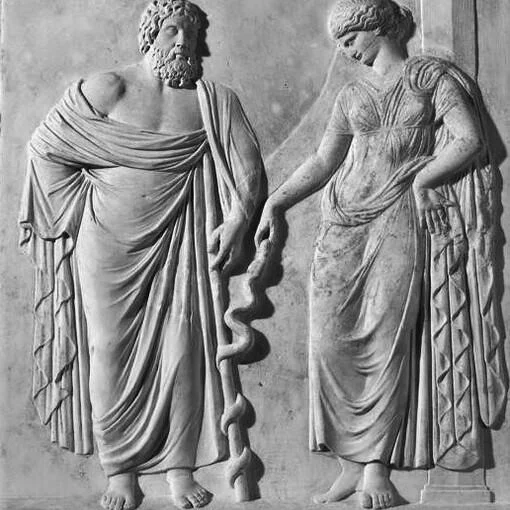
Healing is another important association, especially when snakes appear alongside medical or spiritual symbols. The connection is particularly visible in the Rod of Asclepius, an ancient Greek symbol of medicine featuring a single serpent wrapped around a staff.
A snake tattoo inspired by this emblem may represent recovery, healthcare, medical knowledge, or a personal journey through illness. In other contexts, it can symbolize emotional healing after a difficult period.
The distinction between healing and transformation is subtle but meaningful. Transformation focuses on becoming different, while healing emphasizes recovery, restoration, or learning to live with an experience.
Snake Symbolism Across Different Cultures
A snake does not carry one fixed meaning around the world. Its symbolism changes across religions, mythologies, and artistic traditions, so cultural context matters when choosing a design inspired by a particular tradition.
Ancient Greek Symbolism
In ancient Greek tradition, snakes appeared in stories associated with healing and renewal. One important example is Asclepius, the Greek god of medicine, whose staff featured a single serpent.
The Rod of Asclepius remains a recognized medical symbol. It is commonly used to represent medicine and healthcare, making it a meaningful reference for healthcare professionals or people whose lives have been shaped by recovery.
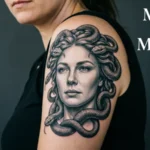
Snakes also appear in Greek mythology in more complicated roles. The Gorgon Medusa, for example, is famously depicted with snakes for hair. A snake tattoo inspired by Medusa may communicate danger, protection, fear, or resistance, depending on the wider design.
Hindu Traditions
In Hindu traditions, serpents known as nagas appear in religious stories and imagery. They can be associated with divine power, protection, water, fertility, and the hidden forces of nature.
The god Shiva is frequently depicted with a serpent around his neck. This imagery carries religious significance and should not be reduced to a general symbol of rebellion or toughness.
A tattoo inspired by Hindu serpent imagery may therefore have spiritual meaning for someone familiar with the tradition. Anyone considering a design that directly uses a sacred figure or symbol should understand its context and approach it respectfully.
Chinese Zodiac and Traditional Symbolism
The snake is one of the twelve animals in the Chinese zodiac. In traditional zodiac interpretations, people born in Snake years are often associated with qualities such as intelligence, composure, and strategic thinking.
These descriptions belong to a system of cultural symbolism, not scientific personality testing. Still, someone who identifies with the Snake zodiac sign may choose a tattoo to express a connection to family traditions, birth-year identity, or personal beliefs.
The design might feature a stylized serpent, traditional Chinese artistic elements, or a date that connects it to a meaningful milestone.
Biblical and Western Symbolism
In the biblical account of Genesis, the serpent appears in the story of Adam and Eve and is associated with temptation and disobedience. This story has strongly influenced Western interpretations of snake imagery.
Yet the serpent’s symbolism is not exclusively negative. In Numbers 21, Moses raises a bronze serpent as part of a story involving healing, and the image later receives a connection to Jesus in the Gospel of John.
These contrasting examples show why a snake tattoo should not automatically be labeled evil or sinful. Its meaning depends on the specific story, the wearer’s beliefs, and the details of the design.
Popular Snake Tattoo Designs and Their Meanings
The artistic style can change the impression of a snake tattoo as much as its subject does. Here are several common approaches and the symbolism they can communicate.
| Design | Common interpretation | Visual character |
| Coiled snake | Protection, readiness, self-control | Compact and watchful |
| Snake shedding skin | Renewal, change, and recovery | Focused on transition |
| Snake and dagger | Danger, courage, conflict, or betrayal | Bold and confrontational |
| Ouroboros | Cycles, continuity, and renewal | Circular, symbolic |
| Japanese-style snake | Protection, strength, and good fortune in some artistic contexts | Detailed and decorative |
| Snake with flowers | Balance between beauty and danger, growth, or healing | Soft and contrasting |
| Minimalist snake | Independence, subtle strength, or personal change | Simple and understated |
These meanings are common interpretations rather than strict definitions. A wearer may choose a design simply because they appreciate its appearance.
Ouroboros: The Snake Eating Its Tail
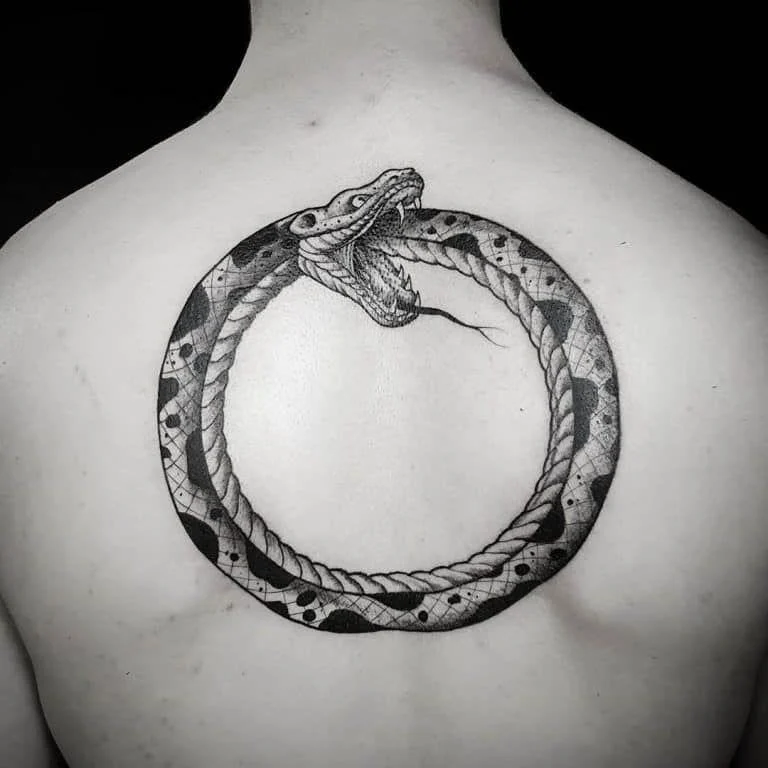
The ouroboros depicts a serpent biting or swallowing its own tail, usually forming a circle. It is an ancient symbol that appears in different historical and cultural contexts.
The circular form is often interpreted as a representation of cycles, continuity, renewal, or the relationship between endings and beginnings. Because the snake appears to consume itself while maintaining a complete shape, the design can also suggest self-renewal.
This tattoo may appeal to someone who sees life as a series of changes rather than a straight path. It can represent the end of one chapter and the beginning of another, without implying that the process ever fully stops.
Snake and Dagger
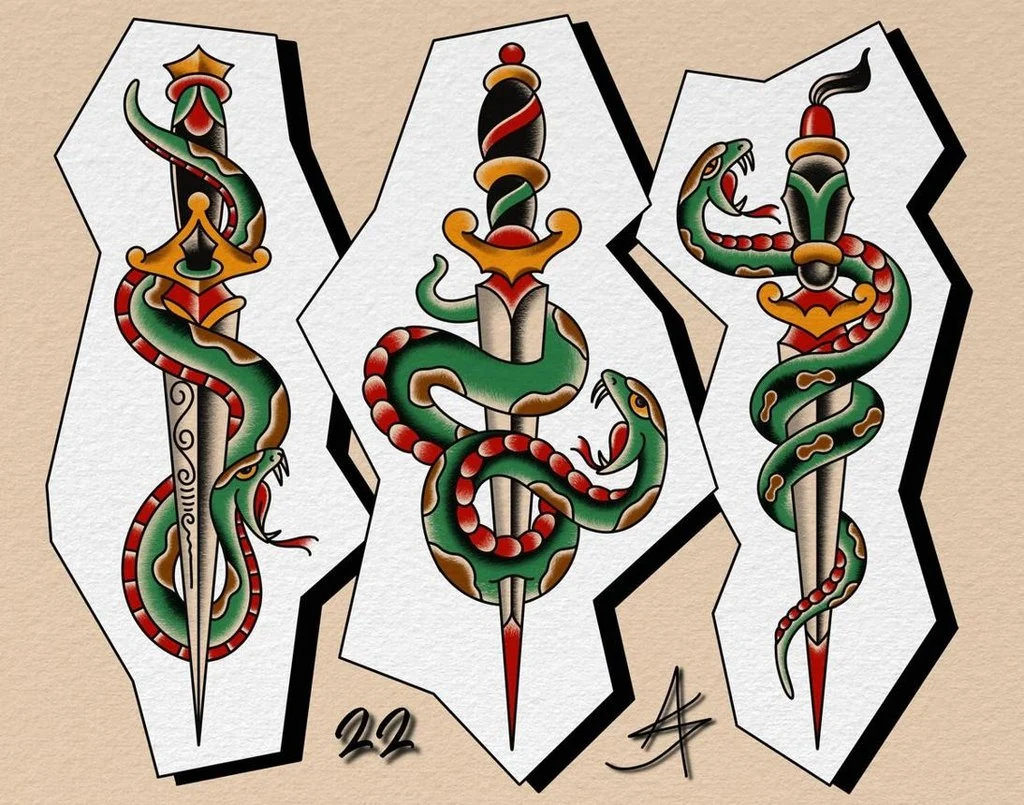
A snake wrapped around a dagger creates a sharper, more confrontational image. The combination can symbolize courage in the face of danger, conflict, betrayal, or the need to defend oneself.
Traditional tattoo styles often use this pairing because the curved body of the snake contrasts strongly with the straight blade. The result is visually striking, even at a moderate size.
The design can also represent a difficult decision. The dagger introduces the idea of action, while the snake may suggest caution, instinct, or an underlying threat.
Snake and Flowers
Flowers soften the snake’s appearance and create a contrast between delicate beauty and potential danger. Roses may introduce associations with love and passion, while lotus imagery can suggest spiritual development in traditions where the lotus holds that significance.
The exact flower matters. A rose and a lotus do not have identical cultural associations, so the combination should reflect the intended message rather than simply add decoration.
This style works particularly well for someone who wants a tattoo that expresses complexity. Strength and tenderness can coexist, just as beauty and danger can appear in the same image.
Japanese-Inspired Snake Tattoos
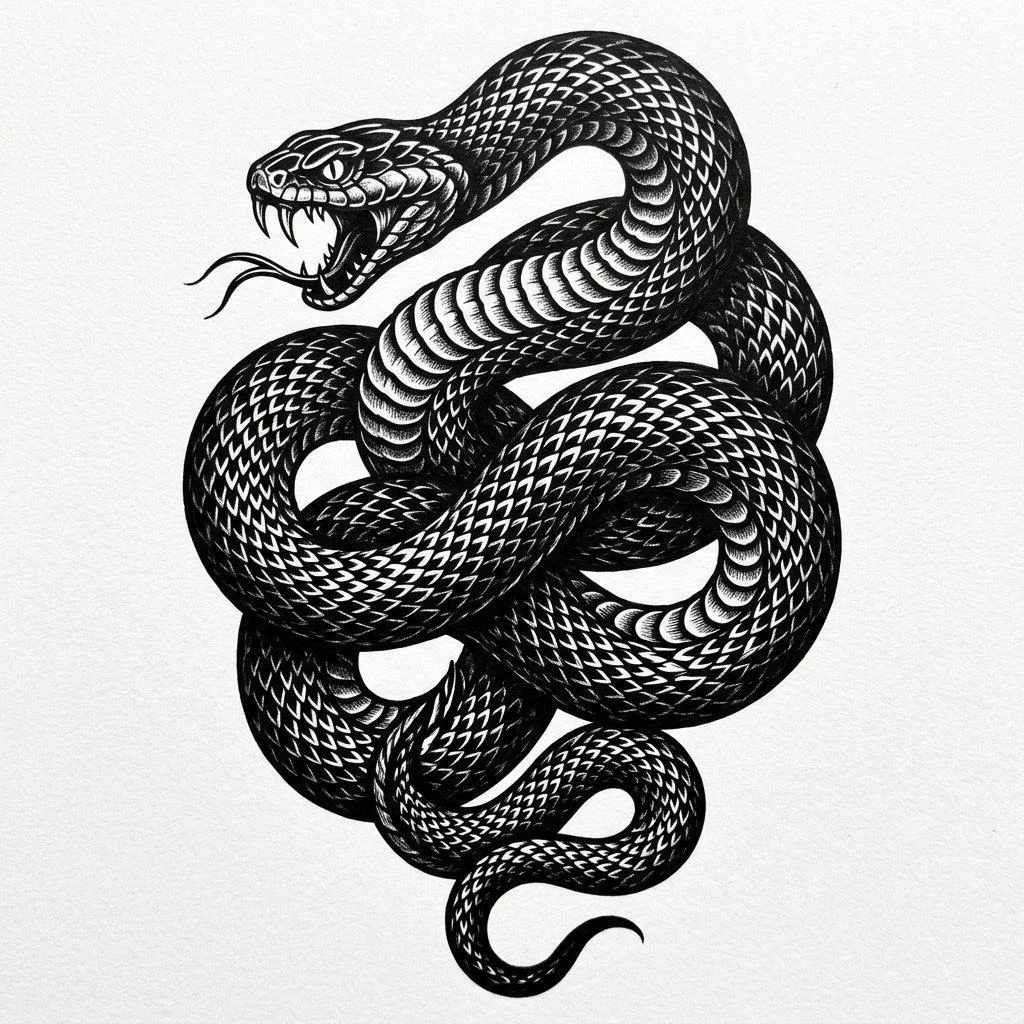
Snakes appear in Japanese art and folklore in a range of roles, including protective and supernatural ones. In tattoo designs influenced by traditional Japanese imagery, the serpent may be combined with flowers, waves, or other motifs to create a larger composition.
The meaning depends on the particular story and symbols chosen. It would be inaccurate to claim that every Japanese snake tattoo represents luck or protection.
If you prefer this style, research the specific imagery and consult an artist experienced in Japanese-inspired tattooing. Their understanding of composition and cultural references can help avoid mixing unrelated symbols without a clear purpose.
The Natural Traits Behind Snake Symbolism
Snake symbolism did not develop entirely from mythology. Several real features of snake biology help explain why people have connected these animals with change, caution, and survival.
Shedding Skin and the Idea of Renewal
Snakes shed their skin throughout life, although the timing and frequency vary with age, species, growth, and health. Unlike a person changing clothes, a snake sheds an entire outer layer of skin, including the transparent covering over its eyes.
This visible change offers a natural metaphor for leaving an old identity behind. It helps explain why snake imagery appears in designs about fresh starts, recovery, and personal development.
However, shedding skin does not make a snake immortal or mean that it can escape every consequence of its past. In tattoo art, the association with rebirth is symbolic rather than a literal description of what happens biologically.
Venom, Defense, and Survival
Some snakes use venom to capture prey or defend themselves, while many other species rely on different strategies. Venom is a biological adaptation, not evidence that snakes are inherently aggressive.
The distinction is useful when interpreting a tattoo. A snake displaying its fangs may represent danger or a willingness to defend boundaries, but the same animal shown calmly coiled might communicate restraint.
The cobra is a recognizable example. The Indian cobra (Naja naja) can spread its neck ribs into a hood when threatened, creating a dramatic silhouette that artists often use to convey authority and power.
Other species create different visual effects. The ball python (Python regius) is known for its defensive tendency to curl into a ball, while the green tree python (Morelia viridis) has a distinctive arboreal appearance that lends itself to winding, branch-like designs.
Snakes in the Natural World
Snakes are also important predators in many ecosystems. Depending on the species and habitat, they eat rodents, birds, amphibians, insects, fish, or other reptiles. Some animals also prey on snakes, including birds of prey and certain mammals.
Their ecological roles help explain why people have encountered them with a mixture of fear, respect, and fascination. A snake may threaten a person in one setting while helping limit pest populations in another.
The International Union for Conservation of Nature (IUCN) assesses the conservation status of many snake species through its Red List. These assessments distinguish between species facing different levels of extinction risk; they do not treat all snakes as equally threatened.
For tattoo inspiration, real species can add distinctive shapes and details. A cobra, a python, and a rattlesnake have very different appearances, and choosing one intentionally can make the design more personal than a generic serpent.
Snake Tattoos Compared With Other Animal Tattoos
If you are deciding between a snake and another animal, think about the message you want to express rather than choosing by appearance alone.
| Animal tattoo | Common symbolic associations | How it differs from a snake |
| Snake | Transformation, wisdom, danger, healing | Emphasizes change, instinct, and contrasting meanings |
| Butterfly | Metamorphosis, freedom, new beginnings | More directly associated with visible transformation |
| Eagle | Vision, freedom, authority, and strength | Often emphasizes independence and a broad perspective |
| Wolf | Loyalty, instinct, family, or independence | Commonly connected with social bonds and group identity |
| Dragon | Power, protection, wisdom, or supernatural force | Often expresses legendary or mythic strength |
| Scorpion | Defense, danger, resilience, or intensity | More strongly associated with a defensive posture and a venomous sting |
These comparisons are guides, not universal rules. Cultural background and individual experience can change the meaning of any animal tattoo.
The snake is particularly flexible because it can look peaceful or threatening without changing its basic form. That range allows the design to express several sides of a personality or mark a personal experience that cannot be captured by a simpler symbol.
Choosing the Right Snake Tattoo Design and Placement
Before settling on a design, decide whether you want the tattoo to communicate a specific story or simply reflect an image you find compelling. That decision can guide its size, style, and placement.
Best Placement Options
- Forearm: A winding snake fits the length of the arm and remains visible when you want to see the design regularly.
- Upper arm: This area provides room for a coiled snake, a cobra, or a detailed design with flowers.
- Back: A larger canvas allows for elaborate scales, a full serpent, and surrounding imagery.
- Thigh: The available space works well for curved compositions and detailed artwork.
- Wrist or ankle: Small snake tattoos suit these areas, especially when you prefer a minimalist outline.
- Rib cage: A long, curved snake can follow the body’s natural shape, although this placement can be more painful to tattoo.
How to Personalize Your Tattoo
Consider these questions before your appointment:
- Do you want the snake to represent change, healing, protection, or another personal value?
- Should it look calm and elegant, or fierce and intimidating?
- Would a real species, such as a cobra or python, better communicate your idea?
- Do additional symbols have personal significance, or would a single snake make a stronger statement?
- Will the design remain readable as it ages?
Choose an experienced tattoo artist who can translate your idea into a clear composition. Fine scales and tiny details may blur over time, so the design should suit the available space.
FAQs
Does a snake tattoo mean someone is dangerous?
No. Although snakes can symbolize danger, aggression, or intimidation, they also represent wisdom, healing, transformation, and protection. A person’s tattoo does not reliably reveal their personality or intentions.
What does a snake tattoo mean for people of all genders?
There is no universal difference based on gender. people of all genders can use the same design to express independence, renewal, strength, or personal growth. Individual experiences and cultural associations matter more than gender.
What does a snake tattoo on the hand mean?
A snake tattoo on the hand can express confidence, transformation, protection, or a personal connection to the animal. Its placement makes it highly visible, but the location itself does not have one established symbolic meaning.
What does a black snake tattoo symbolize?
Black ink often gives a snake a mysterious, dramatic, or serious appearance. Depending on the design, it may represent hidden knowledge, resilience, protection, or a difficult experience. The color alone does not determine its meaning.
Is a snake tattoo considered good luck?
Some cultural traditions associate snakes with good fortune, protection, or prosperity, but these associations are not universal. Whether the tattoo represents luck depends on the tradition, symbolism, and personal beliefs behind the design.
Final Thoughts:
A snake tattoo can tell a story about change, survival, knowledge, or the balance between beauty and danger. Its rich history gives the design depth, but your own experience determines what it ultimately represents. Choose a style that feels meaningful to you, and let the details reflect the message you want to carry.