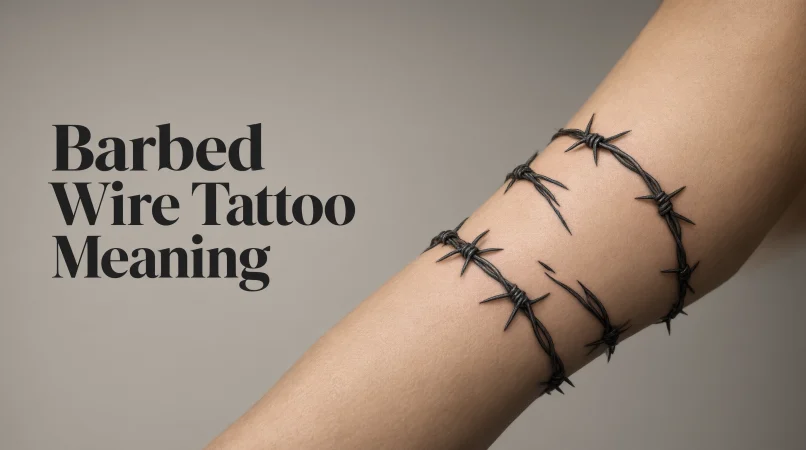
A barbed wire tattoo commonly symbolizes protection, resilience, hardship, rebellion, and personal boundaries. Its sharp points can represent emotional pain or the need to keep others at a distance, while an unbroken strand may suggest endurance and strength.
A broken or cut strand can symbolize freedom from restrictions or leaving a difficult past behind. The meaning ultimately depends on the wearer’s personal story, design, and cultural associations.
A barbed wire tattoo can represent strength, protection, emotional pain, rebellion, or the boundaries a person builds to protect themselves. Its sharp points and twisted strands give it a striking appearance, but the meaning often goes much deeper than the design itself.
Some people choose it to reflect hardships they have survived, while others connect it with independence, toughness, or a refusal to let others cross their boundaries.
The symbolism also depends on how the tattoo looks. Barbed wire wrapped around an arm may suggest toughness or defense, while a broken strand can represent freedom from a restrictive situation. For some wearers, the image carries memories of a difficult chapter in life. For others, it is simply a bold design with a distinctive visual style.
Understanding the different interpretations can help you choose a tattoo that reflects your own experiences rather than relying on assumptions about what the symbol means to everyone else.
Table of Contents
- The Main Symbolism Behind Barbed Wire
- Strength, Resilience, and Survival
- Protection and Personal Boundaries
- Pain, Confinement, and Emotional Struggles
- Rebellion and Individuality
- The History Behind the Symbol
- Popular Barbed Wire Tattoo Designs and Their Meanings
- Barbed Wire Tattoos Compared With Other Symbols
- Choosing the Right Placement and Style
- Frequently Asked Questions
The Main Symbolism Behind Barbed Wire
Barbed wire consists of metal strands fitted with sharp projections that discourage people or animals from crossing a boundary. It is used in settings such as farms, secured properties, and restricted areas. Its practical purpose is to create a barrier, which explains why the design can suggest both safety and separation.
As a tattoo, the same image can carry opposing ideas. A barrier may protect someone from harm, but it can also keep them trapped. A sharp point may suggest aggression, yet it can also represent the pain a person has learned to withstand.
A Symbol With Two Sides
Few tattoo designs communicate such different ideas through the same basic shape. Barbed wire can represent the desire to keep something out, the feeling of being held in, or the struggle to escape a situation that has become restrictive.
For one person, it may symbolize emotional independence after a damaging relationship. For another, it may represent a difficult period that left a lasting mark on their life.
This flexibility is part of the design’s appeal. The wearer does not need to explain every detail, and the image can hold a private meaning even when other people interpret it differently.
Why the Sharp Points Matter
The barbs are often the most visually important part of the tattoo. Unlike a smooth chain or simple line, they make the design look difficult to touch without getting hurt.
That quality can represent caution, defensiveness, or the experience of learning to protect oneself. Some people use the sharp points to express a tougher public image, while others connect them with emotional scars.
The interpretation depends on the surrounding design. A strand wrapped tightly around the body may feel restrictive, while one that breaks apart can suggest release.
Strength, Resilience, and Survival
Barbed wire is built to resist pressure and maintain a barrier. Its physical toughness makes it a natural image for people who associate strength with surviving difficult experiences.
A tattoo may commemorate a period of grief, a major life change, a personal setback, or another challenge that required patience and determination. The design does not erase what happened. Instead, it can acknowledge that the experience became part of the wearer’s story.
Surviving Difficult Experiences
Some people choose barbed wire after a period when life felt harsh or unforgiving. The tattoo can represent the determination to continue, even when circumstances leave emotional marks.
It may also reflect a shift in how someone views their own strength. Rather than seeing hardship as proof of weakness, they may choose to recognize the effort it took to recover and keep going.
An unbroken strand can suit this interpretation because it suggests continuity. The wearer has been through difficult circumstances but remains standing.
Toughness Without a Perfect Ending
Resilience does not always mean that every problem has been solved. Sometimes it means learning to live with a difficult memory, accepting that recovery takes time, or continuing to build a better life despite uncertainty.
A barbed wire tattoo can express that less polished version of strength. Its rough appearance may feel more honest to someone whose experience was complicated rather than neatly resolved.
For this reason, the design can appeal to people who prefer a direct, uncompromising image instead of a traditional symbol of hope.
Protection and Personal Boundaries
Protection is another common interpretation. Barbed wire creates a physical boundary, so a tattoo may represent the limits a person sets around their time, emotions, relationships, or personal space.
This meaning can be particularly relevant after a relationship or situation in which someone felt pressured, disrespected, or taken advantage of.
Keeping Harmful Behavior at a Distance
A barbed wire tattoo can communicate the idea that access to someone’s life should not be automatic. The wearer may value loyalty and kindness while also refusing to tolerate manipulation or repeated disrespect.
That does not necessarily mean the person wants to appear hostile. For some, the tattoo is a reminder that compassion and self-protection can exist together.
The message may be simple: being a caring person does not require allowing everyone close.
Protection Versus Isolation
There is an important distinction between setting boundaries and shutting everyone out. A barrier can provide safety, but it can also prevent healthy relationships from developing.
Some wearers may connect their tattoo with learning to make that distinction. They want to protect themselves without letting past experiences define every future relationship.
A design that incorporates flowers, an open section, or another softer element can reflect the balance between caution and openness. The contrast is not a universal code, but it can make the personal meaning more visible.
Pain, Confinement, and Emotional Struggles
The same qualities that make barbed wire protective can also make it a symbol of pain and restriction. It is associated with fences, guarded spaces, and barriers that are difficult to cross. These associations can give the tattoo a darker emotional meaning.
Emotional Scars
For some people, the sharp wire represents experiences that caused lasting hurt. The tattoo may reflect betrayal, loss, rejection, or the difficulty of trusting others again.
It does not necessarily mean the wearer remains trapped in those feelings. The image can serve as a reminder of what happened and how the person changed afterward.
A tattoo may also provide a way to acknowledge an experience without describing it publicly. Someone who sees the design might notice its appearance without knowing the story behind it.
Feeling Trapped or Restricted
Barbed wire is also used around prisons, military installations, and other controlled spaces. Because of these associations, it can represent a feeling of being confined by circumstances, expectations, or other people’s decisions.
A tightly wrapped design may suit someone who wants to express the weight of that experience. A strand that appears loose or broken may instead suggest the process of leaving those restrictions behind.
These interpretations can overlap with themes of recovery and personal freedom, but the emphasis is different. Here, the focus is on the barrier itself and what it feels like to live behind it.
Rebellion and Individuality
Barbed wire has a bold, confrontational appearance that can appeal to people who prefer tattoos with a tougher edge. It may express independence, defiance, or a refusal to follow expectations simply to make others comfortable.
The design has also appeared in tattoo traditions associated with rock music, alternative fashion, and tough or rebellious visual styles.
A Defiant Personal Image
A person might choose barbed wire because it feels direct and unapologetic. The sharp points, dark lines, and repeating pattern create a strong visual statement without requiring words.
For some wearers, that statement is about personal independence. They may see the tattoo as a reminder to make their own choices rather than live according to other people’s standards.
Others simply enjoy the design’s graphic quality. Not every tattoo needs to represent a major life event, and aesthetic preference is a perfectly valid reason to choose one.
Connection With Alternative Style
Barbed wire became especially recognizable in popular culture through tattoos, fashion, music imagery, and celebrity appearances. Its association with a rebellious look helped make it a familiar choice for people drawn to alternative or edgy designs.
However, the style does not prove that someone belongs to a particular group or follows a specific belief system. Tattoos move between cultural settings, and people regularly adopt designs for reasons that differ from their original associations.
If you like the look, consider whether you also connect with its possible meanings. That extra thought can help you choose a design that feels personal rather than temporary.
The History Behind the Symbol
Barbed wire was developed in the nineteenth century as a practical way to mark and secure boundaries, particularly in agricultural settings. Patents for barbed wire designs emerged in the United States during the 1860s and 1870s, and the material became closely associated with the fencing of land across the American West.
Its practical use shaped its cultural meaning. On farms, it could keep livestock within a designated area and protect crops from grazing animals. In other settings, it became a tool for restricting movement and securing places where entry was controlled.
During wartime, barbed wire became especially associated with trenches, fortifications, and dangerous ground that soldiers had to cross. Its presence in military settings reinforced its image as an obstacle that could cause injury and prevent movement.
The wire also carries difficult historical associations with internment and concentration camps, where fences were used to confine people. In these contexts, it can evoke oppression, separation, and the denial of freedom.
These histories help explain why the symbol can communicate protection and confinement at the same time. The material itself has no single emotional meaning, but its use in different environments has given it a range of associations.
Popular Barbed Wire Tattoo Designs and Their Meanings
Small changes in shape and placement can affect how a tattoo looks and what the wearer wants it to express.
| Tattoo design | Common interpretation | Suitable for |
| Simple barbed wire band | Toughness, protection, or individuality | People who prefer a classic, direct design |
| Barbed wire around the arm | Strength, boundaries, or a bold personal identity | Wearers who want a visible band-style tattoo |
| Broken barbed wire | Freedom, release, or overcoming restrictions | People marking a major life transition |
| Barbed wire with a rose | Love complicated by pain, beauty, or resilience | Those connecting affection with difficult experiences |
| Barbed wire with a heart | Emotional vulnerability, guarded love, or heartbreak | People expressing a personal relationship story |
| Barbed wire with a cross | Faith tested by hardship or spiritual endurance | Those whose personal beliefs support this interpretation |
| Realistic barbed wire | Confinement, hardship, or a stark visual statement | People who prefer detailed, dramatic artwork |
| Minimalist barbed wire | Boundaries, independence, or understated toughness | Wearers who prefer clean lines and limited detail |
These meanings are suggestions, not fixed rules. A rose does not always mean heartbreak, and a broken strand does not always represent freedom. The story behind the tattoo matters more than a standard interpretation.
Barbed Wire Around the Arm
A band of barbed wire around the upper arm or forearm is one of the most recognizable versions of the design. The circular arrangement can create a strong visual effect, especially when the artist follows the arm’s natural shape.
Some people associate this style with toughness and independence. Others like it because it resembles a cuff or bracelet made from a rougher material.
Before choosing a band, ask your artist to consider how the design will look when your arm bends and rotates. Even spacing and consistent linework can make a major difference to the finished result.
Barbed Wire With a Rose
The combination of barbed wire and a rose creates a contrast between softness and sharpness. The rose may suggest love, beauty, or affection, while the wire can represent pain, protection, or obstacles.
Together, they may express the idea that meaningful relationships can involve both joy and difficulty. They can also represent finding beauty after hardship or protecting something precious.
This design can be adapted in several ways. A rose growing through the wire may suggest persistence, while a flower caught within it can create a more somber impression.
Broken or Cut Barbed Wire
A broken strand is often chosen to symbolize release. It may represent leaving a restrictive environment, ending a damaging relationship, or deciding not to let past experiences control future choices.
The visual break gives the design a clear point of change. Instead of showing a continuous barrier, it suggests that the barrier no longer holds.
This style may suit someone who wants to focus on progress rather than the difficult experience itself. Still, the wearer may choose it for a different reason, such as artistic preference or the appeal of an asymmetrical design.
Barbed Wire Tattoos Compared With Other Symbols
If you are considering several designs, comparing their usual associations can help you find the one that fits your intention.
| Tattoo symbol | Common meaning | Main difference |
| Barbed wire | Protection, boundaries, hardship, or rebellion | Emphasizes barriers and the tension between safety and restriction |
| Broken chain | Freedom and release | Focuses more directly on escaping control |
| Thorny rose | Love, beauty, and pain | Combines affection with the possibility of emotional difficulty |
| Snake | Transformation, danger, renewal, or wisdom | Often emphasizes change, instinct, or cycles of life |
| Shield | Defense, courage, and protection | Usually communicates protection without the same sense of injury or confinement |
| Anchor | Stability, commitment, and staying grounded | Focuses on steadiness rather than barriers |
The best choice depends on the idea you want to communicate. A broken chain may be more direct if freedom is your main theme, while barbed wire can feel more fitting when protection and restriction are both part of the story.
Choosing the Right Placement and Style
Placement influences visibility, detail, and how the tattoo fits with other artwork. It is worth considering the practical side before deciding on a final design.
Forearm and Upper Arm
The forearm provides a clear area for straight strands, small broken-wire designs, or combinations with flowers and lettering. It is also relatively easy to see, which can suit someone who wants a frequent visual reminder of the tattoo’s meaning.
The upper arm works well for band designs and larger compositions. It can be easier to cover with clothing when needed.
Wrist and Ankle
A narrow barbed wire design can fit around the wrist or ankle, but the available space may limit the size of the barbs. Very small details can blur together over time, so ask your artist how much space the design needs to remain readable as it ages.
These areas may also experience friction from clothing, accessories, or footwear during healing. Follow your tattoo artist’s aftercare advice and avoid choosing a placement only because the design looks good in a reference photo.
Black Ink or Color?
Black ink is a popular choice because it emphasizes the wire’s sharp points and mechanical appearance. Strong outlines can create a clear, graphic result, while realistic shading can make the strands look three-dimensional.
Color can change the tone of the design. Red roses, green leaves, or muted background shades can soften the harshness of the wire or add personal meaning.
Before booking, review healed examples of your artist’s work and discuss the size, spacing, and placement. A well-planned design will usually serve you better than one that relies on tiny details or complicated shading in a very small area.
FAQs
Does a barbed wire tattoo have a negative meaning?
A barbed wire tattoo may symbolize pain or aggression, but it can also represent protection, resilience, or independence, depending on the wearer.
What does a barbed wire tattoo around the bicep mean?
A barbed wire arm band can symbolize toughness, boundaries, or personal identity, though some choose it purely for its bold appearance.
Can a barbed wire tattoo represent recovery?
A barbed wire tattoo can symbolize overcoming hardship, with broken strands or flowers representing personal growth and change.
Is barbed wire tattoo imagery connected with prison tattoos?
Barbed wire can symbolize confinement, but the tattoo does not imply a criminal history, as it is also used in fashion, art, and personal expression.
Is a barbed wire tattoo still a popular design?
Band tattoos remain popular for their bold, simple look and can suit minimalist, realistic, or decorative styles despite changing trends.
Conclusion
A barbed wire tattoo can express the need for protection, the strength to endure hardship, or the desire to break free from restrictive circumstances. Its history gives it both practical and darker associations, which is why the design can feel tough, personal, or deeply reflective.
Think about the message you want to carry before choosing the style and placement. A meaningful tattoo should reflect your own experience, not simply the assumptions other people make about it.